

CAT Previous Year Paper 2013

CAT 2013

Section

Questions

Marks

Quantitative Aptitude

22 Questions

66

DILR

19 Questions

57

English

19 Questions

57

Questions: 1 – 2

Functions g and h are defined on n constants, a₀,a₁,a₂,a₃, … aₙ₋₁, as follows:

g(aₚ, aq) = a|ₚ₋q| , if |p-q| ≤ (n-4)

= aₙ₋|ₚ₋q, if |p-q|>(n-4)

h (aₚ,aq) = aₖ, where k is the remainder when p+q is divided by n.


Q. 1 If n=10, find the value of g(g(a₂,a₈),(a₁,a₇)),

A. a₉

B. a₇

C. a₂

D. a₀


Q. 2 If h(aₖ,aₘ)=aₘ for all m, where 1≤m

A. 0

B. 1

C. n-1

D. n-2


Q. 3 In a bag there are total of 150 coins in three denominators -₹1,₹2 and ₹5-with at least one coin of each denomination being present in the bag. The total value of the Re.1 coins is at least 50% of the total value of the coins in the bag. If there are 23 ₹5 coins in the bag and the total value of the ₹2 coins is at least 3% of the total value of the coins in the bag, find the number of ₹2 coins in the bag.

A. 2

B. 3

C. 4

D. 1


Q. 4 Let P,Q,S,R,T,U and V represent the seven distinct digits from 0 to 6, not necessarily in that order. If PQ and RS are both two-digit numbers adding up to the three-digit number TUV, find the value of V.

A. 3

B. 6

C. 5

D. Cannot be determined


Q. 5 There are five cards lying on a table in one row. Five numbers from among 1 to 100 have to be written on them, one number per card, such that the difference between the numbers on any two adjacent cards is not divisible by 4 is written down on another card, i.e., a sixth card, in that order. How many sequences can be written down on the sixth card?

A. 2²3³

B. 4(3)⁴

C. 4²3³

D. 4²3⁴


Questions: 6 – 9

Summary of the estimate of memory space occupied by the information worldwide, stored in various storage media, in the year 2000


Q. 6 If the information contained in each X-Rat occupies 30MB of memory space on an average, and by using a new technology each X-Ray is now stored in magnetic media that saves 60% of the memory space required, what is the total amount of memory space of magnetic media that is required to to store all the X-Rays available in the year 2000. (1MB=10⁶ Bytes of memory space)

A. 10,170 TB

B. 6,780

C. 1,703,170 TB

D. None of these


Q. 7 The information stored in Newspapers, Books and Periodicals forms what percentage of the total information stored on paper media? Assume that the information stored per unit memory space occupied is the same for all media mentioned.

A. 37.5%

B. 45%

C. 57%

D. 54%


Q. 8 When compared to the total memory space occupied by the information stored in any single category of storage media, what is the highest percentage share of memory space occupied by the information stored in any single media within that

category(approximately)?

A. 68.75%

B. 62.5%

C. 96%

D. 98.3%


Q. 9 Due to advances in technology, the information stored per unit memory space occupied worldwide increases by 20% every year, while the total memory space available worldwide increases at the rate of 10% every year. If in the year 2000, 80% of the memory space available worldwide is occupied by the information available worldwide, and the information available worldwide were to increase by 45% every year, then which of the following years is the earliest by which there will be a shortage of memory space?

A. 2002

B. 2003

C. 2004

D. 2005


Q. 10 a,b and are the lengths of the triangle ABC and d,e and f are the lengths of the sides of the triangle DEF. If the following equations hold true:

a(a+b+c)=d²

b(a+b+c)=e²

c(a+b+c)=f²

then which of the following is always true of triangle DEF?

A. It is an acute-angled triangle

B. It is an right-angled triangle

C. It is an obtuse-angled triangle

D. None of the above


Q. 11 Sujith looked at the six-digit number on his CAT admit card and said “If I multiply the first two digits with three, I get all ones. If I multiply the last two digits 9, I get all threes.” What is the sum of the digits of the number on Sujith’s admit card?

A. 30

B. 33

C. 60

D. 45


Q. 12 Two cars P and Q start from two points A and B towards each other simultaneously. They meet for the first time 40km from B. After meeting they exchange their speeds as well as directions and proceed to their respective starting points. On reaching their starting points, they turn back with the same speeds and meet at a point 20 km from A. Find the distance between A and B.

A. 130 km

B. 100 km

C. 120 km

D. 110 km


Q. 13 Consider the following two curves in the XY plane:

y=2x³+3x²+4 and

y=3x²-2x+8

Which of the following statements is true for -3≤x≤2?

A. The two curves intersect thrice

B. The two curves intersect twice

C. The two curves intersect once

D. The two curves do not intersect


Q. 14 A cuboidal aquarium, of base dimensions 100cm*80cm and height 60cm, is filled with water to its brim. The aquarium is now tilted along one of the 80cm edges and the water begin to spill. The tilting is continued till the water surface touches a line on the base which is at a distance of one-third of the length from(and parallel to) the edge on which the aquarium is being tilted. Now the box is returned to its original position. By how many centimeters has the height of water reduced?

A. 50

B. 40

C. 20

D. 10


Q. 15 Some persons are standing at distinct points on a circle, all facing towards the center. Each possible pair of persons who are not adjacent sing a three-minute sing, one pair after another. If the total time taken by all the pairs to finish singing is 1 hour, find the number of persons standing on the circle

A. 5

B. 7

C. 9

D. 8


Q. 16 In a triangle PQR, PQ=12 cm and PR=9 cm and ∠Q+∠R=120⁰

Find the length of QR

A. 15/√2 cm

B. 3√13 cm

C. 5√5 cm

D. 5√17 cm


Q. 17 In a triangle PQR, PQ=12 cm and PR=9 cm and ∠Q+∠R=120⁰

If the angle bisector of ∠P meets QR at M, find the length of PM

A. 28√5/9 cm

B. 42√5/11 cm

C. 36√3/7 cm

D. 4√3 cm


Questions: 18 – 21

The following is the table of points drawn at the end of all matches in a six-nation Hockey tournament, in which each country played with every other country exactly once. The table gives the positions of the countries in terms of their respective total points scored(i.e., in the decreasing order of their total points). Each win was worth three points, each draw one point, and there were no points for a loss. Some information in the table has been intentionally left out. The results of none of the individual matches are known, except that Pakistan beat India and no two teams finished with the same number of points.


Q. 18 Which of the following matches was a draw?

A. India vs South Korea

B. Spain vs Netherlands

C. Netherlands vs South Korea

D. Spain vs South Korea


Q. 19 The total number of points won by India is

A. 5

B. 6

C. 7

D. Cannot be determined


Q. 20 The total number of goals scored in the match between Netherlands and Pakistan is

A. 0

B. 1

C. 2

D. Cannot be determined


Q. 21 The number of goals scored by Australia against India is at most

A. 5

B. 4

C. 3

D. 2


Q. 22 Outside a sweet shop, its name “Madhu Sweet House” is displayed using blinking lights. Each word flashes at a regular interval and remains lit for 1 second. After remaining lit for 1 second, “Madhu” remains unlit for 3¹/₂seconds, “Sweet” remains unlit for 5³/₄ seconds and “House” remains until 9¹/₈ seconds. If all the words flash together at 8:00 p.m. sharp, find the time interval between the next time the first two words flash together and the next time the last two words flash together

A. 45 seconds

B. 22.5 seconds

C. 112 seconds

D. 6.75 seconds


Q. 23 If g(x)=p|x|-qx², where p and q are constants, then at x=0, g(x) will be

A. maximum when p>0,q>0

B. minimum when p<0,q<0

C. minimum when p>0,q<0

D. maximum when p>0,q<0


Q. 24 A television company manufactures two models of televisions-A and B. Each unit of model A requires four hours to manufacture and each unit of model B requires two hours to manufacture. The total time available in a month to manufacture these two models is 1600 hours. The profits generated on selling each unit of model A and each unit of model B are ₹1200 and ₹1000 respectively. Find the number of units of each of model A and model B television to be manufactured to maximize the profit.

A. 200 model as As and 600 model Bs

B. 800 model as As

C. 800 model Bs

D. None of the above


Q. 25 The age of a son, who is more than two years old, is equal to the units digit of the age of his father. After ten years, the age of the father will be thrice the age of the son. What is the sum of the present ages of the son and the father?

A. 30 years

B. 36 years

C. 40 years

D. Cannot be determined


Q. 26 Given that -3

A. max[(x+y)(x-y)]-min[(x+y)(x-y)]=57¹/₂

B. max[(x-y)²]=169/4

C. min[(x-y)²]=1

D. All of the above


Q. 27 Each side of a polygon is either parallel to the x-axis or parallel to the y-axis. A corner of the polygon is known as convex if the corresponding internal angle is 90⁰ and as concave if the corresponding internal angle is 270⁰. If the polygon has 26 convex corners, the number of its concave corners is

A. 18

B. 22

C. 26

D. 24


Q. 28 The density of a liquid us defined as the weight per unit volume of the liquid. The densities of two liquids A and B are in the ratio 2:1. The liquid B evaporates at a rate (in kg/hr) which is twice as fast compared to that of liquid A, which evaporates at a rate of 1 kg/hour. If 70 kg of liquid A is mixed with 30 kg of liquid of B to form a mixture, find the number of hours the mixture needs to be evaporated so that the density of the resultant mixture is 1.04 times that of the original mixture. Assume that there is no chemical reaction between the liquids

A. 2.5

B. 3

C. 3.5

D. 4


Q. 29 Let f(x)=1/(1+x²) and g(x)=e⁻ˣ/(1+[x]), where [x] is the greatest integer less than or equal to x. Then which of the following domain is truw?

I. domain of (f+g)=R-(-2,-1]

II. domain of (f+g)=R-[-1,0)

III. [range of f]∩[range of g]=[-2,1/2]

iV. [range of f]∩[range of g]=[-1/2,1/2]-{0}

A. Both II and IV

B. Both I and III

C. Both I and IV

D. Both II and III


Q. 30 The line L passing through the points (1,1) and (2,0) meets the y-axis at A. The line through the point (1/2,0) and perpendicular to L meets the y-axis at B and L at C. Find area of the triangle ABC

A. 25/16

B. 16/9

C. 32/19

D. 40/23


Q. 31  The following question presents four statements, of which three, when places in appropriate order, would form a contextually complete paragraph. Pick the statements that is not part of the context

(A) But as access to other texts is enjoyed more widely, some of the dominance textbooks now enjoy will wane.

(B) As indeed will the power of teachers-whose prejudices may often be just as ingrained as those found in textbooks, and rather harder to pin down

(C) It won’t be long before children, will be able to access, by way of smartphones, the textbooks prescribed for their courses

(D) As long as textbooks in one form or another are used and as long as they are issued or approved by the state, they will remain a political issue

A. (A)

B. (B)

C. (C)

D. (D)


Questions: 32 – 35

Psychotherapeutic processes deal with psychological problems, ranging From mild ones like a depressed mood, to more subtle ones like interpretation of dreams to more  controversial problems like dissociative identity disorder. Denied emotions trot admitting or voicing one’s emotions to the terapist) is a root cause of many psychological problems as honest communication is the %metro uno factor for the psychotherapeutic process to work. Emotional honesty can be a difficult task for the client or patient, Psychotherapists make analysis of dreams a significant part of their work. Il is tempting to wish petulantly that the unconscious would speak to us more clearly as significance of many dreams eludes us. But dreams that can be interpreted provide helpful information like warnings of personal pitfalls; solution guides to problems; sources of necessary information and judgement; as direction-finders when we feel lost; as pointers to the way we need to go when we are floundering and the message always seems to be one designed to nurture spiritual growth The unconscious may communicate to us when we are awake with as much elegance and beneficence as when we are asleep. although in a slightly different Form of ‘idle thoughts’ or oven Fragments of thought. As with dreams. we pay these idle thoughts no attention and cast them aside as insignificant. Hence patients in psychoanalysis are instructed to say everything, however insignificant, that comes in their minds. Idle thoughts provide us with insight into ourselves and others. The seemingly alien and unwanted quality is characteristic of unconscious material and its manner of presentation to the conscious mind. This and the associated resistance of the conscious mind led Freud to perceive the unconscious as a repository of the primitive, the antisocial and the evil within us_ He tended to assume that mantel illness somehow resided in the unconscious as a demon in the subterranean depths of our mind. To Carl Jung fell the responsibility of correcting this which he did through his work The Wisdom of the Unconscious.” As he concluded, mental illness i5 not a product of the unconscious but a phenomenon or consciousness or a disordered relationship between conscious and unconscious. Consider the matter of repression_ Freud discovered in his patents sexual desires and hostile feelings of which they were unaware but which were making them ill, Because these desires and Feelings resided in the unconscious, the notion arose that it was the Unconscious that caused mental illness. But why were these desires and feelings in the unconscious in the firs’ place? Why were they repressed? The answer is that the conscious mind did not want them. And it is in this not wanting, this disowning. that the problem lies.


Q. 32 A major difference between the points of view expressed by Freud and Jung as discussed in the passage is

A. One considered ailments of the mind to be the resu:t. of conflict between the conscious and the unconscious, while the other considered them to be inherent in the unconscious

B. One considered that ailments of the mind are grounded in the conscious, while the other considered them to be triggered by the unconscious

C. One oonsidere. that the evil qualities of human beings reside in their unconscious mind, while the other considered lhat the unconscious mind repressed desires and feeling

D. One considered that ailments of the mind are grounded in the unconscious, while the other considered them to be triggered by the conscious.


Q. 33 Which of the following statements are logically consistent with the content of the paragraph?

(I) Idle thoughts can sometimes illuminate the situation of the person as valuable messages from the unconscious can be received

(III Emotionally dishonest clients are very poor communicators and suffer from psychologcal problems.

(III) Dissociative identity disorder is primarily due to denied emotions_

(IV) Dreams can help effect. in us. better understanding, and development, of file spirit within.

(V) Honest communication and open in can positively influence a psychotherapeutic decision

A. I,III,IV,V

B. I,IV,V

C. I,II,IV

D. II,IV,V


Q. 34 If a paragraph were lo be inserted between the first and the second paragraphs, it would most likely deal with which of the following?

A. Dreams can be instrumental in gauging a person’s emotional slate.

B. Emotions are, very often, the substance of a person’s idle thoughts.

C. It is very difficult to gauge emotional honesty

D. Dreams often, are indicative of emotions that re main unexpressed.


Q. 35 In saying it is tempting to wish petulantly that the unconscious would speak to us more clearly”…. (in pare 2) the author wishes to indicate that

A. the inability lo understand the unconscious can irritate psyohotherapists when pursuing their objectives.

B. the inability to understand the unconscious can guile psychotherapists in pursuit of they objectives.

C. the inability lo understand the unconscious can frustrate psychotherapists when pursuing their objectives.

D. the inability to understand the unconscious can divert psychotherapists from their objectives.


Questions: 36 – 38

Each of nine persons. P, 0, R, S. T. U, V, Ar and X. rives in a different flat in an aparimont building, which has six floors (excluding the ground floor, which is used only for parking) anc three flats on each floor, The three flats on each floor are in a row and no two adjacent flats on a floor are occupied. Al least one person lives on each floor.

Further the fcllow.ng information is known:

(i)  P and 0 live on the same floor.

(ii) R and S live on different floors.

(iii) T lives in the middle flat on the fourth Floor

(iv) U lives on the sixth floor and V lives on the first /1001.

(v) W Fives on the floor which is immediately above the floor on which X lives.


Q. 36 If W and U do not live on the same floor, then which of the following cannot be true?

A. W lives on the third floor

B. Q lives on the third floor

C. R lives on the second floor

D. P lives on the second floor.


Q. 37 If S and R are living on the first floor and the sixth floor respectively, then which of the following must be true’

A. T is living on the same floor as X

B. O is living on the second floor.

C. P is living on the third floor.

D. W is living alone on his floor.


Q. 38 If Q lives on the third floor, then how many combinations of persons could live on the second floor?

A. 8

B. 6

C. 5

D. 7


Q. 39 there are five sentences or parts of sentences that form a paragraph. Identity the sentence(s or part(s) of sentence(s) that is/are correct in terms of grammar and usage.

Then. choose the most appropriate option

(a) Leonardo da Vinci wed a self-taught man and began Leeching himself Latin at the early age.

(b) He became a great engineer and was the first to discover that blood circuleled through the body

(c) He believed that coarse people of bad habits and shallow judgments did not deserve so beautiful an instrument and such a complex anatomical equipment than the human body.

(d) They should merely have a sack for taking in food and letting it out again, for they are nothing but the alimirtary r.nnal

(e) Very fond of animals, he was himself a vegetarian and had the habit of buying caged birds from the market end setting thorn free immediately.

A. a and c

B. b and d

C. only a

D. only e


Q. 40 From among the lour choices given below the question, choose the most logical order of sentences that constructs a coherent paragraph.

(a) Although thoughts are primary. thoughts in themselves have no method of transmission and are therefore dependent on speech.

(b) If we were to summarize the logo-centric approach to meaning, we should state that what emerges is that speech rs the original signifier of meaning

(c) Language, the cornerstone of humanity, emerges as a process to allow our thoughts to travel across space and !between people

(d) Language can then be viewed as a system of verbal signs that signify individual thought.

(e) Language produces speech to transmit thoughts and writing to transmit speech.

A. cabed

B. baced

C. beard

D. caledb


Q. 41 The word in capitals is used in four different ways. Choose the option in which the usage of the word is INCORRECT or INAPPROPRIATE.

MELT

A. The crowd melted away after the prayer meeting.

B. Even the sternest mother’s heart melts at the sight of her baby crying.

C. His anxiety melted away when he received an SMS from his daughter confirming that she had reached her destination safely.

D. The cries of opposition suddenly melted to cheers when the principal agreed to the demands of the students.


Q. 42 The sentences given in the following question, when properly sequenced, form a coherent paragraph. Each sentence is labelled wilh a letter_ From among the four choices given below the question, choose the most logical order of sentences that constructs a coherent paragraph.

(a) Generally speaking, in pre-capitalist societies people produced things directly for other people, not fir sale on a market – in Marx’s Language they produced for use, not exchange.

(b) However, producing things for sale (or exchange) creates a new dynamic, different from societies That produce directly for use_

(C] Capitalism is very different from past modes of production.

(d) Under capitalism, nearly all of the products of human labor are commodities, that is, they are produced for sale,

(e) Every system of production has to regulate now much of people’s labor is spent producing one thing versus another. 5,0 that society does not expend labor on things that are useless.

(f) Marx called this -generalized commodity production’ – people obtain their needs and wants by purchasing them on a market, and people produce what other people need and want by selling thing’s. on a market.

A. dfbeac

B. abcdef

C. eacdfb

D. cdfabe


Questions: 43 – 45

Marcel Pious! ( 1871-1922) was immensely well read. ‘In search of Lost Time encapsulates within itself the main traditions in French literature: both in Fiction (from Madame de Lafayette through Stendhal, Balzac. Flaubert and Zola) and in the bellelettristic-philosophical line {from Montaigne through Pascal. La Rochefoucauld and Chamfort). Proust formed a strong long taste for generalization through these latter writers, I own a small book of his maxims, drawn from the novel and his discursive writings. and an unusually high quotient of them are dazzling. Let one example suffice: “It has been said that the greatest praise of God lies in the negation of the atheist, who considers creation sufficiently perfect to dispense with a creator.’ As an asthmatic child, Proust read more than most children. By the age of 15, he was already immersed in contemporary literature. having read the essays and novels of Anatole France and Pierre Lob. the poetry of Mallarme and Leconle de Lisle, and a number of the novels or Dostoyevsky, Tolsloy. Dickens and George Eliot. Linl4ce Henry James, who referred to their works as `baggy monsters,” Proust ‘Fully appreciated the great Russian novelists. He thought Tolstoy -a serene god”, valuing especially his ability to generalize in the form of setting down laws about human nature. For Proust, Dostoyevsky surpassed all other writers, and he found “The Idiot” the most beautiful novel he had ever read. He admired Dostoyesky’s skill with sudden twists in plot, providing the plausible surprises that propelled his novels. In his 1905 essay ‘On Reading,’ a key document in Proust’s freeing himself to write his great novel, he quoted Descartes: The reading of all Rudd books is tike a conversation with the most cultivated of men of past centuries who have been their authors.” Proust’s examinalion of ‘the original psychological act calted “reading.” that “noblest of distractions.” He stated that reading is superior to conversalion, which ‘dissipates immediately.” A book. he fell. is “a friendship… and the fact that it is directed to one who is absent, gives it something disinterested. almost moving.” Books are actually better than friends, Proust thought. because you turn to there only when you truly desire their company and can ignore them when you wish. neither of which is true of a friend. One also frequently loves people in books, -to whom one had given more of ones attention and tenderness thrill to people in real life.” In his own novel, Proust wrote-Real life, life at last laid bare and illuminated—the on’y life in consequence which can be said to be really lived—is literature.”


Q. 43 In the passage the author is primarily concerned with?

A. critically examining Proust’s in Search of Lost Time.”

B. providing a synopsis of Proust’s reading tastes

C. evaluating Proust’s position in the great literary tradition

D. discussing the intellectual influence Proust’s contemporaries had on his works.


Q. 44 The author quotes art example of Proust’s maxims to highlight his (Proust’s)

A. grasp at the metaphysical

B. penchant for the philosophical.

C. belief in a Supreme Being

D. exceptional choice of thought and word


Q. 45 The passage implies that Proust subscribes to which of the following views?

(a)Reading a good book is like having a conversation with a classical writer.

(b)Reading is a virtuous pastime and it leaves an indelible impression on one’s mind.

(c) Literature Imitates life.

(d) A reader can invest in the feelings for characters in a book.

(e) Dosloyetisky’s `The Iclibl” was appreciated by him for the unanticipated turns in the plot.

(f)) Elosloyevsky’s ‘The Idiot” was known for its aesthetics. its gapping pace and its unlikely element of surprise

A. a,c,d,e

B. a,e,f

C. a,b,c,e

D. a,b,c,d,e


Q. 46 Eight men have their first names. as Ratan. Rama. Ramesh. Rarnu, Ramesh, Rajah, Rishabh and Rohit and their surnames are Kulkarni, Anora, Jain, Dutta. Singh. Sharma. Sen and Murthy, not necessarily in the same order. These eight persons are sitting around a circular table as per the following instructions;

(i) Ramu is sitting opposite Kulkarni and to the left of Sing h.

(ii)Rajan is sitting opposite Sharma and next to Murthy, who is sitting to the left of Rama.

(iii) Arora is sitting opposite Ratan and Rohit sits adjacent to Dutta.

(iv)Rama, who is next to Rishabh and Ramesh, sits opposite Sen.

If Rishabh Arora sits between Kulkarni and Sharma. and opposite Singh, then who sits opposite of Rakesh Dutta?

A. Ramesh Murthy

B. Rama Murthy

C. Rajah Jain

D. Rishabh Arora


Questions: 47 – 49

“SOVEREIGN in tastes, steely-eyed and point-on in perception of risk, and relentless in maximization of happiness.’ This was Daniel McFadden’s memorable summation, in 20013, of the idea of Every man held by economists. That this description is unlike any real person was Mr.McFadden’s point. The Nobel prizewinning economist at the University of California, Berkeley, wryly termed homo economicus is rare species”. In his latest paper he outlines a new science of pleasure”, in which he argues that economics should draw much more heavily on Fields such as psychology, neuroscience and anthropology. He wants economists to accept that evidence from other discilplines does not just explain those bits of behavior that do not fit the standard models Rather. What economists consider anomalous is the norm, Homo economics, not his fallible counterpart, is the oddity.

To take one example, the “people” in economic models have fixed preferences which are taken as given. Vet a large body of research from cognitive psychology shows that preferences are in fad rather fluid People value mundane things much more highly when they think of them as somehow ‘Their own”: they insist on a much higher price for a coffee cup they think of as theirs, for instance. Than for an identical one that isn’t. This -endowment effect’ means that people hold on to shares well past the point where it makes sense to sell tern. Cognitive scientists have also found that people dislike losing something much more than they like gaining the same amount. Such ‘loss aversion’ can explain why people often pick insurance policies with lower deductible charges even that they are more expensive. At the moment of an accident a deductible feels like a loss, whereas all those premium payments are part of the status quo. Such tools have Implications for policy. Plenty of poor people in America are wary of programmes like the Earned Income Tax Credit (EITC) because the idea of getting a handout Irom the government reinforces a sense of helpnessness. Dignity is not something mainstream economics has much truck with. 80 creating a sense of dignity turns out to be a powerful way of affecting decisions. One study by Crystal Hall, Waying Zhao and Elder Sher, a trio of psychologists, found that getting poor people in a soup kitchen to recall a time when they felt ‘successful and proud” made them almost twice as likely to accept leaflets that told them how to get an EITC refund than members of another group who were

merely asked about the Fast meal they had eaten Taking the path Mr.McFarlden urges might also lead economists to reassess some articles of faith. Economists tend to think that more choice is good Yet people with many options sometimes fail to make any choice at all: think of workers who prefer their employers to put them by “default’ into pension plans at preset contribution rates. Explicitly modelling the process of making a choice might prompt economists to take a more ambiguous view of an abundance of choices. This is undoubtedly messier than standard economics. So is real life.


Q. 47 Which of the Following most accurately represents the author’s criticism of ‘Homo economicus’?

A. It gives an inaccurate picture of consumer behavior in real economic transactions

B. The ideal person who makes choices in conservative economic models is, in fact, the opposite of ‘homo economicus

C. It is nowhere close to the unpredictable consumer in real economic situations.

D. It is the economists’ mythical EveryMan.


Q. 48 The author of the passage mentions the observations of Hall, Zhao and Sharif in order to

A. demonstrate that people take pride in their achievements even in hard times

B. demonstrate how empathy can play a significant role in persuasion.

C. provide support for the assertion that dignity is a powerful factor in decision-making.

D. illustrate that authorities would be able to implement policies more effectively if they understand their citizens.


Q. 49 The view mentioned in the last paragraph (-Taking the path… real life’) refers to which of the following?

A. People are loath to make any choice when faced with a plethora of options

B. Consumers prefer to seek expert guidance while making a choice.

C. Employers coax workers lo accept pension plans with fixed contribution rates.

D. The view that more choice is good for consumers should be regarded with skepticism.


Q. 50 The word at the top is used in four different ways, numbered 1 to 4. Choose the option in which the usage of the word is INCORRECT or INAPPROPRIATE.

PULL

A. Pull aside the curtains and let in some fresh air

B. I decided to pull away from the venture due to differences of opinion with my partners.

C. Being a charismatic leader that he is, he can certainly pull the crowds.

D. The municipal corporation has decided to pull down all illegal constructions in the city.


Q. 51 The scientst and the artist are both concerned to change the world — the one the external world of man’s objective relations with nature, the other the internal world of his subjective relations with his fellow men. The scientist discovers a contradiction in his consciousness of the external world and resolves it in a scientific hypothesis: the artist discovers a contradiction in his consciousness of the internal world and resolves it in a work of art. Both are creative acts. The scientist extends our knowledge and hence also Our control of nature_

A. The artist takes complex explanations and renders them simple.

B. In doing so, he proves that there is nothing we cannot do – everything is brought within our reach.

C. The artist heightens our sense of ourselves as social beings and so advances the class struggle.

D. The artist teaches us to think for ourselves


Q. 52 In the following question, a part of a sentence is left blank. Choose from among the four options given below the question, the one which would best fill the blanks.

When we call others dogmatic, what we really object to is ___.

A. their giving the dog a bad name

B. their holding beliefs that are different from our own

C. the extremism that goes along with it

D. the subversion of whatever they actually believe in concomitantly


Questions: 53 – 55

Four friends John. Mike. Lewis and Peter went on a picnic and they participated in four adventure sports – Paragliding, Skiing, Bungee Jumping and Rock climbing Further_the following information is known about them:

The number of persons who participated in Skiing is one more than that of those who participated in Bungee Jumping, which, in turn, is same as that of those who participated in Paragliding. which. in turn, is twice that of those who participated in Rock Climbing

(ii) Every person participated in at least one event and each sport was taken up by at least one person.

(iii) John participated in Skiing but not in Rock Climbing while Lewis participated in Bungee Jumping but not in Paragliding

(iv) None of them participated in both Bungee Jumping and Rock Climbing

(v) Peter participated in three sports.

(vi) Between Skiing and Paraglidling, Mike participated in exactly one sport


Q. 53 If Lewis participated in two sports, which of the following is definitely false?

A. Mike did not participate in Skiing

B. John participated in Paragliding

C. Lewis participated in Skiing.

D. Mike participated in Paragliding


Q. 54 If John participated in Paragliding, which of the following statements is definitely true?

A. Mike participated in Rock Climbing

B. John Participated in Bungee Jumping.

C. Lewis did not participate in Skiing

D. Peter did not participate in Rock Climbing.


Q. 55 Which of the following is not a possible combination of number of sports taken up by John, Mike and Lewis?

A. John -.1, Mike- 2, Lewis -2

B. John – 3, Mike- 1, Lewis – 1

C. John – 1, Mike – 3, Lewis

D. John – 2, Mike – 2, Lewis – 1


Questions: 56 – 59

There are ten boxes. numbered 1 to 10, each containing g gold coins. Each 01 the coins in nine of these ten boxes weighs 10 gm, whereas each of the coins in the tenth box weighs 20 gm_ A digital weighing machine is provided. Now, a logician, Mr. Kapil, is invited The task assigned to him is that he has to find out the box containing the coins weighing 20 gm each.


Q. 56 If g = 9, then what is the minimum possible number of times for which the weighing machine is to be used?

A. 1

B. 2

C. 3

D. 4


Q. 57 If g = T. what is the minimum possible number of times For which the weighing machine is to be used’?

A. 1

B. 2

C. 3

D. 4


Q. 58 If g = 3. what is the minimum possible number of times For which the weighing machine is to be used?

A. 3

B. 2

C. 5

D. 4


Q. 59 If g = 2. what is the minimum possible number of times for which the weighing machine is to be used?

A. 2

B. 3

C. 5

D. 4


Q. 60 The following question presents four statements, of which three, when places in appropriate order, would form a contextually complete paragraph. Pick the statement that is not part of the context

(A) The trade in iron ore make it the second-largest commodity market by value after crude oil

(B) The metal provides the backbone of skyscrapers, bridges and motorways, and the carapace and internal organs of cars, fridges and washing machines

(C) Given steel’s ubiquity-it makes up 95% of global metal production-iron ore, the raw material from which it is made, attracts strangely little attention

(D) The development of a process to turn raw earth into steel merits a high spot on a list of mankind’s most ingenious achievements

A. (A)

B. (B)

C. (C)

D. (D)


Answer Sheet
Question 1 2 3 4 5 6 7 8 9 10
Answer D A C C B B A C B A
Question 11 12 13 14 15 16 17 18 19 20
Answer A B C A D B C D B A
Question 21 22 23 24 25 26 27 28 29 30
Answer C D C C C B B D A A
Question 31 32 33 34 35 36 37 38 39 40
Answer C A B D C D D C B B
Question 41 42 43 44 45 46 47 48 49 50
Answer D C B C C A C C D B
Question 51 52 53 54 55 56 57 58 59 60
Answer C B B D D A B B B A

CAT Previous Year Paper 2012

CAT 2012

Section

Questions

Marks

Quantitative Aptitude

27 Questions

66

DILR

14 Questions

57

English

19 Questions

57

Q. 1 Consider a sequence S whose nth Tern is defined as 1+3/n, where n = 1, 2,… Find the product of all the consecutive terms of S starting from the 4th term to the 60th term

A. 1980.55

B. 1985.55

C. 1990.55

D. 1975.55


Q. 2 Let P = {2, 3, 4,….100} and q = {101, 102, 103,…200}. How many elements of Q are there such that they do not have any element of P as a factor?

A. 20

B. 24

C. 23

D. 21


Q. 3 What is the sum of all the 2-digit numbers which leave a remainder of 6 when divided by 8?

A. 612

B. 594

C. 324

D. 872


Q. 4 Which of the terms 2¹/³, 3¹/⁴, 4¹/⁶, 6¹/⁸ and 10¹/¹² is the largest?

A. 2¹/³

B. 3¹/⁴

C. 4¹/⁶

D. 10¹/¹²


Q. 5 If the roots of the equation (a²+b²)x²+2(b²+c²)x+(b²+c²)=0 are real, which of the following must hold true?

A. c² ≥ a²

B. c⁴ ≥ a² (b²+c²)

C. b² ≥ a²

D. a⁴ ≤ b² (a²+c²)


Q. 6 Find the remainder of 2¹⁰⁴⁰ divided by 131.

A. 1

B. 3

C. 5

D. 7


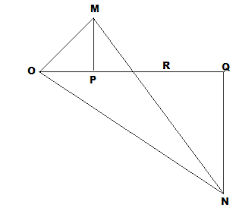
Q. 7 In the figure below, ∠MON =∠MPO = ∠NQO = 90° and OQ is the bisector of ∠MON and QN = 10, OR=40/7. Find OP.

A. 4.8

B. 4.5

C. 4

D. 5


Q. 8 If (a²+b²),(b²+c²) and (a²+c²) are in geometric progression, which of the following holds true?

A. b²-c²=a⁴-c⁴/b²+a²

B. b²-a²=a⁴-c⁴/b²+c²

C. b²-c²=b⁴-a⁴/b²+a²

D. b²-a²=b⁴-c⁴/b²+a²


Q. 9 p is a prime and m is a positive integer. How many solutions exist for the equation p⁶-p=(m² +m+6)(p-1)?

A. 0

B. 1

C. 2

D. Infinite


Q. 10 A certain number written in a certain base is 144. Which of the following is always true?

I. Square root of the number written in the same base is 12.

II. If base is increased by 2, the number becomes 100.

A. Only I

B. Only II

C. Neither I nor II

D. Both I and II


Q. 11 A rectangle is drawn such that none of its sides has length greater than ‘a’. All lengths less than ‘a’ are equally likely. The chance that the rectangle has its diagonal greater than ‘a’ is (in terms of %)

A. 29.3%

B. 21.5%

C. 66.66%

D. 33.33%


Q. 12 If x is a real number, [x] is greatest integer less than or equal to x, then 3[x]+2-[x]=0/ Will the above equation have any real root?

A. Yes

B. No

C. Will have real roots for x<0

D. Will have real roots for x>0


Q. 13 If a=x/y+z, b=y/z+y, c=z/x+y, then which of the following statements is/are true?

I. b+c-1/yz + a+c-1/xzz + a+b-1/yx = 1

II. x²/a(1-bc) = y²/b(1-ca) = z²/c(1-ab)

III. (a+b)c+(b+c)a+(a+c)b = {2(x+y+z)(xy+xz+yz)-6xyz}/(x+y)(y+z)(z+x)

A. I and II

B. I and III

C. II and III

D. None of these


Q. 14 If α and β are the roots of the quadratic equation x²-10x+15=0, then find the quadratic equation whose roots are (α+α/β) and (β+β/α)

A. 15x²+71x+210=0

B. 5x²-22x+56=0

C. 3x²-44x+78=0

D. Cannot be determined


Questions: 15 – 17

Directions (Q. Nos. 15-17)

Read the information carefully and answer the questions that follow.

A cricket tournament had three teams – India, Australia and Sri Lanka taking part in it. The format of the tournament was such that in the preliminary stage each of these teams, would play the other teams four times. Four points are awarded for a win and in case a team beats another team by a huge margin, it is given a bonus point in addition to the four points. At the end of the preliminary stage, the top two teams, in terms of points scored, reaches the finals. No match in the tournament ends in a tie and if two teams end up with the same number of points at the end of the preliminary stage, the team with the better net run rate is placed higher.


Q. 15 If India reached the finals, then what is the minimum numbers of points it would have scored in the preliminary stage?

A. 8

B. 10

C. 12

D. 16


Q. 16 If Sri Lanka was eliminated in the preliminary stage, then what is the maximum number of points it could have scored?

A. 12

B. 14

C. 16

D. 20


Q. 17 If Australia had the highest number of points at the end of the preliminary stage, then at least how many points did it have?

A. 16

B. 17

C. 18

D. 20


Q. 18 A vessel has a milk station in which milk and water are in the ratio 4:1. By addition of water to it, milk solution with milk and water in the ratio 4:3 was formed. On replacing 14 L of this solution with pure milk the ratio of milk and water changed to 5:3. What is the volume of the water added?

A. 12 L

B. 60 L

C. 32 L

D. 24 L


Q. 19 A car 􀀁 starts from a point P towards another point Q. Another car 􀀂 starts (also from P) 1 h after the first car and overtakes it after covering 30% of the distance PQ. After that, the cars continue. On reaching Q, car 􀀂 reverses and meets car 􀀁, after covering 23+1/3 of the distance QP. Find the time taken by car 􀀂 to cover the distance PQ (in hours).

A. 3

B. 4

C. 5

D. 3+1/3


Q. 20 A, B and C can independently do a work in 15 days, 20 days and 30 days, respectively. They work together for some time after which C leaves. A total of ₹18000 is paid for the work and B gets ₹6000 more than C. Find how many days did A work?

A. 2

B. 4

C. 6

D. 8


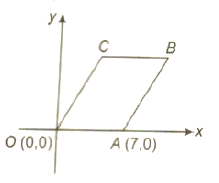
Q. 21 In the figure given, OABC is a parallelogram. The area of the parallelogram is 21 sq units and the point C lies on the line x=3. Find the coordinates of B.

A. (3, 10)

B. (10, 3)

C. (10, 10)

D. (8, 3)


Q. 22 Find the complete set of values that satisfy the relations ||x|-3|<2 and ||x|-2|<3.

A. (-5, 5)

B. (-5, -1) ∪ (1, 5)

C. (1, 5)

D. (-1, 1)


Q. 23 If ax²+bx+c=0 and 2a, b and 2c are in arithmetic progression, which of the following are roots of the equation?

A. a, c

B. -a, -c

C. -a/2, -c/2

D. -c/a, -1


Q. 24 A solid sphere of radius 12 inches is melted and cast into a right circular cone whose base diameter is √2 times its slant height. If the radius of the sphere and the cone are the same, how many such cone are the same, how many such cones can be made and how much material is left out?

A. 4 and 1 cubic inch

B. 3 and 12 cubic inches

C. 4 and 0 cubic inch

D. 3 and 6 cubic inches


Q. 25 If logₓ(a-b)-logₓ(a+b)=logₓ(b/a), find a²/b² + b²/a²

A. 4

B. 2

C. 3

D. 6


Q. 26 Letters of the word “ATTRACT” are written on cards and are kept on a table. Manish is asked to lift three cards at a time, write all possible combinations of the three letters on a piece of paper and then replace the three cards. The exercise ends when all possible combinations of letters are exhausted. Then, he is asked to strike out all words in his list, which look the same when seen in a mirror. How many words is he left with?

A. 40

B. 20

C. 30

D. None of these


Q. 27 S is a set given by S={1, 2, 3,….4n}, where n is a natural number. S is partitioned into n disjoint subsets A₁, A₂, A₃,…An each containing four elements. It is given that in everyone of these subsets there is one element, which is the arithmetic mean of the other three elements of the subsets. Which of the following statements is then true?

A. n≠1 and n≠2

B. n≠1 but can be equal to 2

C. n≠2 but can be equal to 1

D. it is possible to satisfy the requirement for n =1 as well as for n = 2


Q. 28 When asked for his taxi number, the driver replied, “If you divide the number of my taxi by 2, 3, 4, 5, 6 each time you will find a remainder of one. But if, you divide it by 11, the remainder is zero. You will also not find any other driver with a taxi having a lower number who can say the same.” What is the taxi number?

A. 121

B. 1001

C. 1881

D. 781


Q. 29 A student is asked to form numbers between 3000 and 9000 with digits 2, 3, 5, 7 and 9. If no digit is to be repeated, in how many ways can the student do so?

A. 24

B. 120

C. 60

D. 72


Q. 30 The side of an equilateral triangle is 10 cm long. By drawing parallels to all its sides, the distance between any two parallel lines being the same. The triangle is divided into smaller equilateral triangle, each of which has sides of length 1 cm. How many such small triangles are formed?

A. 60

B. 90

C. 120

D. None of these


Questions: 31 – 32

Directions (Q. Nos. 31-32)

Each of the following questions has a paragraph from which a sentence has been deleted. From the given options, choose the one that completes the paragraph in the most appropriate way.


Q. 31 RD Laing developed a broad range of thought on interpersonal psychology. This deals with interactions between people, which he considered important, for an ethical action always occurs between one person and another. In books, such as The Politics of Experience, he deal with issues concerning how we should relate to persons labelled by the psychiatric establishment as “schizophrenic”.

A. He came to be seen as a champion for the rights of those considered mentally ill

B. He spoke out against (and wrote about) practices of psychiatrists which he considered inhumane or barbaric, such as electric shock treatment

C. Laing also did work in establishing true asylums as places of refuge for those who feel disturbed and want a safe place to go through whatever it is they want to explore in themselves and with others

D. He suggested that the effects of psychiatric drugs (some of which are very deleterious, such as tardive diskensia) be called just that: “effects” and not be referred to by the preferred euphesisms of the drug companies, who prefer to call them “side effects”


Q. 32 Jurisprudence is the theory and philosophy of law. Students of jurisprudence aim to understand fundamental nature of law and to analyse its purpose, structure and application. Jurisprudential scholars (sometimes confusingly referred to as “jurists”) hope to obtain a deeper understanding of the law, the kind of power that it exercises and its role in human societies.

They seek a deeper understanding behind law’s seemingly unpredictable and certain nature.

A. At a practical level, some jurists hope to improve society by studying what the Law is, what it ought to be, and how it actually operates

B. A common starting point in understanding jurisprudence is the objective of law to achieve justice

C. Hence, the arguable scientific nature of jurisprudence

D. Jurisprudence seeks to draw on unrestricted elements of life and the world to aid the critical study of law


Questions: 33 – 35

Directions (Q. Nos. 33-35)

Read the following passage carefully and answer the questions based on that.

Human reason, in one sphere of its cognition, is called upon to consider questions, which it cannot decline, as they are presented by its own nature but which it cannot answer, as they transcend every faculty of the mind. It falls into this difficulty without any fault of its own. It begins with principles which cannot be dispensed within the field of experience and the truth and sufficiency of which are, at the same time insured by experience, With these principles it rises, in obedience to the laws of its own nature, to even higher and more remote conditions. But it quickly discovers that in this way, its labours must remain ever incomplete because new questions never cease to present themselves and thus it finds itself compelled to have recourse to principled which transcend the region of experience while they are regarded by common sense without distrust. It thus falls into confusion and contradictions from which it conjectures the presence of latent errors, which however, it is unable to discover because the principles it employs transcending the limits of experience cannot be tested by that criterion. The arena of these endless contests is called Metaphysic. Time, when she was the queen of all the sciences and if we take the will for the deed, she certainly deserves, so far as regards the high importance of her objectmatter, this title of honour.


Q. 33 According to the author, ‘Metaphysic’ is best defined when human reason

A. Becomes conscious of the presence of latent errors

B. Solves pending old questions, tackles new ones that arise

C. Employs principles that transcend the limits of experience

D. Rises to higher and more remote conditions


Q. 34 If there were a paragraph succeeding the last, it would probably be about

A. The rise of Metaphysic into the realm of popular acclaim

B. Metaphysic as the final solution to human misery

C. The modern day contempt for metaphysical reasoning

D. The subjugation of science by a transcendental human consciousness


Q. 35 The passage provides an answer to which of the following questions?

A. How does experience limit the human mind’s recourse to principles in combating new questions that present themselves?

B. Why does human reason restrain its forays to within its known limitations?

C. How does the human mind attempt to resolve problems beyond its scope?

D. None of the above


Q. 36 Find the incorrect usage of the word in the following questions.

The word is SLAM –

A. I heard the door slam behind him.

B. She slammed down the phone angrily.

C. She slammed his face hard.

D. The ear skidded and slammed into a tree.


Q. 37 Find the incorrect usage of the word in the following questions.

The word is STOP –

A. The car stopped at the traffic light.

B. Shantaram immediately stopped what he was doing.

C. We need more laws to stop pollution.

D. He is stopped by law from holding a license.


Q. 38 Find the incorrect usage of the word in the following questions.

The word is TIME –

A. I can remember very few times when we had to cancel due to ill health.

B. This is the first time that I have been to London.

C. The train arrived right on time.

D. The changing seasons mark the passing of time.


Q. 39 Find the incorrect usage of the word in the following questions.

The word is SOMBRE –

A. He was dressed in sombre shades of grey and black.

B. Paul was in a sombre mood.

C. The year ended on a sombre note.

D. He is in the sombre position of not having to worry about money.


Q. 40 Find the incorrect usage of the word in the following questions.

The word is CALL –

A. She payed him a call from the pay phone near her home.

B. I will call on you tomorrow evening at 7 pm.

C. Vikram decided to call a meeting to discuss the trade fair.

D. She felt the call of religion early in her life.


Questions: 41 – 42

Read the following passage carefully and answer the questions that follow:

It is essential to rid ourselves of the false impressions of time, which our human limitations seem to impose upon us. Above all, we must rid ourselves of the belief that the future is in some way less determined than the past, if the borderline between past and future is illusory, then so must be the distinction between two regions of time which it is supposed to separate. The only reason we believe the future to be still undecided while the past is immutable is that we can remember the one and not the other. To avoid these prejudices we must picture the history of the universe not as a three-dimensional stage on which things change but as a static four-dimensional space time structure of which we are a part. We believe that events are not real until they “happen”, whereas in reality past, present and future are all frozen in the four dimensions of space time. Unfortunately even if all this is accepted, we have to continue using the language of a “moving” time, for we have no other but we must try to interpret this language always as a description of the unchanging space time structure of the universe. Contemplating the history of the universe in this way, it is attractive to believe that the periods of expansion and contraction could be related to each other by symmetry. Both points of view merit serious consideration and that we cannot say with any certainty that the contracting universe will or will not, differ fundamentally from the expanding phase that we observe today.


Q. 41 According to the author of the passage,

A. The time value called ‘now’ is most essential to the understanding of the universe

B. The impression of a moving time is not a false imposition of human limitation

C. There is noting with respect to which time could move

D. The future is better determined than the past


Q. 42 Which of the following best exemplifies the author’s attitude to time?

A. The impression of a moving time is false

B. ‘Now’ is a purely subjective phenomenon existing only within the human mind

C. The future is not in anyway less determined than the past

D. All of the above


Questions: 43 – 47

Read the passage and answer the questions that follow:

Amidst the increasing clamour for a discourse on educational improvement, on budgetary allocations and retention rates, there is one crucial question which is insufficiently discussed. And the question is this what is the purpose of education today? At various times, over the past 100 yr, that question has been answered differently – in colonial India, the official answer would have been, “to create a cadre of clerks and officials to run the colonial state”, while in a newly decolonized India, the official answer could be, “to create a nationalist sensibility and the national citizen.” Today, I suspect the official answer to the question about the purpose of education would be, “to give people jobs”. Increasingly, the emphasis in education is towards vocationalisation and skills development. In a recent private conversation, the Education Minister of a North Indian state said, “we have a lot of jobs. We just don’t have the people skilled enough to do them. We need bio technologists, fitters, crane operators, nurses and lab assistants. But our education does not prepare young people for what we need. We need to change that.” Similarly, we find that the Confederation of Indian Industry is showing increasing interest in school education. The CII recently commissioned a study to look at the challenges and opportunities which face the Indian industry and this is its thesis that in the year 2025, there will be about 40 million jobs worldwide, which need to be filled. India will be one of the few countries in the world to have a labour surplus of the right age group. It, therefore believes that we need to think about the kinds of education system necessary to develop skills whereby our children will be best equipped to function in this scenario. Public consensus on the way to improve educational access is increasingly moving towards a public-private partnership. But we must be concerned about the terrible narrowness of the vision for educational improvement which characterizes our discourse. Education, in this picture, is about the implanting of useful skills – the assumption being that it will ultimately lead to both personal and national enrichment but as Martha Nussbaum writes, education is not simply a producer of wealth; it is a producer of citizens. Citizens in a democracy need, above all, freedom of mind – to learn to ask searching questions; to reject shoddy historical argument; to imagine alternative possibilities from a globalizing, service and market-driven economy, to think what it might be like to be in others’ shoes. Recently, the Israeli novelist, Amos Oz, spoke about the importance of reading novels as what he calls an antidote to hate. He said, “I believe in literature as a bridge between peoples. I believe curiosity can be a moral quality. I believe imagining the other can be an antidote to fanaticism. Imagining the other will make you not only a better businessperson or a better lover but even a better person. Part of the tragedy between Jew and Arab is the inability of so many of us, Jews and Arabs, to imagine each other – really imagine each other; the loves, the terrible fears, the anger, the passion. There is too much hostility between us, too little curiosity.” The skills and thought processes while engender the curiosity, the imagining are associated with the humanities, the arts and literature and despite the splendid interventions in the NCERT’s new textbooks for History and Political Science, these areas are terribly neglected. Our dominant conception of worthwhile education is increasingly technical and mechanistic. The thinking processes engendered by the social sciences are today seen as quaint, vaguely leftyintellectual, a kind of quixotic idealism – which has very little to do with the real business of life. It is a strange irony that in the educational world of Gandhi, Tagore and Aurobindo, there are tragically few voices which assert a more holistic vision.


Q. 43 The true purpose of education in India as inferred from the passage ?

A. Is to create a nationalist sensibility in every citizen

B. Has been a topic of debate since independence

C. Is a concept that has been changing from time to time

D. Is to teach an individual the necessary skills to earn his livelihood


Q. 44 In the author’s perception, our vision for educational improvement is narrow because our system

A. Gives importance only to vocationalisation and skills development

B. Believes in making people earn more so that they can stand up to the challenges of a globalizing economy

C. Does not acknowledge the importance of humanist concepts

D. Does not support a public-private partnership in improving educational access to everyone


Q. 45 Amos Oz believes that the world will become a peaceful place, if people

A. Become less hostile

B. Become less narrow minded

C. Become less fanatic

D. Empathise with each other


Q. 46 The Indian concept of worthwhile education is that which

I. Gives technical training

II. Makes people think

III. Has a measurable outcome

IV. Kindles our curiosity and imagination

V. Helps people become wealthy

A. I and V

B. II and III

C. I, II and IV

D. I, III and IV


Q. 47 Which of the following is not an attribute of a good citizen in a democracy?

A. Learning to ask searching questions

B. Not accepting inadequate reasons from history

C. Thinking out of the box

D. Learning to negotiate with people


Questions: 48 – 51

Directions (Q. Nos. 48-51)

Read the following information carefully and answer the questions based on that.

Two teams of five each must be selected from a group of ten persons – A through J – of which A, E and G are doctors; D, H and J are lawyers; B and I are engineers; C and F are managers. It is also known that

i) Every team must contain persons of each of the four professions

ii) C and H cannot be selected together

iii) I cannot be selected into a team with two lawyers

iv) J cannot be in a team with two doctors

v) A and D cannot be selected together


Q. 48 If C and G are in different teams, then who are the other team members of A?

A. C, D, E and I

B. B, F, I, and J

C. B, C, H and J

D. F, H, I and G


Q. 49 Who among the following cannot be in the same team as I?

A. H

B. J

C. C

D. F


Q. 50 Who among the following must always be in the same team as A?

A. D

B. B

C. H

D. J


Q. 51 If F and G are in the same team, which among the following statements is true?

A. B and H will be in the other team

B. E and I must be in the same team

C. H must be in the same team but B must be in the other team

D. C must be in the other team but D must be in the same team


Questions: 52 – 55

Directions (Q. Nos. 52-55)

Read the following information carefully and answer the questions based on that.

Two families are planning to go on a canoe trip together. The families consists of the following people : Robert and Mary Henderson and their three sons Tommy, Don and William, Jerome and Ellen Penick and their two daughters Kate and Susan. There will be three canoes with three people in each canoe. At least one of the four parents must be in each canoe. At least one person from each family must be in each canoe.


Q. 52 If the two mothers ride together in the same canoe and the three brothers each ride in a different canoe, which of the following must be true?

A. Each canoe has both males and females in it

B. One of the canoes has only females in it

C. One of the canoes has only males in it

D. The sisters ride in the same canoe


Q. 53 If Ellen and Susan are together in one of the canoes, which of the following could be a list of the people together in another canoe?

A. Dan, Jerome, Kate

B. Dan, Jerome, William

C. Dan, Kate, Tommy

D. Jerome, Kate, Mary


Q. 54 If Jerome and Mary are together in one of the canoes, each of the following could be a list of the people together in another canoe except

A. Dan, Ellen, Susan

B. Ellen, Robert, Tommy

C. Ellen, Susan, William

D. Ellen, Tommy, William


Q. 55 If each of the Henderson children rides in a different canoe, which of the following must be true?

I. The Penick children do not ride together

II. The Penick parents do not ride together

III. The Henderson parents do not ride together

A. Only I

B. Only II

C. I and II

D. I and III


Questions: 56 – 57

Directions (Q. Nos. 56-57)

Each question has a sentence with a part of the sentence quoted that may contain an error. Four alternative substitutes are given for the quoted portion. Identify the choice that replaces the quoted part to form a logically and grammatically correct statement and mark it as your correct answer.


Q. 56 Feminism is not simply a movement to ensure that women will have equal rights with men “but that a commitment for eradiating the ideology of domination” that permeates Indian culture at various levels

A. That is a commitment to eradicate the ideology to dominate that

B. It is a commitment to eradicating the ideology of domination that

C. Whose commitment to eradicating the ideology of domination which

D. But that a commitment for eradicating the ideology of domination that


Q. 57 It is unfortunate that the lure of visiting foreign countries still draws a very large number if our people, “who do not seem to be realizing what their own country is and how much can be seen and learnt from it?”

A. Who do not seem to realize their country and see and learn from it

B. Who are not realizing what their own country is and how much there is in it to see and learn from

C. Who do not seem to realize what their own country is and how much there is in it to see and learn from it

D. Who do not seem to realize what their own country is and how much there is in it to see and learn from


Questions: 58 – 60

Directions (Q. Nos. 58-60)

Read the following information carefully and answer the questions based on that.

Each of five people – A, B, C, D and E owns a different car among Maruti, Mercedes, Sierra, Fiat and Audi and the colours of these cars are Black, Green, Blue, White and Red, not necessarily in that order. No two cars are of the same colour. It is also known that

i) A’s car is not Black and it is not a Mercedes

ii) B’s car is Green and it is not a Sierra

iii) E’s car is not White and it is not an Audi

iv) C’s car is a Mercedes and it is not Blue

v) D’s car is not Red and it is a Fiat


Q. 58 If A owns a Blue Sierra, then E’s car can be a

A. Red Maruti

B. White Maruti

C. Black Audi

D. Red Audi


Q. 59 If A owns a White Audi, then E’s car can be a

A. Red Maruti

B. Blue Maruti

C. Green Audi

D. Black Sierra


Q. 60 If A’s car is a Red Maruti and D’s car is White, then E owns a

A. Black Audi

B. Blue Sierra

C. Black Sierra

D. Blue Audi


Answer Sheet
Question 1 2 3 4 5 6 7 8 9 10
Answer B D B D A A C B B D
Question 11 12 13 14 15 16 17 18 19 20
Answer B B A C A D B C D D
Question 21 22 23 24 25 26 27 28 29 30
Answer B B D C D A B A D D
Question 31 32 33 34 35 36 37 38 39 40
Answer A A B C C C D A D A
Question 41 42 43 44 45 46 47 48 49 50
Answer C D C A D A D D B C
Question 51 52 53 54 55 56 57 58 59 60
Answer C A B B D B D A D B

CAT Previous Year Paper 2010

CAT 2010

Section

Questions

Marks

DILR

20 Questions (1 – 20)

60

Quantitative Aptitude

20 Questions (21 – 40)

60

English

20 Questions (41 – 60)

60

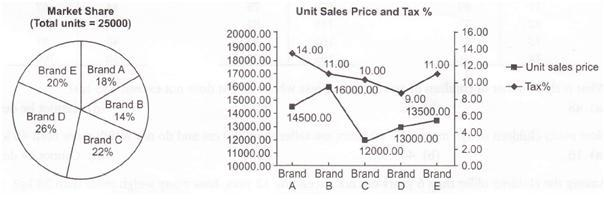
Q. 1 – 3 Read the graph carefully and answer the questions that follow.

One of the graph below represent the market share of five different brands of bikes sold in a particular city. The total number of bikes sold was 25000. The other one shows the unit sales price and the tax the brand is subjected to. Tax is calculated on the sales price.


Q. 1 What is the difference in number of units sold by the most popular brand and the second most popular brand?

A. 800

B. 1000

C. 1200

D. 1400


Q. 2 Which brand earned the maximum revenue before tax?

A. A

B. B

C. C

D. D


Q. 3 Which brand earned the maximum revenue after tax?

A. A

B. B

C. C

D. D


Q. 4 Whenever Amit sings, Bharat gets a headache and Chandu complains. If Chandu is not complaining, which of the following statements must be true?

A. Amit is singing and bharat has a headache

B. Bharat has a headache but Amit is not necessarily singing.

C. Amit is singing, but Bharat does not necessarily have a headache.

D. Amit is not singing.


Q. 5 Atul will eat the apple if Bhanu does not cook. Based only on the information above, which of the following must be true?

A. Atul will not eat the apple if Bhanu cooks

B. If Atul did not eat the apple, Bhanu did cook

C. If Atul eats the apple, then Bhanu did not cook

D. If Bhanu does not cook, Atul will not eat the apple


Questions: 6 – 8

Answer the questions on the basis of the information given below.

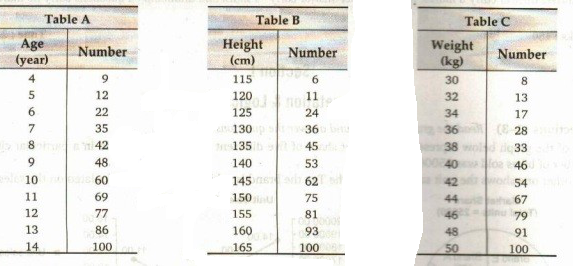
Table A below provides data about ages of children in a school. For the age given in the first column, the second column gives the number of children not exceeding that age. For example, first entry indicates that there are 9 children aged 4 years or less. Tables B and C provide data on the heights and weights respectively of the same group of children in a similar format. Assuming that an older child is always taller and weighs more than a younger child.


Q. 6 What is the number of children of age 9 years or less whose height does not exceed 135 cm?

A. 48

B. 45

C. 3

D. Cannot be determined


Q. 7 How many children of age more than 10 years are taller than 150 cm and do not weigh more than 48 kg?

A. 16

B. 40

C. 9

D. Cannot be determined


Q. 8 Among the children older than 6 years but not exceeding 12 yeas, how many weigh more than 38 kg?

A. 34

B. 52

C. 44

D. Cannot be determined


Questions: 9 – 12

Answer the questions on the basis of the information given below.

A study was conducted to ascertain the relative importance that employees in five different countries assigned to five different traits in their chief executive officers. The traits were compassion (C), decisiveness (D), negotiation skills (N), public visibility (P) and vision (V). The level of dissimilarity between two countries to any of the five traits. The following table indicates the rank order of the five traits. The following table indicates the rank order of the five traits for each country.


Q. 9 Which of the following countries is least dissimilar to India?

A. China

B. Japan

C. Malaysia

D. Thailand


Q. 10 Which among the following countries is most dissimilar to India?

A. China

B. Japan

C. Malaysia

D. Thailand


Q. 11 Which of the following pairs of countries are most dissimilar?

A. China and Japan

B. India and China

C. Malaysia and Japan

D. Thailand and Japan


Q. 12 Three of the following four pairs of countries have identical levels of dissimilarity. Which pair is the odd one out?

A. Malaysia and China

B. China and Thailand

C. Thailand and Japan

D. Japan and Malaysia


Questions: 13 – 15

Answer the questions on the basis of the information given below.

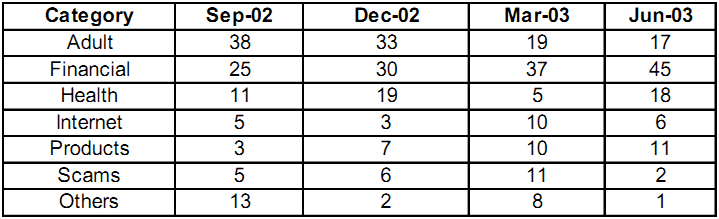
Spam that enters our electronic mailboxes can be classified under several spam heads. The following table shows the distribution of such spam worldwide over time. The total number of spam e-mails received during December 2002 was larger than the number received in June 2003. The total number of spam e-mails received during September 2002 was larger than the number received in March 2003. The figures in the table represent the percentage of all spam e-mails received during that period, failing into those respective categories.


Q. 13 In which category was the percentage of spam e-mails increasing but at a decreasing rate?

A. Financial

B. Scams

C. Products

D. None of these


Q. 14 In the health category, the number of spam e-mails received in December 2002 as compared to June 2003 was

A. Larger

B. Smaller

C. Equal

D. cannot be determined


Q. 15 In the financial category, the number of spam e-mails received in September 2002 as compared to March 2003 was

A. Larger

B. Smaller

C. equal

D. cannot be determined


Questions: 16 – 20

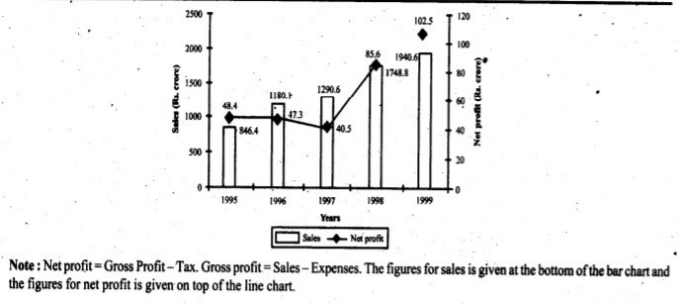
Refer to the following graph and answer the questions.


Q. 16 Which month has the highest profit per employee?

A. September

B. July

C. January

D. March


Q. 17 In which month is die percentage increase in sales over the sales two months before, the highest?

A. March

B. September

C. July

D. May


Q. 18 In which month is the total increase in the cost highest as compared to the cost two months ago?

A. March

B. September

C. July

D. May


Q. 19 Assuming that no employee left the job, how many more people did the company take on in the given period?

A. 4600

B. 5100

C. 5800

D. 6400


Q. 20 In which month is the total increase in the cost highest as compared to the cost two months ago?

A. March

B. May

C. September

D. July


Q. 21 The largest number amongst the following that will perfectly divide 101¹⁰⁰ – 1 is

A. 100

B. 10000

C. 100¹⁰⁰

D. 100000


Question:- 22

Rohan and Sohan take a vacation at their grandparents house. During the vacation, they do any activity together. They either played Tennis in the evening or practiced Yoga in the morning, ensuring that they do not undertake both the activities on any single day. There were some days when they did nothing. Out of the days that they stayed at their grandparents’ house, they involved in one of the two activities on 22 days.However, their grandmother while sending an end of vacation report to their parents stated that they did not do anything on 24 mornings and they did nothing on 12 evenings.


Q. 22 How long was their vacation?

A. 36 days

B. 14 days

C. 29 days

D. cannot be determined


Q. 23 The equation, 2x² + 2(p + 1)x + p = 0, where p is real, always has roots that are

A. Equal

B. Equal in magnitude but opposite in sign

C. Irrational

D. real


Q. 24 Ram Kumar buys every year Bank’s cash certificates of value exceeding the last year’s purchase by 300. After 20 years, he finds that the total value of the certificates purchased by him is 83000. Find the value of the certificates purchased by him in the 13th year.

A. Rs. 4900

B. Rs. 6900

C. Rs. 1300

D. none of these


Q. 25 Ram starts working on a job and works on it for 12 days and completes 40% of the work_ To help him complete the work, he employs Ravi and together they work for another 12 days and the work gets completed. How much more efficient is Ram than Ravi?

A. 50%

B. 200%

C. 60%

D. 100%


Q. 26 A pump can be used either to fill or to empty a tank. The capacity of the tank is 3600 m³. The emptying capacity of the pump is 10 m³/min higher than its filling capacity. What is the emptying capacity of the pump, if pump needs 12 more minutes to fill the tank than to empty it?

A. 50 m³/min

B. 60 m³/min

C. 45 m³/min

D. 90 m³/min


Q. 27 How many integers, greater than 999 but not greater than 4000, can be formed with the digits 0, 1, 2, 3 and 4, if repetition of digits is allowed?

A. 499

B. 500

C. 375

D. 376


Q. 28 How many five digit positive integers that are divisible by 3 can be formed using the digits 0, 1, 2, 3, 4 and 5, without any of the digits getting repeating?

A. 15

B. 96

C. 216

D. 120


Q. 29 There are four boxes. Each box contains two balls: one red and one blue. You draw one ball from each of the four boxes. What is the probability of drawing at least one red ball?

A. 1/2

B. 1/4

C. 1/16

D. 15/16


Q. 30 Which of the following statements is not correct?

A. log₁₀10 = 1

B. log (2 + 3) = log (2 x 3)

C. log₁₀1 = 0

D. log (1 + 2 + 3) = log 1 + log 2 + log 3


Q. 31 The sum of the number of factors of the number N and N² is 34. How many such distinct numbers N < 150 exist?

A. 6

B. 2

C. 4

D. 3


Q. 32 The sum of 3rd and 15th elements of an arithmetic progression is equal to the sum of 6th, 11th and 13th elements of the same progression. Then which element of the series should necessarily be equal to zero?

A. 1st

B. 9th

C. 12th

D. none of these


Q. 33 The function f(x) – lX – 2 l+l 2.5 – x l + l3.6 – xl , where x is a real number, attains a minimum at

A. x = 2.3

B. x = 2.5

C. x = 2.7

D. none of these


Q. 34 The remainder, when (1523 + 2323 ) is divided by 19, is

A. 4

B. 15

C. 0

D. 18


Q. 35 In a race of 200 m, A beats S by 20 m and N by 40 m. If S and N are running a race of 100 m with exactly the same speed as before, then by how many meters will S heat N?

A. 11.11 m

B. 10 m

C. 12 m

D. 25 m


Questions: 36 – 37

These questions are based on the given information

There are three different cable channels namely Ahead, Luck and Bang. In a survey, it was found that 85% of viewers respond to Bang, 20% to Luck, and 30% to Ahead. 20% of viewers respond to exactly two channels and 5% to none.


Q. 36 What percentage of the viewers responded to all three?

A. 10

B. 12

C. 14

D. none of these


Q. 37 Assuming 20% respond to Ahead and Bang, and 16% respond to Bang and Luck, what is the percentage of viewers who watch only Luck?

A. 20

B. 10

C. 16

D. none of these


Q. 38 A milkman mixes 20 L of water with 80 L of milk. After selling one-fourth of this mixture, he adds water to replenish the quantity that he has sold. What is the current proportion of water to milk?

A. 2:3

B. 1:2

C. 1:3

D. 3:4


Q. 39 Let u = (log₂ x) 2 – 6 log₂ , x + 12 where, x is a real number. Then the equation x^u = 256, has

A. no solution for x

B. exactly one solution for x

C. exactly two distinct solutions for x

D. exactly three distinct solutions for x


Q. 40 A positive whole number M less than 100 is represented in base 2 notation, base 3 notation, and base 5 notation. It is found that in all three cases the last digit is 1, while in exactly two out of the three cases the leading digit is 1. Then M equals

A. 31

B. 63

C. 75

D. 91


Questions: 41 – 43

The passage given below is followed by a set of three questions. Choose the most appropriate answer to each question.

Bruce Robbins’s excellent article points up the paradox of cosmopolitanism – that it seems ‘perpetually torn between an empirical dimension and a normative dimension’. For Robbins, the paradox of cosmopolitanism is rooted in the limited empirical sense of political community. For genuine democracy people need to belong to the same community of fate’, and there is at present little evidence of such a sense of cosmopolitan consciousness. Although leading (Western) governments make claims in support of cosmopolitan human rights established by virtue of membership of a common humanity, their practice is often limited by the ‘communitarian’ reality. The lack of ‘shared fate’ leads to inequalities in practice as governments are often reluctant to sacrifice either treasury resources or military lives in the cause of others, and citizens appear unwilling to shoulder the tax burdens involved in any potential cosmopolitan redistribution of wealth and opportunities. Robbins suggests that it would be wrong to use the empirical limits to cosmopolitan practices as an argument against normative cosmopolitan claims. He asserts that there is ‘no possibility of simply choosing the actual over the normative’ and instead suggests that we should accept that the ‘contradiction’ exists.

A solution to the problem lies in political change which seeks ‘to bring abstraction and actuality together’. A ‘Left cosmopolitanism’ is one that denies ‘the past authority over the present’ – the empirical reality that ‘there is as yet little evidence of transnational solidarity’ should be the justification for engagement and struggle on the side of the progressive cosmopolitan cause. This campaigning perspective is advocated by several cosmopolitan theorists who, in different ways, seek to develop ideas and mechanisms whereby global civil society can encourage and further cosmopolitan practices against the communicant inclinations of national governments and their electorates. This article suggests that the ‘cosmopolitan paradox’ – the gap between universal aspiration and hierarchical practice – is not merely one of cosmopolitan ‘consciousness’ lagging behind an immanent cosmopolitan ‘reality’. Rather, the paradox is rooted in the essence of the cosmopolitan thesis itself. The limitations of abstract normative cosmopolitan conceptions of ‘rights’ and ‘responsibilities’, in a world structured by economic and social inequalities, raise major questions over the progressive claims made by cosmopolitan theorists. In fact, rather than challenging existing international structures of power, there is a real danger that the cosmopolitan impulse will legitimize a much more hierarchical set of international relationships.

Whether the cosmopolitan aspiration takes the form of Robbins’s call for a transnational welfare safety net or claims for the protection and promotion of a more extensive range of human rights, all cosmopolitan perspectives reflect the increasing prominence of individual rights claims in the international sphere. Leading cosmopolitan theorists seek to challenge the restrictions of the UN Charter framework, imposed by the major powers in the aftermath of the Second World War, which formally prioritized the ‘state-based’ principles of sovereignty and non-intervention_ They argue that these principles need to be replaced by a new set of cosmopolitan principles, which make the universal individual rights of members of ‘global society’ the primary focus.


Q. 41 Which of the following is a part of the empirical dimension as per the passage?

A. Shared fate

B. Universal aspiration

C. Inequalities in practices

D. The cosmopolitan paradox


Q. 42 Which of the following can he inferred from the passage?

A. Cosmopolitan theorists seek to legitimize a much more hierarchical set of international relationships

B. Cosmopolitan theorists feel that the principles of sovereignty and non-intervention need to be implemented at a global level

C. the theories and conceptions of cosmopolitanism are responsible for the cosmopolitan paradox

D. Cosmopolitan consciousness does not really lag behind an immanent cosmopolitan reality


Q. 43 The author is primarily concerned with

A. exploring the cosmopolitan paradox and solutions and reasons for the Mee

B. exploring the tussle between the advocates of nationalism and cosmopolitanism

C. arguing that the cosmopolitan paradox will continue to exist

D. enthusing that ’empirical reality’ is not an excuse to do away with cosmopolitan aspirations.


Question:-  44

For the question word below, a contextual usage is provided. Pick the word from the alternatives given that is closest, in meaning, in the given context.


Q. 44 Amortise It was a rude shock to witness the sober, usually docile child in a DIOK, fighting ferociously while the parents amortised his insatiable demands.

A. Servile

B. Delibrate

C. Abort

D. Decant


Question 45

Five sentences are given below, labelled A, B, C, D and E. They need to be arranged in a logical order to form a coherent paragraph/passage. From the given options, choose the most appropriate option.


Q. 45 (A) The revolution began as an attack on despotism.

(B) Already by 1762 Rousseau was implying in his ‘Social Contract’ that there was no meaningful difference between the authority of a despot and that of a monarch.

(C) As usual, regular usage soon diluted the original rigor of the expression’s meaning.

(D) Montesquieu has defined its spirit as “The rule of one, according to no law”.

(E) Obeying no law, authority was arbitrary and its animating spirit was fear.

A. ABDCE

B. AEDCB

C. ADECB

D. None of these


Q. 46 The word given below has been used in sentences in four different ways. Choose the option corresponding to the sentence in which the usage of the word is incorrect or inappropriate.

Make

A. May I make so bold as to suggest that you comply to the rules of the game?

B. Thiruvan decided to make over her studio to the house where he grew up.

C. It’s so strange that Aparna could not make up the meaning of the riddle.

D. The two friends fought vicariously, but their neighbors forced them to make up.


Question 47

On the other hand, some writers have expressed_______ that a few publishing houses refuse to publish women writers whose works are, as they are described, “not bold enough”, that is they are not sensational enough to ______ the market.


Q. 47 There are two gaps in the sentence/paragraph given . From the pairs of words given, choose the one that fills the gaps most appropriately.

A. concern, stimulate

B. disquiet, titillate

C. anxiety, manoeuvre

D. apprehension, excite


Q. 48 Given below are sets of four sentences that form part of a paragraph. Arrange the four sentences so that the given sentences constitute a coherent paragraph.

(A) What came out was very large garland made out of currency notes?

(B) The unsuspecting governor opened the box in full view of the gathering

(C) When the RBI governor came to inaugurate the new printing press, the local unit of the BJP handed him a gift wrapped box

(D) There was a twist – the notes were all as tattered as notes could get

A. DACB

B. CABD

C. CBAD

D. DCAB


Q. 49 In the question, there are four sentences or parts of sentences that form a paragraph.

Identify the sentence(s) or part(s) of sentence(s) that is/are incorrect in terms of grammar and usage. Then, choose the most appropriate option.

(A) The finding suggests some cases of the disease could be caused by the immune system running amok and attacking healthy tissues or failing to fight infection that leave people susceptible to the condition.

(B) The study is the first to use evidence from the human genome to confirm the long-held suspicion that the immune system plays role in the disease.

(C) “People have speculated about a link between the immune system and Parkinson’s disease for sometime and this study suggests that a link is real”, said Cyrus Zabetian.

(D) Parkinson’s disease is caused by steady dying-off of brain cells that produce a chemical called dopamine

A. A and D

B. B and C

C. Only D

D. Only C


Q. 50 In the question, there are four sentences that form a paragraph. Identify the sentence(s) or part(s) of sentence(s) that is/are correct in terms of grammar and usage. Then, choose the most appropriate option.

(A) But the ‘economic miracle’ came to a juddering halt at the beginning of the 1990s when the property bubble busted.

(B) What followed was a decade in the doldrums and the country has never fully recovered.

(C) Today, it faces deflation, an ageing and shrinking population and only minimal growth.

(D) Economists also cited the figures as evidence that the global recovery was still facing strong headwind.

A. C and D

B. B and C

C. B, C and D

D. A and C


Questions: 51 – 54

Read the passage given below and answer questions that follow based on the information given in the passage.

First AOL and Time Warner announced their intention to combine. Then came Time Warner/EMI and Tribune/ Times Mirror. Even more significant, however, has been the speculation that these mergers have caused: If these transactions are consummated, a large number of additional media mergers are expected. There is even the possibility of a nightmare scenario-a wave of media mergers so large that within a decade most of our information will be supplied by perhaps six of these huge conglomerates and a fringe of much smaller firms. It’s time to ask two critical questions. Is this kind of media oligopoly what we, as a loom. want? And if not, can the anti-trust laws effectively prevent the threatened merger wave? The answer to the first IllaelltiCKI is clear. We do not want a media oligopoly. The answer to the second question, however, is far less certain_ We should distrust a media oligopoly because it would give undue control to a small number of individuals. This need not manifest itself in a price rise for the daily newspaper or AOL’s monthly fee. Rather, it could consist of a change in editorial viewpoints, a shift in the relative prominence of links to certain websites or a decision not to cover certain topics, became they ate not ‘newsworthy’. These problems could exist without any improper intent on the part of the media barons.Even if they try to be fair and objective, they will necessarily bring their own worldview to the job, And in time some of these conglomerates may be controlled by people who are not fair or objective. At first, it might appear that the anti-trust laws can be of little help in grappling ’emit rite roans presented by large media mergers. The anti-merger laws are commonly understood as protecting price competition and a relatively small number of firms-to greatly oversimplify, let’s say at most half a dozen-are normally thought to be enough to keep a market price-competitive. In industry after industry firms merge until there is only a handful left ad the antitrust enforcers are normally unable to do anything to prevent this. (In former years, mergers were governed by an Incipiency’ standard that prevented mergers and merger waves well before they would have led to very large at likely anti – competitive problems). Even if a handful of firms are enough to insure effective competition in most industries, would six conglomerate media firms be sufficient for the diversity of viewpoints necessary to democracy? Would have be reassured if they could somehow guarantee that they would sell their magazines and

Internet advertisements at competitive prices? I am hopeful that the anti-trust laws, if correctly and vigorously interpreted, are adaptable aweigh to meet this challenge. This is because anti-trust is not exclusively about price. It is essentially about choice hem giving consumers a competitive range of options in the marketplace so that they can make their own, effective seined= boas the market’s offerings. Consumers should be able to make their choices along any dimension important to them including price, variety and editorial viewpoint. Communications media compete in part by offering independent editorial viewpoints and an independent gatekeeper function. Six media firms cannot effectively respond to the demand for choice ar tibialsay 0-Ir.:petition by extending their product lines, because new media products will inevitably bear, to some degree the perspective of their corporate parent. For these reasons, competition in terms of editorial viewpoint or gate-keeping can be guaranteed only by insuring that a media market contains a significantly larger number of firms than is required for price competition in other, more conventional markets. It is unclear, however, whether this interpretation of the anti-trust laws will be applied by the enforcement agencies and the courts. What is needed, therefore, is a much more careful look at the challenges that will be raised by future media mergers. This could best be accomplished if Congress created a Temporary Committee to study Media Mergers and Media Convergence. This committee could include members of Congress; the heads of the federal Trade Commission, the Federal Communications Commission and the Justice Department’s anti-trust divisions, CEOs of media companies; and representatives of consumer groups. The committee would identify problems that are used by large media mergers and by media convergence. If the committee concludes that existing anti-trust laws are inadequate, it should recommend to Congress that new anti-merger legislation he enacted. This may be the only way to prevent the nightmare scenario of a media oligopoly.


Q. 51 A wave of media mergers could

A. be a threat to democracy

B. result in limiting editorial viewpoints

C. result in misuse of certain laws

D. Both (a) and (b)


Q. 52 According to the passage, what could be the most significant outcome of media oligopoly?

A. An increase in the cost of newspapers

B. The fact that in the long run, there will be a shift of power to people who might not be balanced and fair in the way they deal with the media

C. Certain websites may get more prominence than others

D. There will be no competition among the newspapers


Q. 53 Which of the following statements, according to the author, are true?

(A) Half a dozen firms are enough to keep the market price-competitive

(B) Half a dozen companies are not enough to provide a democratic media

(C) Enforcement agencies may not interpret the anti-trust laws correctly

(D) Half a dozen companies will be inadequate to meet the consumer demand for product diversity

A. A, B

B. A, B,C

C. A, B,C,D

D. B,C,D


Q. 54 To get a clear picture of the challenges posed by media mergers, the author recommends

A. creation of strict laws

B. strengthening the enforcement agencies

C. creation of a study committee by the Congress

D. none of the above


Questions: 55 – 58

Read the passage given below and answer questions that follow based on the information given in the passage.

One major obstacle in the struggle to lower carbon dioxide emissions, which are believed to play a role in climate change, is the destruction of tropical rainforests. Trees naturally store more carbon dioxide as they age, and the trees of the tropical rain forests in the Amazon, for example, store an average of 500 tonnes of carbon dioxide per hectare (10,000 square miles). When such trees are harvested, they release their carbon dioxide into the atmosphere. This release of carbon dioxide through the destruction of tropical forests, which experts estimate accounts for 20% of global carbon dioxide emissions annually, traps heat in the earth’s atmosphere, which leads to global warming. The Kyoto treaty set forth a possible measure to curtail the rate of deforestation. In the treaty, companies that exceed their carbon dioxide emission limits are permitted to buy the right to pollute by funding reforestation projects in tropical rainforests. Since forests absorb carbon dioxide through photosynthesis, planting such forests helps reduce the level of atmospheric carbon dioxide, thus balancing out the companies’ surplus of carbon dioxide emissions. However, attempts at reforestation have so far been unable to keep up with the alarming rate of deforestation, and it has become increasingly clear that further steps must be taken to curtail deforestation and its possible deleterious effects on the global environment. One possible solution is to offer incentives for governments to protect their forests. While this solution could lead to a drastic reduction in the levels of carbon dioxide, such incentives would need to be tied to some form of verification, which is extremely difficult, since most of the world’s tropical forests are in remote areas, like Brazil’s Amazon basin or the island of New Guinea, which makes on-site verification logistically difficult. Furthermore, heavy cloud cover and frequent heavy rain make conventional satellite monitoring difficult.

Recently, scientists at the Japan Aerospace Exploration Agency have suggested that the rates of deforestation could be monitored using new technology to analyse radar waves emitted from a surveillance satellite. By analysing multiple radar microwaves sent by a satellite, scientists are able to prepare a detailed, high resolution map of remote tropical forests. Unlike photographic satellite images, radar images can be measured at night and during days of heavy cloud cover and bad weather. Nevertheless, critics of government incentives argue that radar monitoring has been employed in the past with little success, citing the Global Rainforest Mapping Project which was instituted in the mid 1990s amid concern over rapid deforestation in the Amazon. However, the limited data of the Mapping Project was due only to the small amount of data that could be sent from the satellite. Modern satellites can send and receive 10 times more data than their predecessors of the mid 1990s, obviating past problems with radar monitoring. Furthermore, ream recent technology advances in satellite radar that allow for more accurate measurements to be made, even in remote meek make such technology a promising step in monitoring and controlling global climate change.


Q. 55 Which one of the following most accurately expresses the main point of the passage?

A. Although scientists continue to search for a solution, there is. as vet. no good solution for the problem of rain forest deforestation.

B. One major obstacle to lessening the contribution of atmospheric carbon dioxide caused by deforestation may be removed through satellite radar monitoring.

C. Recent increases in the rate of deforestation of tropical rainforests have caused serious concern and spurred efforts to curb such deforestation.

D. Although an excellent first step, the solutions set forth by the Kyoto treaty will not significantly curb the rate of deforestation unless companies begin to lessen their carbon dioxide emissions.


Q. 56 It can be inferred from the passage that photographic satellite images

A. are impervious to bad weather

B. cannot be used efficiently at night

C. are less expensive than radar monitoring

D. can send only a small amount of data from a satellite to a base


Q. 57 Which one of the following most accurately describes the author’s attitude toward radar monitoring as expressed in the passage?

A. Wary skepticism

B. Cautious ambivalence

C. Grudging respect

D. Reasoned optimism


Q. 58 The information presented in the passage implies which one of the following about the Mapping Project?

A. The project was unsuccessful because it used only satellite radar monitoring

B. If the satellite had been able to send more data, the project may have been successful

C. It was established by the Kyoto treaty in response to widespread concern over deforestation

D. The project used only conventional satellite monitoring and on-site verification visits


Questions: 59 – 60

Given are sets of four sentences that form part of a paragraph. Arrange the four sentences so that the given sentences constitute a coherent paragraph.


Q. 59 A) 1971 war changed the political geography of the subcontinent

(B) Despite the significance of the event, there has been no serious book about the conflict

(C) Surrender at Dhaka aims to fill this gap

(D) It also profoundly altered the geo-strategic situation in South-East Asia

A. ACBD

B. CADB

C. BADC

D. ADBC


Q. 60 (A) Thus begins the search for relief: painkillers, ice, yoga, herbs, even surgery

(B) Most computer users develop disorders because they ignore warnings like tingling fingers, a numb hand or a sore shoulder

(C) They keep pointing and dragging until tendons chafe and scar tissue forms, along with bad habits that are almost impossible to change.

(D) But cures are elusive, because repetitive injuries present a bag of ills that often defy easy diagnosis.

A. BDAC

B. BADC

C. BCAD

D. ABCD


Answer Sheet
Question 1 2 3 4 5 6 7 8 9 10
Answer B D D D B B A C A B
Question 11 12 13 14 15 16 17 18 19 20
Answer D D C A D D A D B B
Question 21 22 23 24 25 26 27 28 29 30
Answer B C B A D B D C D B
Question 31 32 33 34 35 36 37 38 39 40
Answer B C B C A A D A B D
Question 41 42 43 44 45 46 47 48 49 50
Answer C C A C C C B C A B
Question 51 52 53 54 55 56 57 58 59 60
Answer D C C C B B D B D C

CAT Previous Year Paper 2009

CAT 2009

Section

Quantitative Aptitude

Questions

25 Questions

Marks

75

DILR

15 Questions (21 – 35)

45

English

20 Questions (41 – 60)

60

Q. 1 If mxᵐ-nxⁿ = 0 , then what is the value of 1/(xᵐ+xⁿ) + 1/(xᵐ+xⁿ) in terms of xⁿ?

A. 2mn/xⁿ(n²-m²)

B. 2mn/xⁿ(n² + m²)

C. 2mn/xⁿ(m² – n²)

D. 2mn/xⁿ(m² + n²)


Q. 2 If log (0.57) = 1(bar).756 , then the value of

log 57 + log (0.57)³ + log √0.57 is

A. 0.902

B. 2(bar).146

C. 1.902

D. 1(bar).146


Q. 3 In a certain zoo, there are 42 animals in one sector, 34 in the second sector and 20 in the third sector. Out of this, 24 graze in sector one and also in sector two. 10 graze in sector two and sector three, 12 graze in sector one and sector three. These figures also include four animals grazing in all the three sectors are now transported to another zoo, find the total number of animals.

A. 38

B. 56

C. 54

D. None of the above


Q. 4 The ratio of the roots of bx² + nx + n = 0 is p :q , then

A. √(q/p) + √(p/q) + √(l/n) = 0

B. √(p/q) + √(q/p) + √(n/l) = 0

C. √(q/p) + √(p/q) + √(n/l) = 0

D. √(p/q) + √(q/p) + √(l/n) = 0


Q. 5 The average age of a couple is 25 years. The average age of the family just after the birth of the first child was 18 years. The average age of the family just after the second child was born was 15 years. The average age of the family after the third and the fourth children (who are twins) were born was 12 years. If the present average age of the family of six persons is 16 years, how old is the eldest child?

A. 6 years

B. 7 years

C. 8 years

D. 9 years


Q. 6 10% of the voters did not cast their vote in an election between two candidates. 10% of the votes polled were found invalid. The successful candidate got 54% of the valid votes and won by a majority of 1620 votes. The number of voters enrolled on the voters list was:

A. 25000

B. 33000

C. 35000

D. 40000


Q. 7 The resistance of a wire is proportional to its length and inversely proportional to the square of its radius. Two wires of the same material have the same resistance and their radii are in the ratio 9:8. If the length of the first wire is 162 cms, find the length of the other.

A. 64 cm

B. 120 cm

C. 128 cm

D. 132 cm


Q. 8 A 20 litre vessel is filled with alcohol. Some of the alcohol is poured out into another vessel of an equal capacity, which is then completely filled by adding water. The mixture thus obtained is then poured into the first vessel to capacity. Then 623 litres is poured from the first vessel into the second. Both vessels now contain an equal amount of alcohol. How much alcohol was originally poured from the first vessel into the second?

A. 9 litres

B. 10 litres

C. 12 litres

D. 12.5 litres


Q. 9 The shaded portion of figure shows the graph of which of the following ?

A. x (y – 2x) ≥ 0

B. x (y – 2x) ≤ 0

C. x (y + 1/2x) ≥ 0

D. x (y – 1/2x) ≤ 0


Q. 10 If f (x + y/8 , x – y/8) = xy , then f(m , n) + f(n , m) = 0

A. Only when m = n

B. Only when m ≠ n

C. Only when m = −n

D. For all m and n


Q. 11 A person closes his account in an investment scheme by withdrawing Rs. 10000. One year ago he had withdrawn Rs. 6000. Two years ago he had withdrawn Rs. 5000. Three years ago he had not withdrawn any money. How much money he had deposited approximately at the time of opening of the account 4 years ago , if the annual simple interest is 10% ?

A. Rs. 15600

B. Rs. 16500

C. Rs. 17280

D. None of these


Q. 12 It takes 6 technicians a total of 10 hours to build a new server from direct computer , with each working at the same rate. If six technicians start to build the server at 11:00 am , and one technician per hour is added beginning at 5:00 pm , at what time will the server be completed ?

A. 6:40 pm

B. 7:00 pm

C. 7:20 pm

D. 8:00 pm


Q. 13 A ship 55 kms from the shore springs a leak which admits 2 tonnes of water in 6 min ; 80 tonnes of water would suffer to sink her , but the pumps can throw out 12 tonnes an hour. Find the average rate of sailing that she may just reach the shore as she begins to sink.

A. 5.5 km/hr

B. 6.5 km/hr

C. 7.5 km/hr

D. 8.5 km/hr


Q. 14 In a 400 meter race around a circular stadium having a circumference of 1000 meters , the fastest runner and the slowest runner reach the same point at the end of the 5th minute , for the first time after the start of the race. All the runners have the same starting point and each runner maintains a uniform speed throughout the race. If the fastest runner runs at twice the speed of the slowest runner , what is the time taken by the fastest runner to finish the race ?

A. 20 mins

B. 15 mins

C. 10 mins

D. 5 mins


Q. 15 A train crosses a platform 100 meters long in 60 seconds at a speed of 45 km/hr. The time taken by the train to cross an electric pole is

A. 8 sec

B. 1 min

C. 52 sec

D. data inadequate


Q. 16 If x = 1 + 2a + 3a² + 4a² +………….. (−1 < a < 1) and

y = 1 + 3b + 6b² + 10b³ +………….. (−1 < b < 1) ,

then find 1 + ab + (ab)² + (ab)³ +………………… in terms of x and y

A. x½ y⅓ / x½ + y⅓ − 1

B. xy / x + y − 1

C. x⅓ y⅔ / x⅓ + y½ − 1

D. None of the above


Q. 17 Two vertical lamp-posts of equal heights stand on either side of a road 50 m wide. At a point P on the road between them , the elevation of the tops of the lamp-post are 60°and 30°. Find the distance of P from the lamp post which makes angle of 60°.

A. 25 m

B. 12.5 m

C. 16.5 m

D. 20.5 m


Q. 18 M is the centre of the circle. l(QS) = 10√2 ; l(RS) = l(RS) and PR ∥ QS. Find the area of the shaded region. (use π = 3)

A. 100 sq. units

B. 114 sq. units

C. 50 sq. units

D. 200 sq. units


Q. 19 There are three coplanar parallel lines. If any p points are taken on each of the lines , then find the maximum number of triangles with the vertices of these points.

A. p² (4p − 3)

B. p³ (4p − 3)

C. p (4p − 3)

D. p³


Q. 20 A and B throw with one dice for a stake of Rs. 11 which is to be won by the player who first throws 6. If A has the first throw , what are their respective expectations.

A. Rs.7 , Rs. 4

B. Rs. 6 , Rs. 5

C. Rs. 4 , Rs. 7

D. Rs. 5 , Rs. 6


Questions: 21 – 25

DIRECTIONS (Q 21 – 25) : These are based on the following Line Chart : The sales and net profit of XPL Electronics in Rs. crores is given below.


Q. 21 What is the net profit percentage of XPL in 1998 ?

A. 4.6%

B. 4.8%

C. 5.1%

D. 6.2%


Q. 22 Which year showed the maximum percentage increase in sales ?

A. 1999

B. 1998

C. 1997

D. 1996


Q. 23 By how much percentage has the net profit dropped in 1996 ?

A. 1.1%

B. 2.27%

C. 2.53%

D. cannot be determined


Q. 24 If XPL sold 20,000 units in both 1998 and 1999 , by what percentage has the price per unit changed ?

A. 8.7%

B. 10.96%

C. 9.86%

D. cannot be determined


Q. 25 The year in which the expenses of XPL Electronic are highest is

A. 1999

B. 1998

C. 1997

D. cannot be determined


Questions: 26 – 30

DIRECTIONS (Q 26 – 30) : These are based on the following data.

The following chart gives the production of three major crops (in million tons) across five Indian states in the year 1998.


Q. 26 If Tamil Nadu registers an annual increase of 22% in rice production , what was the rice production in Tamil Nadu in 1998 ?

A. 1900 million tons

B. 2300 million tons

C. 2180 million tons

D. 2520 million tons


Q. 27 What is the ratio of total wheat production in the five states states to total sugar production ?

A. 0.6

B. 1.4

C. 1.0

D. 0.75


Q. 28 If sugar costs Rs. 700 per ton and wheat costs Rs. 400 ton , what was the total worth of sugar and wheat production in India ?

A. 42 million

B. 21 million

C. 10.5 million

D. data sufficient


Q. 29 If the yield per hectare of sugar is 3.86 tons , what is the ratio of area employed to produce sugar in Bihar to Gujarat ?

A. 1.15

B. 1.45

C. 1.35

D. data insufficient


Q. 30 If these five states constitute 77% of the country’s wheat production and 23% of country’s wheat consumption is imported , what is the amount of wheat imported in 1998 ?

A. 4700 million tons

B. 3900 million tons

C. 3500 million tons

D. data insufficient


Questions: 31 – 35

Directions (Q 31 – 35) : Read the following information ans answer the questions that follow.

The cars at a dealership come with a choice of the following options : air conditioning , a cassette deck , leather seats , power windows , a sunroof and tinted glass. None of the cars has any other optional equipment. The following conditions apply :

If a car has leather seats , it also has a cassette deck. If a car has a cassette deck, it also has power windows. If a car has power windows , it also has a cassette deck. Cars with tinted glass have a sunroof , but no air-conditioning. Cars that have air conditioning , have at most , two other options.


Q. 31 If a car has both tinted glass and leather seats , what is the greatest number of additional options that the car could have ?

A. 1

B. 2

C. 3

D. 4


Q. 32 Which one of the following could be a complete and accurate list of options on a car ?

A. air conditioning , cassette deck , leather seats , power windows

B. air conditioning , cassette deck , leather seats , sunroof

C. cassette , leather seats , sunroof , tinted roof

D. cassette deck , power windows , sunroof , tinted glass


Q. 33 If a car has power windows and a sunroof, how many different sets of options, at most, can the car have ?

A. 2

B. 3

C. 4

D. 5


Q. 34 If a car has exactly two options , which one of the following could they be ?

A. air conditioning and cassette deck

B. tinted glass and sunroof

C. cassette deck and leather seats

D. power windows and sunroof


Q. 35 If a car has tinted glass , which one of the following CANNOT be true ?

A. The car has 3 options

B. The car has 4 options

C. The car has power windows and a sunroof

D. The car does not have both leather seats and cassette deck


Questions: 36 – 40

DIRECTIONS (Q 36 – 40) : Each of the following problems consists of a question and the statements labelled (1) and (2). You must decide whether the data given for the statements are sufficient to answer the question.


Q. 36 If both ABDC and CDFE are parallelograms , what is q + r ?

(1) r = 70

(2) p = 110

A. Statement (1) ALONE is sufficient , but statement (2) alone is not sufficient

B. Statement (2) ALONE is sufficient , but statement (1) alone is not sufficient

C. BOTH statements TOGETHER are sufficient , but NEITHER statement alone is sufficient

D. EACH statement ALONE is sufficient


Q. 37 A certain stadium is currently full to 13/16 of its maximum seating capacity. What is the maximum seating capacity of the stadium ?

(1) If 1250 people were to enter the stadium , the stadium would be full to 15/16 of its maximum seating capacity

(2) If 2500 people were to leave the stadium , the stadium would be full to 9/16 of its maximum seating capacity

A. Statement (1) ALONE is sufficient , but statement (2) alone is not sufficient

B. Statement (2) ALONE is sufficient , but statement (1) alone is not sufficient

C. BOTH statements TOGETHER are sufficient , but NEITHER statement alone is sufficient

D. EACH statement ALONE is sufficient


Q. 38 If n is an integer , is n even ?

(1) 2n is an even integer

(2) n -1 is an odd integer

A. Statement (1) ALONE is sufficient , but statement (2) alone is not sufficient

B. Statement (2) ALONE is sufficient , but statement (1) alone is not sufficient

C. BOTH statements TOGETHER are sufficient , but NEITHER statement alone is sufficient.

D. EACH statement ALONE is sufficient


Q. 39 What is the value of x ?

(1) x² − 5x + 4 = 0

(2) x is not prime

A. Statement (1) ALONE is sufficient , but statement (2) alone is not sufficient

B. Statement (2) ALONE is sufficient , but statement (1) alone is not sufficient

C. BOTH statements TOGETHER are sufficient , but NEITHER statement alone is sufficient

D. EACH statement ALONE is sufficient


Q. 40 A fish tank contains a number of fish , including 5 Fantails. If two fish are selected from the tank at random , what is the probability that both will be Fantails ?

(1) The probability that the first fish chosen will be Fantail is 1/2

(2) The probability that the second fish chosen will be a Fantail is 4/9

A. Statement (1) ALONE is sufficient , but statement (2) alone is not sufficient

B. Statement (2) ALONE is sufficient , but statement (1) alone is not sufficient

C. BOTH statements TOGETHER are sufficient , but NEITHER statement alone is sufficient

D. EACH statement ALONE is sufficient


Questions: 41 – 44

Directions (Q.41 to 44) : Read the following passage and give answer based on it. History has shaped academic medical centers (AMCs) to perform 3 functions:

patient care, research, and teaching. These 3 missions are now fraught with problems because the attempt to combine them has led to such inefficiencies as duplication of activities and personnel, inpatient procedures that could and should have been out-patient procedures, and unwieldy administrative bureaucracies.

One source of inefficiency derives from mixed lines of authority. Clinical chiefs and practitioners in AMCs are typically responsible to the hospital for practice issues but to the medical school for promotion, marketing, membership in a faculty practice plan, and educational accreditation. Community physicians with privileges at a university hospital add more complications. They have no official affiliationwith the AMC’s medical school connected, but their cooperation with faculty members is essential for proper patient treatment. The fragmented accountability is heightened by the fact that 3 different groups often vie for the loyalty of physicians who receive research. The medical school may wish to. capitalize on the research for its educational value to students; the hospital may desire the state-of-the-art treatment methods resulting from the research; and the grant administrators may, focus on the researchers’ humanitarian motives. Communication among these groups is rarely coordinated, and the physicians may serve whichever group promises the best perks and ignore the rest – which inevitably strains relationships.

Another source of inefficiency is the fact that physicians have obligations to many different groups: patients, students, faculty members, referring physicians, thirdparty payers, and staff members, all of whom have varied expectations. Satisfying the interests of one group may alienate others. Patient care provides a common example. For the benefit of medical students, physicians may order too many tests, prolong patient visits, or encourage experimental studies of a patient. If AMC faculty physicians were more aware of how much treatments of specific illnesses cost, and of how other institutions treat patient conditions, they would be better practitioners, and the educational and clinical care missions of AMCs would both be better served.

A bias toward specialization adds yet more inefficiency. AMCs are viewed as. institutions serving the gravest cases in need of the most advanced treatments. The high number of specialty residents and the presence of bum units, blood banks, and, transplant centers validate this belief. Also present at AMCs, though less conspicuous, are facilities for ordinary primary care patients. In fact, many patients choose to visit an AMC for primary care because they realize that any necessary follow-up can occur almost instantaneously. While AMCs have emphasized cutting-edge specialty medicine, their more routine medical services need development and enhancement. A final contribution to inefficiency is organizational complacency. Until recently, most academic medical centers drew the public merely by existing. The rising presence, however, of tertiary hospitals with patient care as their only goal has immersed AMCs in a very competitive market. It is only in the past several years that AMCs have started to recognize and develop strategies to address competition.


Q. 41 The author’s attitude toward the inefficiencies at academic medical centers is one of

A. reluctant acquiescence

B. strident opposition

C. agonized indecision

D. reasoned criticism


Q. 42 The author of the passage would most likely agree with which of the following statements about primary care at AMCs?

A. AMCs would make more money if they focused mainly on primary care.

B. Bum and transplant patients need specialty care more than primary care.

C. AMCs offer the best primary care for most patients.

D. Inefficiencies at AMCs would be reduced if better primary care were offered.


Q. 43 The author’s primary purpose in this passage is to

A. discuss the rise and fall of academic medical centers

B. explain that multiple lines of authority in a medical centre create inefficiencies

C. delineate conflicts occurring in academic medical facilities

D. examine the differences between-academic and other health care entities


Q. 44 The author implies which of the following about faculty physicians at AMCs?

A. Most of them lack good business sense.

B. They put patients’ physical health above their hospitals’ monetary concerns.

C. They sometimes focus on education at the expense of patient care.

D. They lack official affiliation with the medical schools connected to AMCs.


Questions: 45 – 47

Directions (Q.45 to 47) : Read the following passage and give answer based on it. Founded at the dawn of the modem industrial era, the nearly forgotten Women’s Trade Union League (WTUL) played an instrumental Line role in advancing the cause of working women throughout.the early part of the twentieth century. In the face of considerable adversity, the WTUL made a contribution far greater than did most historical footnotes. The organization’s successes did not come easily; conflict beset the WTUL in many forms. During those early days of American unions, organized labour was aggressively opposed by both industry and government. The WTUL, which represented a largely unskilled labour force, had little leverage against these powerful opponents. Also, because of the skill level of its workers as well as inherent societal gender bias, the WTUL had great difficulty finding allies among other unions. Even the large and powerful American Federation of Labour (AFL), which nominally took the WTUL under its wing, kept it at a distance. Because the AFL’S power stemmed from its highly skilled labour force, the organization saw little economic benefit in working with the WTUL. The – affiliation provided the AFL with political cover, allowing it to claim support for women workers; in return, the WTVL gained a potent but largely absent ally. The WTUL also had to overcome internal discord. While the majority of the group’s members were working women, a sizeable and powerful minority consisted of middle- and upperclass social reformers whose goals extended beyond labour reform. While workers argued that the WTUL should focus its efforts on collective bargaining and working conditions, the reformers looked beyond the workplace, seeking state and national legislation aimed at education reform and urban poverty relief as well as workplace issues. Despite these obstacles, the WTUL accomplished a great deal. The organization was instrumental in the passage of state laws mandating an eight-hour workday, a minimum wage for women, and a ban on child labour. It provided seed money to women who organized workers in specific plants and industries, and also established strike funds and soup kitchens to support striking unionists. After the tragic Triangle Shirtwaist Company fire of 1911, the WTUL launched a four-year investigation whose conclusions formed the basis of much subsequent workplace safety legislation. The organization also offered a political base for all reform-minded women, and thus helped develop the next generation of American leaders. Eleanor Roosevelt was one of many prominent figures to emerge from the WTUL. The organization began a slow death in the late I920s, when the Great Depression choked off its funding. The organization limped through the I940s; the death knell eventually rang in 1950, at the onset of the McCarthy era. A turn of-the-century labor organization dedicated to. social reform, one that during its heyday was regarded by many as “radical,” stood little chance of weathering that storm. This humble ending, however, does nothing to diminish the accomplishments of an organization that is yet to receive its historical due.


Q. 45 The primary purpose of this passage is to.

A. describe the barriers confronting women in the contemporary workplace

B. call readers’ attention to an overlooked contributor to American history

C. critique the methods employed by an important labor union

D. rebuke historians for failing to cover the women’s labor movement adequately


Q. 46 Which of the following best characterizes the American Federation of Labor’s view of the Women’s Trade Union League, as it is presented in the passage?

A. The WTUL was an important component of the AFLs multi front assault on industry and its treatment of workers-

B. Because of Eleanor Roosevelt’s affiliation with the organization, the WTUL was a vehicle through which the AFL could gain access to the White House.

C. The WTUL was to. be avoided because the radical element within it attracted unwanted government scrutiny.

D. The WTUL offered the AFL some political capital but little that would assist it in labour negotiations.


Q. 47 Each ofthe following is cited in the passage as an accomplishment of the Women’s Trade Union League EXCEPT

A. It organized a highly skilled workforce to increase its bargaining power.

B. It contributed to the development of a group of leaders in America.

C. It provided essential support to striking women.

D. It helped fund start-up unions for women.


Questions: 48 – 53

Directions (Q.48 to 53) : Read the following passage and give answer based on it. The function of strategic planning is to. position a company for long-term growth and expansion in a variety of markets by analyzing its strengths and weaknesses and examining current and potential opportunities. Based on this information, the company develops strategy for itself. That strategy then becomes the basis for supporting strategies for its various departments. This is where all too. many strategic plans go astray-at implementation. Recent business management surveys show that most CEOs who have a strategic plan are concerned with the potential breakdown in the implementation of the plan. Unlike 1980s corporations that blindly followed their 5-year plans, even when they were misguided, today’s corporations tend to. Second-guess. Outsiders can help facilitate the process, but in the final analysis, ifthe company doesn’t make the plan, the company won’t follow the plan. This was one of the problems with strategic planning in the 1980s. In that era, it was an abstract, top down process involving only a few top corporate officers and hired guns. Number crunching experts came into a company and generated tome-like volumes filled with a mixture of abstruse facts and grand theories which had little to do with the day- to-day realities of the company. Key middle managers were left out of planning sessions, resulting in lost opportunities and ruffled feelings. However, more hands-on strategic planning can produce startling results. A recent survey queried more than a thousand small-to- jnedium sized businesses to compare companies with a strategic plan to companies without one. The survey found that companies with strategic plans had annual revenue growth of 6.2 percent as opposed to 3.8 percent for the other companies. Perhaps most important, a strategic plan helps companies anticipate-and survive-change. New technology and the mobility of capital mean that markets can shift faster than ever before. Some financial analysts wonder why they should bother planning two. years ahead when market dynamics might be transformed by next quarter. The fact is that it’s the very pace of change that makes planning so crucial. Now, more than ever, companies have to stay alert to the marketplace, In an environment of continual and rapid change, long range planning expands options and organizational flexibility.


Q. 48 The primary purpose of the passage is to

A. refute the idea that change is bad for a corporation’s long-term health

B. describe how long-term planning, despite some potential pitfalls, can help a corporation to. grow

C. compare and contrast two styles of corporate planning

D. evaluate the strategic planning goals of corporate America today


Q. 49 It can be inferred from the passage that, in general, strategic planning during the 1980s had all of the following shortcomings EXCEPT

A. a reliance on outside consultants who did not necessarily understand the nuts and bolts of the business

B. a dependence on theoretical models that did not always perfectly describe the workings of the company

C. an inherent weakness in the company’s own ability to implement the strategic plan

D. an excess of information and data that made it difficult to get to key concepts


Q. 50 The author most likely mentions the results of the survey of 1,000 companies in order to  

A. put forth an opposing view on strategic plans so that she can then refute it

B. illustrate that when strategic planning is “hands-on,” it produces uninspiring results

C. give a concrete example of why strategic planning did not work during the 1980s

D. support her contention that strategic planning when done correctly can be very successful


Q. 51 Over the last 20 years the rate of increase in total production in Workland has been second to none in the world. However, the growth is more modest when calculated per capita of total population. Over the last ten years progress has been much slower. If the information above is accurate, which of the following must be true?

A. Work land has a very large population.

B. Productivity per capita has not grown as fast during the past ten years.

C. Total production has increased faster than population growth ..

D. The birth rate has declined.


Q. 52 Between 1979 and 1983, the number of unincorporated business self-employed women increased five times faster than the number of self employed men and more than three times faster than women wage-and-salary workers. Part-time self-employment among women increased more than full-time self-employment. Each of the following, if true, could help to account for this trend except:

A. Owning a business affords flexibility to combine work and family responsibilities.

B. The proportion of women studying business administration courses has grown considerable.

C. There are more self-employed women than men.

D. Uninorporated service industries have grown by 300 percent over the period; the ratio of women to men in this industry is three to one.


Q. 53 There is no clear line between health and illness; it is easy to forget what it feels like to be really well and to get gradually used to often having a headache, feeling irritable, or tired. There is an unrecognized proportion of the population that has been tipped over the brink into ill health by ubiquitous contaminants.

Which of the following statements best describes the purpose of the abvoe?

A. The public must be encouraged to have regular medical examinations.

B. The public must be warned ~o be aware of various physical and chemical hazards.

C. The public must be warned to treat seriously such symptoms as headaches, irritability, and tiredness.

D. The medical professional is not always capable of diagnosing illness.


Questions: 54 – 55

Directions (Q.54 – 55) : In each question, there are five sentences. Each sentence has a pair of words that are italicized and highlighted. From the italicized and highlighted words, select the most appropriate words (A or B) to form correct sentences. The sentences are followed by options that indicate the words, which may be selected to correctly complete the set of sentences. From the options given, choose the most appropriate one.


Q. 54 The further [A] /farther [B] he pushed himself, the more disillusioned he grew.

For the crowds it was more ofa historical [A] / historic [B] event; for their leader, it was just another day.

The old man has a healthy distrust [A] / mistrust [B] for all new technology. This film is based on a real [A] / true [B] story .

One suspects that the compliment [A] / complement [B] was backhanded.

A. BABAB

B. ABABA

C. BAABA

D. BBAAB


Q. 55 Regrettably [A] / Regretfully [B] I have to decline your invitation.

I am drawn to the poetic, sensual [A] / sensuous [B] quality of her paintings.

He was besides [A] / beside [B] himself with age when I told him what J had done.

After brushing against a stationary [A] / stationery [B] truck my car turned turtle .

As the water began to rise over [A] / above [B] the danger mark, the signs of an imminent flood were clear.

A. BAABA

B. BBBAB

C. AAABA

D. BBAAB


Questions: 56 – 57

Directions (Q.56 – 57) : In each question, the word at the top is used in four different ways, numbered (a) to (d). Choose the option in which the usage of the word is Incorrect or Inappropriate.


Q. 56 Choose the correct answer.

SORT

A. Let’s sort these boys into four groups

B. They serve tea of a sort on these trains.

C. Farmers of all sort attended the rally.

D. Farmers of all sort attended the rally.


Q. 57 Choose the correct answer.

HOST

A. A virus has infected the host computer

B. Ranchi will play the host to the next national film festival

C. Kerala’ s forests are host to a range of snakes

D. If you host the party, who will foot the bill


Q. 58 Select the one which would best fill the blanks.

Football evokes a ________ response in India compared to cricket, the almost _________ the nation

A. tepid boiling

B. lukewarm, electrifies

C. turbid, fascinating

D. apocryphal, genuinely fascinates


Questions: 59 – 60

Directions (Q.59 – 60): Each question consists of four sentences on a topic. Some sentences are grammatically incorrect or inappropriate. Select the option that indicates the grammatically correct and. appropriate sentence(s).


Q. 59 A. Last Sunday, Archana had nothing to do.

B. After waking up, she lay on the bed thinking of what to do.

C. At 11 o’clock she took shower and got ready.

D. She spent most of the day shopping.

A. B and C

B. C

C. A and B

D. B , C and D


Q. 60 A. Large reductions in the ozone layer, which sits about 15-30 km above the Earth, take place each winter over the polar regions, especially the Antarctic, as low temperatures allow the formation of stratospheric clouds that assist chemical reactions breaking down ozone.

B. Industrial chemicals containing chlorine and bromine have-been blamed for thinning the layer because they attack the ozone molecules, making them to break apart.

C. Many an offending chemicals have now been banned.

D. It will still take several decades before these substances have disappeared from the atmosphere.

A. D

B. B and D

C. A and D

D. A and C


Answer Sheet
Question 1 2 3 4 5 6 7 8 9 10
Answer A D C B D A C B A D
Question 11 12 13 14 15 16 17 18 19 20
Answer A D A C C A B C A B
Question 21 22 23 24 25 26 27 28 29 30
Answer C D B B D D B D B D
Question 31 32 33 34 35 36 37 38 39 40
Answer C D C B A D D B D D
Question 41 42 43 44 45 46 47 48 49 50
Answer D D D C B D A B C D
Question 51 52 53 54 55 56 57 58 59 60
Answer B C B B B C C B D C

CAT Previous Year Paper 2008

CAT 2008

Section

Questions

Marks

Quantitative Aptitude

19 Questions

76

Logical Reasoning

24 Questions

96

Data Interpretation

7 Questions

28

Verbal Ability

20 Questions (51 – 70)

80

Reading Comprehension

20 Questions (71 – 90)

80

Q. 1 The integers 1, 2, …, 40 are written on a blackboard. The following operation is then repeated 39 times : In each repetition, any two numbers, say a and b, currently on the blackboard are erased and a new number a + b – 1 is written. What will be the number left on the board at the end ?

A. 820

B. 821

C. 781

D. 819

E. 780


Q. 2 What are the last two digits of 7²⁰⁰⁸ ?

A. 21

B. 61

C. 01

D. 41

E. 81


Q. 3 If the roots of the equation x³ – ax² + bx – c = 0 are three consecutive integers, then what is the smallest possible value of b ?

A. -1/√3

B. –1

C. 0

D. 1

E. 1/√3


Q. 4 A shop stores x kg of rice. The first customer buys half this amount plus half a kg of rice. The second customer buys half the remaining amount plus half a kg of rice. Then the third customer also buys half the remaining amount plus half a kg of rice. Thereafter, no rice is left in the shop. Which of the following best describes the value of x?

A. 2 ≤ x ≤ 6

B. 5 ≤ x ≤ 8

C. 9 ≤ x ≤ 12

D. 11≤ x ≤ 14

E. 13 ≤ x ≤ 18


Questions: 5 – 6

Directions for Questions 5 and 6:

Let f(x) = ax² + bx + c, where a, b and c are certain constants and a ≠ 0 It is known that f = – 3f and that 3 is a root of f(x) = 0.


Q. 5 What is the other root of f(x) = 0?

A. –7

B. – 4

C. 2

D. 6

E. cannot be determined


Q. 6 What is the value of a + b + c?

A. 9

B. 14

C. 13

D. 37

E. cannot be determined


Q. 7 The number of common terms in the two sequences 17, 21, 25,…, 417 and 16, 21, 26,…, 466 is

A. 78

B. 19

C. 20

D. 77

E. 22


Q. 8 How many integers, greater than 999 but not greater than 4000, can be formed with the digits 0, 1, 2, 3 and 4, if repetition of digits is allowed?

A. 499

B. 500

C. 375

D. 376

E. 501


Questions: 9 – 10

The figure below shows the plan of a town. The streets are at right angles to each other. A rectangular park (P) is situated inside the town with a diagonal road running through it. There is also a prohibited region (D) in the town.


Q. 9 Neelam rides her bicycle from her house at A to her office at B, taking the shortest path. Then the number of possible shortest paths that she can choose is

A. 60

B. 75

C. 45

D. 90

E. 72


Q. 10 Neelam rides her bicycle from her house at A to her club at C, via B taking the shortest path. Then the number of possible shortest paths that she can choose is

A. 1170

B. 630

C. 792

D. 1200

E. 936


Q. 11 Let f(x) be a function satisfying f(x)f(y) = f(xy) for all real x, y. If f = 4, then what is the value of f(1/2)?

A. 0

B. 1/4

C. 1/2

D. 1

E. cannot be determined


Q. 12 Suppose, the seed of any positive integer n is defined as follows:

seed(n) = n, if n < 10 = seed(s(n)), otherwise,

where s(n) indicates the sum of digits of n. For example, seed(7) = 7, seed(248) = seed(2 + 4 + 8) = seed(14) = seed(1 + 4) = seed = 5 etc. How many positive integers n, such that n < 500, will have seed (n) = 9?

A. 39

B. 72

C. 81

D. 108

E. 55


Q. 13 In a triangle ABC, the lengths of the sides AB and AC equal 17.5 cm and 9 cm respectively. Let D be a point on the line segment BC such that AD is perpendicular to BC. If AD = 3 cm, then what is the radius (in cm) of the circle circumscribing the triangle ABC?

A. 17.05

B. 27.85

C. 22.45

D. 32.25

E. 26.25


Q. 14 Consider obtuse-angled triangles with sides 8 cm, 15 cm and x cm. If x is an integer, then how many such triangles exist?

A. 5

B. 21

C. 10

D. 15

E. 14


Q. 15 Consider a square ABCD with midpoints E, F, G, H of AB, BC, CD and DA respectively. Let L denote the line passing through F and H. Consider points P and Q, on L and inside ABCD, such that the angles APD and BQC both equal 120°. What is the ratio of the area of ABQCDP to the remaining area inside ABCD?

A. 4√2/3

B. 2+√3

C. 10-3√3/9

D. 1+1/√3

E. 2√3−1


Q. 16 What is the number of distinct terms in the expansion of (a + b + c)²⁰?

A. 231

B. 253

C. 242

D. 210

E. 228


Questions: 17 – 18

Directions for Questions 17 and 18:

Five horses, Red, White, Grey, Black and Spotted participated in a race. As per the rules of the race, the persons betting on the winning horse get four times the bet amount and those betting on the horse that came in second get thrice the bet amount. Moreover, the bet amount is returned to those betting on the horse that came in third, and the rest lose the bet amount. Raju bets Rs. 3000, Rs. 2000 and Rs. 1000 on Red, White and Black horses respectively and ends up with no profit and no loss.


Q. 17 Which of the following cannot be true?

A. At least two horses finished before Spotted

B. Red finished last

C. There were three horses between Black and Spotted

D. There were three horses between White and Red

E. Grey came in second


Q. 18 Suppose, in addition, it is known that Grey came in fourth. Then which of the following cannot be true?

A. Spotted came in first

B. Red finished last

C. White came in second

D. Black came in second

E. There was one horse between Black and White


Questions: 19 – 20

Directions for Questions 19-20:

Mark (1) if Q can be answered from A alone but not from B alone.

Mark (2) if Q can be answered from B alone but not from A alone.

Mark (3) if Q can be answered from A alone as well as from B alone.

Mark (4) if Q can be answered from A and B together but not from any of them alone.

Mark (5) if Q cannot be answered even from A and B together.

In a single elimination tournament, any player is eliminated with a single loss.

The tournament is played in multiple rounds subject to the following rules :

(a) If the number of players, say n, in any round is even, then the players are grouped into n/2 pairs. The players in each pair play a match against each other and the winner moves on to the next round.

(b) If the number of players, say n, in any round is odd, then one of them is given a bye, that is he automatically moves on to the next round. The remaining (n–1) players are grouped into (n–1)/2 pairs. The players in each pair play a match against each other and the winner moves on to the next round. No player gets more than one bye in the entire tournament.

Thus, if n is even, then n/2 players move on to the next round while if n is odd, then (n+1)/2 players move on to the next round. The process is continued till the final round, which obviously is played between two players. The winner in the final round is the champion of the tournament.


Q. 19 What is the number of Matches played by the champion?

A. The entry list for the tournament consists of 83 players.

B. The champion received one bye.

A. Q can be answered from A alone but not from B alone.

B. Q can be answered from B alone but not from A alone.

C. Q can be answered from A alone as well as from B alone.

D. Q can be answered from A and B together but not from any of them alone.

E. Q cannot be answered even from A and B together.


Q. 20 If the number of players, say n, in the first round was between 65 and 128, then what is the exact value of n?

A. Exactly one player received a bye in the entire tournament.

B. One player received a bye while moving on to the fourth round from the third round.

A. Q can be answered from A alone but not from B alone.

B. Q can be answered from B alone but not from A alone.

C. Q can be answered from A alone as well as from B alone.

D. Q can be answered from A and B together but not from any of them alone.

E. Q cannot be answered even from A and B together.


Q. 21 Two circles, both of radii 1 cm, intersect such that the circumference of each one passes through the centre of the other. What is the area (in sq. cm.) of the intersecting region?

A. π/3-√3/4

B. 2π/3+√3/2

C. 4π/3-√3/2

D. 4π/3+√3/2

E. 2π/3-√3/2


Q. 22 Rahim plans to drive from city A to station C, at the speed of 70 km per hour, to catch a train arriving there from B. He must reach C at least 15 minutes before the arrival of the train. The train leaves B, located 500 km south of A, at 8:00 am and travels at a speed of 50 km per hour. It is known that C is located between west and northwest of B, with BC at 60° to AB. Also, C is located between south and southwest of A with AC at 30° to AB. The latest time by which Rahim must leave A and still catch the train is closest to

A. 6 : 15 am

B. 6 : 30 am

C. 6 :45 am

D. 7 : 00 am

E. 7 : 15 am


Q. 23 Three consecutive positive integers are raised to the first, second and third powers respectively and then added. The sum so obtained is perfect square whose square root equals the total of the three original integers. Which of the following best describes the minimum, say m, of these three integers?

A. 1≤ m ≤ 3

B. 4 ≤ m ≤ 6

C. 7 ≤ m ≤ 9

D. 10 ≤ m ≤ 12

E. 13 ≤ m ≤ 15


Q. 24 Find the sum of the following

A. 2008-1/2008

B. 2007-1/2007

C. 2007-1/2008

D. 2008-1/2007

E. 2008-1/2009


Q. 25 Consider a right circular cone of base radius 4 cm and height 10 cm. A cylinder is to be placed inside the cone with one of the flat surfaces resting on the base of the cone. Find the largest possible total surface area (in sq. cm) of the cylinder.

A. 100π/3

B. 80π/3

C. 120π/7

D. 130π/9

E. 110π/7


Questions: 26 – 28

Answer the following questions based on the statements given below:

(i) There are three houses on each side of the road.

(ii) These six houses are labelled as P, Q, R, S, T and U.

(iii) The houses are of different colours, namely, Red, Blue, Green, Orange, Yellow and White.

(iv) The houses are of different heights.

(v) T, the tallest house, is exactly opposite to the Red coloured house.

(vi) The shortest house is exactly opposite to the Green coloured house.

(vii) U, the Orange coloured house, is located between P and S.

(viii) R, the Yellow coloured house, is exactly opposite to P.

(ix) Q, the Green coloured house, is exactly opposite to U.

(x) P, the White coloured house, is taller than R, but shorter than S and Q.


Q. 26 What is the colour of the house diagonally opposite to the Yellow coloured house?

A. White

B. Blue

C. Green

D. Red

E. none of these


Q. 27 Which is the second tallest house?

A. P

B. S

C. Q

D. R

E. cannot be determined


Q. 28

What is the colour of the tallest house?

A. Red

B. Blue

C. Green

D. Yellow

E. none of these


Questions: 29 – 31

Directions for questions 29 to 31:

Answer the following questions based on the information given below:

Telecom operators get revenue from transfer of data and voice. Average revenue received from transfer of each unit of data is known as ARDT. In the diagram below, the revenue received from data transfer as percentage of total revenue received and the ARDT in US Dollars (USD) are given for various countries.


Q. 29 It was found that the volume of data transfer in India is the same as that of Singapore. Then which of the following statements is true?

A. Total revenue is the same in both countries.

B. Total revenue in India is about 2 times that of Singapore.

C. Total revenue in India is about 4 times that of Singapore.

D. Total revenue in Singapore is about 2 times that of India.

E. Total revenue in Singapore is about 4 time that of India.


Q. 30 It is expected that by 2010, revenue from data transfer as a percentage of total revenue will triple for India and double for Sweden. Assume that in 2010, the total revenue in India is twice that of Sweden and that the volume of data transfer is the same in both the countries. What is the percentage increase of ARDT in India if there is no change in ARDT in Sweden?

A. 400%

B. 550%

C. 800%

D. 950%

E. cannot be determined


Q. 31 If the total revenue received is the same for the pairs of countries listed in the choices below, choose the pair that has approximately the same volume of data transfer.

A. Philippines and Austria

B. Canada and Poland

C. Germany and USA

D. UK and Spain

E. Denmark and Mexico


Questions: 32 – 34

Answer the following questions based on the information given below:

For admission to various affiliated colleges, a university conducts a written test with four different sections, each with a maximum of 50 marks. The following table gives the aggregate as well as the sectional cut-off marks fixed by six different colleges affiliated to the university. A student will get admission only if he/she gets marks greater than or equal to the cut-off marks in each of the sections and his/her aggregate marks are at least equal to the aggregate cut-off marks as specified by the college.


Q. 32 Bhama got calls from all colleges. What could be the minimum aggregate marks obtained by her?

A. 180

B. 181

C. 196

D. 176

E. 184


Q. 33 Charlie got calls from two colleges. What could be the minimum marks obtained by him in a section?

A. 0

B. 21

C. 25

D. 35

E. 41


Q. 34 Aditya did not get a call from even a single college. What could be the maximum aggregate marks obtained by him?

A. 181

B. 176

C. 184

D. 196

E. 190


Questions: 35 – 38

Directions for Questions 35 to 38:

Answer the following questions based on the information given below:

In a sports event, six teams (A, B, C, D, E and F) are competing against each other. Matches are scheduled in two stages. Each team plays three matches in stage – I and two matches in Stage – II. No team plays against the same team more than once in the event. No ties are permitted in any of the matches. The observations after the completion of Stage – I and Stage – II are as given below.

Stage-I:

• One team won all the three matches.

• Two teams lost all the matches.

• D lost to A but won against C and F.

• E lost to B but won against C and F.

• B lost at least one match.

• F did not play against the top team of Stage-I.

Stage-II:

• The leader of Stage-I lost the next two matches.

• Of the two teams at the bottom after Stage-I, one team won both matches, while the other lost both matches.

• One more team lost both matches in Stage-II.


Q. 35 The two teams that defeated the leader of Stage-I are:

A. F & D

B. E & F

C. B & D

D. E & D

E. F & D


Q. 36 The only team(s) that won both matches in Stage-II is (are):

A. B

B. E & F

C. A, E & F

D. B, E & F

E. B & F


Q. 37 The teams that won exactly two matches in the event are:

A. A, D & F

B. D & E

C. E & F

D. D, E & F

E. D & F


Q. 38 The team(s) with the most wins in the event is (are):

A. A

B. A & C

C. F

D. E

E. B & E


Questions: 39 – 42

Directions for Questions 39 to 42:

Answer the following questions based on the information given below:

The bar chart below shows the revenue received in million US Dollars (USD), from subscribers to a particular Internet service. The data covers the period 2003 to 2007 for the United States (US) and Europe. The bar chart also shows the estimated revenues from subscription to this service for the period 2008 to 2010.


Q. 39 The difference between the estimated subscription in Europe in 2008 and what it would have been if it were computed using the percentage growth rate of 2007 (over 2006), is closest to:

A. 50

B. 80

C. 20

D. 10

E. 0


Q. 40 In 2003, sixty percent of subscribers in Europe were men. Given that women subscribers increase at the rate of 10 percent per annum and men at the rate of 5 percent per annum, what is the approximate percentage growth of subscribers between 2003 and 2010 in Europe? The subscription prices are volatile and may change each year.

A. 62

B. 15

C. 78

D. 84

E. 50


Q. 41 Consider the annual percent change in the gap between subscription revenues in the US and Europe. What is the year in which the absolute value of this change is the highest?

A. 03 – 04

B. 05 – 06

C. 06 – 07

D. 08 – 09

E. 09 – 10


Q. 42 While the subscription in Europe has been growing steadily towards that of the US, the growth rate in Europe seems to be declining. Which of the following is closest to the percent change in growth rate of 2007 (over 2006) relative to the growth rate of 2005 (over 2004)?

A. 17

B. 20

C. 35

D. 60

E. 100


Questions: 43 – 45

Answer the following questions based on the information given below:

Abdul, Bikram and Chetan are three professional traders who trade in shares of a company XYZ Ltd. Abdul follows the strategy of buying at the opening of the day at 10 am and selling the whole lot at the close of the day at 3 pm. Bikram follows the strategy of buying at hourly intervals: 10 am, 11 am, 12 noon, 1 pm, and 2 pm, and selling the whole lot at the close of the day. Further, he buys an equal number of shares in each purchase. Chetan follows a similar pattern as Bikram but his strategy is somewhat different. Chetan’s total investment amount is divided equally among his purchases. The profit or loss made by each investor is the difference between the sale value at the close of the day less the investment in purchase. The “return” for each investor is defined as the ratio of the profit or loss to the investment amount expressed as a percentage.


Q. 43 On a day of fluctuating market prices, the share price of XYZ Ltd. ends with a gain, i.e, it is higher at the close of the day compared to the opening value. Which trader got the maximum return on that day?

A. Bikram

B. Chetan

C. Abdul

D. Bikram or Chetan

E. cannot be determined


Q. 44 Which one of the following statements is always true?

A. Abdul will not be one with the minimum return

B. Return for Chetan will be higher than that of Bikram

C. Return for Bikram will be higher than that of Chetan

D. Return for Chetan cannot be higher than that of Abdul

E. none of the above


Q. 45 On a “boom” day the share price of XYZ Ltd. keeps rising throughout the day and peaks at the close of the day. Which trader got the minimum return on that day?

A. Bikram

B. Chetan

C. Abdul

D. Abdul or Chetan

E. cannot be determined


Questions: 46 – 47

Answer the following questions based on the information given below:

One day, two other traders, Dane and Emily joined Abdul, Bikram and Chetan for trading in the shares of XYZ Ltd. Dane followed a strategy of buying equal numbers of shares at 10 am. 11 am and 12 noon, and selling the same numbers at 1 pm, 2 pm and 3 pm. Emily, on the other hand, followed the strategy of buying shares using all her money at 10 am and selling all of them at 12 noon and again buying the shares for all the money at 1 pm and again selling all of them at the close of the day at 3 pm. At the close of the day the following was observed.

i. Abdul lost money in the transactions.

ii. Both Dane and Emily made profits.

iii. There was an increase in share price during the closing hour compared to the price at 2 pm.

iv. Share price at 12 noon was lower than the opening price


Q. 46 Share price was at its highest at

A. 10 am

B. 11 am

C. 12 noon

D. 1 pm

E. cannot be determined


Q. 47 Which of the following is necessarily false?

A. Share price was at its lowest at 2 pm

B. Share price was at its lowest at 11 am

C. Share price at 1 pm was higher than the share price at 2 pm

D. Share price at 1 pm was higher than the share price at 12 noon

E. none of the above


Questions: 48 – 50

Answer the following questions based on the information given below:

There are 100 employees in an organization across five departments. The following table gives the department- wise distribution of average age, average basic pay and allowances. The gross pay of an employee is the sum of his/her basic pay and allowances.

There are limited numbers of employees considered for transfer/promotion across departments. Whenever a person is transferred/promoted from a department of lower average age to a department of higher average age, he/she will get an additional allowance of 10% of basic pay over and above his/her current allowance. There will not be any change in pay structure if a person is transferred/promoted from a department with higher average age to a department with lower average age.

Questions below are independent of each other.


Q. 48 What is the approximate percentage change in the average gross of the HR department due to transfer of a 40-year old person with basic pay of Rs. 8000 from the Marketing department?

A. 9%

B. 11%

C. 13%

D. 15%

E. 17%


Q. 49 There was a mutual transfer of an employee between Marketing and Finance departments and transfer of one employee from Marketing to HR. As a result, the average age of Finance department increased by one year and that of Marketing department remained the same. What is the new average age of HR department?

A. 30

B. 35

C. 40

D. 45

E. cannot be determined


Q. 50 If two employees (each with a basic pay of Rs. 6000) are transferred from Maintenance department to HR department and one person (with a basic pay of Rs. 8000) was transferred from Marketing department to HR department, what will be the percentage change in average basic pay of HR department?

A. 10.5%

B. 12.5%

C. 15%

D. 30%

E. 40%


Questions: 51 – 54

In each of the following questions there are sentences that form a paragraph.

Identify the sentence(s) or part(s) of sentence(s) that is/are correct in terms of grammar and usage (including spelling, punctuation and logical consistency). Then, choose the most appropriate option.


Q. 51 A. In 1849, a poor Bavarian immigrant named Levi Strauss

B. landed in San Francisco, California,

C. at the invitation of his brother-in-law David Stern

D. owner of dry goods business.

E. This dry goods business would later became known as Levi Strauss & Company.

A. B only

B. B and C

C. A and B

D. A only

E. A, B and D


Q. 52 A. In response to the allegations and condemnation pouring in,

B. Nike implemented comprehensive changes in their labour policy.

C. Perhaps. sensing the rising tide of global labour concerns,

D. from the public would become a prominent media issue,

E. Nike sought to be a industry leader in employee relations.

A. D and E

B. D only

C. A and E

D. A and D

E. B, C and E


Q. 53 A. Charges and counter charges mean nothing

B. to the few million who have lost their home.

C. The nightmare is far from over, for the government

D. is still unable to reach hundreds who are marooned.

E. The death count have just begun.

A. A only

B. C only

C. A and C

D. A, C and D

E. D only


Q. 54 A. I did not know what to make of you.

B. Because you’d lived in India, I associate you more with my parents than with me.

C. And yet you were unlike my cousins in Calcutta, who seem so innocent and obedient when I visited them.

D. You were not curious about me in the least.

E. Although you did make effort to meet me.

A. A only

B. A and B

C. A and E

D. D only

E. A and D


Questions: 55 – 58

In each question, there are five sentences. Each sentence has a pair of words that are italicized and highlighted. From the italicized and highlighted words, select the most appropriate words (A or B) to form correct sentences. The sentences are followed by options that indicate the words, which may be selected to correctly complete the set of sentences. From the options given, choose the most appropriate one.


Q. 55 Anita wore a beautiful broach (A)/brooch (B) on the lapel of her jacket.

If you want to complain about the amenities in your neighbourhood, please meet your councillor(A)/counsellor(B).

I would like your advice(A)/advise(B) on which job I should choose.

The last scene provided a climactic(A)/climatic(B) ending to the film.

Jeans that flair(A)/flare(B) at the bottom are in fashion these days.

A. BABAA

B. BABAB

C. BAAAB

D. ABABA

E. BAABA


Q. 56 The cake had lots of currents(A)/currants(B) and nuts in it.

If you engage in such exceptional(A)/exceptionable(B) behaviour, I will be forced to punish you.

He has the same capacity as an adult to consent(A)/assent(B) to surgical treatment. The minister is obliged (A)/compelled(B) to report regularly to a parliamentary board. His analysis of the situation is far too sanguine(A)/genuine(B).

A. BBABA

B. BBAAA

C. BBBBA

D. ABBAB

E. BABAB


Q. 57 She managed to bite back the ironic(A)/caustic(B) retort on the tip of her tongue. He gave an impassioned and valid(A)/cogent(B) plea for judicial reform.

I am not adverse(A)/averse(B) to helping out. The coupé(A)/coup(B) broke away as the train climbed the hill. They heard the bells peeling(A)/pealing(B) far and wide.

A. BBABA

B. BBBAB

C. BAABB

D. ABBAA

E. BBBBA


Q. 58 We were not successful in defusing(A)/diffusing(B) the Guru’s ideas.

The students baited(A)/bated(B) the instructor with irrelevant questions.

The hoard(A)/horde(B) rushed into the campus.

The prisoner’s interment(A)/interment(B) came to an end with his early release.

The hockey team could not deal with his unsociable(A)/unsocial(B) tendencies.

A. BABBA

B. BBABB

C. BABAA

D. ABBAB

E. AABBA


Questions: 59 – 62

In each of the questions, a word has been used in sentences in five different ways. Choose the option corresponding to the sentence in which the usage of the word is incorrect or inappropriate.


Q. 59 The word is – Run

A. I must run fast to catch up with him.

B. Our team scored a goal against the run of play.

C. You can’t run over him like that.

D. The newly released book is enjoying a popular run.

E. This film is a run-of-the-mill production.


Q. 60 The word is – Round

A. The police fired a round of tear gas shells.

B. The shop is located round the corner.

C. We took a ride on the merry-go-round.

D. The doctor is on a hospital round.

E. I shall proceed further only after you come round to admitting it.


Q. 61 The word is – Buckle

A. After the long hike our knees were beginning to buckle.

B. The horse suddenly broke into a buckle.

C. The accused did not buckle under police interrogation.

D. Sometimes, an earthquake can make a bridge buckle.

E. People should learn to buckle up as soon as they get into a car.


Q. 62 The word is – File

A. You will find the paper in the file under C.

B. I need to file an insurance claim.

C. The cadets were marching in a single file.

D. File your nails before you apply nail polish.

E. When the parade was on, a soldier broke the file.


Questions: 63 – 66

Directions for Questions 63 to 66:

Each of the following questions has a sentence with two blanks. Given below each question are five pairs of words. Choose the pair that best completes the sentence.


Q. 63 The genocides in Bosnia and Rwanda, apart from being mis-described in the most sinister and _________ manner as ‘ethnic cleansing’, were also blamed, in further hand-washing rhetoric, on something dark and interior to __________ and perpetrators alike.

A. innovative; communicator

B. enchanting; leaders

C. disingenuous; victims

D. exigent; exploiters

E. tragic; sufferers


Q. 64 As navigators, calendar makers, and other __________ of the night sky accumulated evidence to the contrary, ancient astronomers were forced to __________ that certain bodies might move in circles about points, which in turn moved in circles about the earth.

A. scrutinizers; believe

B. observers; agree

C. scrutinizers; suggest

D. observers; concede

E. students; conclude


Q. 65 Every human being, after the first few days of his life, is a product of two factors: on the one hand, there is his __________ endowment; and on the other hand, there is the effect of environment, including _____

A. constitutional; weather

B. congenital; education

C. personal; climate

D. economic; learning

E. genetic; pedagogy


Q. 66 Exhaustion of natural resources, destruction of individual initiative by governments, control over men’s minds by central _______ of education and propaganda are some of the major evils which appear to be on the increase as a result of the impact of science upon minds suited by __________ to an earlier kind of world.

A. tenets; fixation

B. aspects; inhibitions

C. institutions; inhibitions

D. organs; tradition

E. departments; repulsion


Questions: 67 – 70

Directions for Questions 67 to 70:

Each of the following questions has a paragraph from which the last sentence has been deleted. From the given options, choose the sentence that completes the paragraph in the most appropriate way.


Q. 67 Most people at their first consultation take a furtive look at the surgeon’s hands in the hope of reassurance. Prospective patients look for delicacy, sensitivity, steadiness, perhaps unblemished pallor. On this basis, Henry Perowne loses a number of cases each year. Generally, he knows it’s about to happen before the patient does: the downward glance repeated, the prepared questions beginning to falter, the overemphatic thanks during the retreat to the door.

A. Other people do not communicate due to their poor observation.

B. Other patients don’t like what they see but are ignorant of their right to go elsewhere.

C. But Perowne himself is not concerned.’

D. But others will take their place, he thought.

E. These hands are steady enough, but they are large.


Q. 68 Trade protectionism, disguised as concern for the climate, is raising its head. Citing competitiveness concerns, powerful industrialized countries are holding out threats of a levy on imports of energy-intensive products from developing countries that refuse to accept their demands. The actual source of protectionist sentiment in the OECD countries is, of course, their current lacklustre economic performance, combined with the challenges posed by the rapid economic rise of China and India – in that order.

A. Climate change is evoked to bring trade protectionism through the back door.

B. OECD countries are taking refuge in climate change issues to erect trade barriers against these two countries.

C. Climate change concerns have come as a convenient stick to beat the rising trade power of China and India.

D. Defenders of the global economic status quo are posing as climate change champions.

E. Today’s climate change champions are the perpetrators of global economic inequity.


Q. 69 Mattancherry is Indian Jewry’s most famous settlement. Its pretty streets of pastel coloured houses, connected by first-floor passages and home to the last twelve saree-and-sarongwearing, whiteskinned Indian Jews are visited by thousands of tourists each year. Its synagogue, built in 1568, with a floor of blue-and-white Chinese tiles, a carpet given by Haile Selassie and the frosty Yaheh selling tickets at the door, stands as an image of religious tolerance.

A. Mattancherry represents, therefore, the perfect picture of peaceful co-existence.

B. India’s Jews have almost never suffered discrimination, except for European colonizers and each other.

C. Jews in India were always tolerant.

D. Religious tolerance has always been only a façade and nothing more.

E. The pretty pastel streets are, thus, very popular with the tourists.


Q. 70 Given the cultural and intellectual interconnections, the question of what is ‘Western’ and what is ‘Eastern’ (or ‘Indian’) is often hard to decide, and the issue can be discussed only in more dialectical terms. The diagnosis of a thought as ‘purely Western’ or ‘purely Indian’ can be very illusory.

A. Thoughts are not the kind of things that can be easily categorized.

B. Though ‘occidentalism’ and ‘orientalism’ as dichotomous concepts have found many adherents.

C. ‘East is East and West is West’ has been a discredited notion for a long time now.

D. Compartmentalizing thoughts is often desirable.

E. The origin of a thought is not the kind of thing to which ‘purity’ happens easily.


Questions: 71 – 75

The passage given below is followed by a set of five questions. Choose the most appropriate answer to each question.

When I was little, children were bought two kinds of ice cream, sold from those white wagons with canopies made of silvery metal: either the two-cent cone or the four-cent ice-cream pie. The two-cent cone was very small, in fact it could fit comfortably into a child’s hand, and it was made by taking the ice cream from its container with a special scoop and piling it on the cone. Granny always suggested I eat only a part of the cone, then throw away the pointed end, because it had been touched by the vendor’s hand (though that was the best part, nice and crunchy, and it was regularly eaten in secret, after a pretence of discarding it). The four-cent pie was made by a special little machine, also silvery, which pressed two disks of sweet biscuit against a cylindrical section of ice cream. First you had to thrust your tongue into the gap between the biscuits until it touched the central nucleus of ice cream; then, gradually, you ate the whole thing, the biscuit surfaces softening as they became soaked in creamy nectar. Granny had no advice to give here: in theory the pies had been touched only by the machine; in practice, the vendor had held them in his hand while giving them to us, but it was impossible to isolate the contaminated area. I was fascinated, however, by some of my peers, whose parents bought them not a four-cent pie but two two-cent cones. These privileged children advanced proudly with one cone in their right hand and one in their left; and expertly moving their head from side to side, they licked first one, then the other. This liturgy seemed to me so sumptuously enviable, that many times I asked to be allowed to celebrate it. In vain. My elders were inflexible: a four-cent ice, yes; but two two-cent ones, absolutely no. As anyone can see, neither mathematics nor economy nor dietetics justified this refusal. Nor did hygiene, assuming that in due course the tips of both cones were discarded. The pathetic, and obviously mendacious, justification was that a boy concerned with turning his eyes from one cone to the other was more inclined to stumble over stones, steps, or cracks in the pavement. I dimly sensed that there was another secret justification, cruelly pedagogical, but I was unable to grasp it. Today, citizen and victim of a consumer society, a civilization of excess and waste (which the society of the thirties was not), I realize that those dear and now departed elders were right. Two two-cent cones instead of one at four cents did not signify squandering, economically speaking, but symbolically they surely did. It was for this precise reason, that I yearned for them: because two ice creams suggested excess. And this was precisely why they were denied to me: because they looked indecent, an insult to poverty, a display of fictitious privilege, a boast of wealth. Only spoiled children ate two cones at once, those children who in fairy tales were rightly punished, as Pinocchio was when he rejected the skin and the stalk. And parents who encouraged this weakness, appropriate to little parvenus, were bringing up their children in the foolish theatre of “I’d like to but I can’t.” They were preparing them to turn up at tourist-class check-in with a fake Gucci bag bought from a street peddler on the beach at Rimini. Nowadays the moralist risks seeming at odds with morality, in a world where the consumer civilization now wants even adults to be spoiled, and promises them always something more, from the wristwatch in the box of detergent to the bonus bangle sheathed, with the magazine it accompanies, in a plastic envelope. Like the parents of those ambidextrous gluttons I so envied, the consumer civilization pretends to give more, but actually gives, for four cents, what is worth four cents. You will throwaway the old transistor radio to purchase the new one, that boasts an alarm clock as well, but some inexplicable defect in the mechanism will guarantee that the radio lasts only a year. The new cheap car will have leather seats, double side mirrors adjustable from inside, and a panelled dashboard, but it will not last nearly so long as the glorious old Fiat 500, which, even when it broke down, could be started again with a kick. The morality of the old days made Spartans of us all, while today’s morality wants all of us to be Sybarites.


Q. 71 Which of the following cannot be inferred from the passage?

A. Today’s society is more extravagant than the society of the 1930s.

B. The act of eating two ice cream cones is akin to a ceremonial process.

C. Elders rightly suggested that a boy turning eyes from one cone to the other was more likely to fall.

D. Despite seeming to promise more, the consumer civilization gives away exactly what the thing is worth.

E. The consumer civilization attempts to spoil children and adults alike.


Q. 72 In the passage, the phrase “little parvenus” refers to

A. naughty midgets.

B. old hags.

C. arrogant people.

D. young upstarts.

E. foolish kids.


Q. 73 The author pined for two two-cent cones instead of one four-cent pie because

A. it made dietetic sense.

B. it suggested intemperance.

C. it was more fun.

D. it had a visual appeal.

E. he was a glutton.


Q. 74 What does the author mean by “nowadays the moralist risks seeming at odds with morality”?

A. The moralists of yesterday have become immoral today.

B. The concept of morality has changed over the years.

C. Consumerism is amoral.

D. The risks associated with immorality have gone up.

E. The purist’s view of morality is fast becoming popular.


Q. 75 According to the author, the justification for refusal to let him eat two cones was plausibly

A. didactic.

B. dietetic.

C. dialectic.

D. diatonic.

E. diastolic.


Questions: 76 – 80

The passage given below is followed by a set of five questions. Choose the most appropriate answer to each question.

Language is not a cultural artifact that we learn the way we learn to tell time or how the federal government works. Instead, it is a distinct piece of the biological makeup of our brains. Language is a complex, specialized skill, which develops in the child spontaneously, without conscious effort or formal instruction, is deployed without awareness of its underlying logic, is qualitatively the same in every individual, and is distinct from more general abilities to process information or behave intelligently. For these reasons some cognitive scientists have described language as a psychological faculty, a mental organ, a neural system, and a computational module. But I prefer the admittedly quaint term “instinct”. It conveys the idea that people know how to talk in more or less the sense that spiders know how to spin webs. Web-spinning was not invented by some unsung spider genius and does not depend on having had the right education or on having an aptitude for architecture or the construction trades. Rather, spiders spin spider webs because they have spider brains, which give them the urge to spin and the competence to succeed. Although there are differences between webs and words, I will encourage you to see language in this way, for it helps to make sense of the phenomena we will explore.  Thinking of language as an instinct inverts the popular wisdom, especially as it has been passed down in the canon of the humanities and social sciences. Language is no more a cultural invention than is upright posture. It is not a manifestation of a general capacity to use symbols: a three-year-old, we shall see, is a grammatical genius, but is quite incompetent at the visual arts, religious iconography, traffic signs, and the other staples of the semiotics curriculum. Though language is a magnificent ability unique to Homo sapiens among living species, it does not call for sequestering the study of humans from the domain of biology, for a magnificent ability unique to a particular living species is far from unique in the animal kingdom. Some kinds of bats home in on flying insects using Doppler sonar. Some kinds of migratory birds navigate thousands of miles by calibrating the positions of the constellations against the time of day and year. In nature’s talent show, we are simply a species of primate with our own act, a knack for communicating information about who did what to whom by modulating the sounds we make when we exhale. Once you begin to look at language not as the ineffable essence of human uniqueness hut as a biological adaptation to communicate information, it is no longer as tempting to see language as an insidious shaper of thought, and, we shall see, it is not. Moreover, seeing language as one of nature’s engineering marvels — an organ with “that perfection of structure and co-adaptation which justly excites our admiration,” in Darwin’s words – gives us a new respect for your ordinary Joe and the much-maligned English language (or any language). The complexity of language, from the scientist’s point of view, is part of our biological birthright; it is not something that parents teach their children or something that must be elaborated in school — as Oscar Wilde said, “Education is an admirable thing, but it is well to remember from time to time that nothing that is worth knowing can be taught.” A preschooler’s tacit knowledge of grammar is more sophisticated than the thickest style manual or the most state-of-the-art computer language system, and the same applies to all healthy human beings, even the notorious syntax fracturing professional athlete and the, you know, like, inarticulate teenage skateboarder. Finally, since language is the product of a well engineered biological instinct, we shall see that it is not the nutty barrel of monkeys that entertainer columnists make it out to be.


Q. 76 According to the passage, which of the following does not stem from popular wisdom on language?

A. Language is a cultural artifact.

B. Language is a cultural invention.

C. Language is learnt as we grow.

D. Language is unique to Homo sapiens.

E. Language is a psychological faculty.


Q. 77 Which of the following can be used to replace the “spiders know how to spin webs” analogy as used by the author?

A. A kitten learning to jump over a wall

B. Bees collecting nectar

C. A donkey carrying a load

D. A horse running a Derby

E. A pet clog protecting its owner’s property


Q. 78 According to the passage, which of the following is unique to human beings?

A. Ability to use symbols while communicating with one another.

B. Ability to communicate with each other through voice modulation.

C. Ability to communicate information to other members of the species.

D. Ability to use sound as means of communication.

E. All of the above.


Q. 79 According to the passage, complexity of language cannot be taught by parents or at school to children because

A. children instinctively know language.

B. children learn the language on their own.

C. language is not amenable to teaching.

D. children know language better than their teachers or parents.

E. children are born with the knowledge of semiotics.


Q. 80 Which of the following best summarizes the passage?

A. Language is unique to Homo sapiens.

B. Language is neither learnt nor taught.

C. Language is not a cultural invention or artifact as it is made out.

D. Language is instinctive ability of human beings.

E. Language is use of symbols unique to human beings.


Questions: 81 – 85

The passage given below is followed by a set of five questions. Choose the most appropriate answer to each question.

To summarize the Classic Maya collapse, we can tentatively identify five strands. I acknowledge, however, that Maya archaeologists still disagree vigorously among themselves in part, because the different strands evidently varied in importance among different parts of the Maya realm; because detailed archaeological studies are available for only some Maya sites; and because it remains puzzling why most of the Maya heartland remained nearly empty of population and failed to recover after the collapse and after re-growth of forests. With those caveats, it appears to me that one strand consisted of population growth outstripping available resources: a dilemma similar to the one foreseen by Thomas Malthus in 1798 and being played out today in Rwanda, Haiti and elsewhere. As the archaeologist David Webster succinctly puts it, “Too many farmers grew too many crops on too much of landscape.” Compounding that mismatch between population and resources was the second strand: the effects of deforestation and hillside erosion, which caused a decrease in the amount of useable farmland at a time when more rather than less farmland was needed, and possibly exacerbated by an anthropogenic drought resulting from deforestation, by soil nutrient depletion and other soil problems, and by the struggle to prevent bracken ferns from overrunning the fields. The third strand consisted of increased fighting, as more and more people fought over fewer resources. Maya warfare, already endemic, peaked just before the collapse. That is not surprising when one reflects that at least five million people, perhaps many more, were crammed into an area smaller than the US state of Colorado (104,000 square miles). That warfare would have decreased further the amount of land available for agriculture, by creating no-man’s lands between principalities where it was now unsafe to farm. Bringing matters to a head was the strand of climate change. The drought at the time of the Classic collapse was not the first drought that the Maya had lived through, but it was the most severe. At the time of previous droughts, there were still uninhabited parts of the Maya landscape, and people at a site affected by drought could save themselves by moving to another site. However, by the time of the Classic collapse the landscape was now full, there was no useful unoccupied land in the vicinity on which to begin anew, and the whole population could not be accommodated in the few areas that continued to have reliable water supplies. As our fifth strand, we have to wonder why the kings and nobles failed to recognize and solve these seemingly obvious problems undermining their society. Their attention was evidently focused on their short-term concerns of enriching themselves, waging wars, erecting monuments, competing with each other, and extracting enough food from the peasants to support all those activities. Like most leaders throughout human history, the Maya kings and nobles did not heed long-term problems, insofar as they perceived them. Finally, while we still have some other past societies to consider before we switch our attention to the modern world, we must already he struck by some parallels between the Maya and the past societies. As on Mangareva, the Maya environmental and population problems led to increasing warfare and civil strife. Similarly, on Easter Island and at Chaco Canyon, the Maya peak population numbers were followed swiftly by political and social collapse. Paralleling the eventual extension of agriculture from Easter Island’s coastal lowlands to its uplands, and from the Mimbres floodplain to the hills, Copan’s inhabitants also expanded from the floodplain to the more fragile hill slopes, leaving them with a larger population to feed when the agricultural boom in the hills went bust. Like Easter Island chiefs erecting ever larger statues, eventually crowned by pukao, and like Anasazi elite treating themselves to necklaces of 2,000 turquoise beads, Maya kings sought to outdo each other with more and more impressive temples, covered with thicker and thicker plaster — reminiscent in turn of the extravagant conspicuous consumption by modern American CEOs. The passivity of Easter chiefs and Maya kings in the face of the real big threats to their societies completes our list of disquieting parallels.


Q. 81 According to the passage, which of the following best represents the factor that has been cited by the author in the context of Rwanda and Haiti?

A. Various ethnic groups competing for land and other resources

B. Various ethnic groups competing for limited land resources

C. Various ethnic groups fighting with each other

D. Various ethnic groups competing for political power

E. Various ethnic groups fighting for their identity


Q. 82 By an anthropogenic drought, the author means

A. a drought caused by lack of rains.

B. a drought caused due to deforestation.

C. a drought caused by failure to prevent bracken ferns from overrunning the fields.

D. a drought caused by actions of human beings.

E. a drought caused by climate changes.


Q. 83 According to the passage, the drought at the time of Maya collapse had a different impact compared to the droughts earlier because

A. The Maya kings continued to be extravagant when common people were suffering.

B. it happened at the time of collapse of leadership among Mayas.

C. it happened when the Maya population had occupied all available land suited for agriculture.

D. it was followed by internecine warfare among Mayans.

E. irreversible environmental degradation led to this drought.


Q. 84 According to the author, why is it difficult to explain the reasons for Maya collapse?

A. Copan inhabitants destroyed all records of that period.

B. The constant deforestation and hillside erosion have wiped out all traces of the Maya kingdom.

C. Archaeological sites of Mayas do not provide any consistent evidence.

D. It has not been possible to ascertain which of the factors best explains as to why the Maya civilization collapsed.

E. At least five million people were crammed into a small area.


Q. 85 Which factor has not been cited as one of the factors causing the collapse of Maya society?

A. Environmental degradation due to excess population

B. Social collapse due to excess population

C. Increased warfare among Maya people

D. Climate change

E. Obsession of Maya population with their own short-term concerns


Questions: 86 – 90

The passage given below is followed by a set of five questions. Choose the most appropriate answer to each question.

A remarkable aspect of art of the present century is the range of concepts and ideologies which it embodies. It is almost tempting to see a pattern emerging within the art field – or alternatively imposed upon it a posteriori – similar to that which exists under the umbrella of science where the general term covers a whole range of separate, though interconnecting, activities. Any parallelism is however – in this instance at least – misleading. A scientific discipline develops systematically once its bare tenets have been established, named and categorized as conventions. Many of the concepts of modern art, by contrast, have resulted from the almost accidental meetings of groups of talented individuals at certain times and certain places. The ideas generated by these chance meetings had twofold consequences. Firstly, a corpus of work would be produced which, in great part, remains as a concrete record of the events. Secondly, the ideas would themselves be disseminated through many different channels of communication – seeds that often bore fruit in contexts far removed from their generation. Not all movements were exclusively concerned with innovation. Surrealism, for instance, claimed to embody a kind of insight which can be present in the art of any period. This claim has been generally accepted so that a sixteenth century painting by Spranger or a mysterious photograph by Atget can legitimately be discussed in surrealist terms. Briefly, then, the concepts of modern art are of many different (often fundamentally different) kinds and resulted from the exposures of painters, sculptors and thinkers to the more complex phenomena of the twentieth century, including our ever increasing knowledge of the thought and products of earlier centuries. Different groups of artists would collaborate in trying to make sense of a rapidly changing world of visual and spiritual experience. We should hardly be surprised if no one group succeeded completely, but achievements, though relative, have been considerable. Landmarks have been established – concrete statements of position which give a pattern to a situation which could easily have degenerated into total chaos. Beyond this, new language tools have been created for those who follow – semantic systems which can provide a springboard for further explorations. The codifying of art is often criticized. Certainly one can understand that artists are wary of being pigeonholed since they are apt to think of themselves as individuals – sometimes with good reason. The notion of self-expression, however, no longer carries quite the weight it once did; objectivity has its defenders. There is good reason to accept the ideas codified by artists and critics, over the past sixty years or so, as having attained the status of independent existence – an independence which is not without its own value. The time factor is important here. As an art movement slips into temporal perspective, it ceases to be a living organism – becoming, rather, a fossil. This is not to say that it becomes useless or uninteresting. Just as a scientist can reconstruct the life of a prehistoric environment from the messages codified into the structure of a fossil, so can an artist decipher whole webs of intellectual and creative possibility from the recorded structure of a ‘dead’ art movement. The artist can match the creative patterns crystallized into this structure against the potentials and possibilities of his own time. As T.S. Eliot observed, no one starts anything from scratch; however consciously you may try to live in the present, you are still involved with a nexus of behaviour patterns bequeathed from the past. The original and creative person is not someone who ignores these patterns, but someone who is able to translate and develop them so that they conform more exactly to his – and our – present needs.


Q. 86 Many of the concepts of modern art have been the product of

A. ideas generated from planned deliberations between artists, painters and thinkers.

B. the dissemination of ideas through the state and its organizations.

C. accidental interactions among people blessed with creative muse.

D. patronage by the rich and powerful that supported art.

E. systematic investigation, codification and conventions.


Q. 87 In the passage, the word ‘fossil’ can be interpreted as

A. an art movement that has ceased to remain interesting or useful.

B. an analogy from the physical world to indicate a historic art movement.

C. an analogy from the physical world to indicate the barrenness of artistic creations in the past.

D. an embedded codification of pre-historic life.

E. an analogy from the physical world to indicate the passing of an era associated with an art movement.


Q. 88 In the passage, which of the following similarities between science and art may lead to erroneous conclusions?

A. Both, in general, include a gamut of distinct but interconnecting activities.

B. Both have movements not necessarily concerned with innovation.

C. Both depend on collaborations between talented individuals.

D. Both involve abstract thought and dissemination of ideas.

E. Both reflect complex priorities of the modern world.


Q. 89 The range of concepts and ideologies embodied in the art of the twentieth century is explained by

A. the existence of movements such as surrealism.

B. landmarks which give a pattern to the art history of the twentieth century.

C. new language tools which can be used for further explorations into new areas.

D. the fast changing world of perceptual and transcendental understanding.

E. the quick exchange of ideas and concepts enabled by efficient technology.


Q. 90 The passage uses an observation by T.S. Eliot to imply that

A. creative processes are not ‘original’ because they always borrow from the past.

B. we always carry forward the legacy of the past.

C. past behaviours and thought processes recreate themselves in the present and get labeled as ‘original’ or ‘creative’.

D. ‘originality’ can only thrive in a ‘greenhouse’ insulated from the past biases.

E. ‘innovations’ and ‘original thinking’ interpret and develop on past thoughts to suit contemporary needs.


Answer Sheet
Question 1 2 3 4 5 6 7 8 9 10
Answer C C B B B E C D D A
Question 11 12 13 14 15 16 17 18 19 20
Answer B E E C E A D C D D
Question 21 22 23 24 25 26 27 28 29 30
Answer E B A A A E D B C E
Question 31 32 33 34 35 36 37 38 39 40
Answer D C B C E E B E D C
Question 41 42 43 44 45 46 47 48 49 50
Answer A A E E A A D C C B
Question 51 52 53 54 55 56 57 58 59 60
Answer A E D E C B B A D D
Question 61 62 63 64 65 66 67 68 69 70
Answer B E C D B D B D B E
Question 71 72 73 74 75 76 77 78 79 80
Answer C D B B A E B B A D
Question 81 82 83 84 85 86 87 88 89 90
Answer B D C D E C E A D E

CAT Previous Year Paper 2007

CAT 2007

Section

Questions

Marks

Quantitative Aptitude

25 Questions (1 – 25)

75

Data Interpretation

21 Questions

63

Logical Reasoning

4 Questions (30 – 33)

12

Reading Comprehension

12 Questions

36

Verbal Ability

13 Questions

39

Q. 1 Consider the set S = {2, 3, 4, ……, 2n+1}, where ‘n’ is a positive integer larger than 2007. Define X as the average of the odd integers in S and Y as the average of the even integers in S. What is the value of X – Y?

A. 0

B. 1

C. (1/2)n

D. (n+1)/2n

E. 2008


Q. 2 Ten years ago, the ages of the members of a joint family of eight people added up to 231 years. Three years later, one member died at the age of 60 years and a child was born during the same year. After another three years, one more member died, again at 60, and a child was born during the same year. The current average age of this eight-member joint family is nearest to

A. 23 years

B. 22 years

C. 21 years

D. 25 years

E. 24 years


Q. 3 A function f(x) satisfies f(1) = 3600 and f(1) + f(2) + ………. + f(n) = n^2 f(n), for all positive integers n > 1. What is the value of f(9)?

A. 80

B. 240

C. 200

D. 100

E. 120


Q. 4 Suppose you have a currency, named Miso, in three denominations: 1 Miso, 10 Misos and 50 Misos. In how many ways can you pay a bill of 107 Misos?

A. 17

B. 16

C. 18

D. 15

E. 19


Q. 5 A confused bank teller transposed the rupees and paise when he cashed a cheque for Shailaja giving her rupees instead of paise and paise instead of rupees. After buying a toffee for 50 paise, Shailaja noticed that she was left with exactly three times as much as the amount on the cheque. Which of the following is a valid statement about the cheque amount?

A. Over Rupees 13 but less than Rupees 14

B. Over Rupees 7 but less than Rupees 8

C. Over Rupees 22 but less than Rupees 23

D. Over Rupees 18 but less than Rupees 19

E. Over Rupees 4 but less than Rupees 5


Q. 6 How many pairs of positive integers m, n satisfy 1/m +4/n = 1/12, where, ‘n’ is an odd integer less than 60?

A. 6

B. 4

C. 7

D. 5

E. 3


Questions: 7 – 10

Each question is followed by two statements A and B. Indicate your response based on the following directives.

Mark (1) if the questions can be answered using A alone but not using B alone. Mark (2) if the question can be answered using B alone but not using A alone. Mark (3) if the question can be answered using A and B together, but not using either A or B alone. Mark (4) if the question cannot be answered even using A and B together.


Q. 7 The average weight of a class of 100 students is 45 kg. The class consists of two sections, I and II, each with 50 students. The average weight, WI , of Section I is smaller than the average weight WII , of the Section II. If the heaviest student say Deepak, of section II is moved to Section I, and the lightest student, say Poonam, of Section I is moved to Section II, then the average weights of the two sections are switched, i.e., the average weight of Section I becomes WII and that of Section II becomes WI . What is the weight of Poonam?

A: WII – WI = 1.0 .

B: Moving Deepak from Section II to I (without any move I to II) makes the average weights of the two sections equal.

A. (1)

B. (2)

C. (3)

D. (4)


Q. 8 ABC Corporation is required to maintain at least 400 Kilolitres of water at all times in its factory, in order to meet safety and regulatory requirements. ABC is considering the suitability of a spherical tank with uniform wall thickness for the purpose. The outer diameter of the tank is 10 meters. Is the tank capacity adequate to met ABC’s requirements?

A: The inner diameter of the tank is at least 8 meters.

B: The tank weights 30,000 kg when empty, and is made of a material with density of 3 gm/cc.

A. (1)

B. (2)

C. (3)

D. (4)


Q. 9 Consider integers x, y, z. What is the minimum possible value of x^2 + y^2 + z^2 = ?

A: x + y + z = 89.

B: Among x, y, z two are equal.

A. (1)

B. (2)

C. (3)

D. (4)


Q. 10 Rahim plans to draw a square JKLM with point O on the side JK but is not successful. Why is Rahim unable to draw the square?

A: The length of OM is twice that of OL.

B: The length of OM is 4 cm.

A. (1)

B. (2)

C. (3)

D. (4)


Questions: 11 – 12

Cities A and B are in different time zones. A is located 3000 km east of B. The table given in figure (1) describes the schedule of an airline operating non-stop flights between A and B. All the times indicated are local and on the same day. Assume that planes cruise at the same speed in both directions. However, the effective speed is influenced by a steady wind blowing from east to west at 50 km per hour.


Q. 11 What is the time difference between A and B?

A. 1 hour and 30 minutes

B. 2 hours

C. 2 hours and 30 minutes

D. 1 hour

E. Cannot be determined


Q. 12 What is the plane’s cruising speed in km per hour?

A. 700

B. 550

C. 600

D. 500

E. Cannot be determined.


Questions: 13 – 14

Shabnam is considering three alternatives to invest her surplus cash for a week. She wishes to guarantee maximum returns on her investment. She has three options, each of which can be utilized fully or partially in conjunction with others


Q. 13 The maximum guaranteed return to Shabnam is

A. 0.25%

B. 0.10%

C. 0.20%

D. 0.15%

E. 0.30%


Q. 14 What strategy will maximize the guaranteed return to Shabnam?

A. 100% in option A

B. 36% in option B and 64% in option C

C. 64% in option B and 36% in option C

D. 1/3 in each of the three options

E. 30% in option A, 32% in option B and 38% in option C


Questions: 15 – 16

Let S be the set of all pairs (i, j) where, 1 ≤ i < j ≤ n and n ≥ 4 . Any two distinct members of S are called “friends” if they have one constituent of the pairs in common and “enemies” otherwise. For example, if n = 4, then S = {(1, 2), (1, 3), (1, 4), (2, 3), (2, 4), (3, 4)}. Here, (1, 2) and (1, 3) are friends, (1, 2) and (2, 3) are also friends, but (1, 4) and (2, 3) are enemies.


Q. 15 For general ‘n’, how many enemies will each member of S have?

A. n – 3

B. 1/2 (n^2 – 3n – 2)

C. 2n – 7

D. 1/4 (n^2 – 5n + 6)

E. 1/2 (n^2 – 7n + 14)


Q. 16 For general ‘n’, consider any two members of S that are friends. How many other members of S will be common friends of both these members?

A. 1/2 (n^2 – 5n + 8)

B. 2n – 6

C. 1/2(n)(n – 3)

D. n – 2

E. 1/2 (n^2 – 7n + 14)


Q. 17 In a tournament, there are n teams T1, T2, …., Tn, with n > 5. Each team consists of ‘k’ players, k > 3. The following pairs of teams have one player in common: T1 & T2, T2 & T3, ……….., Tn-1 & Tn, and Tn & T1.

No other pair of teams has any player in common. How many players are participating in the tournament, considering all the ‘n’ teams together?

A. n(k-1)

B. k(n-1)

C. n(k-2)

D. k(n-2)

E. (n-1)(k-1)


Q. 18 Consider four-digit numbers for which the first two digits are equal and the last two digits are also equal. How many such numbers are perfect squares?

A. 3

B. 2

C. 4

D. 0

E. 1


Questions: 19 – 20

Mr. David manufactures and sells a single product at a fixed price in a niche market. The selling price of each unit is Rs. 30. On the other hand, the cost, in rupees, of producing ‘x’ units is 240 + bx + cx^2, where ‘b’ and ‘c’ are some constants. Mr. David noticed that doubling the daily production from 20 to 40 units increases the daily production cost by 66 2/3%. However, an increase in daily production from 40 to 60 units results in an increase of only 50% in the daily production cost. Assume that demand is unlimited and that Mr. David can sell as much as he can produce. His objective is to maximize the profit.


Q. 19 How many units should Mr. David produce daily?

A. 130

B. 100

C. 70

D. 150

E. Cannot be determined


Q. 20 What is the maximum daily profit, in rupees, that Mr. David can realize from his business?

A. 620

B. 920

C. 840

D. 760

E. Cannot be determined


Q. 21 The price of Darjeeling tea (in rupees per kilogram) is 100 + 0.10n, on the nth day of 2007 (n = 1, 2, …, 100), and then remains constant. On the other hand, the price of Ooty tea (in rupees per kilogram) is 89 + 0.15n, on the nth day of 2007 (n = 1, 2, …, 365). On which date in 2007 will the prices of these two varieties of tea be equal?

A. May 21

B. April 11

C. May 20

D. April 10

E. June 30


Q. 22 Two circles with centres P and Q cut each other at two distinct points A and B. The circles have the same radii and neither P nor Q falls within the intersection of the circles. What is the smallest range that includes all possible values of the angle AQP in degrees?

A. Between 0 and 90

B. Between 0 and 30

C. Between 0 and 60

D. Between 0 and 75

E. Between 0 and 45


Q. 23 A quadratic function ƒ(x) attains a maximum of 3 at x = 1. The value of the function at x = 0 is 1. What is the value ƒ(x) at x = 10?

A. –119

B. –159

C. –110

D. –180

E. –105


Questions: 24 – 25

Let a1 = p and b1 = q, where p and q are positive quantities. Define a n = pb n–1, b n = qb n–1, for even n > 1, and a n = pa n-1, b n = qa n-1, for odd n > 1.


Q. 24 Which of the following best describes an + bn for even ‘n’?

A. q(pq)^1/2(n-1) (p + q)

B. qp^1/2(n-1) (p + q)

C. q^1/2(n) (p + q)

D. q^1/2(n) (p + q)^1/2(n)

E. q(pq)^1/2(n-1) (p + q)^1/2(n)


Q. 25 If p = 1/3 and q = 2/3, then what is the smallest odd ‘n’ such that an + bn < 0.01

A. 7

B. 13

C. 11

D. 9

E. 15


Questions: 26 – 29

A health-drink company’s R&D department is trying to make various diet formulations, which can be used for certain specific purposes. It is considering a choice of 5 alternative ingredients (O, P, Q, R, and S), which can be used in different proportions in the formulations. The table given in figure (1) gives the composition of these ingredients. The cost per unit of each of these ingredients is O: 150, P: 50. Q: 200, R: 500, S: 100. .


Q. 26 For a recuperating patient, the doctor recommended a diet containing 10% minerals and at least 30% protein. In how many different ways can we prepare this diet by mixing at least two ingredients?

A. One

B. Two

C. Three

D. Four

E. None


Q. 27 Which among the following is the formulation having the lowest cost per unit for a diet having 10% fat and at least 30% protein? (The diet has to be formed by mixing two ingredients).

A. P and Q

B. P and S

C. P and R

D. Q and S

E. R and S


Q. 28 In what proportion P, Q and S should be mixed to make a diet having at least 60% carbohydrate at the lowest cost per unit?

A. 2:1:3

B. 4:1:2

C. 2:1:4

D. 3:1:2

E. 4:1:1


Q. 29 The company is planning to launch a balanced diet required for growth needs of adolescent children. This diet must contain at least 30% each of carbohydrate and protein, no more than 25% fat and at least 5% minerals. Which one of the following combinations of equally mixed ingredients is feasible?

A. O and P

B. R and S

C. P and S

D. Q and R

E. O and S


Questions: 30 – 33

Each question is followed by two statements, A and B. Answer each question using the following instructions:

Mark (1) if the question can be answered by using the statement A alone but not by using the statement B alone.

Mark (2) if the question can be answered by using the statement B alone but not by using the statement A alone.

Mark (3) if the question can be answered by using either of the statements alone.

Mark (4) if the question can be answered by using both the statements together but not by either of the statements alone.

Mark (5) if the question cannot be answered on the basis of the two statements.


Q. 30 In a particular school, sixty students were athletes. Ten among them were also among the top academic performers. How many top academic performers were in the school?

A. Sixty per cent of the top academic performers were not athletes.

B. All the top academic performers were not necessarily athletes.

A. (1)

B. (2)

C. (3)

D. (4)

E. (5)


Q. 31 Five students Atul, Bala, Chetan, Dev and Ernesto were the only ones who participated in a quiz contest. They were ranked based on their scores in the contest. Dev got a higher rank as compared to Ernesto, while Bala got a higher rank as compared to Chetan. Chetan’s rank was lower than the median. Who among the five got the highest rank?

A. Atul was the last rank holder.

B. Bala was not among the top two rank holders.

A. (1)

B. (2)

C. (3)

D. (4)

E. (5)


Q. 32 Thirty per cent of the employees of a call centre are males. Ten per cent of the female employees have an engineering background. What is the percentage of male employees with engineering background?

A. Twenty five per cent of the employees have engineering background.

B. Number of male employees having an engineering background is 20% more than the number of female employees having an engineering background.

A. (1)

B. (2)

C. (3)

D. (4)

E. (5)


Q. 33 ln a football match, at the half-time, Mahindra and Mahindra Club was trailing by three goals. Did it win the match?

A. In the second-half Mahindra and Mahindra Club scored four goals.

B. The opponent scored four goals in the match.

A. (1)

B. (2)

C. (3)

D. (4)

E. (5)


Questions: 34 – 37

The following table given in figiure (1) shows the break-up of actual costs incurred by a company in last five years (year 2002to year 2006) to produce a particular product.

The production capacity of the company is 2000 units. The selling price for the year 2006 was Rs. 125 per unit. Some costs change almost in direct proportion to the change in volume of production, while others do not follow any obvious pattern of change with respect to the volume of production and hence are considered fixed. Using the information provided for the year 2006 as the basis for projecting the figures for the year 2007, answer the following questions:


Q. 34 What is the approximate cost per unit in rupees, if the company produces and sells 1400 units in the year 2007?

A. 104

B. 107

C. 110

D. 115

E. 116


Q. 35 What is the minimum number of units that the company needs to produce and sell to avoid any loss?

A. 313

B. 350

C. 384

D. 747

E. 928


Q. 36 If the company reduces the price by 5%, it can produce and sell as many units as it desires. How many units the company should produce to maximize its profit?

A. 1400

B. 1600

C. 1800

D. 1900

E. 2000


Q. 37 Given that the company cannot sell more than 1700 units, and it will have to reduce the price by Rs.5 for all units, if it wants to sell more than 1400 units, what is the maximum profit, in rupees, that the company can earn?

A. 25,400

B. 24,400

C. 31,400

D. 32,900

E. 32,000


Questions: 38 – 41

The proportion of male students and the proportion of vegetarian students in a school are given in figure (1). The school has a total of 800 students, 80% of whom are in the Secondary Section and rest are equally divided between Class 11 and 12.


Q. 38 What is the percentage of male students in the secondary section?

A. 40

B. 45

C. 50

D. 55

E. 60


Q. 39 In Class 12, twenty five per cent of the vegetarians are male. What is the difference between the number of female vegetarians and male non-vegetarians?

A. less than 8

B. 10

C. 12

D. 14

E. 16


Q. 40 What is the percentage of vegetarian students in Class 12?

A. 40

B. 45

C. 50

D. 55

E. 60


Q. 41 In the Secondary Section, 50% of the students are vegetarian males. Which of the following statements is correct?

A. Except vegetarian males, all other groups have same number of students.

B. Except non-vegetarian males, all other groups have same number of students.

C. Except vegetarian females, all other groups have same number of students.

D. Except non-vegetarian females, all other groups have same number of students.

E. All of the above groups have the same number of students


Questions: 42 – 45

The Table given in figure (1) shows the comparative costs, in US Dollars, of major surgeries in USA and a select few Asian countries.

The equivalent of one US Dollar in the local currencies is given in figure (2): A consulting firm found that the quality of the health services were not the same in all the countries above. A poor quality of a surgery may have significant repercussions in future, resulting in more cost in correcting mistakes. The cost of poor quality of surgery is given in the table in figure (3):


Q. 42  A US citizen is hurt in an accident and requires an angioplasty, hip replacement and a knee replacement. Cost of foreign travel and stay is not a consideration since the government will take care of it. Which country will result in the cheapest package, taking cost of poor quality into account?

A. India

B. Thailand

C. Malaysia

D. Singapore

E. USA


Q. 43 Taking the cost of poor quality into account, which country/countries will be the most expensive for knee replacement?

A. India

B. Thailand

C. Malaysia

D. Singapore

E. India and Singapore


Q. 44 Approximately, what difference in amount in Bahts will it make to a Thai citizen if she were to get a hysterectomy done in India instead of in her native country, taking into account the cost of poor quality? (It costs 7500 Bahts for one-way travel between Thailand and India).

A. 23500

B. 40500

C. 57500

D. 67500

E. 75000


Q. 45 The rupee value increases to Rs.35 for a US Dollar, and all other things including quality, remain the same. What is the approximate difference in cost, in US Dollars, between Singapore and India for a Spinal Fusion, taking this change into account?

A. 700

B. 2500

C. 4500

D. 8000

E. No difference


Questions: 46 – 50

A low-cost airline company connects ten Indian cities, A to J. The table given in figure (1) shows the distance between a pair of airports and the corresponding price charged by the company. Travel is permitted only from a departure airport to an arrival airport. The customers do not travel by a route where they have to stop at more than two intermediate airports.


Q. 46  What is the lowest price, in rupees, a passenger has to pay for travelling by the shortest route from A to J?

A. 2275

B. 2850

C. 2890

D. 2930

E. 3340


Q. 47 The company plans to introduce a direct flight between A and J. The market research results indicate that all its existing passengers travelling between A and J will use this direct flight if it is priced 5% below the minimum price that they pay at present. What should the company charge approximately, in rupees, for this direct flight?

A. 1991

B. 2161

C. 2707

D. 2745

E. 2783


Q. 48 If the airports C, D and H are closed down owing to security reasons, then what would be the minimum price, in rupees, to be paid by a passenger travelling from A to J?

A. 2275

B. 2615

C. 2850

D. 2945

E. 3190


Q. 49 If the prices include a margin of 10% over the total cost that the company incurs, then what is the minimum cost per kilometer that the company incurs in flying from A to J?

A. 0.77

B. 0.88

C. 0.99

D. 1.06

E. 1.08


Q. 50 If the prices include a margin of 15% over the total cost that the company incurs, then which among the following is the distance to be covered in flying from A to J that minimizes the total cost per kilometer for the company?

A. 2170

B. 2180

C. 2315

D. 2350

E. 2390


Questions: 51 – 53

Human Biology does nothing to structure human society: age may enfeeble us all, but cultures vary considerably in the prestige and power they accord to the elderly. Giving birth is a necessary condition for being a mother, but it is not sufficient. We expect mothers to behave in maternal ways and to display appropriately maternal sentiments. We prescribe a clutch of norms or rules that govern the role of a mother. That the social role is independent of the biological base can be demonstrated by going back three sentences. (giving birth is certainly not sufficient to be a mother but, as adoption and fostering show, it is not even necessary!

The fine detail of what is expected of a mother or a father or a dutiful son differs from culture to culture, but everywhere behaviour is coordinated by the reciprocal nature of roles. Husbands and wives, parents and children, employers and employees, waiters and customers, teachers and pupils, warlords and followers: each makes sense only in its relation to the other. The term ‘role’ is an appropriate one. because the metaphor of an actor in a play neatly expresses the rule-governed nature or scripted nature of much of social life and the sense that society is a joint production. Social life occurs only because people play their parts (and that is as true for war and conflicts as for peace and love) and those parts make sense only in the context of the overall show. The drama metaphor also reminds us of the artistic licence available to the players. We can play a part straight or, as the following from J.P. Sartre conveys, we can ham it up. Let us consider this waiter in the café. His movement is quick and forward, a little too precise, a little too rapid. He comes towards the patrons with a step a little too quick. He bends forward a little too eagerly: his voice, his eyes express an interest a little too solicitous for the order of the customer. Finally there he

returns, trying to imitate in his walk the inflexible stiffness of some kind of automation while carrying his tray with the recklessness of a tightropewalker…..All his behaviour seems to us a game….But what is he playing? We need not watch long before we can explain it: he is playing at being a waiter in a café.

The American sociologist Frying Goffman built an influential body of social analysis on elaborations of themetaphor of social life as drama. Perhaps his most telling point was that it is only through acting out a part that we express character. It is not enough to be evil or virtuous: we have to be seen to be evil or virtuous.

There is distinction between the roles we play and some underlying self. Here we might note that some roles are more absorbing than others. We would not be surprised by the waitress who plays the part in such a way as to signal to us that she is much more than her occupation. We would be surprised and offended by the father who played his part ‘tongue in cheek’. Some roles are broader and more far-reaching than others. Describing someone as a clergyman or faith healer would say far more about that person than describing someone as a bus driver.


Q. 51 What is the thematic highlight of the passage?

A. In the absence of strong biological linkages, reciprocal roles provide the mechanism for coordinating human behaviour.

B. In the absence of reciprocal roles, biological linkages provide the mechanism for coordinating human behaviour

C. Human behaviour is independent of biological linkages and reciprocal roles.

D. Human behaviour depends on biological linkages and reciprocal roles.

E. Reciprocal roles determine normative human behaviour in society.


Q. 52 Which of the following would have been true if biological linkages structured human society?

A. The role of mother would have been defined through her reciprocal relationship with her children.

B. We would not have been offended by the father playing his role ‘tongue in cheek’.

C. Women would have adopted and fostered children rather than giving birth to them.

D. Even if warlords were physically weaker than their followers, they would still dominate them.

E. Waiters would have stronger motivation to serve their customers.


Q. 53 It has been claimed in the passage that “some roles are more absorbing than others”. According to the passage, which of the following seem(s) appropriate reason(s) for such a claim?

A. Some roles carry great expectations from the society preventing manifestation of the true self.

B. Society ascribes so much importance to some roles that the conception of self may get aligned with the roles being performed.

C. Some roles require development of skill and expertise leaving little time for manifestation of self.

A. A only

B. B only

C. C only

D. A and B

E. B and C


Questions: 54 – 56

In each question, there are five sentences or parts of sentences that form a paragraph. Identify the sentence(s) or part(s) of sentence(s) that is/are correct in terms of grammar and usage.


Q. 54 A. When I returned to home, I began to read.

B. everything I could get my hand on about Israel.

C. That same year Israel’s Jewish Agency sent

D. a Shaliach a sort of recruiter to Minneapolis.

E. I became one of his most active devotees.

A. C and E

B. C only

C. E only

D. B, C and E

E. C, D and E


Q. 55 A. So once an economy is actually in a recession,

B. he authorities can, in principle, move the economy

C. out of slump – assuming hypothetically.

D. that they know how to – by a temporary stimuli.

E. In the longer term, however, such polices have no affect on the overall behaviour of the economy.

A. A, B & E

B. B, C & E

C. C & D

D. E only

E. B only


Q. 56 A. It is sometimes told that democratic

B. government originated in the city-states

C. of ancient Greece. Democratic ideals have been handed to us from that time.

D. In truth, however, this is an unhelpful assertion.

E. The Greeks gave us the word, hence did not provide us with a model.

A. A, B & D

B. B, C & D

C. B & D

D. B only

E. D only


Questions: 57 – 59

Every civilized society lives and thrives on a silent but profound agreement as to what is to be accepted as the valid mould of experience. Civilization is a complex system of dams, dykes. and canals warding off, directing, and articulating the influx of the surrounding fluid element: a fertile fenland, elaborately drained and protected from the high tides of chaotic, unexercised, and inarticulate experience. In such a culture, stable and sure of itself within the frontiers of ‘naturalized’ experience, the arts wield their creative power not so much in width as in depth. They do not create new experience, but deepen and purify the old. Their works do not differ from one another like a new horizon from a new horizon, but like a madonna from a Madonna.

The periods of art which are most vigorous in creative passion seem to occur when the established pattern of experience loosens its rigidity without as yet losing its force. Such a period was the Renaissance, and Shakespeare its poetic consummation. Then it was as though the discipline of the old order gave depth to the excitement of the breaking away, the depth of job and tragedy, of incomparable conquests and irredeemable losses. Adventurers of experience set out as though in lifeboats to rescue and bring back to the shore treasures of knowing and feeling which the old order had left floating on the high seas. The works of the early Renaissance and the poetry of Shakespeare vibrate with the compassion for live experience in danger of dying from exposure and neglect. In this compassion was the creative genius of the age. Yet, it was a genius of courage, not of desperate audacity. For, however elusively, it still knew of harbours and anchors, of homes to which to return, and of barns in which to store the harvest. The exploring spirit of art was in the depths of its consciousness still aware of a scheme of things into which to fit its exploits and creations. But the more this scheme of things loses its stability, the more boundless and uncharted appears the ocean of potential exploration. In the blank confusion of infinite potentialities flotsam of significance gets attached to jetsam of experience: for everything is sea, everything is at sea-

…The sea is all about us;

The sea is the land’s edge also, the granite

Into which it reaches, the beaches where it tosses

Its hints of earlier and other creation…

– and Rilke tells a story in which, as in T.S. Eliot’s poem, it is again the sea and the distance of ‘other creation’ that becomes the image of the poet’s reality. A rowing boat sets out on a difficult passage. The oarsmen labour in exact rhythm. There is no sign yet of the destination. Suddenly a man. seemingly idle, breaks out into song. And if the labour of the oarsmen meaninglessly defeats the real resistance of the real waves, it is the idle single who magically conquers the despair of apparent aimlessness. While the people next to him try to come to grips with the element that is next to them, his voice seems to bind the boat to the farthest distance so that the farthest distance draws it towards itself. ‘I don’t know why and how,’ is Rilke’s conclusion, ‘but suddenly I understood the situation of the poet, his place and function in this age. It does not matter if one denies him every place — except this one. There one must tolerate him.’


Q. 57 In the passage, the expression “like a madonna from a madonna” alludes to

A. The difference arising as a consequence of artistic license.

B. The difference between two artistic interpretations.

C. The difference between ‘life’ and ‘interpretation of life’.

D. The difference between ‘width’ and ‘depth’ of creative power.

E. The difference between the legendary character and the modern day singer.


Q. 58 The sea and ‘other creation’ leads Rilke to

A. Define the place of the poet in his culture.

B. Reflect on the role of the oarsman and the singer.

C. Muse on artistic labour and its aimlessness.

D. Understand the elements that one has to deal with.

E. Delve into natural experience and real waves.


Q. 59 According to the passage, the term “adventurers of experience” refers to

A. Poets and artists who are driven by courage.

B. Poets and artists who create their own genre.

C. Poets and artists of the Renaissance.

D. Poets and artists who revitalize and enrich the past for us.

E. Poets and artists who delve in flotsam and jetsam in sea.


Q. 60 Each of the following questions has a paragraph from which the last sentence has been deleted. From the given options, choose the sentence that completes the paragraph in the most appropriate way.

Characters are also part of deep structure. Characters tie events in a story together and provide a thread of continuity and meaning. Stories can be about individuals, groups, projects, or whole organizations, so from an organizational studies perspective, the focal actor(s) determine the level and unit of analysis used in a study. Stories of mergers and acquisitions, for example, are commonplace. In these stories whole organizations are personified as actors. But these macrolevel stories usually are not told from the perspective of the macro-level participants, because whole organizations cannot narrate their experiences in the first person.

A. More generally, data concerning the identities and relationships of the characters in the story are required, if one is to understand role structure and social networks in which that process is embedded.

B. Personification of a whole organization abstracts away from the particular actors and from traditional notions of level of analysis.

C. The personification of a whole organization is important because stories differ depending on who is enacting various events.

D. Every story is told from a particular point of view, with a particular narrative voice, which is not regarded as part of the deep structure.

E. The personification of a whole organization is a textual device we use to make macrolevel theories more comprehensible. 61. Nevertheless, photographs still retain


Q. 61 Each of the following questions has a paragraph from which the last sentence has been deleted. From the given options, choose the sentence that completes the paragraph in the most appropriate way.

Nevertheless, photographs still retain some of the magical allure that the earliest daguerreotypes inspired. As objects, our photographs have changed; they have become physically flimsier as they have become more technologically sophisticated. Daguerre produced pictures on copper plates: today many of our photographs never become tangible things, but instead remain filed away on computers and cameras, part of the digital ether that envelops the modern world. At the same time, our patience for the creation of images has also eroded. Children today are used to being tracked from birth by digital cameras and video recorders and they expect to see the results of their poses and performances instantly. The space between life as it is being lived and life as it is being displayed shrinks to a mere second.

A. Yet, despite these technical developments, photographs still remain powerful because they are reminders of the people and things we care about.

B. Images, after all, are surrogates carried into battle by a soldier or by a traveller on holiday.

C. Photographs, be they digital or traditional, exist to remind us of the absent, the beloved, and the dead.

D. In the new era of the digital image, the images also have a greater potential for fostering falsehood and trickery, perpetuating fictions that seem so real we cannot tell the difference.

E. Anyway, human nature being what it is, little time has passed after photography’s invention became means of living life through images.


Q. 62 Each of the following questions has a paragraph from which the last sentence has been deleted. From the given options, choose the sentence that completes the paragraph in the most appropriate way.

Mma Ramotswe had a detective agency in Africa, at the foot of Kgale Hill. These were its assets: a tiny white van, two desks, two chairs, a telephone, and an old typewriter. Then there was a teapot, in which Mma Ramotswe – the only private lady detective in Botswana – brewed redbush tea. And three mugs – one for herself, one for her secretary, and one for the client. What else does a detective agency really need? Detective agencies rely on human intuition and intelligence, both of which Mma Ramotswe had in abundance.

A. But there was also the view, which again would appear on no inventory.

B. No inventory would ever include those, of course.

C. She had an intelligent secretary too.

D. She was a good detective and a good woman.

E. What she lacked in possessions was more than made up by a natural shrewdness.


Questions: 63 – 65

To discover the relation between rules, paradigms, and normal science, consider first how the historian isolates the particular loci of commitment that have been described as accepted rules. Close historical investigation of a given specialty at a given time discloses a set of recurrent and quasi-standard illustrations of various theories in their conceptual, observational, and instrumental applications. These are the community’s paradigms, revealed in its textbooks, lectures, and laboratory exercises. By studying them and by practicing with them, the members of the corresponding community learn their trade. The historian, of course, will discover in addition a penumbral area occupied by achievements whose status is still in doubt, but the core of solved problems and techniques will usually be clear. Despite occasional ambiguities, the paradigms of a mature scientific community can be determined with relative ease. That demands a second step and one of a somewhat different kind. When undertaking it, the historian must compare the community’s paradigms with each other and with its current research reports. In doing so, his object is to discover what isolable elements, explicit or implicit, the members of that community may have abstracted from their more global paradigms and deploy it as rules in their research. Anyone who has attempted to describe or analyze the evolution of a particular scientific tradition will necessarily have sought accepted principles and rules of this sort. Almost certainly, he will have met with at least partial success. But, if his experience has been at all like my own, he will have found the search for rules both more difficult and less satisfying than the search for paradigms. Some of the generalizations he employs to describe the community’s shared beliefs will present more problems. Others, however, will seem a shade too strong. Phrased in just that way, or in any other way he can imagine, they would almost certainly have been rejected by some members of the group he studies. Nevertheless, if the coherence of the research tradition is to be understood in terms of rules, some specification of common ground in the corresponding area is needed. As a result, the search for a body of rules competent to constitute a given normal research tradition becomes a source of continual and deep frustration. Recognizing that frustration, however, makes it possible to diagnose its source. Scientists can agree that a Newton, Lavoisier, Maxwell, or Einstein has produced an apparently permanent solution to a group of outstanding problems and still disagree, sometimes without being aware of it, about the particular abstract characteristics that make those solutions permanent. They can, that is, agree in their identification of a paradigm without agreeing on, or even attempting to produce, a full interpretation or rationalization of it. Lack of a standard interpretation or of an agreed reduction to rules will not prevent a paradigm from guiding research. Normal science can be determined in part by the direct inspection of paradigms, a process that is often aided by but does not depend upon the formulation of rules and assumption. Indeed, the existence of a paradigm need not even imply that any full set of rules exists.


Q. 63 What is the author attempting to illustrate through this passage?

A. Relationships between rules, paradigms, and normal science

B. How a historian would isolate a particular ‘loci of commitment’

C. How a set of shared beliefs evolves into a paradigm

D. Ways of understanding a scientific tradition

E. The frustrations of attempting to define a paradigm of a tradition


Q. 64 The term ‘loci of commitment’ as used in the passage would most likely correspond with which of the following?

A. Loyalty between a group of scientists in a research laboratory

B. Loyalty between groups of scientists across research laboratories

C. Loyalty to a certain paradigm of scientific inquiry

D. Loyalty to global patterns of scientific inquiry

E. Loyalty to evolving trends of scientific inquiry


Q. 65 The author of this passage is likely to agree with which of the following?

A. Paradigms almost entirely define a scientific tradition.

B. A group of scientists investigating a phenomenon would benefit by defining a set of rules.

C. Acceptance by the giants of a tradition is a sine qua non for a paradigm to emerge

D. Choice of isolation mechanism determines the type of paradigm that may emerge from a tradition.

E. Paradigms are a general representation of rules and beliefs of a scientific tradition.


Q. 66 In each question, there are four sentences. Each sentence has pairs of words/phrases that are italicized and highlighted. From the italicized and highlighted word(s)/phrase(s), select the most appropriate word(s)/phrase(s) to form correct sentences. Then, from the options given, choose the best one.

The cricket council that was [A] / were [B] elected last March is [A] are [B] at sixes and sevens over new rules.

The critics censored [A] / censured [B] the new movie because of its social unacceptability.

Amit’s explanation for missing the meeting was credulous [A] I credible [B].

She coughed discreetly [A] / discretely [B] to announce her presence.

A. BBAAA

B. AAABA

C. BBBBA

D. AABBA

E. BBBAA


Q. 67 In each question, there are four sentences. Each sentence has pairs of words/phrases that are italicized and highlighted. From the italicized and highlighted word(s)/phrase(s), select the most appropriate word(s)/phrase(s) to form correct sentences. Then, from the options given, choose the best one.

The further [A] / farther [B] he pushed himself, the more disillusioned he grew. For the crowds it was more of a historical [A] / historic [B] event; for their leader, it was just another day.

The old man has a healthy distrust [A] / mistrust [B] for all new technology.

This film is based on a real [A] I true [B] story.

One suspects that the compliment [A] / complement [B] was backhanded.

A. BABAB

B. ABBBA

C. BAABA

D. BBAAB

E. ABABA


Q. 68 In each question, there are four sentences. Each sentence has pairs of words/phrases that are italicized and highlighted. From the italicized and highlighted word(s)/phrase(s), select the most appropriate word(s)/phrase(s) to form correct sentences. Then, from the options given, choose the best one.

Regrettably [A] / Regretfully [B] I have to decline your invitation.

I am drawn to the poetic, sensual [A] / sensuous [B] quality of her paintings.

He was besides [A] / beside [B] himself with rage when I told him what I had done.

After brushing against a stationary [A] / stationery [B] truck my car turned turtle.

As the water began to rise over [A] / above [B] the danger mark, the signs of an imminent flood were clear.

A. BAABA

B. BBBAB

C. AAABA

D. BBAAB

E. BABAB


Questions: 69 – 71

The difficulties historians face in establishing cause-and-effect relations in the history of human societies are broadly similar to the difficulties facing astronomers, climatologists, ecologists, evolutionary biologists; geologists, and palaeontologists. To varying degrees each of these fields is plagued by the impossibility of performing replicated, controlled experimental interventions, the complexity arising from enormous numbers of variables, the resulting uniqueness of each system, the consequent impossibility of formulating universal laws, and the difficulties of predicting emergent properties and future behaviour. Prediction in history, as in other historical sciences, is most feasible on large spatial scales and over long times, when the unique features of millions of small-scale brief events become averaged out. Just as I could predict the sex ratio of the next 1,000 newborns but not the sexes of my own two children. The historian can recognize factors that made inevitable the broad outcome of the collision between American and Eurasian societies after 13,000 years of separate developments, but not the outcome of the 1960 U.S. presidential election. The details of which candidate said what during a single televised debate in October 1960 could have given the electoral victory to Nixon instead of to Kennedy, but no details of who said what could have blocked the European conquest of Native Americans. How can students of human history profit from the experience of scientists in other historical sciences? A methodology that has proved useful involves the comparative method and so-called natural experiments. While neither astronomers studying galaxy formation nor human historians can manipulate their systems in controlled laboratory experiments, they both can take advantage of natural experiments, by comparing systems differing in the presence or absence (or in the strong or weak effect) of some putative causative factor. For example, epidemiologists, forbidden to feed large amounts of salt to people experimentally, have still been able to identify effects of high salt intake by comparing groups of humans who already differ greatly in their salt intake: and cultural anthropologists, unable to provide human groups experimentally with varying resource abundances for many centuries, still study long-term effects of resource abundance on human societies by comparing recent Polynesian populations living on islands differing naturally in resource abundance. The student of human history can draw on many more natural experiments than just comparisons among the five inhabited continents. Comparisons can also utilize large islands that have developed complex societies in a considerable degree of isolation (such as Japan, Madagascar. Native American Hispaniola, New Guinea, Hawaii, and many others), as well as societies on hundreds of smaller islands and regional societies within each of the continents. Natural experiments in any field, whether in ecology or human history, are inherently open to potential methodological criticisms. Those include confounding effects of natural variation in additional variables besides the one of interest, as well as problems in inferring chains of causation from observed correlations between variables. Such methodological problems have been discussed in great detail for some of the historical sciences. In particular, epidemiology, the science of drawing inferences about human diseases by comparing groups of people (often by retrospective historical studies), has for a long time successfully employed formalized procedures for dealing with problems similar to those facing historians of human societies. In short, I acknowledge that it is much more difficult to understand human history than to understand problems in fields of science where history is unimportant and where fewer individual variables operate. Nevertheless, successful methodologies for analyzing historical problems have been worked out in several fields. As a result, the histories of dinosaurs, nebulae, and glaciers are generally acknowledged to belong to fields of science rather than to the humanities.


Q. 69 Why do islands with considerable degree of isolation provide valuable insights into human history?

A. Isolated islands may evolve differently and this difference is of interest to us

B. Isolated islands increase the number of observations available to historians.

C. Isolated islands, differing in their endowments and size may evolve differently and this difference can be attributed to their endowments and size.

D. Isolated islands. differing in their endowments and size, provide a good comparison to large islands such as Eurasia, Africa, Americas and Australia.

E. Isolated islands, in so far as they are inhabited, arouse curiosity about how human beings evolved there.


Q. 70 According to the author, why is prediction difficult in history?

A. Historical explanations are usually broad so that no prediction is possible.

B. Historical outcomes depend upon a large number of factors and hence prediction is difficult for each case.

C. Historical sciences, by their very nature, are not interested in a multitude of minor factors, which might be important in a specific historical outcome.

D. Historians are interested in evolution of human history and hence are only interested in long-term predictions.

E. Historical sciences suffer from the inability to conduct controlled experiments and therefore have explanations based on a few long-term factors.


Q. 71 According to the author, which of the following statements would be true?

A. Students of history are missing significant opportunities by not conducting any natural experiments.

B. Complex societies inhabiting large islands provide great opportunities for natural experiments.

C. Students of history are missing significant opportunities by not studying an adequate variety of natural experiments.

D. A unique problem faced by historians is their inability to establish cause and effect relationships.

E. Cultural anthropologists have overcome the problem of confounding variables through natural experiments.


Q. 72 The sentence/paragraph labelled A is in its correct place. The four that follow are labelled B, C, D and E, and need to be arranged in the logical order to form a coherent paragraph/passage. From the given options, choose the most appropriate one.

A. In America, highly educated women, who are in stronger position in the labour market than less qualified ones, have higher rates of marriage than other groups.

B. Some work supports the Becker thesis, and some appears to contradict it.

C. And, as with crime, it is equally inconclusive.

D. But regardless of the conclusion of any particular piece of work, it is hard to establish convincing connections between family changes and economic factors using conventional approaches.

E. Indeed, just as with crime, an enormous academic literature exists on the validity of the pure economic approach to the evolution of family structures.

A. BCDE

B. DBEC

C. BDCE

D. ECBD

E. EBCD


Q. 73 The sentence/paragraph labelled A is in its correct place. The four that follow are labelled B, C, D and E, and need to be arranged in the logical order to form a coherent paragraph/passage. From the given options, choose the most appropriate one.

A. Personal experience of mothering and motherhood are largely framed in relation to two discernible or “official” discourses: the “medical discourse and natural childbirth discourse”. Both of these tend to focus on the “optimistic stories” of birth and mothering and underpin stereotypes of the “good mother”.

B. At the same time, the need for medical expert guidance is also a feature for contemporary reproduction and motherhood. But constructions of good mothering have not always been so conceived – and in different may exist in parallel to other equally dominant discourses.

C. Similarly, historical work has shown how what are now taken-for-granted aspects of reproduction and mothering practices result from contemporary “pseudoscientific directives” and “managed constructs”. These changes have led to a reframing of modern discourses that pattern pregnancy and motherhood leading to an acceptance of the need for greater expert management.

D. The contrasting, overlapping, and ambiguous strands within these frameworks focus to varying degrees on a woman’s biological tie to her child and predisposition to instinctively know and be able to care for her child.

E. In addition, a third, “unofficial popular discourse” comprising “old wives” tales and based on maternal experiences of childbirth has also been noted. These discourses have also been acknowledged in work exploring the experiences of those who apparently do not “conform” to conventional stereotypes of the “good mother”.

A. EDBC

B. BCED

C. DBCE

D. EDCB

E. BCDE


Q. 74 The sentence/paragraph labelled A is in its correct place. The four that follow are labelled B, C, D and E, and need to be arranged in the logical order to form a coherent paragraph/passage. From the given options, choose the most appropriate one.

A. Indonesia has experienced dramatic shifts in its formal governance arrangements since the fall of President Soeharto and the close of his centralized, authoritarian “New Order” regime in 1997.

B. The political system has taken its place in the nearly 10 years since Reformasi began. It has featured the active contest for political office among a proliferation of parties at central, provincial and district levels; direct elections for the presidency (since 2004); and radical changes in centre-local government relations towards administrative, fiscal, and political decentralization.

C. The mass media, once tidily under Soeharto’s thumb, has experienced significant liberalization, as has the legal basis for non-governmental organizations, including many dedicated to such controversial issues as corruption control and human rights.

D. Such developments are seen optimistically by a number of donors and some external analysts, who interpret them as signs of Indonesia’s political normalization.

E. A different group of analysts paint a picture in which the institutional forms have changed, bitt power relations have not. Vedi Hadiz argues that Indonesia’s “democratic transition” has been anything but linear.

A. BDEC

B. CBDE

C. CEBD

D. BCDE


Q. 75 The sentence/paragraph labelled A is in its correct place. The four that follow are labelled B, C, D and E, and need to be arranged in the logical order to form a coherent paragraph/passage. From the given options, choose the most appropriate one.

A. I had six thousand acres of land, and had thus got much spare land besides the coffee plantation. Part of the farm was native forest, and about one thousand acres were squatters’ land, what [the Kikuyu] called their shambas.

B. The squatters’ land was more intensely alive than the rest of the farm, and was changing with the seasons the year round. The maize grew up higher than your head as you walked on the narrow hard-trampled footpaths in between the tall green rustling regiments.

C. The squatters are Natives, who with their families hold a few acres on a white man’s farm, and in return have to work for him a certain number of days in the year. My squatters, I think, saw the relationship in a different light, for many of them were born on the farm, and their fathers before them, and they very likely regarded me as a sort of superior squatter on their estates.

D. The Kikuyu also grew the sweet potatoes that have a vine like leaf and spread over the ground like a dense entangled mat, and many varieties of big yellow and green speckled pumpkins.

E. The beans ripened in the fields, were gathered and thrashed by the women, and the maize stalks and coffee pods were collected and burned, so that in certain seasons thin blue columns of smoke rose here and there all over the farm

A. CBDE

B. BCDE

C. CBED

D. DBCE

E. EDBC


Answer Sheet
Question 1 2 3 4 5 6 7 8 9 10
Answer B E A C D E C B A A
Question 11 12 13 14 15 16 17 18 19 20
Answer D B C B E D A E B D
Question 21 22 23 24 25 26 27 28 29 30
Answer C C B B D A D E E A
Question 31 32 33 34 35 36 37 38 39 40
Answer D C E B C E A B E A
Question 41 42 43 44 45 46 47 48 49 50
Answer C C A D B D B C B D
Question 51 52 53 54 55 56 57 58 59 60
Answer E B B C E C C A C E
Question 61 62 63 64 65 66 67 68 69 70
Answer A B A C E D E B D E
Question 71 72 73 74 75
Answer B E A B C
×

Hello!

Click one of our representatives below to chat on WhatsApp or send us an email to info@vidhyarthidarpan.com

×