Given the current scenario, homeschooling has caught the attention of many parents and educators across the world. Homeschooling has a less formal and more personalized way of imparting education. Read on to know more about homeschooling and its future aspects.
WHAT IS HOMESCHOOLING?
Homeschooling is a way of acquiring education without physically going to traditional private or public schools. Instead, the children follow a home-based curriculum. It allows children to complete tasks at their own pace and time. Home-schools have the option to explore their interests. It also gives parents a chance to know their child better by having absolute surveillance of child growth.
According to Dr. Brian Ray at the National Home Education Research Institute, “It appears the home-school population is continuing to grow at an estimated 2% to 8% per annul over the past few years.” The statistics show that home-schooled kids are active and score 15 – 30% better than those who studied at public schools on standardized tests irrespective of the parents’ education status.
HOMESCHOOLING OR UN-SCHOOLING – WHICH ONE TO CHOOSE?
Un-schooling is a form of homeschooling where there is no particular syllabus, where students learn without any external structure. It differs from homeschooling in a way that this method relies on a person’s curiosity, capability, and interests.
Both of them may not have established parent-teacher meeting, sports day, annual day programs, a celebration of events, or club participation as opposed to regular public schools. However, there are other benefits.
Choosing the way to learn things solely depends on the understanding of the person. Does your child wander by itself for education? Does your child have a natural inclination towards a certain subject? Does your child have a constant curiosity to know stuff? Or does your child like to have a routine and timetable? Based on the likeness, you can choose either of the two methods to enrich your child with a suitable education.
FORMS OF HOMESCHOOLING
Homeschooling does not follow a certain trend as every child is unique with a unique academic requirement. It is a student-driven program with contributions from mentors and parents. It is different from online education provided by institutes as a study from the home initiative.
Under Parental Supervision
Parents do not need an educational degree to teach their children. An apt and child-friendly learning approach is needed. In this method, parents supervise the child’s schedule. The parent constantly observes the children as they learn. This allows a parent to have a track of a child’s proficiency and struggles.
Home Tutoring
It includes hiring a tutor to teach at home. The tutor should cater to the children’s needs by adapting and responding to questions. The tutors are paid on a weekly, monthly, or yearly basis. Assignments and projects are given accordingly.
Online Forums
The Online forum is similar to online classes in the way the doubts are cleared. Here, children can post their questions and receive answers from a cluster of online tutors and other children. There are online forums, such as the Homeschoolers’ Nook in Bengaluru, that organize play dates, meet-ups, and field trips. Nowadays, these forums are converted into e-meets and video calls.
WHAT ABOUT SOCIAL CIRCLE?
Homeschooled kids are prejudice to have little to no social life. Some people argue that the kids will lack social skills and be unable to keep up with worldly trends. It is not so. There is a customized interaction with youth and peers that provide valuable knowledge. It has a vast impact on the child compared to conventional interaction with classmates in school. It generates guided and reasonable connections that benefit the child in long run.
While traditional school takes a weekly or monthly tour, a homeschooler can visit educational places, museums, science centers, institutes, and more as part of their learning. They meet specialists, travel places, have meaningful conversations; in a shell, they have plenty of social encounters.
Homeschoolers are involved in field trips to gain hands-on experiences. Even sport is not neglected. They participate in recreational sports such as basketball, athletics, organized within their community. It is one of the reasons that
PERKS OF HOMESCHOOLING
1) Bonding: Parents stay with their children for a long time that creates a strong bond of trust, security, and understanding between them. It improves emotional intelligence and removes the fear of judgment from peers. The more time you spend with your kid, the more you’ll know about them.
2) Flexibility: When your child takes time to absorb a topic/subject or cannot comprehend the problem, there is no hurry to move on. Alternately, you can help him/her to solve and learn the difficult concept. It helps to adapt to the teaching method suited for the child.
3) Life skills enhancement: One of the beauties of homeschooling is an opportunity to venture into new ideas and interests with regular learning. In addition to a defined curriculum, the child can learn organizational skills, problem-solving skills, verbal proficiency, leadership, early entrepreneurship, and the ability to take up tasks with real-life situations.
4) In-dependency: Since it does not follow a strict accredited curriculum, parents can customize the study pattern as per the child’s requirement and capacity. They have the liberty to choose the type of approach and resources suited to the prescribed pattern.
5) One-to-one learning: The environment plays an important role in a child’s thinking process. Under parents or tutor supervision, there is less disturbance. Also, this has scope for
6) Prevent substance and drug abuse: Among school kids, it is common to indulge in bad habits. Eve teasing, drug abuse, smoking, alcohol consumption find their way to ruin a child’s life. This stuff is prevented in the homeschooling regime as adults don’t let their children distract.
7) Increase productivity: Due to the fluidity of the timing of each activity, the child focuses on personal developments. It lets the kid engage in extracurricular exercises such as painting, sports, music, games, swimming, etc.
8) M-factor: All the expenses of homeschoolers are bare minimum compared to the hefty purchase of school supplies to cater to school needs. The M-factor or Money factor does not affect the daily expenditure of the family at large.
DISADVANTAGES
1) Constant eyes on the child: Parents have to be constantly aware of what the child is up to, often hindering their personal goals.
2) Frustrations: It is explicit that it sometimes gets a burden. Parents get frustrated over repetitive mistakes. Children get irritated because of a lack of friends or peer to share talks & feelings.
3) Domestic abuse: In constraint surrounding, the child can be physically abused by parents without anyone knowing. It often leads to social insecurity.
4) Overall knowledge: Since the concepts vary and the syllabus upgrades with advancements in some topics, parents may not be always updated on stuff. It can hamper learning.
5) Worry of lagging: All parents worry if their child can keep up with the curriculum. It can cause trust issues with children.
IS HOMESCHOOLING EASY?
It all depends on the enthusiasm and learning aspects of the child. Any activity can be easy or difficult, based on one’s dedication and effort. The best thing about homeschooling is the pace. It minimizes the unimportant activities such as travel time and energy and frees up much more time for personal pursuits and leisure.
Research shows that the home-educated do above average on factors of social, emotional, and psychological development. Research measures include peer interaction, family cohesion, participation in community service, self-concept, leadership skills, and self-esteem. These are learned traits through parent dispersed education.
Homeschooling is an organized form of education. Homeschooling is comparatively easier than school-based learning. But it depends on children’s emotional intelligence to capture the knowledge at hand.
CONCLUSION
Is homeschooling the right choice for your kid? Essentially it varies from child to child and their exquisite needs. It is the parents’ responsibility and commitment that ensures quality learning and growth of the child. An open-minded and progressive approach is required. The bottom line is whether it’s learning in school with fellow faces or at home with a flexible schedule; a child must get the best education possible.
HOMESCHOOLING: सब कुछ जो आपके लिए जानना ज़रूरी है
वर्तमान परिदृश्य को देखते हुए, होमस्कूलिंग ने दुनिया भर में कई माता-पिता और शिक्षकों का ध्यान आकर्षित किया है। होमस्कूलिंग में शिक्षा प्रदान करने का कम औपचारिक और अधिक व्यक्तिगत तरीका है। होमस्कूलिंग और इसके भविष्य के पहलुओं के बारे में अधिक जानने के लिए पढ़ें।
HOMESCHOOLING क्या है?
होमस्कूलिंग शारीरिक रूप से पारंपरिक निजी या सार्वजनिक स्कूलों में जाने के बिना शिक्षा प्राप्त करने का एक तरीका है। इसके बजाय, बच्चे घर-आधारित पाठ्यक्रम का पालन करते हैं। यह बच्चों को अपनी गति और समय पर कार्यों को पूरा करने की अनुमति देता है। होमस्कूलों के पास अपने हितों का पता लगाने का विकल्प है। यह माता-पिता को बाल विकास की पूर्ण निगरानी के द्वारा अपने बच्चे को बेहतर तरीके से जानने का मौका भी देता है।
नेशनल होम एजुकेशन रिसर्च इंस्टीट्यूट में डॉ। ब्रायन रे के अनुसार, “ऐसा प्रतीत होता है कि होमस्कूल की आबादी पिछले कुछ वर्षों में अनुमानित 2% से 8% प्रति वर्ष की दर से बढ़ रही है।” आंकड़े बताते हैं कि होमस्कूल किए गए बच्चे सक्रिय हैं और माता-पिता की शिक्षा की स्थिति के बावजूद मानकीकृत परीक्षणों पर पब्लिक स्कूलों में अध्ययन करने वालों की तुलना में 15 – 30% बेहतर हैं।
HOMESCHOOLING या UNSCHOOLING – जो चुनने के लिए एक है?
Unschooling होमस्कूलिंग का एक रूप है जहां कोई विशेष पाठ्यक्रम नहीं है, जहां छात्र बिना किसी बाहरी संरचना के सीखते हैं। यह एक तरह से होमस्कूलिंग से भिन्न है कि यह विधि किसी व्यक्ति की जिज्ञासा, क्षमता और हितों पर निर्भर करती है।
दोनों ने नियमित सार्वजनिक स्कूलों के विरोध के रूप में अभिभावक-शिक्षक बैठक, खेल दिवस, वार्षिक दिवस कार्यक्रम, कार्यक्रमों का उत्सव या क्लब की भागीदारी की स्थापना नहीं की हो सकती है। हालांकि, इसके अन्य फायदे भी हैं।
चीजों को सीखने का तरीका चुनना पूरी तरह से व्यक्ति की समझ पर निर्भर करता है। क्या आपका बच्चा शिक्षा के लिए खुद भटकता है? क्या आपके बच्चे में एक निश्चित विषय के प्रति स्वाभाविक झुकाव है? क्या आपके बच्चे को सामान जानने की निरंतर जिज्ञासा है? या क्या आपका बच्चा दिनचर्या और समय सारिणी पसंद करता है? समानता के आधार पर, आप अपने बच्चे को एक उपयुक्त शिक्षा के साथ समृद्ध करने के लिए दोनों में से कोई भी तरीका चुन सकते हैं।
होम्स के फार्मिंग:
होमस्कूलिंग एक निश्चित प्रवृत्ति का पालन नहीं करता है क्योंकि प्रत्येक बच्चा अद्वितीय शैक्षणिक आवश्यकता के साथ अद्वितीय है। यह छात्रों और अभिभावकों के योगदान के साथ एक छात्र-संचालित कार्यक्रम है। यह घर की पहल से एक अध्ययन के रूप में संस्थानों द्वारा प्रदान की गई ऑनलाइन शिक्षा से अलग है।
अभिभावक पर्यवेक्षण के तहत:
माता-पिता को अपने बच्चों को पढ़ाने के लिए शैक्षिक डिग्री की आवश्यकता नहीं है। उपयुक्त और बच्चे के अनुकूल सीखने के दृष्टिकोण की आवश्यकता है। इस पद्धति में, माता-पिता बच्चे की अनुसूची का पर्यवेक्षण करते हैं। अभिभावक लगातार सीखते हुए बच्चों को देखते हैं। यह माता-पिता को बच्चे की प्रवीणता और संघर्ष का ट्रैक रखने की अनुमति देता है।
होम ट्यूटरिंग:
इसमें घर पर पढ़ाने के लिए एक ट्यूटर को काम पर रखना शामिल है। ट्यूटर को बच्चों की ज़रूरतों को समझकर और उन्हें जवाब देकर पूरा करना चाहिए। ट्यूटर का भुगतान साप्ताहिक, मासिक या वार्षिक आधार पर किया जाता है। नियमानुसार असाइनमेंट और प्रोजेक्ट दिए गए हैं।
ऑनलाइन मंच:
ऑनलाइन फोरम संदेह को साफ करने के तरीके में ऑनलाइन कक्षाओं के समान है। यहां, बच्चे अपने प्रश्न पोस्ट कर सकते हैं और ऑनलाइन ट्यूटर्स और अन्य बच्चों के समूह से उत्तर प्राप्त कर सकते हैं। ऑनलाइन फ़ोरम हैं, जैसे कि बैंगलोर में होमस्कूलर्स नुक्कड़, जो प्ले डेट, मीट-अप और फील्ड ट्रिप आयोजित करते हैं। आजकल, इन मंचों को ई-मीट और वीडियो कॉल में बदल दिया जाता है।
SOCIAL CIRCLE के बारे में क्या ?
होमस्कूल किए गए बच्चे किसी भी सामाजिक जीवन के लिए बहुत कम पूर्वाग्रह रखते हैं। कुछ लोगों का तर्क है कि बच्चों में सामाजिक कौशल की कमी होगी और वे सांसारिक रुझानों के साथ नहीं रह सकते हैं। एसा नही है। युवाओं और साथियों के साथ एक अनुकूलित बातचीत है जो मूल्यवान ज्ञान प्रदान करती है। स्कूल में सहपाठियों के साथ पारंपरिक बातचीत की तुलना में बच्चे पर इसका व्यापक प्रभाव पड़ता है। यह निर्देशित और उचित कनेक्शन उत्पन्न करता है जो लंबे समय में बच्चे को लाभान्वित करता है।
जबकि पारंपरिक स्कूल एक साप्ताहिक या मासिक दौरे पर जाता है, एक होमस्कूलर शैक्षिक स्थानों, संग्रहालयों, विज्ञान केंद्रों, संस्थानों, और उनके सीखने के हिस्से के रूप में यात्रा कर सकता है। वे विशेषज्ञों से मिलते हैं, यात्रा करते हैं, सार्थक बातचीत करते हैं; एक खोल में, उनके पास बहुत सारे सामाजिक मुकाबले हैं।
होमस्कूलर हाथों के अनुभवों को हासिल करने के लिए फील्ड ट्रिप में शामिल होते हैं। यहां तक कि खेल भी उपेक्षित नहीं है। वे बास्केटबॉल, एथलेटिक्स जैसे मनोरंजक खेलों में भाग लेते हैं, जो उनके समुदाय के भीतर आयोजित किए जाते हैं – यह एक कारण है।
HOMESCHOOLING की सुविधाएं:
1) संबंध: माता-पिता अपने बच्चों के साथ लंबे समय तक रहते हैं जो उनके बीच विश्वास, सुरक्षा और समझ का एक मजबूत बंधन बनाता है। यह भावनात्मक बुद्धिमत्ता में सुधार करता है और साथियों से निर्णय के भय को दूर करता है। जितना अधिक समय आप अपने बच्चे के साथ बिताएंगे, उतना ही आप उनके बारे में जान पाएंगे।
2) लचीलापन: जब आपका बच्चा किसी विषय / विषय को अवशोषित करने में समय लेता है या समस्या को समझ नहीं पाता है, तो आगे बढ़ने की कोई जल्दी नहीं है। वैकल्पिक रूप से, आप कठिन अवधारणा को हल करने और सीखने के लिए उसकी मदद कर सकते हैं। यह बच्चे के लिए अनुकूल शिक्षण पद्धति को अपनाने में मदद करता है।
3) जीवन कौशल वृद्धि: होमस्कूलिंग की सुंदरियों में से एक नियमित सीखने के साथ नए विचारों और रुचियों में उद्यम करने का अवसर है। एक परिभाषित पाठ्यक्रम के अलावा, बच्चे संगठनात्मक कौशल, समस्या को सुलझाने के कौशल, मौखिक प्रवीणता, नेतृत्व, शुरुआती उद्यमशीलता, और वास्तविक जीवन की स्थितियों के साथ कार्यों को लेने की क्षमता सीख सकते हैं।
4) स्वतंत्रता: चूंकि यह एक सख्त मान्यता प्राप्त पाठ्यक्रम का पालन नहीं करता है, इसलिए माता-पिता बच्चे की आवश्यकता और क्षमता के अनुसार अध्ययन पैटर्न को अनुकूलित कर सकते हैं। उनके पास निर्धारित पैटर्न के अनुकूल दृष्टिकोण और संसाधनों के प्रकार को चुनने की स्वतंत्रता है।
5) एक-से-एक सीख: पर्यावरण एक बच्चे की सोच प्रक्रिया में महत्वपूर्ण भूमिका निभाता है। माता-पिता या ट्यूटर की देखरेख में, कम गड़बड़ी है। साथ ही, इसके लिए गुंजाइश है
6) मादक द्रव्यों के सेवन और नशीली दवाओं के दुरुपयोग को रोकें: स्कूली बच्चों के बीच, बुरी आदतों में लिप्त होना आम है। ईव टीजिंग, नशीली दवाओं का सेवन, धूम्रपान, शराब का सेवन बच्चे के जीवन को बर्बाद करने का उनका तरीका है। इस सामान को होमस्कूलिंग शासन में रोका जाता है क्योंकि वयस्क अपने बच्चों को विचलित नहीं होने देते हैं।
7) उत्पादकता बढ़ाएँ: प्रत्येक गतिविधि के समय की तरलता के कारण, बच्चा व्यक्तिगत विकास पर ध्यान केंद्रित करता है। यह बच्चे को पेंटिंग, खेल, संगीत, खेल, तैराकी, आदि जैसे अतिरिक्त अभ्यास में संलग्न होने देता है।
8) एम-फैक्टर: स्कूल की जरूरतों को पूरा करने के लिए स्कूल की आपूर्ति की भारी खरीद की तुलना में होमस्कूलर्स के सभी खर्च नंगे न्यूनतम हैं। एम-फैक्टर या मनी फैक्टर बड़े पैमाने पर परिवार के दैनिक खर्च को प्रभावित नहीं करता है।
नुकसान :
1) बच्चे पर लगातार नज़रें रखना: माता-पिता को लगातार इस बात से अवगत रहना है कि बच्चा क्या कर रहा है, अक्सर अपने व्यक्तिगत लक्ष्यों में बाधा डालता है।
2) निराशा: यह स्पष्ट है कि यह कभी-कभी एक बोझ हो जाता है। दोहराए जाने वाली गलतियों पर माता-पिता निराश हो जाते हैं। बातचीत और भावनाओं को साझा करने के लिए दोस्तों या साथियों की कमी के कारण बच्चे चिढ़ जाते हैं।
3) घरेलू दुर्व्यवहार: आसपास के अवरोध में, बच्चे को बिना किसी को पता चले माता-पिता द्वारा शारीरिक रूप से दुर्व्यवहार किया जा सकता है। यह अक्सर सामाजिक असुरक्षा की ओर जाता है।
4) समग्र ज्ञान: चूंकि अवधारणाएं बदलती हैं और कुछ विषयों में प्रगति के साथ पाठ्यक्रम का उन्नयन, माता-पिता को हमेशा सामान पर अपडेट नहीं किया जा सकता है। यह सीखने में बाधा डाल सकता है।
5) लैगिंग की चिंता: सभी माता-पिता चिंता करते हैं कि क्या उनका बच्चा पाठ्यक्रम के साथ रख सकता है। यह बच्चों के साथ विश्वास के मुद्दों का कारण बन सकता है।
HOMESCHOOLING आसान है?
यह सब बच्चे के उत्साह और सीखने के पहलुओं पर निर्भर करता है। किसी भी गतिविधि किसी के समर्पण और प्रयास के आधार पर आसान या कठिन हो सकती है। होमस्कूलिंग के बारे में सबसे अच्छी बात गति है। यह यात्रा के समय और ऊर्जा जैसी महत्वहीन गतिविधियों को कम करता है और व्यक्तिगत गतिविधियों और अवकाश के लिए अधिक समय तक मुक्त करता है।
अनुसंधान से पता चलता है कि घर-शिक्षित सामाजिक, भावनात्मक और मनोवैज्ञानिक विकास के कारकों पर औसत से ऊपर है। अनुसंधान उपायों में सहकर्मी बातचीत, पारिवारिक सामंजस्य, सामुदायिक सेवा में भागीदारी, आत्म-अवधारणा, नेतृत्व कौशल और आत्म-सम्मान शामिल हैं। ये अभिभावक द्वारा छितरी हुई शिक्षा के माध्यम से सीखे गए लक्षण हैं।
होमस्कूलिंग शिक्षा का एक संगठित रूप है। होमस्कूलिंग स्कूल-आधारित सीखने की तुलना में अपेक्षाकृत आसान है। लेकिन यह ज्ञान को हाथ में पकड़ने के लिए बच्चों की भावनात्मक बुद्धिमत्ता पर निर्भर करता है।
निष्कर्ष:
क्या आपके बच्चे के लिए होमस्कूल सही विकल्प है? अनिवार्य रूप से यह बच्चे से बच्चे और उनकी उत्तम आवश्यकताओं में भिन्न होता है। यह माता-पिता की जिम्मेदारी और प्रतिबद्धता है जो बच्चे की गुणवत्ता सीखने और विकास सुनिश्चित करता है। एक खुले दिमाग और प्रगतिशील दृष्टिकोण की आवश्यकता है। लब्बोलुआब यह है कि यह स्कूल में साथी चेहरों के साथ या घर पर एक लचीली अनुसूची के साथ सीख रहा है; एक बच्चे को सर्वोत्तम शिक्षा मिलनी चाहिए।
A) Amarinder meets Shah to help end deadlock between Centre and farmers.
While the ongoing talks between farmers’ groups and the Centre remained inconclusive, Punjab Chief Minister Amarinder Singh on Thursday appealed to Union Home Minister Amit Shah and the protesting farmers to find an early resolution to the impasse over the new farm laws, saying the agitation is affecting Punjab’s economy and the nation’s security. The Centre and farmers groups are holding their fourth round of talks today and reportedly met for over five hours at Vigyan Bhavan. Singh, after meeting Shah at his residence here, said common ground must be found soon and the two sides should not take rigid positions on the matter. He came to meet the Home Minister to reiterate our position and to make a request to him and the farmers to resolve this soon because this (agitation) affects the economy of Punjab as well as the security of the nation, the Congress leader told reporters after the meeting. He said he urged the home minister to find an early solution to the issue. The meeting was held at the same time as the interaction between the agitating farmer leaders and the government at Vigyan Bhawan in Delhi, sources said. The protesting farmers, a large number of whom are from Punjab, have been holding sit-ins on the borders of the national capital. They are demanding that the government withdraw the new farm laws if it wants them to end their stir.
B) Farmers refuse food provided by government.
Farmer leaders who met with Central Ministers today at Vigyan Bhavan declined the government’s offer of lunch and tea, preferring to bring in their own food from a nearby gurdwara. The government said they would not repeal the three laws, and there is much anger about that, and a lot of heated arguments going on in the meeting room. In that situation, how can they eat the government’s food during the lunch break?” said one farmer leader on the Singhu border, whose colleagues were inside Vigyan Bhavan. So they brought lunch for themselves from a gurdwara langar instead. Just regular chapati and dal. A few minutes ago, during the tea break, chai was also taken in from outside, he added.
C) Congress seeks winter session of Parliament to discuss key issues.
A day after protesting farmers demanded a special Parliament session, leader of the Congress in the Lok Sabha Adhir Ranjan Chowdhury on Thursday wrote to Speaker Om Birla to convene a short winter session. In his letter, Chowdhury mentioned a number of issues such as farmers’ agitation, status/preparation of Covid-19 vaccine, Chinese intrusion, economic slowdown and the unemployment scenario to press for the session. Chowdhury is likely to raise this issue at Friday’s all-party meeting on Covid-19, to be chaired by Prime Minister Narendra Modi. He would like to draw their kind attention that there are a number of very important issues that the nation is facing in the present times. The most notable among them are the ongoing farmers’ agitation, status/preparation of Covid-19 vaccine, the economic slowdown, unemployment scenario, the continuous stand-off on India-China border, unabated ceasefire violations on the Indo-Pak border. There is a need for a thorough and transparent debate/discussion on all the above mentioned important issues, Chowdhury wrote in his letter to Birla. In view of the above, he shall request them that a short Winter Session may be convened taking all COVID precautions. This will help the nation at large to understand and appreciate current important issues that the country is grappling with, he added.
D) Rajinikanth to launch political party in January.
Actor Rajinikanth today said that he will launch a political party in January 2021 to contest in the upcoming Tamil Nadu Assembly elections and that the date of the launch will be announced on December 31. In a tweet in Tamil, Rajinikanth said that in the upcoming elections, they will achieve a big victory with the support of the people. A spiritual politics will emerge in Tamil Nadu that will bring transparency, honesty, a politics with no corruption and one that is free of caste and religious bias. He further said that miracles would happen. In December 2017, the actor had declared that his political entry was a certainty. However, last month, Rajinikanth raised doubts over his much-awaited political plunge when he confirmed that doctors have advised him against meeting people and campaigning during the elections as it would increase the risk of contracting Covid-19. Elaborating on his fragile health, Rajinikanth said that everybody knows that he have had a kidney transplant. The natural (body’s) immunity needs to be reduced to enable the body to accept a new organ. However, the body needs immunity to fight Covid-19. This is a big problem. Doctors advised that it was dangerous to meet people and campaign. But now he had decided to take the plunge, he added. Rajinikanth said that prominent political activist Tamilaruvi Manian will supervise party activities while R. Arjunamoorthy, who was serving as president of the State unit of the BJP’s intellectual wing, has been made the chief coordinator of RMM. Though the BJP has relieved Arjunamoorthy of his responsibilities in the party, his appointment to this key post has sparked speculation regarding Rajinikanth’s possible leanings towards the BJP.
E) Cyclone Burevi: IMD predicts heavy rains in southern T.N., Kerala.
The Burevi tropical cyclone is headed towards southern India, authorities confirmed today, after it slammed Sri Lanka’s east coast earlier this week but caused little damage. According to the India Meteorological Department (IMD), ‘Burevi’ lay centred over north Sri Lanka and adjoining Gulf of Mannar, and 310 km east-northeast of Kanniyakumari. It was likely to move west-northwestwards and emerge into Gulf of Mannar. Heavy rains lashed parts of Tamil Nadu and Puducherry as the cyclonic storm approached closer. Southern Tamil Nadu and Kerala are on red alert.
INTERNATIONAL NEWS
A) Turkey makes plans with Chinese vaccine.
Turkey has announced a vaccination plan starting with an experimental inactivated vaccine later this month to combat the Covid-19 pandemic, according to reporting by the Associated Press. Turkey’s health minister Fahrettin Koca had previously announced an agreement with Chinese biopharmaceutical company Sinovac Biotech for 50 million doses of CoronaVac, which is currently in Phase 3 trials. Koca said in a statement late Wednesday that the first shipment of the inactivated vaccine will arrive in Turkey after Dec. 11. Inactivated vaccines are made by growing the whole virus in a lab and then killing it. It is an older method for vaccine development compared to the mRNA technology used by firms like Pfizer or Moderna, which instruct the body’s cells to make a spike protein that could potentially train the immune system to recognise and destroy the virus. The mRNA technology is as yet untested for widespread use. The minister said early use authorization would be granted after Turkish labs confirm vaccine safety and initial results from Phase 3 trials are assessed. If developments continue positively as they expect, Turkey would be among the first countries in the world to begin vaccinations in the early phase, Koca said.
B) China plays down plan to build dam on Brahmaputra river.
China on Thursday played down its plan to build a major dam in the lower reaches of the Brahmaputra river in Tibet, saying there is no need to have any anxiety over the project and Beijing will continue to have good communication with lower riparian states, India and Bangladesh. China’s plan to build the dam over Brahmaputra river, reportedly at Medog in Tibet, which borders Arunachal Pradesh, was disclosed by Yan Zhiyong, chairman of the Power Construction Corp of China, at a conference recently. The over 3,800-km-long Brahmaputra, one of the longest rivers in the world, passes through China, India and Bangladesh and has several tributaries and sub-tributaries. Yan had said China will implement hydropower exploitation in the downstream of the Yarlung Zangbo River (the Tibetan name for Brahmaputra) and the project could serve to maintain water resources and domestic security, the Global Times reported on Sunday.
Since the launch of Twitter in 2006, it has gained popularity over the years. Twitter is the trendsetter in today’s tech-savvy world where social media play an indispensable role in people’s life. What started as a simple interactive SMS-ing platform for primary communications now has a whopping 100+ million daily active users with 500+ million daily tweets. Twitter growth has proved that a lot can be conveyed in mere 280 characters (while post with video/photo permits 140 characters), also called a “tweet”. The micro-blogging platform gives users the freedom to deliver their point of view to the world.
WHAT MAKES TWITTER FUN?
The Tweets, of course! There is always chatter going on Twitter. From people pouring their heart in the minuscule space of 280 words to posting long threads elaborating important issues, from highly educated users to trollers; you will find all kinds of people on Twitter.
You can follow people that pique your interest. It brings you quality content at the tips of your fingers. It lets you explore new ventures. You will provide value as well as make harmonious attachments. It helps you express out your emotions. It brings you an atmosphere of growth and learning. And what not?
HOW TO USE TWITTER
About 23% of the world’s internet population has an account on Twitter. From rants on politics, trolling, passing judgments to igniting trends, expanding brands, and sharing ideas, Twitter has undergone upgrades. It is, therefore, essential to know the basics of usage of Twitter.
Twitter Language:
Well, we all know every app has a language of its own. Let’s learn about some of the Twitter terminologies that may come in handy for your next tweet.
Hashtag (#): It is a keyword or phrase preceded by the “#” symbol. By clicking on the hashtag, you can directly reach a page consisting of all posts and Twitter users who have included that hashtag in their tweets. You can also follow hashtags to stay updated with the event.
@mention: It is to mention, acknowledge, or reply to a concerned person or organization. You can directly message the account or mention the user in a public post.
Follow: This denotes Twitter users you follow. You will be able to see the posts of people you follow in your timeline.
Followers: This shows the number of people who follow you. That allows them to see your posts, retweets, likes, comments, and engagements in their timeline. Presently, US ex-President Barack Obama has the most followed account on Twitter with over 118 M followers. In India, this feat is achieved by PM Narendra Modi with 48.1 M followers.
Unfollow: You can choose to unfollow any account by pressing this button. The user will no longer be able to see your tweets.
Retweet: It means sharing a post to your timeline. You can post a comment along with a retweet.
DM (Direct Message): You can connect more in the DM section. This feature allows you to go beyond the 280 characters to chat privately. The messages from non-followers end up as “message requests”.
Trending/Trend: Most popular hashtags give rise to trends that are present on the left side of the screen. Trending topics catches the attention of many.
Engagement: It generally means conversing with fellow Twitterian in a series of replies. It is useful for making valuable connections through social media.
Feed: It is your timeline. It presents new tweets in the forefront, viewing older tweets as you scroll down.
Thread: It consists of a series of tweets, one after another. It is used as a continuation to express views.
For Business Purpose
85% of small and medium business users use Twitter to provide consumer service. In a small area, brands can creatively advertise their product and spark people’s attention before making them a customer. Bearing an enthralling strategy, companies grow their business through social media. The main challenge is engagements. That can be done by frequent announcements on deals, sales, and special discounts through ads.
Here’s a fun fact: About 26% of users spent more time viewing ads than absorbing the actual content on Twitter.
Individual use
Twitter, just like Facebook is all about entertainment and making connections. Be it with your childhood friend or potential employer, it lets you reach out to anyone.
Reporting current events
71% of Twitter users claim to rely on tweets for news. People get access to live incidents much before it hits the conventional news channels. There are about 24.6% verified journalists that feed headlines directly from the concerned place. However, Twitter should not become the primary source of daily news as most of the tweets are controversial that lack background research. Some tweets ignite social imbalance and start burning arguments while tweets from global leaders keep the citizens updated on national events.
Do you know that 83% of world leaders have a Twitter account?
WHY SHOULD YOU USE TWITTER?
Twitter allows you to express your views – personal or political or denoting an industry/brand or anything – in short, concise sentences in an easily readable manner, usually on mobile. Nowadays, Twitter has become the first approach for instant news updates. Since the brand-new information shows up at top of the feed, it becomes easier for users to read.
Twitter provides a platform to put your thoughts in one place and explore more. You can publish and promote your works such as reports or finding by sliding the link for the same in a simple tweet.
Twitter is a great place to meet new people. You may follow your favorite author or your dream company or expand your network. It is one of the best places for marketers to increase brand awareness and enrich their audience with their product.
Every app has a set of trollers. Keep your distance from them. Do not entertain them.
Twitter can land you a job! Yes, companies announce job opportunities on Twitter. You can follow companies you want to work with and be the first one to know of such proposals.
If you are a blogger, content writer, author, speaker, photographer, musician, tweet your upcoming albums or art/articles or novel by attaching links for the same. The more interactions, the more it will benefit you.
Although Twitter is the first media where news explodes every second, it is also the origination point of meme material. You can find a myriad of hilarious tweets that becomes content for a meme on other platforms such as Instagram and Facebook.
TIPS FOR BEGINNERS
No wonder with the introduction of Twitter during the millennial period, most of the active users are people under 50. With advancements in social media, most teenagers use other platforms like Whats App, Facebook, Snap chat, Instagram, etc. for varying purposes. Unlike these applications, 37% of Twitter users are between 18-29 age and 25% of users are of the 30-49 age range.
Here are 10 tips for people who have just entered the Twitter world and to save themselves the embarrassment of the wrong tweet.
1) More engagements, fewer announcements
Connect with people by engaging in meaningful conversations. Most brands broadcast their product often and listen to feedback more. You can ask questions or do polls to gain audience attention.
2) Tweet often
Tweeting frequently keeps the audience glued to more. But do not overdo it. The informative 6-10 tweets a day are enough as against 50 tweets of repetitive ones.
3) Focus on the trending section
Plenty is going on in the world. It is nice to keep yourself updated with current trends and have an opinionated mind.
4) Make the best use of the space
In 2017, Twitter expanded the writing space from 140 to 280 characters. Power of expression and
5) Be a part of a community
Contribute to conversations. Leverage content. Observe what is needed and act accordingly.
6) Presentation matters
Present the best version of yourself by stating sources of your claim over controversial topics. Do not get carried away.
7) Be authentic
Show yourself as you are. Do not copy what others are doing. Sometimes it can get you in trouble.
8) Add a video/photo with the text
Video and photo interests’ people. Twitter with videos gets 10x attention and engagement as watching videos is 3rd reason (82%) people use Twitter. It also gets 50% more revenue, so a win-win.
9) @mention while replying to a tweet
Reply to the queries directed at you. If you are a brand, keep one person only for resolving inquiries.
10) Follow a trend or begin one
CONCLUSION
In this fast-paced world, keeping up with the trends is not difficult. With over about 11.7 million downloads from Play Store/App Store, Twitter maintains to be on top. Its versatility and all-in-one features make Twitter the best platform to gain knowledge. All the famous personalities are tweeting, where are you?
Self-confidence is the understanding that you trust your own judgment, having a value to yourself and feel that you are worthy, regardless of any flaws and imperfections or the opinions of others about you.
Self-confidence is a feeling of trust in one’s abilities, qualities, and judgment. It is very important to one’s health, both physical, emotional and mental.
Why is it important ?
Having a healthy level of self-confidence can help you become successful in both your personal and professional life. When you believe in yourself, you’ll be more willing to try new things and opportunities. This gives you a new outlook towards life and gives you a new perspective. One gains a sense of self-efficacy when one sees themselves mastering new skills and making accomplishments.
Having a healthy self-esteem is really important as it helps you make positive choices in your everyday life, gives you the courage to be your own person, have good relationships and helps you deal with difficult situations.
NEGATIVE EFFECTS OF LOW SELF- CONFIDENCE
Low self-esteem has adverse effects specially on your mental health. It affects your decisions about your body, appearance and ultimately, your future. Overall, it has the following negative effects:
People tend to avoid difficult situations
People tend to become extra sensitive to criticism
They develop anxiety
They show withdrawal from social situations
They lose self-trust
WAYS TO ACHIEVE SELF-CONFIDENCE:
To achieve our personal goals and make ourselves truly happy, we need to develop and maintain our self-confidence and self-esteem.
It will help us in finding true happiness, increasing our wealth and possessions, enhancing our reputation or finding a better partner.
Use these tried and tested methods to build your self-confidence:
Get to know yourself: When you are trying to adopt a positive self-image, your worst enemy can be you, yourself. Get to know yourself well. Start listening to your thoughts. You can start a daily journal to keep a track of your negative thoughts and analyse them as to why they happen. Dig deep within yourself, and you’ll come out with even greater self-confidence.
Self-grooming: A shower and a shave can make a lot of difference in your feelings of self-confidence and for your self-image. Groom yourself daily and make this a daily habit. Better appearance means better confidence.
Dress well: If you dress nicely, you’ll feel presentable and ready to tackle the world. This will help you find your success. It doesn’t have to be too formal. Keep it casual and light.
Retrospect your self-image: We all have a mental picture of ourselves, and it determines how confident we are in ourselves. But this picture isn’t unchangeable. Figure out why you see yourself that way, and find a way to fix it.
Adopt a positive thinking: Replace your negative thoughts with the positive ones and slowly watch your life changing bit by bit. Talk to people in a positive way, put energy into your actions. You’ll soon start to notice a difference.
Block negative thoughts: Learn the art of self-pep and talk about what things you are doing. Visualize your brain as a computer and delete all your negative thoughts.
Be kind to others: You act according to ‘the golden rule’ and you will start to feel good about yourself, and to think that you are a good person. It does wonders for your self-confidence.
Have a good preparation: It’s hard to be confident in yourself if you don’t think you’ll do well at something. Beat that feeling by preparing yourself as much as possible.
Live by your principles: Have a few principles you’d like to live your life by and don’t forget them.
Set small targets: Set a small goal you know you can definitely achieve, and then achieve it. You’ll feel good about that. Now set another small goal and achieve that. The more you achieve small goals, the better you’ll be at it, and the better you’ll feel. This will help you achieve bigger targets in the future.
Leave problems and focus on solutions: Bring a change in your focus towards solutions rather than problems.
Fake it till you make it: This is one of the most effective methods. Act as if you have already made it. This will help you focus on your success as if you’ve already achieved it.
Work on your physical health and exercise: Exercise will help with your bodily strength and you’ll feel more empowered. It makes you feel so much better about yourself. Start with a daily walk and extend it to more vigorous exercises.
Gain more knowledge: The more knowledgeable you’ll become, the more confident you’ll be. Start by reading and researching. The internet can be a great tool to do the same alongwith books, magazines, and educational institutions.
Stop procrastinating: Don’t put things off for tomorrow. Do them on the day assigned itself to avoid future hassle. This will help you clear your mind and give confidence.
Adopt these methods in your day to day life and see yourself changing in a positive manner! Remember, self-confidence is the key to life and success. Start small and take it to newer levels everyday at your own pace. Keep learning!
कैसे आत्मविश्वास का निर्माण करें
आत्मविश्वास क्या है?
आत्मविश्वास वह समझ है जो आप अपने स्वयं के निर्णय पर भरोसा करते हैं, खुद के लिए एक मूल्य रखते हैं और महसूस करते हैं कि आप किसी भी दोष और खामियों या आपके बारे में दूसरों की राय की परवाह किए बिना योग्य हैं।
आत्मविश्वास किसी की क्षमताओं, गुणों और निर्णय में विश्वास की भावना है। यह शारीरिक, भावनात्मक और मानसिक दोनों तरह के स्वास्थ्य के लिए बहुत महत्वपूर्ण है।
यह महत्वपूर्ण क्यों है?
आत्मविश्वास का एक स्वस्थ स्तर होने से आप अपने व्यक्तिगत और पेशेवर जीवन दोनों में सफल हो सकते हैं। जब आप खुद पर विश्वास करते हैं, तो आप नई चीजों और अवसरों की कोशिश करने के लिए अधिक इच्छुक होंगे। यह आपको जीवन के प्रति एक नया दृष्टिकोण देता है और आपको एक नया दृष्टिकोण देता है। जब कोई खुद को नए कौशल में महारत हासिल करता है और उपलब्धि हासिल करता है, तो आत्म-प्रभावकारिता की भावना प्राप्त करता है।
एक स्वस्थ आत्म-सम्मान होना वास्तव में महत्वपूर्ण है क्योंकि यह आपके रोजमर्रा के जीवन में सकारात्मक विकल्प बनाने में मदद करता है, आपको अपने स्वयं के व्यक्ति होने का साहस देता है, अच्छे संबंध रखता है और आपको कठिन परिस्थितियों से निपटने में मदद करता है।
कम आत्मविश्वास के नकारात्मक प्रभाव
कम आत्मसम्मान का आपके मानसिक स्वास्थ्य पर विशेष रूप से प्रतिकूल प्रभाव पड़ता है। यह आपके शरीर, उपस्थिति और अंततः, आपके भविष्य के बारे में आपके निर्णयों को प्रभावित करता है।
इसके निम्नलिखित नकारात्मक प्रभाव हैं:
लोग कठिन परिस्थितियों से बचते हैं
लोग आलोचना के प्रति अतिरिक्त संवेदनशील हो जाते हैं
उनमें चिंता पैदा होती है
वे सामाजिक स्थितियों से वापसी दिखाते हैं
वे आत्म-विश्वास खो देते हैं
आत्मविश्वास को प्राप्त करने का तरीका:
अपने व्यक्तिगत लक्ष्यों को प्राप्त करने और खुद को वास्तव में खुश करने के लिए, हमें अपने आत्मविश्वास और आत्म-सम्मान को विकसित करने और बनाए रखने की आवश्यकता है।
यह हमें सच्ची खुशी पाने में मदद करेगा, हमारे धन और संपत्ति को बढ़ाएगा, हमारी प्रतिष्ठा बढ़ाएगा या एक बेहतर साथी ढूंढेगा।
अपना आत्मविश्वास बनाने के लिए इन आजमाए और आजमाए हुए तरीकों का इस्तेमाल करें:
अपने आप को जानें: जब आप एक सकारात्मक आत्म-छवि को अपनाने की कोशिश कर रहे हैं, तो आपका सबसे बड़ा दुश्मन आप खुद हो सकते हैं। खुद को अच्छी तरह से जान लें। अपने विचारों को सुनना शुरू करें। आप अपने नकारात्मक विचारों पर नज़र रखने के लिए एक दैनिक पत्रिका शुरू कर सकते हैं और उनका विश्लेषण कर सकते हैं कि वे क्यों होते हैं। अपने भीतर गहरे खोदो, और तुम और भी अधिक आत्मविश्वास के साथ बाहर आओगे।
सेल्फ-ग्रूमिंग: एक शॉवर और दाढ़ी आपके आत्मविश्वास की भावनाओं में और आपकी आत्म-छवि के लिए बहुत अंतर ला सकती है। रोजाना खुद को तैयार करें और इसे रोज की आदत बनाएं। बेहतर दिखने का मतलब है बेहतर आत्मविश्वास।
अच्छी तरह से कपड़े पहनें: यदि आप अच्छी तरह से कपड़े पहनते हैं, तो आप दुनिया से निपटने के लिए प्रेजेंटेबल और तैयार महसूस करेंगे। इससे आपको अपनी सफलता का पता लगाने में मदद मिलेगी। यह बहुत औपचारिक होना जरूरी नहीं है। इसे आकस्मिक और हल्का रखें।
अपनी आत्म-छवि को पुनः निर्देशित करें: हम सभी के पास खुद की एक मानसिक तस्वीर है, और यह निर्धारित करता है कि हम अपने आप में कितना आश्वस्त हैं। लेकिन यह तस्वीर अपरिवर्तनीय नहीं है। पता लगाएँ कि आप अपने आप को इस तरह क्यों देखते हैं, और इसे ठीक करने का एक तरीका खोजें।
सकारात्मक सोच को अपनाएं: अपने नकारात्मक विचारों को सकारात्मक लोगों के साथ बदलें और धीरे-धीरे अपने जीवन को थोड़ा बदलकर देखें। लोगों से सकारात्मक तरीके से बात करें, अपने कार्यों में ऊर्जा लगाएं। आप जल्द ही अंतर देखना शुरू कर देंगे।
नकारात्मक विचारों को रोकें: स्वयं-कला की कला सीखें और इस बारे में बात करें कि आप क्या कर रहे हैं। अपने मस्तिष्क को एक कंप्यूटर के रूप में कल्पना करें और अपने सभी नकारात्मक विचारों को हटा दें।
दूसरों के प्रति दयालु बनें: आप to गोल्डन रूल ’के अनुसार काम करते हैं और आप अपने बारे में अच्छा महसूस करने लगेंगे और यह सोचेंगे कि आप एक अच्छे इंसान हैं। यह आपके आत्मविश्वास के लिए चमत्कार करता है।
एक अच्छी तैयारी करें: अगर आपको लगता है कि आप किसी चीज़ में अच्छा नहीं करेंगे, तो अपने आप पर विश्वास करना मुश्किल है। जितना संभव हो सके खुद को तैयार करके उस भावना को हराएं।
अपने सिद्धांतों से जीते: कुछ ऐसे सिद्धांत हैं जिनके द्वारा आप अपना जीवन जीना चाहेंगे और उन्हें मत भूलिए।
छोटे लक्ष्य निर्धारित करें: एक छोटा लक्ष्य निर्धारित करें जिसे आप जानते हैं कि आप निश्चित रूप से प्राप्त कर सकते हैं, और फिर इसे प्राप्त कर सकते हैं। आप उसके बारे में अच्छा महसूस करेंगे। अब एक और छोटा लक्ष्य निर्धारित करें और उसे हासिल करें। जितना अधिक आप छोटे लक्ष्य प्राप्त करते हैं, उतना ही बेहतर होगा, और आप जितना बेहतर महसूस करेंगे। इससे आपको भविष्य में बड़े लक्ष्य हासिल करने में मदद मिलेगी।
समस्याओं को छोड़ें और समाधानों पर ध्यान केंद्रित करें: समस्याओं के बजाय समाधानों की ओर अपने ध्यान में बदलाव लाएं।
आप इसे बनाने तक नकली इस्तेमाल करो: यह सबसे प्रभावी तरीकों में से एक है। एक्ट करें जैसे कि आप पहले ही बना चुके हैं। इससे आपको अपनी सफलता पर ध्यान केंद्रित करने में मदद मिलेगी जैसे कि आपने पहले ही हासिल कर लिया है।
अपने शारीरिक स्वास्थ्य और व्यायाम पर काम करें: व्यायाम आपकी शारीरिक शक्ति के साथ मदद करेगा और आप अधिक सशक्त महसूस करेंगे। यह आपको अपने बारे में इतना बेहतर महसूस कराता है। रोजाना टहलने के साथ शुरुआत करें और इसे अधिक जोरदार अभ्यासों तक बढ़ाएं।
अधिक ज्ञान प्राप्त करें: आप जितने अधिक ज्ञानी बनेंगे, आप उतने ही अधिक आश्वस्त होंगे। पढ़ना और शोध से शुरू करें। पुस्तकों, पत्रिकाओं और शैक्षिक संस्थानों के साथ-साथ इंटरनेट भी ऐसा करने के लिए एक महान उपकरण हो सकता है।
रूकना बंद करो: कल के लिए चीजों को मत रखो। भविष्य के झंझट से बचने के लिए उन्हें उसी दिन सौंपे। इससे आपको अपना दिमाग साफ करने और आत्मविश्वास देने में मदद मिलेगी।
अपने दैनिक जीवन में इन तरीकों को अपनाएं और खुद को सकारात्मक तरीके से बदलते हुए देखें! याद रखें, आत्मविश्वास जीवन और सफलता की कुंजी है। छोटी शुरुआत करें और इसे अपनी गति से रोज़ नए स्तरों पर ले जाएँ। सीखते रहो!
Security forces unearthed a tunnel beneath the International Border (IB) in Jammu’s Samba Sector on Sunday, which was used by the Pakistan army to push in four Jaish-e-Muhammad (JeM) militants who were killed in an encounter in Nagrota on Thursday. They were on a lookout to establish the route used by the four JeM terrorists. Each piece of information, including technical details, was put together. They all pointed towards their favourite Samba Sector (in Jammu). After a lot of hard work, the police and the Border Security Forces (BSF) were able to find the tunnel within 76 hours of the encounter. It was coming from Pakistan’s Chakbura post, Director General of Police Dilbagh Singh told. Describing the spotting of the tunnel as a big success, DGP Singh said the tunnel was used by the four infiltrators to cross into India during the night of November 18. Everything they recovered from the slain militants, from phones to shoes to medicine, all bore the imprint of Pakistan. Even the sandbags used to cover the tunnel, in a bid to use it again, is Pakistan made. There is no scope for Pakistan for lying about the incident, the DGP said. Inspector-General, BSF, N.S. Jamwal said the freshly dug tunnel was 30-40 metre long.
B) Congress needs team dedicated to polls: Karti Chidambaram.
Elections are now a 24×7/365 day phenomena and the Congress party needs to have an election preparedness committee with a general secretary, whose sole task is to be election-ready, Lok Sabha member from Sivaganga Karti Chidambaram said on Sunday. The Lok Sabha MP, who had earlier endorsed senior party leader Kapil Sibal’s critical assessment of Congress’ performance in the recently concluded Assembly election in Bihar, in an exclusive interview has suggested that the party should put in place a plan that can tackle BJP’s well-oiled election machine. There is this new terminology called strike rate that has come into electoral politics. Our strike rate seems to be lower than that of our allies in elections. So these factors are being used now by our potential allies in the upcoming elections to browbeat us into contesting lesser or a limited number of seats. That is not necessarily true because each State election is different, Mr. Chidambaram said. Congress is not just a mere addition but a multiplier. In Tamil Nadu, for example, we bring greater value when we are in an alliance compared to when we contest alone, he added. The MP from Tamil Nadu admitted that Congress’ performance in two consecutive Lok Sabha elections (2014 and 2019) has not been stellar cumulatively winning less than 100 seats and needs a strong counter strategy. It is imperative for them to understand that the BJP is a well-oiled election machine in terms of preparedness, resources, planning, social media campaign and data. To counter it, they need to have a well thought-out strategy which can’t be rolled out just before the elections. It has to be something which needs to be done well in advance, Mr. Chidambaram said.
C) BJP president Nadda to undertake tour to strengthen party machinery.
BJP on Sunday announced that party national president J.P. Nadda will be embarking on a 120-day nationwide tour to tone up the party’s organizational machinery and in areas where the party hasn’t done well in the past, with an eye on the 2024 general elections. The tour is quite like the Vistarak tour undertaken by Mr. Nadda’s predecessor and Union Home Minister Amit Shah when the latter was party president. Mr. Shah had concentrated on 130 seats where the BJP had come second or never won polls, and in 2019 it was found that the party had won 80 of those seats. BJP general secretary Arun Singh told reporters that Mr. Nadda will begin his yatra from Uttarakhand. December 5 is the likely date for the start of his tour. Mr. Singh said Mr. Nadda would visit every State, hold virtual meetings with heads of all booth units, the smallest organisational entity in the party, and meet every MP and MLA of the organisation besides its senior leaders, including district chiefs, in each State. Mr Nadda will visit some booths to interact with ground workers, he added. During the trip, he will also strategise with party leaders for strengthening the organisation in Lok Sabha seats and regions where the BJP did not win in the 2019 polls, he said. With Assembly polls in four States, West Bengal, Kerala, Tamil Nadu and Assam scheduled for the first half of next year, he will also review the party’s preparedness for the elections, Mr. Singh said.
D) Cyclone likely to cross Tamil Nadu, Puducherry on November 25.
The low pressure area over Bay of Bengal has become well-marked and is likely to concentrate into a depression and intensify into a cyclonic storm and cross Tamil Nadu and Puducherry coasts on November 25 bringing heavy rains, the Meteorological Department said on November 22. Under its influence, on November 25, Tamil Nadu, Puducherry and Karaikkal regions are likely to witness rainfall at most places with heavy to very heavy showers at a few places and extremely heavy rains at isolated places. Recent rainfall, triggered by cyclonic circulation, led to an overflowing Nanmangalam lake in Chennai, Tamil Nadu. Recent rainfall, triggered by cyclonic circulation, led to an overflowing Nanmangalam lake in Chennai, Tamil Nadu. Sea condition would be rough and wind speed is likely to gradually increase from November 22 onwards, gusting 100 kmph over southwest Bay of Bengal and along and off Tamil Nadu and Puducherry coasts around the region of landfall on November 25. Fishermen have been advised to stay off the sea and local authorities said they have also advised fishermen who have already set out for fishing to return.
E) Shivraj Singh Chouhan holds first ‘gau cabinet’ meeting.
The first meeting of the newly constituted ‘gau cabinet’ (cow cabinet) in Madhya Pradesh was held on Sunday with an aim to bolster the economy based on cow and its progeny for making the state self-reliant. Chief Minister Shivraj Singh Chouhan chaired the meeting through virtual mode from his residence here and wished participants on the occasion of ‘Gopashtami’, a festival dedicated to Lord Krishna and cows. The CM on Wednesday announced setting up of a separate cabinet for the protection and promotion of the cow. Ministers of Animal Husbandry, Forest, Panchayat and Rural Development, Revenue, Home and Farmers’ Welfare departments will be part of this cabinet, said to be the first such body in the country, he had informed.
F) Covid watch: Numbers and Developments.
The number of coronavirus cases reported from India stands at 91,21,837 with the death toll at 1,33,563. High-level central teams have been deputed to Uttar Pradesh, Punjab and Himachal Pradesh to support them in COVID-19 response and management. These States have been either reporting a rise in the number of active cases – those who are hospitalised or are in home isolation under medical supervision, or demonstrating a rise in the daily new cases of coronavirus infections, the Union Health Ministry said on Sunday. Earlier, high-level teams were sent to Haryana, Rajasthan, Gujarat, Manipur and Chhattisgarh.
INTERNATIONAL NEWS
A) India, Thailand, Singapore naval exercise concludes.
The second edition of the India, Thailand and Singapore trilateral naval exercise, SITMEX-20, concluded in the Andaman Sea on Sunday. The 27th edition of India, Singapore bilateral maritime exercise, SIMBEX-20, is scheduled to be held in the same area from November 23 to 25. The exercise, being conducted as a ‘non-contact, at sea only’ exercise in view of COVID-19 pandemic, highlights growing synergy, coordination and cooperation in the maritime domain between the three friendly naand maritime neighbours, the Navy said in a statement. The Indian Navy deployed indigenous Anti-Submarine Warfare corvette INS Kamorta and missile corvette INS Karmuk for the exercise held on November 21 and 22 and hosted by the Singapore Navy. Singapore deployed a Formidable Class frigate lntrepid and ‘Endurance’ Class Landing Ship Tank Endeavor and the Royal Thai Navy deployed a ‘Chao Phraya’ Class frigate Kruburi for the exercise. The first edition of the exercise was hosted by the Indian Navy and was held off Port Blair in the month of September last year.
B) Indian-American appointed as policy director of Jill Biden.
U.S. President-elect Joe Biden has appointed Indian American Mala Adiga as the policy director of his wife Jill, choosing an experienced education policy hand as the incoming First Lady focuses on education and plans to continue teaching community college classes. She belongs to the family of K. Suryanarayana Adiga, founder of the erstwhile undivided Dakshina Kannada districts private sector Karnataka Bank Limited, and Aravind Adiga, who won the Man Booker prize in 2008. Ms. Adiga was a senior adviser to Ms. Biden and senior policy adviser for Mr. Biden’s 2020 campaign. She previously worked for the Biden Foundation as director for higher education and military families. Before that, during former President Barack Obama’s administration, she was deputy assistant secretary of state for academic programmes at the Bureau of Educational and Cultural Affairs and worked in the State Department’s Office of Global Women’s Issues as chief of staff and senior adviser to the Ambassador-at-large. Future First Lady Jill Biden’s Policy Director will be Mala Adiga, who served as her senior adviser and a senior policy adviser on the Biden-Harris campaign. Adiga will work for a First Lady who has said she intends to prioritize education and military families, CNN reported on Friday. Ms. Adiga served as Director for Human Rights in the National Security Staff’s (NSS) Multilateral and Human Rights Directorate. Prior to joining NSS, she was an attorney at the Department of Justice, where she served as Counsel to the Associate Attorney General. She earned her J.D. from the University of Chicago Law School and M.P.H from the University of Minnesota. She graduated from Grinnell College in Iowa with a B.A. in Spanish.
C) Antibody treatment given to Trump gets FDA emergency nod.
The Food and Drug Administration has granted emergency authorization for the experimental antibody treatment given to President Donald Trump shortly after he was diagnosed with COVID-19, giving doctors another option to treat COVID-19 patients as cases across the country continue to rise. The treatment, made by the biotech company Regeneron, is a cocktail of two powerful antibodies that have shown promise in early studies at keeping the infection in check, reducing medical visits in patients who get the drug early in the course of their disease. A similar treatment, made by Eli Lilly, was given emergency approval earlier this month. The emergency authorization for Regeneron’s drug is limited in scope: It is for people 12 and over who have tested positive for the coronavirus and who are at high risk for developing severe COVID-19. Evidence so far suggests that antibody treatments work best early in the course of the disease, before the virus has gained a foothold in the body. Like Eli Lilly’s treatment, Regeneron’s is not authorized for use in people who are hospitalized or who need oxygen. The authorization raises immediate questions about who will get access to the treatments as an average of more than people are diagnosed each day with COVID-19 in the U.S. and hospitals are running out of beds in some regions of the country. Regeneron has said it will have enough of the drug for only about 80,000 people by the end of November.
SPORTS NEWS
A) Angulo saves FC Goa’s blushes.
Angulo’s brace helped FC Goa salvage a 2-2 draw against Bengaluru FC (BFC) in its opening Indian Super League (ISL) encounter at Fatorda, Goa, Sunday. New signing Angulo, a replacement for prolific striker Ferran Corominas, made a mark on his ISL debut. FC Goa entered the second-half trailing 0-2, before Angulo came alive. The Spaniard scored his first goal in the 66th minute, slipping behind the BFC defence to latch on to a clever pass from Alberto Noguera. A strong left-footed shot was too hot to handle for BFC goalkeeper Gurpreet Singh. Just a few minutes Iater, Angulo was in perfect position in front of goal to chest in a cross from Alexander Jesuraj. Earlier, BFC held all the cards, going in front through goals from Cleiton Silva and Juanan. On both occasions, the FC Goa defence stumbled. Brazilian Silva got on the scoresheet in the 27th minute, with a powerful header Announcing his arrival: Angulc FC Goa had gone 2-0 down which flew past FC Goa custodian Mohammad Nawaz. Silva was able to shake off his marker Sanson Pereira much too easily. Juanan doubled BFC’s lead after the restart, when he found him completely unmarked deep inside the FC Goa box. BFC midfielder Erik Paartalu similarly left free had all the time and space in the world to head the ball to Juanan, who his shot in. The FC Goa had fallen asleep and paid the price. FC Goa played With greater in the second, half. chances regularly. BFC, on the other hand. Was content to play it safe, substituting forward Udanta Singh for defender Rahul Bheke.
B) Ready to bat anywhere: Rohit.
He has enjoyed and revelled in his role as a Test opener, but Rohit Sharma says he will be flexible about his bate ting position in the Test series against Australia. The senior batsman is expected to play a big role alongside Test vice-captain Ajinkya Rahane and Cheteshwar Pujara when skipper Virat Kohli returns to India after the opening Test for the birth of his first child. He will be happy to bat wherever the team wants him to, but he don’t know if they would change his role as an opener, said Rohit. He is sure that the guys already in Australia must have figured out what the options are when Virat leaves and who will open the innings, Rohit said. Once he reach there, he will have a better idea of what’s going to happen. He will be okay to bat wherever they want. One of the finest players of the hook and the pull, Rohit felt that the bounce on the Australian tracks is not as big a factor as it is made out to be. They talk about bounce, but except for Perth, over the past few years, the other grounds (Adelaide, MCG, SCG) don’t have that much bounce. Nowadays, especially while opening the batting, he will have to think about not playing the cut or pull shots and focus on playing in the ‘V’, he said. Rohit cited the example of how Nathan Lyon was Australia’s best bowler (eight wickets) in the Perth Test that the host won in the 2018 series. They talk about bounce on Australian tracks but tell him how many people got out to bouncers during the last series? When they played in Perth in 2018-19, it was Nathan Lyon who got eight wickets, including a five-for. In Australia, half the job is done if one can start well upfront.
C) Medvedev outduels Nadal.
Daniil Medvedev sent Rafael Nadal packing after a gruelling slugfest at the ATP Finals here on Saturday to set up a title match against Novak Djokovic’s conqueror Dominic Thiem. World No. 2 Nadal, who has never won the elite event in his illustrious career, served for the match in the second set but was eventualIy beaten 3-6, 7-6(4), 6-3. Medvedev arguably the hottest player on the Tour after his Paris Masters win put Nadal’s serve under intense pressure in the early stages of their evening match at the empty 02 Arena. But he was unable to make his chances count and a drop in his level allowed the Spaniard to break to love to lead 5-3 before serving out the set. Medvedev immediately found his focus at the start of the second set, winning his first service game to love before Nadal double-faulted to give the Russian a 2-0 lead. Just when it seemed as though Medvedev was cruising, Nadal broke back twice to take total control and stepped up to serve for the match. But, in another astonishing twist, the 20-time Grand Slam champion was broken to love and Medvedev won the eventual tie-break. The deciding set hinged on the seventh game, which Medvedev won and went on to seal a famous victory.
D) Herrmann quits, AFI for two HPDs.
The Athletics Federation of India, while acknowledging German Volker Herrmann’s contribution, indicated on Sunday that it was looking at dividing the responsibilities of the erstwhile High Performance Director with separate ones for seniors and juniors going ahead. He dedicatedly contributed a lot in their coach’s education programme. They tried to convince him to stay, however, it’s his personal decision to go back to Germany and we respect his decision. He has expressed his wish to continue as a consultant in future and we will definitely do that as and when required, AFI president Adille Sumariwalla said. They are now looking for ward to appoint two High Performance Directors, one for senior athletes and one for juniors and youth, he added. Herrmann, who worked with the AFI for 16 months since joining in July 2019, had resigned three weeks ago and announced the same through a Facebook post late on Saturday night. Working in high performance sports requires a high level of expectations. Numerous athletes and teams all around the world, supported by their coaches and staff, are competing with the one goal to be the best at a particular date. After one and a half fruitful and inspiring years in India, the day has come when he could not any longer meet the self-imposed expectations coming along with the role of AFI’S high performance director, which is why he resigned from his position three weeks ago, Herrmann wrote. Herrmann had expressed positivity at his stint in India in July this year and even expressed hope at the road ahead in another post a month back as athletes’ training resumed.
For two years, I tracked down dozens of . . . Chinese in Upper Egypt [who were] selling lingerie. In a deeply conservative region, where Egyptian families rarely allow women to work or own businesses, the Chinese flourished because of their status as outsiders. They didn’t gossip, and they kept their opinions to themselves. In a New Yorker article entitled “Learning to Speak Lingerie,” I described the Chinese use of Arabic as another non-threatening characteristic. I wrote, “Unlike Mandarin, Arabic is inflected for gender, and Chinese dealers, who learn the language strictly by ear, often pick up speech patterns from female customers. I’ve come to think of it as the lingerie dialect, and there’s something disarming about these Chinese men speaking in the feminine voice.” . . .
When I wrote about the Chinese in the New Yorker, most readers seemed to appreciate the unusual perspective. But as I often find with topics that involve the Middle East, some people had trouble getting past the black-and-white quality of a byline. “This piece is so orientalist I don’t know what to do,” Aisha Gani, a reporter who worked at The Guardian, tweeted. Another colleague at the British paper, Iman Amrani, agreed: “I wouldn’t have minded an article on the subject written by an Egyptian woman—probably would have had better insight.” . . .
As an MOL (man of language), I also take issue with this kind of essentialism. Empathy and understanding are not inherited traits, and they are not strictly tied to gender and race. An individual who wrestles with a difficult language can learn to be more sympathetic to outsiders and open to different experiences of the world. This learning process— the embarrassments, the frustrations, the gradual sense of understanding and connection—is invariably transformative. In Upper Egypt, the Chinese experience of struggling to learn Arabic and local culture had made them much more thoughtful. In the same way, I was interested in their lives not because of some kind of voyeurism, but because I had also experienced Egypt and Arabic as an outsider. And both the Chinese and the Egyptians welcomed me because I spoke their languages. My identity as a white male was far less important than my ability to communicate.
And that easily lobbed word—“Orientalist”—hardly captures the complexity of our interactions. What exactly is the dynamic when a man from Missouri observes a Zhejiang native selling lingerie to an Upper Egyptian woman? . . . If all of us now stand beside the same river, speaking in ways we all understand, who’s looking east and who’s looking west? Which way is Oriental?
For all of our current interest in identity politics, there’s no corresponding sense of identity linguistics. You are what you speak—the words that run throughout your mind are at least as fundamental to your selfhood as is your ethnicity or your gender. And sometimes it’s healthy
to consider human characteristics that are not inborn, rigid, and outwardly defined. After all, you can always learn another language and change who you are.
Q. 1 According to the passage, which of the following is not responsible for language’s ability to change us?
A The ups and downs involved in the course of learning a language.
B Language’s ability to mediate the impact of identity markers one is born with.
C The twists and turns in the evolution of language over time.
D Language’s intrinsic connection to our notions of self and identity.
Answer: C
Explanation:
” This learning process—the embarrassments, the frustrations, the gradual sense of understanding and connection—is invariably transformative.” From this sentence, the option A can be inferred. Hence it is incorrect.
” After all, you can always learn another language and change who you are.” From this line, option B can be inferred. Hence it is incorrect.
“You are what you speak—the words that run throughout your mind are at least as fundamental to your selfhood as is your ethnicity or your gender” From this option D can be inferred. Hence it is incorrect.
The author makes no mention about the inherent ability of language to evolve over time to change a person. Hence, it is not responsible for language’s ability to change us. Option C is the correct answer.
Q. 2 A French ethnographer decides to study the culture of a Nigerian tribe. Which of the following is most likely to be the view of the author of the passage?
A The author would discourage the ethnographer from conducting the study as Nigerian ethnographers can better understand the tribe.
B The author would encourage the ethnographer, but ask him/her to first learn the language of the Nigerian tribe s/he wishes to study.
C The author would encourage the ethnographer, but ask him/her to be mindful of his/her racial and gender identity in the process.
D The author would encourage the ethnographer and recommend him/her to hire a good translator for the purpose of holding interviews.
Answer: B
Explanation:
The author is of the opinion that learning the language of local cultures would help bridge cultural barriers. Option D is against the author’s point of view. Hence it is definitely incorrect.
Option A is incorrect. The author is of the opinion that the ability to communicate is far more important than the racial divide between two people. Hence it is unlikely to be the view of the author.
Option C is incorrect as the author, in the passage, is much more concerned about the ability to communicate that racial and gender identity of the person.
Option B falls in line with the viewpoint of the author. Hence it is the correct answer.
Q. 3 Which of the following can be inferred from the author’s claim, “Which way is Oriental?”
A Globalisation has mitigated cultural hierarchies and barriers.
B Orientalism is a discourse of the past, from colonial times, rarely visible today.
C Goodwill alone mitigates cultural hierarchies and barriers.
D Learning another language can mitigate cultural hierarchies and barriers.
Answer: D
Explanation:
“And that easily lobbed word—“Orientalist”—hardly captures the complexity of our interactions. What exactly is the dynamic when a man from Missouri observes a Zhejiang native selling lingerie to an Upper Egyptian woman? . . . If all of us now stand beside the same river, speaking in ways we all understand, who’s looking east and who’s looking west? Which way is Oriental?”
From the above passage, it is clear that the author consider the word Orientalist an easily lobbied word that does not capture the complex nature of interactions between people of different cultures. The author is of the opinion that if people in different parts of the world all speak in tongues that all of them understand, then the east west divide would be broken.
The author is of the opinion that learning new languages would help bridge the east west divide. There is no information provided in the passage that globalization has enabled people learn more languages and thereby mitigated cultural hierarchies and barriers. Hence, option A is incorrect.
Option B is incorrect. The author never makes the claim that Orientalism has disappeared for the most part. The author makes no claim about goodwill. Hence option C is incorrect.
Option D correctly encapsulates the arguments made by the author. Hence it is the correct answer.
Q. 4 The author’s critics would argue that:
A Language is insufficient to bridge cultural barriers.
B Empathy can overcome identity politics.
C Linguistic politics can be erased.
D Orientalism cannot be practiced by Egyptians.
Answer: A
Explanation:
The major idea put forth by the author is that cultural barriers can be broken down and an outsider can ingrain himself with the local culture by learning the language of the culture.
The author himself says that an individual who wrestles with a difficult language would learn to be more sympathetic to outsiders. He also says that empathy is not tied to gender and race, and therefore an individual who learns languages is usually empathetic to different races in the world. Thus option B can be inferred from the passage and is incorrect.
The passage makes no mention of linguistic politics. Also he is of the opinion that a person’s characteristics can be changed for the good by learning another language. Hence option C can be inferred from the author’s argument and is incorrect.
The word orientalism itself means looking down upon middle eastern countries by the US and European countries. Hence, option D does not make sense.
Option A is directly in conflict with the author’s main point and that would be the major criticism by the author’s critics. Hence it is the correct answer.
Instructions
Comprehension:
British colonial policy . . . went through two policy phases, or at least there were two strategies between which its policies actually oscillated, sometimes to its great advantage. At first, the new colonial apparatus exercised caution, and occupied India by a mix of military power and subtle diplomacy, the high ground in the middle of the circle of circles. This, however, pushed them into contradictions. For, whatever their sense of the strangeness of the country and the thinness of colonial presence, the British colonial state represented the great conquering discourse of Enlightenment rationalism, entering India precisely at the moment of its greatest unchecked arrogance. As inheritors and representatives of this discourse, which carried everything before it, this colonial state could hardly adopt for long such a self-denying attitude. It had restructured everything in Europe—the productive system, the political regimes, the moral and cognitive orders—and would do the same in India, particularly as some empirically inclined theorists of that generation considered the colonies a massive laboratory of utilitarian or other theoretical experiments. Consequently, the colonial state could not settle simply for eminence at the cost of its marginality; it began to take initiatives to introduce the logic of modernity into Indian society. But this modernity did not enter a passive society.
Sometimes, its initiatives were resisted by pre-existing structural forms. At times, there was a more direct form of collective resistance. Therefore the map of continuity and discontinuity that this state left behind at the time of independence was rather complex and has to be traced with care.
Most significantly, of course, initiatives for . . . modernity came to assume an external character. The acceptance of modernity came to be connected, ineradicably, with subjection. This again points to two different problems, one theoretical, the other political.
Theoretically, because modernity was externally introduced, it is explanatorily unhelpful to apply the logical format of the ‘transition process’ to this pattern of change. Such a logical format would be wrong on two counts. First, however subtly, it would imply that what was proposed to be built was something like European capitalism. (And, in any case, historians have forcefully argued that what it was to replace was not like feudalism, with or without modificatory adjectives.) But, more fundamentally, the logical structure of endogenous change does not apply here.
Here transformation agendas attack as an external force. This externality is not something that can be casually mentioned and forgotten. It is inscribed on every move, every object, every proposal, every legislative act, each line of causality. It comes to be marked on the epoch itself. This repetitive emphasis on externality should not be seen as a nationalist initiative that is so well rehearsed in Indian social science. . . .
Quite apart from the externality of the entire historical proposal of modernity, some of its contents were remarkable. . . . Economic reforms, or rather alterations . . . did not foreshadow the construction of a classical capitalist economy, with its necessary emphasis on extractive and transport sectors. What happened was the creation of a degenerate version of capitalism —what early dependency theorists called the ‘development of underdevelopment’.
Q. 5 “Consequently, the colonial state could not settle simply for eminence at the cost of its marginality; it began to take initiatives to introduce the logic of modernity into Indian society.” Which of the following best captures the sense of this statement?
A The cost of the colonial state’s eminence was not settled; therefore, it took the initiative of introducing modernity into Indian society.
B The colonial enterprise was a costly one; so to justify the cost it began to take initiatives to introduce the logic of modernity into Indian society.
C The colonial state’s eminence was unsettled by its marginal position; therefore, it developed Indian society by modernising it.
D The colonial state felt marginalised from Indian society because of its own modernity; therefore, it sought to address that marginalisation by bringing its modernity to change Indian society.
Answer: D
Explanation:
From the passage it can be inferred that though the British enjoyed political eminence in India, they felt that they were still marginalised from Indian society, and hence, to bring the Indian state to the same footing, they sought to introduce modernity, which they felt was the next logical step into Indian society.
It cannot be inferred from the passage that the British introduced modernity because they believed that the cost of their eminence was not settled. Hence, option A is incorrect.
The colonial enterprise tried to introduce the logic of modernity because it felt marginalized, rather than to justify the cost of colonization. Hence option B is incorrect.
Option C states that the introduction of modernity developed Indian society. However, the last paragraph states that the exercise proved counterproductive, and there was a development of underdevelopment. Option C is incorrect.
Option D best explains the reason for the author introducing the statement mentioned in the question. Hence, option D is the correct answer.
Q. 6 All of the following statements, if true, could be seen as supporting the arguments in the passage, EXCEPT:
A throughout the history of colonial conquest, natives have often been experimented on by the colonisers. B modernity was imposed upon India by the British and, therefore, led to underdevelopment. C the change in British colonial policy was induced by resistance to modernity in Indian society.
D the introduction of capitalism in India was not through the transformation of feudalism, as happened in Europe.
Answer: C
Explanation:
“…..empirically inclined theorists of that generation considered the colonies a massive laboratory of utilitarian or other theoretical experiments.” From the aforementioned lines, option A can be inferred.
“What happened was the creation of a degenerate version of capitalism —what early dependency theorists called the
‘development of underdevelopment’.” From these lines it can be inferred that, because modernity was imposed upon India by the British, it led to the development of underdevelopment. Option B can be inferred.
From the passage, it can be understood that feudalism underwent a transformative process into capitalism, unlike the Indian transition which happened inorganically through external factors. Hence, option D can be inferred as well.
The change in British colonial policy was not induced by resistance to modernity in Indian society, but due to the perception that the British were marginalised in the context of the Indian society. Hence, option C, which cannot be inferred is the correct answer.
Q. 7 All of the following statements about British colonialism can be inferred from the first paragraph, EXCEPT that it:
A allowed the treatment of colonies as experimental sites.
B faced resistance from existing structural forms of Indian modernity.
C was at least partly an outcome of Enlightenment rationalism.
D was at least partly shaped by the project of European modernity.
Answer: B
Explanation:
“…..empirically inclined theorists of that generation considered the colonies a massive laboratory of utilitarian or other theoretical experiments” From these lines option A can be inferred.
Consider the lines, “e British colonial state represented the great conquering discourse of Enlightenment rationalism, entering India precisely at the moment of its greatest unchecked arrogance. . As inheritors and representatives of this discourse, which carried everything before it, this colonial state could hardly adopt for long such a self-denying attitude.” Option C can be inferred from it.
Consider the lines , ” It had restructured everything in Europe—the productive system, the political regimes, the moral and cognitive orders—and would do the same in India, ” Option D can be inferred from these lines.
It is nowhere mentioned in the passage, that British colonialism faces resistence from the existing structural forms of Indian modernity. Hence , option B is the correct answer.
Q. 8 Which one of the following 5-word sequences best captures the flow of the arguments in the passage?
A Colonial policy — Enlightenment—external modernity—subjection — underdevelopment.
B Military power—colonialism—restructuring—feudalism—capitalism.
C Military power—arrogance—laboratory—modernity—capitalism.
D Colonial policy—arrogant rationality—resistance—independence—development.
Answer: A
Explanation:
The first part of the passage talks about British colonial policy, which went through two policy phases. Hence, the options B and C which have military power as the introductory idea are incorrect.
The second idea mentioned in the passage is about Enlightenment rationalism, of which the British colonizers were inheritors and representatives of.
The subsequent ideas are about how modernity was inorganically injected into India by subjecting it to external forces. The passage further talks about how these economic alterations did not give rise to the construction of a classical capitalist economy, but rather led to the development of underdevelopment.
Option A mentions all the ideas correctly and hence it is the correct answer.
Q. 9 Which of the following observations is a valid conclusion to draw from the author’s statement that “the logical structure of endogenous change does not apply here. Here transformation agendas attack as an external force”?
A Colonised societies cannot be changed through logic; they need to be transformed with external force.
B The transformation of Indian society did not happen organically, but was forced by colonial agendas.
C The endogenous logic of colonialism can only bring change if it attacks and transforms external forces.
D Indian society is not endogamous; it is more accurately characterised as aggressively exogamous.
Answer: B
Explanation:
“. Theoretically,because modernity was externally introduced, it is explanatorily unhelpful to apply the logical format of the ‘transition process’ to this pattern of change.”
From the given lines it can be understood that the general endogeneous method of the process of transition could not be accepted to British colonisation of India, because modernity did not occur naturally but was externally introduced.
The passage only states that initiatives for modernity were introduced to India through external sources. It does not state that all colonised societies cannot be changed by logic. Hence this option is incorrect.
In the case of India, the transformational agents themselves are inorganic external forces. Hence, option C cannot be inferred.
The passage nowhere states that Indian society is exogamous. Hence option D is incorrect. Option B best describes the conclusion that can be drawn from the author’s statement. Hence it is the correct answer.
Instructions
Comprehension:
Around the world, capital cities are disgorging bureaucrats. In the post-colonial fervour of the 20th century, coastal capitals picked by trade-focused empires were spurned for “regionally neutral” new ones . . . . But decamping wholesale is costly and unpopular; governments these days prefer piecemeal dispersal. The trend reflects how the world has changed. In past eras, when information travelled at a snail’s pace, civil servants had to cluster together. But now desk-workers can ping emails and video-chat around the world. Travel for face-to-face meetings may be unavoidable, but transport links, too, have improved. . . .
Proponents of moving civil servants around promise countless benefits. It disperses the risk that a terrorist attack or natural disaster will cripple an entire government. Wonks in the sticks will be inspired by new ideas that walled-off capitals cannot conjure up. Autonomous regulators perform best far from the pressure and lobbying of the big city. Some even hail a cure for ascendant cynicism and populism. The unloved bureaucrats of faraway capitals will become as popular as firefighters once they mix with regular folk.
Beyond these sunny visions, dispersing central-government functions usually has three specific aims: to improve the lives of both civil servants and those living in clogged capitals; to save money; and to redress regional imbalances. The trouble is that these goals are not always realised.
The first aim—improving living conditions—has a long pedigree. After the second world war Britain moved thousands of civil servants to “agreeable English country towns” as London was rebuilt. But swapping the capital for somewhere smaller is not always agreeable. Attrition
rates can exceed 80%. . . . The second reason to pack bureaucrats off is to save money. Office space costs far more in capitals. . . . Agencies that are moved elsewhere can often recruit better workers on lower salaries than in capitals, where well-paying multinationals mop up talent.
The third reason to shift is to rebalance regional inequality. . . . Norway treats federal jobs as a resource every region deserves to enjoy, like profits from oil. Where government jobs go, private ones follow. . . . Sometimes the aim is to fulfil the potential of a country’s second-tier cities. Unlike poor, remote places, bigger cities can make the most of relocated government agencies, linking them to local universities and businesses and supplying a better-educated workforce. The decision in 1946 to set up America’s Centres for Disease Control in Atlanta rather than Washington, D.C., has transformed the city into a hub for health-sector research and business.
The dilemma is obvious. Pick small, poor towns, and areas of high unemployment get new jobs, but it is hard to attract the most qualified workers; opt for larger cities with infrastructure and better-qualified residents, and the country’s most deprived areas see little benefit. . .
Others contend that decentralisation begets corruption by making government agencies less accountable. . . . A study in America found that state-government corruption is worse when the state capital is isolated—journalists, who tend to live in the bigger cities, become less watchful of those in power.
Q. 10 According to the passage, colonial powers located their capitals:
A based on political expediency.
B to promote their trading interests.
C where they had the densest populations.
D to showcase their power and prestige.
Answer: B
Explanation:
“In the post-colonial fervour of the 20th century, coastal capitals picked by trade-focused empires were spurned for “regionally neutral” new ones”.
From these lines, it can be inferred that the colonial empires had their capitals in the coasts as the empires were mostly focused on trade. It goes on to say that, post – colonisation, empires had their capitals changed to regionally neutral areas.
Hence, it can be directly inferred that colonies had capitals in coasts to promote their trading interests. Option B is the correct answer.
Q. 11 According to the author, relocating government agencies has not always been a success for all of the following reasons EXCEPT:
A a rise in pollution levels and congestion in the new locations.
B the difficulty of attracting talented, well-skilled people in more remote areas.
C increased avenues of corruption away from the capital city.
D high staff losses, as people may not be prepared to move to smaller towns.
Answer: A
Explanation:
Option B is a problem of relocating government agencies and it can be inferred from this line ” Pick small, poor towns, and areas of high unemployment get new jobs, but it is hard to attract the most qualified workers”. Hence, option B is incorrect.
Option C is true with respect to the passage. It can be inferred from the line ” Others contend that decentralisation begets corruption by making government agencies less accountable .” Hence it is incorrect.
Option D is also mentioned in the passage. Qualified workers do not want to live in smaller cities. Hence, it is also a reason for relocation not being a success.
Option A is not mentioned in the passage and hence it is the correct answer.
Q. 12 The “long pedigree” of the aim to shift civil servants to improve their living standards implies that this move:
A has become common practice in several countries worldwide.
B is supported by politicians and the ruling elites.
C takes a long time to achieve its intended outcomes.
D is not a new idea and has been tried in the past.
Answer: D
Explanation:
The word pedigree has a meaning, ” history of an idea or an activity”. The term long pedigree indicates that the idea has been touted with a lot of times in the past.
Option D is the only option that conveys this meaning and hence it is the correct answer.
Q. 13 People who support decentralising central government functions are LEAST likely to cite which of the following reasons for their view?
A It could weaken the nexus between bureaucrats and media in the capital.
B More independence could be enjoyed by regulatory bodies located away from political centres.
C Policy makers may benefit from fresh thinking in a new environment.
D It reduces expenses as infrastructure costs and salaries are lower in smaller cities.
Answer: A
Explanation:
The passage states that regulators perform best if they are far from the lobbying of a big city. Hence, the people who support decentralizing central government functions are likely to cite the above reason for their view. Option B and C are incorrect for this reason.
Option D is incorrect as the passage states that infrastructure costs and salaries would become lower in smaller cities. The argument is used in the passage. Hence it is correct.
The nexus between bureaucrats and media is not mentioned in the passage. Hence the argument is least likely to be used by people who support the decentralising of central government functions.
Option A is the correct answer.
Q. 14 The “dilemma” mentioned in the passage refers to:
A Keeping government agencies in the largest city with good infrastructure or moving them to a remote area with few amenities.
B Relocating government agencies to boost growth in remote areas with poor amenities or to relatively larger cities with good amenities.
C Encouraging private enterprises to relocate to smaller towns or not incentivising them in order to keep government costs in those towns low.
D Concentrating on decongesting large cities or focusing on boosting employment in relatively larger cities.
Answer: B
Explanation:
“The dilemma is obvious. Pick small, poor towns, and areas of high unemployment get new jobs, but it is hard to attract
the most qualified workers; opt for larger cities with infrastructure and better-qualified residents, and the country’s most deprived areas see little benefit”
Option A is incorrect. The passage makes no mention about having the government agencies in the “largest” city. It talks about having them in “larger cities”. Hence it is incorrect.
Option C talks about relocation of private enterprises. This is not mentioned in the passage as the passage is primarily about the relocation of government bureaucrats.
Option D makes no mention about allotting highly qualified workers to smaller cities. Hence it is incorrect.
Option B makes the right comparison. It compares the hard task of relocating qualified workers to smaller towns, to allocating workers to larger cities , which would result in smaller towns receiving little benefit.
Option B is the correct answer.
Instructions
Comprehension:
The magic of squatter cities is that they are improved steadily and gradually by their residents. To a planner’s eye, these cities look chaotic. I trained as a biologist and to my eye, they look organic. Squatter cities are also unexpectedly green. They have maximum density—1 million people per square mile in some areas of Mumbai—and have minimum energy and material use. People get around by foot, bicycle, rickshaw, or the universal shared taxi.
Not everything is efficient in the slums, though. In the Brazilian favelas where electricity is stolen and therefore free, people leave their lights on all day. But in most slums recycling is literally a way of life. The Dharavi slum in Mumbai has 400 recycling units and 30,000 ragpickers. Six thousand tons of rubbish are sorted every day. In 2007, the Economist reported that in Vietnam and Mozambique, “Waves of gleaners sift the sweepings of Hanoi’s streets, just as Mozambiquan children pick over the rubbish of Maputo’s main tip. Every city in Asia and Latin America has an industry based on gathering up old cardboard boxes.” . . .
In his 1985 article, Calthorpe made a statement that still jars with most people: “The city is the most environmentally benign form of human settlement. Each city dweller consumes less land, less energy, less water, and produces less pollution than his counterpart in settlements of lower densities.” “Green Manhattan” was the inflammatory title of a 2004 New Yorker article by David Owen. “By the most significant measures,” he wrote, “New York is the greenest community in the United States, and one of the greenest cities in the world . . .
The key to New York’s relative environmental benignity is its extreme compactness. . . . Placing one and a half million people on a twenty – three – square-mile island sharply reduces their opportunities to be wasteful.” He went on to note that this very compactness forces people to live in the world’s most energy-efficient apartment buildings. . . .
Urban density allows half of humanity to live on 2.8 per cent of the land. . . . Consider just the infrastructure efficiencies.
According to a 2004 UN report: “The concentration of population and enterprises in urban areas greatly reduces the unit cost of piped water, sewers, drains, roads, electricity, garbage collection, transport, health care, and schools.” . . .
The nationally subsidised city of Manaus in northern Brazil “answers the question” of how to stop deforestation: give people decent jobs. Then they can afford houses, and gain security. One hundred thousand people who would otherwise be deforesting the jungle around Manaus are now prospering in town making such things as mobile phones and televisions. . . .
Of course, fast-growing cities are far from an unmitigated good. They concentrate crime, pollution, disease and injustice as much as business, innovation, education and entertainment. . . .
But if they are overall a net good for those who move there, it is because cities offer more than just jobs. They are transformative: in the slums, as well as the office towers and leafy suburbs, the progress is from hick to metropolitan to cosmopolitan . . .
Q. 15 We can infer that Calthorpe’s statement “still jars” with most people because most people:
A do not consider cities to be eco-friendly places.
B consider cities to be very crowded and polluted.
C do not regard cities as good places to live in.
D regard cities as places of disease and crime.
Answer: A
Explanation:
“The city is the most environmentally benign form of human settlement. Each city dweller consumes less land, less energy, less water, and produces less pollution than his counterpart in settlements
of lower densities.”
Calthrope’s major contention is that cites are eco-friendly as they consume less resources than people living in places that have lower population densities.
Options B,C,D does not directly contradict Calthrope’s statement. Hence , they cannot be the reason why the statement that jars with most people.
Option A is directly opposed to Calthrope’s viewpoints. Hence, this option is most likely to jar with most people. Option A i the correct answer.
Q. 16 In the context of the passage, the author refers to Manaus in order to:
A explain how urban areas help the environment.
B describe the infrastructure efficiencies of living in a city.
C promote cities as employment hubs for people.
D explain where cities source their labour for factories.
Answer: A
Explanation:
The author gives the example of Manaus to show how an entire community of people whose major job was deforestation of the jungle have now been able to prosper by making things such as mobile phones and televisions.
Option A is the correct answer. It is the major reason for the author giving out the example of Manaus. Options D is incorrect and is not mentioned in the passage.
Option B and C are the pros of being in a squatter city, but it is not the reason why the author gives the example of Manaus.
Option A is the correct answer.
Q. 17 According to the passage, squatter cities are environment-friendly for all of the following reasons EXCEPT:
A They recycle material.
B their transportation is energy efficient.
C their streets are kept clean.
D they sort out garbage.
Answer: C
Explanation:
Option A would help keep squatter cities environment friendly, as recycling material would reduce the amount of non biodegradable materials present in the environment.
Option B would also help squatter cities be more environment friendly by reducing pollution.
Option D would also help squatter cities be more environment friendly as sorting garbage and treating them would go a long way in preventing soil and water pollution.
Option C is incorrect. This is because, keeping the streets clean would mean that the wastes are somewhere in dumped in the environment near the local community.
Hence, option C cannot be inferred from the passage and is the correct answer.
Q. 18 Which one of the following statements would undermine the author’s stand regarding the greenness of cities?
A Sorting through rubbish contributes to the rapid spread of diseases in the slums.
B The high density of cities leads to an increase in carbon dioxide and global warming.
C The compactness of big cities in the West increases the incidence of violent crime.
D Over the last decade the cost of utilities has been increasing for city dwellers.
Answer: B
Explanation:
The rapid spread of diseases in the slum would only affect the people in the slums and not the greenness of the cities. Hence it is incorrect.
Option C is incorrect as the incidence of crime in the West would not impact the greenness of the cities. Increasing cost of utilities , in the same way, would not affect the flora of the cities.
An increase in carbon-di-oxide and global warming, however, would contribute greatly to the change in climate. A change in climate would adversely affect the greenery in the cities. Hence, this would greatly undermine the author’s stand that cities are indeed green.
Q. 19 From the passage it can be inferred that cities are good places to live in for all of the following reasons EXCEPT that they:
A help prevent destruction of the environment.
B contribute to the cultural transformation of residents.
C offer employment opportunities.
D have suburban areas as well as office areas.
Answer: D
Explanation:
From the sentence, “One hundred thousand people who would otherwise be deforesting the jungle around Manaus are now prospering in town making such things as mobile phones and televisions” given in the passage, option A can be inferred.
“But if they are overall a net good for those who move there, it is because cities offer more than just jobs. They are transformative” From this line, option B can be inferred.
The entire second paragraph of the passage mentions how multiple people have got jobs in squatter cities. Hence, option C can be inferred.
Option D is not a reason for cities being a good place to live in. Hence, this option cannot be inferred and is the correct answer.
Instructions
Comprehension:
War, natural disasters and climate change are destroying some of the world’s most precious cultural sites. Google is trying to help preserve these archaeological wonders by allowing users access to 3D images of these treasures through its site. But the project is raising questions about Google’s motivations and about who should own the digital copyrights. Some critics call it a form of “digital colonialism.” When it comes to archaeological treasures, the losses have been ounting. ISIS blew up parts of the ancient city of Palmyra in Syria and an earthquake hit Bagan, an ancient city in Myanmar, damaging dozens of temples, in 2016. In the past, all archaeologists and historians had for restoration and research were photos, drawings, remnants and intuition. But that’s changing. Before the earthquake at Bagan, many of the temples on the site were scanned. . . .
[These] scans . . . are on Google’s Arts & Culture site. The digital renditions allow viewers to virtually wander the halls of the temple, look up-close at paintings and turn the building over, to look up at its chambers. . . .
[Google Arts & Culture] works with museums and other nonprofits . . . to put high-quality images online. The images of the temples in Bagan are part of a collaboration with CyArk, a nonprofit that creates the 3D scanning of historic sites. . . . Google . . . says [it] doesn’t make money off this website, but it fits in with Google’s mission to make the world’s information available and useful.
Critics say the collaboration could be an attempt by a large corporation to wrap itself in the sheen of culture. Ethan Watrall, an archaeologist, professor at Michigan State University and a member of the Society for American Archaeology, says he’s not comfortable with the arrangement between CyArk and Google. . . . Watrall says this project is just a way for Google to promote Google. “They want to make this material accessible so people will browse it and be filled with wonder by it,” he says. “But at its core, it’s all about advertisements and driving traffic.” Watrall says these images belong on the site of a museum or educational institution, where there is serious scholarship and a very different mission. . . . [There’s] another issue for some archaeologists and art historians. CyArk owns the copyrights of the scans — not the countries where these sites are located. That means the countries need CyArk’s permission to use these images for commercial purposes.
Erin Thompson, a professor of art crime at John Jay College of Criminal Justice in New York City, says it’s the latest example of a Western nation appropriating a foreign culture, a centuries-long battle. . . . CyArk says it copyrights the scans so no one can use them in an inappropriate way. The company says it works closely with authorities during the process, even training local people to help. But critics like Thompson are not persuaded. . . . She would prefer the scans to be owned by the countries and people where these sites are located.
Q. 20 Which of the following, if true, would most strongly invalidate Dr. Watrall’s objections?
A Google takes down advertisements on its website hosting CyArk’s scanned images.
B There is a ban on CyArk scanning archeological sites located in other countries.
C CyArk uploads its scanned images of archaeological sites onto museum websites only.
D CyArk does not own the copyright on scanned images of archaeological sites.
Answer: C
Explanation:
“They want to make this material accessible so people will browse it and be filled with wonder by it,” he says. “But at its core, it’s all about advertisements and
driving traffic.” Watrall says these images belong on the site of a museum or educational institution, where there is serious scholarship and a very different mission”.
From the above mentioned lines it can be reasonably inferred that Dr. Watrall is not critial if the digitally scanned images are on official museum websites and archaeological sites.
Option C mentions the case when CyArk uploads the scanned images on museum sites only. This would invalidate the arguments made by Dr.Watrall.
Option A is incorrect as Dr. Watrall considers the venture as a medium to promote Google itself. Just taking down advertisements would not invalidate the professor’s claim.
Option B is incorrect as a ban in certain locations would certainly not prevent promotion of and commercialization by Google. The same reason can be attributed to option D. CyArk not owning the copyright of the archaeological sites would not prevent using it for commercial purposes.
Hence, option C is the correct answer.
Q. 21 By “digital colonialism”, critics of the CyArk-Google project are referring to the fact that:
A the scanning process can damage delicate frescos and statues at the sites.
B CyArk and Google have not shared the details of digitisation with the host countries.
C countries where the scanned sites are located do not own the scan copyrights.
D CyArk and Google have been scanning images without copyright permission from host countries. Answer: C
Explanation:
From the lines, ” [There’s] another issue for some archaeologists and art historians. CyArk owns the copyrights of the scans — not the countries where these sites are located. That means the countries need CyArk’s permission to use these images for commercial purposes”, it can be seen that critics view the Google-CyArk project as one that appropriates the copyrights of the digital scans in such a way even the countries in which the sites are located need CyArk’s permission to use the images.
Option A, D , B are not mentioned anywhere in the passage.
Option C is describes perfectly why the critics of the Google-CyArk project term it as digital colonialism and hence it is the correct answer.
Q. 22 Of the following arguments, which one is LEAST likely to be used by the companies that digitally scan cultural sites?
A It helps preserve precious images in case the sites are damaged or destroyed.
B It enables people who cannot physically visit these sites to experience them.
C It provides images free of cost to all users.
D It allows a large corporation to project itself as a protector of culture.
Answer: D
Explanation:
The option that would not help a company that digitally scans cultural sites would be the given answer.
Option A is incorrect as preserving images of sites in case they are damaged would be one of the foremost arguments made by these companies.
Option B and C would surely help the cause of companies that scan cultural sites. Hence,they are incorrect.
Option D is the correct answer. A company that digitally scans cultural sites would not give the reason of being able to project itself as a protector of culture as a reason to scan the cultural sites. This is a self centered goal such a company and hence is the least likely of the arguments that would be used in this case.
Hence, option D is the correct answer.
Q. 23 Based on his views mentioned in the passage, one could best characterise Dr. Watrall as being:
A uneasy about the marketing of archaeological images for commercial use by firms such as Google and CyArk. B dismissive of laypeople’s access to specialist images of archaeological and cultural sites. C critical about the links between a non-profit and a commercial tech platform for distributing archaeological images.
D opposed to the use of digital technology in archaeological and cultural sites in developing countries. Answer: C
Explanation:
From the passage, it can be inferred that Dr. Watrall is not comfortable with the arrangement between Cyark and Google. He is of the opinion that though the material is promoted as a means for people to view the artifacts, the ulterior motive is for advertisements and commercial purposes.
Option A is incorrect. The professor is uneasy about the arrangement between a non-profit organisation and a commercial organisation, whose values are, in reality, different from what they portray.
Option B is incorrect. The professor is not in dissmissive of laypeople’s access to specialist images and such information is not given in the passage.
Option D is incorrect. The professor is only dismissive of the commercial agreement between two organisations that portray themselves to be involved in non-profit work. He is not against the use of digital technology in archaeological and cultural sites in developing countries.
Option C is correct and it correctly represents the views of professor Dr. Watrall.
Q. 24 In Dr. Thompson’s view, CyArk owning the copyright of its digital scans of archaeological sites is akin to:
A tourists uploading photos of monuments onto social media.
B the seizing of ancient Egyptian artefacts by a Western museum.
C the illegal downloading of content from the internet.
D digital platforms capturing users’ data for market research.
Answer: B
Explanation:
After reading the lines, “Erin Thompson, a professor of art crime at John Jay College of Criminal Justice in New York City, says it’s the latest example of a Western nation appropriating a foreign culture, a centuries-long battle.” it can be inferred that professor accuses CyArk of appropriating a foreign culture.
The only option present that is an example of a western nation appropriating a foreign culture would be the seizing of ancient Egyptian artefacts by a Western museum. Hence, option B is the correct answer.
Instructions
The four sentences (labelled 1, 2, 3, 4) given below, when properly sequenced would yield a coherent paragraph. Decide on the proper sequence of the order of the sentences and key in the sequence of the four numbers as your answer.
Q. 25 Decide on the proper sequence of the order of the sentences
1. To the uninitiated listener, atonal music can sound like chaotic, random noise.
2. Atonality is a condition of music in which the constructs of the music do not ‘live’ within the confines of a particular key signature, scale, or mode.
3. After you realize the amount of knowledge, skill, and technical expertise required to compose or perform it, your tune may change, so to speak.
4. However, atonality is one of the most important movements in 20th century music.
Answer:2143
Explanation:
After reading all the sentences , it can be inferred that though atonal music can sometimes sound random and chaotic, there is a lot of knowledge and skill that is required to perform atonal music.
Sentence 2 talks about what exactly atonal music is. Hence, this sentence must be the first sentence of the paragraph. Sentence 1 talks about the misconceptions of atonal music that the uninitiated make. This sentence must be the second sentence of the passage. Sentence 4, now clears the misconception about atonality and states that it is one of the most important movements in music. Sentence 3 gives the reason why atonality is music is so difficult to attain and says that the untrained listener would change his mind when he understands the amount of knowledge and skill required to produce atonality. Therefore, sentences 4 and 3 form a block.
Therefore the correct sequence of sentences is 2-1-4-3.
Q. 26 Decide on the proper sequence of the order of the sentences
1. Living things—animals and plants—typically exhibit correlational structure.
2. Adaptive behaviour depends on cognitive economy, treating objects as equivalent.
3. The information we receive from our senses, from the world, typically has structure and order, and is not arbitrary.
4. To categorize an object means to consider it equivalent to other things in that category, and different— along some salient dimension—from things that are not.
Answer:2431
Explanation:
After reading all the sentences, it can be inferred that the passage talks about how comparisons are made between objects in different aspects, and how such comparisons are important facets of cognitive ability and consequently our adaptive behaviour.
Sentence 2 introduces how adaptive behavior depends on cognitive economy. Hence, it is the first sentence of the paragraph.
Sentence 4 elaborates on how different objects are compared. This sentence logically follows sentence 2. Sentence 3 shows how such comparisons have structure and order, and how they are not arbitary. Hence, sentence 3 follows sentence 4. Sentence 1 is completes the passage in a way that elucidates how animals and plats are equivalent to each other by exhibiting correlatoinal structure.
The correct sequence is 2-4-3-1.
Q. 27 Decide on the proper sequence of the order of the sentences
1. Conceptualisations of ‘women’s time’ as contrary to clock-time and clock-time as synonymous with economic rationalism are two of the deleterious results of this representation.
2. While dichotomies of ‘men’s time’, ‘women’s time’, clock-time, and caring time can be analytically useful, this article argues that everyday caring practices incorporate a multiplicity of times; and both men and women can engage in these multiple-times
3. When the everyday practices of working sole fathers and working sole mothers are carefully examined to explore conceptualisations of gendered time, it is found that caring time is often more focused on the clock than generally theorised.
4. Clock-time has been consistently represented in feminist literature as a masculine artefact representative of a ‘time is money’ perspective.
Answer:4132
Explanation:
After reading all the lines it can be seen that the paragraph talks about the deleterious results of introducing the concept of women’s time, and how the everyday practices of both men and women incorporate a multiplicity of times.
Sentence 4 introduces the concept of clock time which has been represented in feminist literature and it is the introductory sentence of the paragraph. The passage goes on to say that the concept of ‘women’s time’ as is deleterious.Hence, sentence 1 follows sentence 4. Sentence 3 explains how the concept of clock time actually works out for working sole fathers and working sole mothers. It follows sentence 1. Sentence 2 gives a summary of the paragraph which states that the everyday caring practices involve a multiplicity of times hence it would be the last sentence of the paragraph.
The correct order of sequence is 4-1-3-2.
Instructions
The passage given below is followed by four alternate summaries. Choose the option that best captures the essence of the passage.
Q. 28 Choose the option that best captures the essence of the passage
Language is an autapomorphy found only in our lineage, and not shared with other branches of our group such as primates. We also have no definitive evidence that any species other than Homo sapiens ever had language. However, it must be noted straightaway that ‘language’ is not a monolithic entity, but rather a
complex bundle of traits that must have evolved over a significant time frame…. Moreover, language crucially draws on aspects of cognition that are long established in the primate lineage, such as memory: the language faculty as a whole comprises more than just the uniquely linguistic features.
A Language evolved with linguistic features building on features of cognition such as memory.
B Language, a derived trait found only in humans, has evolved over time and involves memory.
C Language is not a single, uniform entity but the end result of a long and complex process of linguistic evolution.
D Language is a distinctively human feature as there is no evidence of the existence of language in any other species.
Answer: A
Explanation:
The passage states that language is only found in humans and not among any other primates. The passage also states that language is a bundle of traits such as memory that evolved over a period of time.
The passage does not talk about language that has evolved over time. Hence, option B is incorrect. Option C does not completely summarise the passage. Hence, it incorrect.
Option D talks only about language being a distinctive human feature. It does not talk about language having evolved from a complex bundle of traits. Hence it is incorrect.
Option A correctly summarises the main idea of the passage and is the correct answer.
Q. 29 Choose the option that best captures the essence of the passage
Privacy-challenged office workers may find it hard to believe, but open-plan offices and cubicles were invented by architects and designers who thought that to break down the social walls that divide people, you had to break down the real walls, too. Modernist architects saw walls and rooms as downright fascist. The spaciousness and flexibility of an open plan would liberate homeowners and office dwellers from the confines of boxes. But companies took up their idea less out of a democratic ideology than a desire to pack in as many workers as they could. The typical open-plan office of the first half of the 20th century was a white-collar assembly line. Cubicles were interior designers’ attempt to put some soul back in.
A Wall-free office spaces could have worked out the way their utopian inventors intended had companies cared for workers’ satisfaction.
B Wall-free office spaces did not quite work out as desired and therefore cubicles came into being.
C Wall-free office spaces did not quite work out the way their utopian inventors intended, as they became tools for exploitation of labor.
D Wall-free office spaces did not quite work out as companies don’t believe in democratic ideology.
Answer: C
Explanation:
After reading the entire paragraph, it can be inferred that the main idea of the passage is that while the inventors of the open-plan offices had the liberation of office dwellers from boxes in mind, the companies used it to pack as much people as possible inside.
Option A is incorrect as the passage makes no mentions about workers satisfaction.
Option B is incorrect as it misrepresents the timeline given in the passage. Cubicles existed earlier and only later were wall free office spaces invented.
Option D is incorrect as it could not be inferred from the passage that the companies that did not believe in democratic ideology
Option C correctly encapsulates the main idea of the passage and hence it is the correct answer.
Q. 30 Choose the option that best captures the essence of the passage
Social movement organizations often struggle to mobilize supporters from allied movements in their efforts to achieve critical mass. Organizations with hybrid identities—those whose organizational identities span the boundaries of two or more social movements, issues, or identities—are vital to mobilizing these constituencies. Studies of the post-9/11 U.S. antiwar movement show that individuals with past involvement in non-anti-war movements are more likely to join hybrid organizations than are individuals without involvement in non-anti-war movements. In addition, they show that organizations with hybrid identities occupy relatively more central positions in inter-organizational contact networks within the antiwar movement and thus recruit significantly more participants in demonstrations than do non hybrid organizations.
A Movements that work towards social change often find it difficult to mobilize a critical mass of supporters.
B Organizations with hybrid identities are able to mobilize individuals with different points of view.
C Post 9/11 studies show that people who are involved in non anti-war movements are likely to join hybrid organizations.
D Hybrid organizations attract individuals that are deeply involved in anti-war movements.
Answer: B
Explanation:
After reading all the lines of the paragraph, it is evident that social movement organisations depend on organisations with hybrid identities because , within them they contain individuals with multiple points of views on different movements and issues. The example shows how people who are campaigning for non-anti-war movements are more likely to join hybrid organisations. It also says that organisations with hybrid identities occupy more central positions within organisations that are involved in anti-war movements.
Option A is incorrect. The passage talks more about why hybrid organisations are vital to providing participants in social movements.
Option C is just an illustration of the idea that the paragraph is trying to make. Hence, it would not be the most appropriate summary of the paragraph.
Option D is incorrect. From the paragraph we can infer that hybrid organisations attract individuals that are deeply involved in non-anti-war movements.
Option B is an appropriate summary of the passage and hence it is the correct answer.
Instructions
For the following questions answer them individually
Q. 31 Five sentences related to a topic are given below. Four of them can be put together to form a meaningful and coherent short paragraph. Identify the odd one out. Choose its number as your answer and key it in.
1. Ocean plastic is problematic for a number of reasons, but primarily because marine animals eat it.
2. The largest numerical proportion of ocean plastic falls in small size fractions.
3. Aside from clogging up the digestive tracts of marine life, plastic also tends to adsorb pollutants from the water column.
4. Plastic in the oceans is arguably one of the most important and pervasive environmental problems today.
5. Eating plastic has a number of negative consequences such as the retention of plastic particles in the gut for longer periods than normal food particles.
Answer:2
Explanation:
After reading all the sentences it can be inferred that the passage talks about the impact of ocean plastic on marine organisms.
Sentence 4 introduces the important and pervasive environmental problem of having plastic in the oceans.Hence it is the first sentence of the passage. Sentence 1 gives the reason behind why ocean plastic is problematic, elucidating that marine animals eat it. Hence it should follow sentence 4. Sentence 5 gives the consequences of marine animals eating ocean plastic. Sentence 3 further elaborates sentence 5 and follows it.
Hence the correct order of sentences is 4-1-5-3. Sentence 2 does not fit in with the rest of the passage and is the correct option.
Q. 32 The four sentences (labelled 1, 2, 3, 4) given below, when properly sequenced would yield a coherent paragraph. Decide on the proper sequence of the order of the sentences and key in the sequence of the four numbers as your answer.
1. Such a belief in the harmony of nature requires a purpose presumably imposed by the goodness and wisdom of a deity.
2. These parts, all fit together into an integrated, well-ordered system that was created by design.
3. Historically, the notion of a balance of nature is part observational, part metaphysical, and not scientific in any way.
4. It is an example of an ancient belief system called teleology, the notion that what we call nature has a predetermined destiny associated with its component parts.
Answer:3421
Explanation:
After reading all the sentences it can be reasonably inferred that the passage talks about the ancient belief system called telelogy which describes how nature has a predetermined destiny associated with its component parts, and how these parts fit together into an ordered system.
Sentence 3 introduces the idea of the notion of balance of nature. Hence, this would serve as the introductory sentence. Sentence 4 gives an example of a system that tries to explain the balance in nature called telelogy. Hence, this sentence follows sentence 3. Sentence, 2 follows sentence 4 as it furthers the idea given in sentence 4. It explains about how the component parts explained in sentence 4 fit together. Sentence 1 would serve as the concluding sentence as it gives the necessary condition required to have a belief that has been explained in sentences 4 and 2.
Hence, the correct ordering of the sentences is 3-4-2-1.
Q. 33 Five sentences related to a topic are given below in a jumbled order. Four of them form a coherent and unified paragraph. Identify the odd sentence that does not go with the four. Key in the number of the option that you choose.
1. Socrates told us that ‘the unexamined life is not worth living’ and that to ‘know thyself’ is the path to true wisdom
2. It suggests that you should adopt an ancient rhetorical method favored by the likes of Julius Caesar and known as ‘illeism’ – or speaking about yourself in the third person.
3. Research has shown that people who are prone to rumination also often suffer from impaired decision making under pressure and are at a substantially increased risk of depression.
4. Simple rumination – the process of churning your concerns around in your head – is not the way to achieve self-realization.
5. The idea is that this small change in perspective can clear your emotional fog, allowing you to see past your biases.
Answer:1
Explanation:
After reading all the sentences, it can be reasonably inferred that the passage talks about how rumination is not the way to achieve-self realization, but another method favored by Caesar, ‘illeism’ would help a person see past his biases.
Sentence 4 introduces the idea of rumination. Hence this sentence would serve as the introductory sentence. Sentence 3 follows sentence 4 because it indicates the results of the research done on rumination. Sentence 2 would be the next logical progression, since it puts forth an alternative to rumination, known as illeism. Sentence 2 and sentence 5 would form a block as sentence 5 explains the consequences of adopting the ancient method of illeism, mentioned in sentence 2.
4-3-2-5 would be the correct ordering of the sentences. Sentence 1 does not fit in with the passage and hence, it is the correct answer.
Q. 34 Five sentences related to a topic are given below. Four of them can be put together to form a meaningful and coherent short paragraph. Identify the odd one out.Choose its number as your answer and key it in. 1. A particularly interesting example of inference occurs in many single panel comics. 2. It’s the creator’s participation and imagination that makes the single-panel comic so engaging and so rewarding.
3. Often, the humor requires you to imagine what happened in the instant immediately before or immediately after the panel you’re being shown.
4. To get the joke, you actually have to figure out what some of these missing panels must be. 5. It is as though the cartoonist devised a series of panels to tell the story and has chosen to show you only one – and typically not even the funniest.
Answer:2
Explanation:
After reading all the sentences it is clear that the paragraph talks about how to understand the humor behind the single panel comics.
The sentence 1 sets the platform for the author to explain how to infer humour in a single panel comic. Consider the sentences 3,4,5. Those sentences are aimed at the reader.
“3. Often, the humor requiresyou to imagine what happened in the instant immediately before or immediately after the panel you’re being shown.”
“4.To get the joke, you actually have to figure out what some of these missing panels must be.” “5. It is as though the cartoonist devised a series of panels to tell the story and has chosen to show you only one – and typically not even the funniest.”
Sentence 2 on the other hand is a stand alone sentence that does not fit in with the rest of the paragraph. Hence, it is the odd sentence.
DILR
Instructions
Comprehension:
Ten players, as listed in the table below, participated in a rifle shooting competition comprising of 10 rounds. Each round had 6 participants. Players numbered 1 through 6 participated in Round 1, players 2 through 7 in Round 2,…, players 5 through 10 in Round 5, players 6 through 10 and 1 in Round 6, players 7 through 10, 1 and 2 in Round 7 and so on. The top three performances in each round were awarded 7, 3 and 1 points respectively. There were no ties in any of the 10 rounds. The table below gives the total number of points obtained by the 10 players after Round 6 and Round 10.
The following information is known about Rounds 1 through 6:
1. Gordon did not score consecutively in any two rounds.
2. Eric and Fatima both scored in a round.
The following information is known about Rounds 7 through 10:
1. Only two players scored in three consecutive rounds. One of them was Chen. No other player scored in any two consecutive rounds.
2. Joshin scored in Round 7, while Amita scored in Round 10.
3. No player scored in all the four rounds.
Q. 35 What were the scores of Chen, David, and Eric respectively after Round 3?
A 3, 6, 3
B 3, 3, 3
C 3, 3, 0
D 3, 0, 3
Answer: B
Explanation:
From the condition given in the premise, we can make the following table:
The information known about Rounds 1 through 6:
1. Gordon(G) did not score consecutively in any two rounds.
2. Eric(E) and Fatima(F) both scored in a round.
By observing the table:
1. Jordan(J) scored 7 points in both the rounds 5th & 6th.
2. Amita (A) scored 1,7 points then she scored 7 in the first round.
3. Bala (B) scored 1 point in both the rounds 1st and 2nd.
4. Ikea (I) scored 1 point in the round 4th and 5th.
5. Gordon(G- 7,7,3 ) did not score consecutively in any two rounds so it scored in 2nd, 4th and 6th rounds respectively. We can make the following table from the details given in the question.
T: Total after the sixth round and TT: Total after the 10th round.
1. Only two players scored in three consecutive rounds. One of them was Chen. So He scored 1 point in the rounds 8th, 9th and 10th.
2. Ikea scored 15 points (1,7,7) in three rounds respectively.
3. Eric scored 7 in round 10.
4. Amita will score 3 in round 10, and 7 in round 7.
We can make the following table:
Hence option B is correct.
Q. 36 Which three players were in the last three positions after Round 4?
A Bala, Ikea, Joshin
B Bala, Hansa, Ikea
C Bala, Chen, Gordon
D Hansa, Ikea, Joshin
Answer: D
Explanation:
From the condition given in the premise, we can make the following table:
The information known about Rounds 1 through 6:
1. Gordon(G) did not score consecutively in any two rounds.
2. Eric(E) and Fatima(F) both scored in a round.
By observing the table:
1. Jordan(J) scored 7 points in both the rounds 5th & 6th.
2. Amita (A) scored 1,7 points then she scored 7 in the first round.
3. Bala (B) scored 1 point in both the rounds 1st and 2nd.
4. Ikea (I) scored 1 point in the round 4th and 5th.
5. Gordon(G- 7,7,3 ) did not score consecutively in any two rounds so it scored in 2nd, 4th and 6th rounds respectively.
We can make the following table from the details given in the question.
T: Total after the sixth round and TT: Total after the 10th round.
1. Only two players scored in three consecutive rounds. One of them was Chen. So He scored 1 point in the rounds 8th, 9th and 10th.
2. Ikea scored 15 points (1,7,7) in three rounds respectively.
3. Eric scored 7 in round 10.
4. Amita will score 3 in round 10, and 7 in round 7.
We can make the following table:
Hence option D is correct.
Q. 37 Which player scored points in maximum number of rounds?
A Joshin
B Chen
C Amita
D Ikea
Answer: D
Explanation:
From the condition given in the premise, we can make the following table:
The information known about Rounds 1 through 6:
1. Gordon(G) did not score consecutively in any two rounds.
2. Eric(E) and Fatima(F) both scored in a round.
By observing the table:
1. Jordan(J) scored 7 points in both the rounds 5th & 6th.
2. Amita (A) scored 1,7 points then she scored 7 in the first round.
3. Bala (B) scored 1 point in both the rounds 1st and 2nd.
4. Ikea (I) scored 1 point in the round 4th and 5th.
5. Gordon(G- 7,7,3 ) did not score consecutively in any two rounds so it scored in 2nd , 4th and 6th rounds respectively. We can make the following table from the details given in the question.
T: Total after the sixth round and TT: Total after the 10th round.
1. Only two players scored in three consecutive rounds. One of them was Chen. So He scored 1 point in the rounds 8th, 9th and 10th.
2. Ikea scored 15 points (1,7,7) in three rounds respectively.
3. Eric scored 7 in round 10.
4. Amita will score 3 in round 10, and 7 in round 7.
We can make the following table:
Hence option D is correct.
Q. 38 Which players scored points in the last round?
A Amita, Eric, Joshin
B Amita, Chen, David
C Amita, Bala, Chen
D Amita, Chen, Eric
Answer: D
Explanation:
From the condition given in the premise, we can make the following table: The information known about Rounds 1 through 6:
1. Gordon(G) did not score consecutively in any two rounds.
2. Eric(E) and Fatima(F) both scored in a round.
By observing the table:
1. Jordan(J) scored 7 points in both the rounds 5th & 6th.
2. Amita (A) scored 1,7 points then she scored 7 in the first round.
3. Bala (B) scored 1 point in both the rounds 1st and 2nd.
4. Ikea (I) scored 1 point in the round 4th and 5th.
5. Gordon(G- 7,7,3 ) did not score consecutively in any two rounds so it scored in 2nf , 4th and 6th rounds respectively. We can make the following table from the details given in the question.
T: Total after the sixth round and TT: Total after the 10th round.
1. Only two players scored in three consecutive rounds. One of them was Chen. So He scored 1 point in the rounds 8th, 9th and 10th.
2. Ikea scored 15 points (1,7,7) in three rounds respectively.
3. Eric scored 7 in round 10.
4. Amita will score 3 in round 10, and 7 in round 7.
We can make the following table:
Hence option D is correct.
Instructions
Comprehension:
To compare the rainfall data, India Meteorological Department (IMD) calculated the Long Period Average (LPA) of rainfall during period June-August for each of the 16 states. The figure given below shows the actual rainfall (measured in mm) during June-August, 2019 and the percentage deviations from LPA of respective states in 2018. Each state along with its actual rainfall is presented in the figure.
Q. 39 If a ‘Heavy Monsoon State’ is defined as a state with actual rainfall from June-August, 2019 of 900 mm or more, then approximately what percentage of ‘Heavy Monsoon States’ have a negative deviation from respective LPAs in 2019?
A 42.86
B 75.00
C 57.14
D 14.29
Answer: A
Explanation:
The states which satisfy the condition given in the question:
Maharashtra, Mizoram, Sikkim, Goa, Arunachal, Kerla, Meghalaya…..7 states
The ‘Heavy Monsoon States’ have a negative deviation: Arunachal, Kerla, Meghalaya
= 3/7×100=42.86%
Option A
Q. 40 If a ‘Low Monsoon State’ is defined as a state with actual rainfall from June-August, 2019 of 750 mm or less, then what is the median ‘deviation from LPA’ (as defined in the Y-axis of the figure) of ‘Low Monsoon States’?
A -10%
B 10%
C -20%
D -30%
Answer: A
Explanation:
All the states which satisfy the condition for ‘ Low monsoon state’ are Gujrat (+25%), Karnataka (+20%), Rajasthan (+15), MP (+10%), Assam (-10%), WB (-30%), Jharkhand (-35%), Delhi (-40%) and Manipur (-60%).
The median of all the deviation is -10% Assam.
Q. 41 What is the average rainfall of all states that have actual rainfall of 600 mm or less in 2019 and have a negative deviation from LPA?
A 367 mm
B 500 mm
C 450 mm
D 460 mm
Answer: D
Explanation:
The states Assam, WB, Jharkhand, Delhi and Manipur satisfy the conditions given in the question. The actual rainfall of all these states in 2019 are 600,600,400,300,400
Average of these states= 2300/5=460mm
Q. 42 The LPA of a state for a year is defined as the average rainfall in the preceding 10 years considering the period of June-August. For example, LPA in 2018 is the average rainfall during 2009-2018 and LPA in 2019 is the average rainfall during 2010-2019. It is also observed that the actual rainfall in Gujarat in 2019 is 20% more than the rainfall in 2009. The LPA of Gujarat in 2019 is closest to
A 475 mm
B 505 mm
C 490 mm
D 525 mm
Answer: C
Explanation:
The actual rainfall in Gujarat in 2019 is 20% more than the rainfall in 2009.
So If the actual rainfall in 2009 = x mm
Then the actual rainfall in 2019= 1.2x mm
Actual rainfall in 2019= 600mm
Then, actual rainfall in 2009 = 500mm
As deviation is +25% so average 2009 – 2018 is 600/1.25 = 480
LPA 2019 = (480×10 – 500 + 600 )/10 = 490mm
Answer C
Instructions
Comprehension:
The first year students in a business school are split into six sections. In 2019 the Business Statistics course was taught in these six sections by Annie, Beti, Chetan, Dave, Esha, and Fakir. All six sections had a common midterm (MT) and a common endterm (ET) worth 100 marks each. ET contained more questions than MT. Questions for MT and ET were prepared collectively by the six faculty members. Considering MT and ET together, each faculty member prepared the same number of questions.
Each of MT and ET had at least four questions that were worth 5 marks, at least three questions that were worth 10 marks, and at least two questions that were worth 15 marks. In both MT and ET, all the 5-mark questions preceded the 10-mark questions, and all the 15- mark questions followed the 10-mark questions.
The following additional facts are known.
i. Annie prepared the fifth question for both MT and ET. For MT, this question carried 5 marks.
ii. Annie prepared one question for MT. Every other faculty member prepared more than one questions for MT.
iii. All questions prepared by a faculty member appeared consecutively in MT as well as ET.
iv. Chetan prepared the third question in both MT and ET; and Esha prepared the eighth question in both.
v. Fakir prepared the first question of MT and the last one in ET. Dave prepared the last question of MT and the first one in ET.
Q. 43 The second question in ET was prepared by:
A Chetan
B Beti
C Esha
D Dave
Answer: D
Explanation:
All six sections had a common midterm (MT) and a common end term (ET) worth 100 marks each.
Each of MT and ET had at least four questions that were worth 5 marks, at least three questions that were worth 10 marks, and at least two questions that were worth 15 marks.
5×4=20, 10×3=30, 15×2=30
The total possible with considering the minimum number of questions of each type = 20+30+30=80 marks. Rest 20 marks are possible by the following cases: {5,5,5,5} {5,5,10} {10,10} {5,15}
ET contained more questions than MT.
Thus MT cannot consider the case {5,5,5,5}
The number of questions in each case:
1) {5,5,5,5} = 9+4 =13 questions
2) {5,5,10} = 9+3 =12 questions
3) {10,10} = 9+2 =11 questions
4) {5,15} = 9+2 =11 questions
Considering MT and ET together, each faculty member prepared the same number of questions. The total number of questions should be multiple of 6, thus the total number of questions will be 24.
For ET and MT, there are 2 cases :
{5,5,5,5}{5,15}
{5,5,5,5}{10,10}
According to the statement (i), Annie prepared the fifth question for both MT and ET. For MT, this question carried 5 marks. Thus {10,10} case is not possible.
MT {5,5,5,5,5,10,10,10,15,15,15}
ET {5,5,5,5,5,5,5,5,10,10,10,15,15}
From statement (i),(ii),(iv),(v), every other faculty member prepared two questions for MT. we can create the following table:
{ Annie(A), Beti(B), Chetan(C), Dave (D), Fakir(F) }
There are 24 questions in total so each faculty will make 4 questions.
We can create the following table for ET.
Hence the correct option is D
Q. 44 How many 5‐mark questions were there in MT and ET combined?
A 13
B 12
C 10
D Cannot be determined
Answer: A
Explanation:
All six sections had a common midterm (MT) and a common end term (ET) worth 100 marks each.
Each of MT and ET had at least four questions that were worth 5 marks, at least three questions that were worth 10 marks, and at least two questions that were worth 15 marks.
5×4=20, 10×3=30, 15×2=30
The total possible with considering the minimum number of questions of each type = 20+30+30=80 marks. Rest 20 marks are possible by the following cases: {5,5,5,5} {5,5,10} {10,10} {5,15}
ET contained more questions than MT.
Thus MT cannot consider the case {5,5,5,5}
The number of questions in each case:
1) {5,5,5,5} = 9+4 =13 questions
2) {5,5,10} = 9+3 =12 questions
3) {10,10} = 9+2 =11 questions
4) {5,15} = 9+2 =11 questions
Considering MT and ET together, each faculty member prepared the same number of questions. The total number of questions should be multiple of 6, thus the total number of questions will be 24.
For ET and MT, there are 2 cases :
{5,5,5,5}{5,15}
{5,5,5,5}{10,10}
According to the statement (i), Annie prepared the fifth question for both MT and ET. For MT, this question carried 5 marks. Thus {10,10} case is not possible.
MT {5,5,5,5,5,10,10,10,15,15,15}
ET {5,5,5,5,5,5,5,5,10,10,10,15,15}
From statement (i),(ii),(iv),(v), every other faculty member prepared two questions for MT. we can create the following table:
{ Annie(A), Beti(B), Chetan(C), Dave (D), Fakir(F) }
There are 24 questions in total so each faculty will make 4 questions.
We can create the following table for ET.
Hence the correct option is A
Q. 45 Who prepared 15-mark questions for MT and ET?
A Only Beti, Dave, Esha and Fakir
B Only Dave and Fakir
C Only Esha and Fakir
D Only Dave, Esha and Fakir
Answer: D
Explanation:
All six sections had a common midterm (MT) and a common end term (ET) worth 100 marks each.
Each of MT and ET had at least four questions that were worth 5 marks, at least three questions that were worth 10 marks, and at least two questions that were worth 15 marks.
5×4=20, 10×3=30, 15×2=30
The total possible with considering the minimum number of questions of each type = 20+30+30=80 marks. Rest 20 marks are possible by the following cases: {5,5,5,5} {5,5,10} {10,10} {5,15}
ET contained more questions than MT.
Thus MT cannot consider the case {5,5,5,5}
The number of questions in each case:
1) {5,5,5,5} = 9+4 =13 questions
2) {5,5,10} = 9+3 =12 questions
3) {10,10} = 9+2 =11 questions
4) {5,15} = 9+2 =11 questions
Considering MT and ET together, each faculty member prepared the same number of questions. The total number of questions should be multiple of 6, thus the total number of questions will be 24.
For ET and MT, there are 2 cases :
{5,5,5,5}{5,15}
{5,5,5,5}{10,10}
According to the statement (i), Annie prepared the fifth question for both MT and ET. For MT, this question carried 5 marks. Thus {10,10} case is not possible.
MT {5,5,5,5,5,10,10,10,15,15,15}
ET {5,5,5,5,5,5,5,5,10,10,10,15,15}
From statement (i),(ii),(iv),(v), every other faculty member prepared two questions for MT. we can create the following table:
{ Annie(A), Beti(B), Chetan(C), Dave (D), Fakir(F) }
There are 24 questions in total so each faculty will make 4 questions.
We can create the following table for ET.
Hence the correct option is D
Q. 46 Which of the following questions did Beti prepare in ET?
A Seventh question
B Fourth question
C Ninth question
D Tenth question
Answer: D
Explanation:
All six sections had a common midterm (MT) and a common end term (ET) worth 100 marks each.
Each of MT and ET had at least four questions that were worth 5 marks, at least three questions that were worth 10 marks, and at least two questions that were worth 15 marks.
5×4=20, 10×3=30, 15×2=30
The total possible with considering the minimum number of questions of each type = 20+30+30=80 marks. Rest 20 marks are possible by the following cases: {5,5,5,5} {5,5,10} {10,10} {5,15}
ET contained more questions than MT.
Thus MT cannot consider the case {5,5,5,5}
The number of questions in each case:
1) {5,5,5,5} = 9+4 =13 questions
2) {5,5,10} = 9+3 =12 questions
3) {10,10} = 9+2 =11 questions
4) {5,15} = 9+2 =11 questions
Considering MT and ET together, each faculty member prepared the same number of questions. The total number of questions should be multiple of 6, thus the total number of questions will be 24.
For ET and MT, there are 2 cases :
{5,5,5,5}{5,15}
{5,5,5,5}{10,10}
According to the statement (i), Annie prepared the fifth question for both MT and ET. For MT, this question carried 5 marks. Thus {10,10} case is not possible.
MT {5,5,5,5,5,10,10,10,15,15,15}
ET {5,5,5,5,5,5,5,5,10,10,10,15,15}
From statement (i),(ii),(iv),(v), every other faculty member prepared two questions for MT. we can create the following table:
{ Annie(A), Beti(B), Chetan(C), Dave (D), Fakir(F) }
There are 24 questions in total so each faculty will make 4 questions.
We can create the following table for ET.
Hence the correct option is D
Instructions
Comprehension:
Three pouches (each represented by a filled circle) are kept in each of the nine slots in a 3 × 3 grid, as shown in the figure. Every pouch has a certain number of one-rupee coins. The minimum and maximum amounts of money (in rupees) among the three pouches in each of the nine slots are given in the table.
For example, we know that among the three pouches kept in the second column of the first row, the minimum amount in a pouch is Rs. 6 and the maximum amount is Rs. 8.
There are nine pouches in any of the three columns, as well as in any of the three rows. It is known that the average amount of money (in rupees) kept in the nine pouches in any column or in any row is an integer. It is also known that the total amount of money kept in the three pouches in the first column of the third row is Rs. 4.
Q. 47 What is the total amount of money (in rupees) in the three pouches kept in the first column of the second row?
Answer:13
Explanation:
We can make the following table from “the total amount of money kept in the three pouches in the first column of the third row is Rs. 4.”
If the minimum and maximum value are 1, then the sum of the three pouches in the middle will be Rs 3.
If we calculate the maximum and minimum value possible for each slot in column 1. For the slot, column 1 and row 1, the maximum value possible is 10{2,4,4} while the minimum value possible is 8{2,2,4}.
Similarly, for the slot, column 1 and row 2, the maximum value possible is 13{3,5,5} while the minimum value possible is 11{3,3,5}.
It is known that the average amount of money (in rupees) kept in the nine pouches in any column or in any row is an integer. Thus the sum of coins in a row or column must be a multiple of 9.
So, we can iterate that 10,13,4 …{27} is the only sum possible for the slots of column 1.
We now know two elements of row 2, thus we can iterate from the maximum and the minimum value possible for the slot {cloumn 3, row 2} that 38 is the only value possible for the slot.
We can make the following table:
Similarly, we can find the amount for Column 2.
For the slot, column 2 and row 1, the maximum value possible is 22{6,8,8} while the minimum value possible is 20{6,6,8}.
For the slot, column 2 and row 3, the maximum value possible is 5{1,2,3} while the minimum value possible is 4{1,1,2}. Thus {20,3,4} is the only solution possible.
We can similarly make the following table for the last column.
The total amount of money (in rupees) in the three pouches kept in the first column of the second row=13 Correct answer 13
Q. 48 How many pouches contain exactly one coin?
Answer:8
Explanation:
We can make the following table from “the total amount of money kept in the three pouches in the first column of the third row is Rs. 4.”
If the minimum and maximum value are 1, then the sum of the three pouches in the middle will be Rs 3.
If we calculate the maximum and minimum value possible for each slot in column 1. For the slot, column 1 and row 1, the maximum value possible is 10{2,4,4} while the minimum value possible is 8{2,2,4}.
Similarly, for the slot, column 1 and row 2, the maximum value possible is 13{3,5,5} while the minimum value possible is 11{3,3,5}.
It is known that the average amount of money (in rupees) kept in the nine pouches in any column or in any row is an integer. Thus the sum of coins in a row or column must be a multiple of 9.
So, we can iterate that 10,13,4 …{27} is the only sum possible for the slots of column 1.
We now know two elements of row 2, thus we can iterate from the maximum and the minimum value possible for the slot {cloumn 3, row 2} that 38 is the only value possible for the slot.
We can make the following table:
Similarly, we can find the amount for Column 2.
For the slot, column 2 and row 1, the maximum value possible is 22{6,8,8} while the minimum value possible is 20{6,6,8}.
For the slot, column 2 and row 3, the maximum value possible is 5{1,2,3} while the minimum value possible is 4{1,1,2}. Thus {20,3,4} is the only solution possible.
We can similarly make the following table for the last column.
Answer 8
Q. 49 What is the number of slots for which the average amount (in rupees) of its three pouches is an integer?
Answer:2
Explanation:
We can make the following table from “the total amount of money kept in the three pouches in the first column of the third row is Rs. 4.”
If the minimum and maximum value are 1, then the sum of the three pouches in the middle will be Rs 3.
If we calculate the maximum and minimum value possible for each slot in column 1. For the slot, column 1 and row 1, the maximum value possible is 10{2,4,4} while the minimum value possible is 8{2,2,4}.
Similarly, for the slot, column 1 and row 2, the maximum value possible is 13{3,5,5} while the minimum value possible is 11{3,3,5}.
It is known that the average amount of money (in rupees) kept in the nine pouches in any column or in any row is an integer. Thus the sum of coins in a row or column must be a multiple of 9.
So, we can iterate that 10,13,4 …{27} is the only sum possible for the slots of column 1.
We now know two elements of row 2, thus we can iterate from the maximum and the minimum value possible for the slot {cloumn 3, row 2} that 38 is the only value possible for the slot.
We can make the following table:
Similarly, we can find the amount for Column 2.
For the slot, column 2 and row 1, the maximum value possible is 22{6,8,8} while the minimum value possible is 20{6,6,8}.
For the slot, column 2 and row 3, the maximum value possible is 5{1,2,3} while the minimum value possible is 4{1,1,2}. Thus {20,3,4} is the only solution possible.
We can similarly make the following table for the last column.
Answer 2
Q. 50 The number of slots for which the total amount in its three pouches strictly exceeds Rs. 10 is
Answer:3
Explanation:
We can make the following table from “the total amount of money kept in the three pouches in the first column of the third row is Rs. 4.”
If the minimum and maximum value are 1, then the sum of the three pouches in the middle will be Rs 3.
If we calculate the maximum and minimum value possible for each slot in column 1. For the slot, column 1 and row 1, the maximum value possible is 10{2,4,4} while the minimum value possible is 8{2,2,4}.
Similarly, for the slot, column 1 and row 2, the maximum value possible is 13{3,5,5} while the minimum value possible is 11{3,3,5}.
It is known that the average amount of money (in rupees) kept in the nine pouches in any column or in any row is an integer. Thus the sum of coins in a row or column must be a multiple of 9.
So, we can iterate that 10,13,4 …{27} is the only sum possible for the slots of column 1.
We now know two elements of row 2, thus we can iterate from the maximum and the minimum value possible for the slot {cloumn 3, row 2} that 38 is the only value possible for the slot.
We can make the following table:
Similarly, we can find the amount for Column 2.
For the slot, column 2 and row 1, the maximum value possible is 22{6,8,8} while the minimum value possible is 20{6,6,8}.
For the slot, column 2 and row 3, the maximum value possible is 5{1,2,3} while the minimum value possible is 4{1,1,2}. Thus {20,3,4} is the only solution possible.
We can similarly make the following table for the last column.
Answer 3
Instructions
Comprehension:
Three doctors, Dr. Ben, Dr. Kane and Dr. Wayne visit a particular clinic Monday to Saturday to see patients. Dr. Ben sees each patient for 10 minutes and charges Rs. 100/-. Dr. Kane sees each patient for 15 minutes and charges Rs. 200/-, while Dr. Wayne sees each patient for 25 minutes and charges Rs. 300/-. The clinic has three rooms numbered 1, 2 and 3 which are assigned to the three doctors as per the following table.
The clinic is open from 9 a.m. to 11.30 a.m. every Monday to Saturday.
On arrival each patient is handed a numbered token indicating their position in the queue, starting with token number 1 every day. As soon as any doctor becomes free, the next patient in the queue enters that emptied room for consultation. If at any time, more than one room is free then the waiting patient enters the room with the smallest number. For example, if the next two patients in the queue have token numbers 7 and 8 and if rooms numbered 1 and 3 are free, then patient with token number 7 enters room number 1 and patient with token number 8 enters room number 3.
Q. 51 What is the maximum number of patients that the clinic can cater to on any single day?
A 12
B 30
C 31
D 15
Answer: C
Explanation:
If all the doctors served the patients one after the other, then in 2.5 hrs, Ben will serve 15 patients, Kane will serve 10 patients and Wayne will serve 6 patients.
A total of 31 patients can be served on a particular day.
Q. 52 The queue is never empty on one particular Saturday. Which of the three doctors would earn the maximum amount in consultation charges on that day?
A Dr. Wayne
BDr. Kane
C Dr. Ben
D Both Dr. Wayne and Dr. Kane
Answer: B
Explanation:
If all the doctors served the patients one after the other, then in 2.5 hrs, Ben will serve 15 patients, Kane will serve 10 patients and Wayne will serve 6 patients.
Ben will earn = 15*100=Rs 1500
Kane will earn = 10*200=Rs 2000
Wayne will earn = 6*300=Rs 1800
So Kane will earn the maximum amount in consultation charges on that day.
Option B
Q. 53 Mr. Singh visited the clinic on Monday, Wednesday, and Friday of a particular week, arriving at 8:50 a.m. on each of the three days. His token number was 13 on all three days. On which day was he at the clinic for the maximum duration?
A Same duration on all three days
B Friday
C Monday
D Wednesday
Answer: C
Explanation:
Mr Singh is 13th in the sequence on all the three days.
The following table will show the sequence for Monday, Wednesday and Friday.
He will stay the longest when the 13th guy is served by Doctor Wayne.
From the table, on Monday he had to wait at the clinic for the maximum duration: till 10:15. Option C
Q. 54 On a slow Thursday, only two patients are waiting at 9 a.m. After that two patients keep arriving at exact 15-minute intervals starting at 9:15 a.m. — i.e. at 9:15 a.m., 9:30 a.m., 9:45 a.m. etc. Then the total duration in minutes when all three doctors are simultaneously free is
A 30
B 10
C 15
D 0
Answer: D
Explanation:
On Thursday, the preference order for the patients is Wayne, Ben and Kane.
The first two customers will be served by Wayne and Ben. While Kane will be empty for the first 15 mins. Then he and Ben will serve the next two customers and Wayne will be empty for 5 minutes as shown in the figure below.
As we can see that the cycle will repeat after every 30 mins.
So all three doctors are never simultaneously free.
Option D
Instructions
Comprehension:
In the table below the check marks indicate all languages spoken by five people: Paula, Quentin, Robert, Sally and Terence. For example, Paula speaks only Chinese and English.
These five people form three teams, Team 1, Team 2 and Team 3. Each team has either 2 or 3 members. A team is said to speak a particular language if at least one of its members speak that language.
The following facts are known.
(1) Each team speaks exactly four languages and has the same number of members.
(2) English and Chinese are spoken by all three teams, Basque and French by exactly two teams and the other languages by exactly one team.
(3) None of the teams include both Quentin and Robert.
(4) Paula and Sally are together in exactly two teams.
(5) Robert is in Team 1 and Quentin is in Team 3.
Q. 55 Who among the following four is not a member of Team 2?
A Paula
B Terence
C Quentin
D Sally
Answer: C
Explanation:
From statement 1 and 2,Each team speaks exactly four languages. English and Chinese are spoken by all three teams, Basque and French by exactly two teams and the other languages by exactly one team, multiple options are possible.
In the following tables: A, B, C can be any team among Team 1,Team 2,Team 3.
From the data given in the question, the person who speaks Arabic also speaks French. Thus the only option possible is ‘Table 2’.
According to statement 4, “Paula and Sally are together in exactly two teams.”
Sally knows Basque, thus, she will be in group A and B, with Paula.
According to statement 5, Robert(Arabic) is in Team 1 and Quentin(Dutch) is in Team 3.
Thus, Group C is Team 1 and Group A is Team 3.
From the table, the correct option is C.
Q. 56 Who among the following four people is a part of exactly two teams?
A Paula
B Quentin
C Sally
D Robert
Answer: C
Explanation:
From statement 1 and 2,Each team speaks exactly four languages. English and Chinese are spoken by all three teams, Basque and French by exactly two teams and the other languages by exactly one team, multiple options are possible.
In the following tables: A, B, C can be any team among Team 1,Team 2,Team 3.
From the data given in the question, the person who speaks Arabic also speaks French. Thus the only option possible is ‘Table 2’.
According to statement 4, “Paula and Sally are together in exactly two teams.”
Sally knows Basque, thus, she will be in group A and B, with Paula.
According to statement 5, Robert(Arabic) is in Team 1 and Quentin(Dutch) is in Team 3.
Thus, Group C is Team 1 and Group A is Team 3.
From the table, the correct option is C.
Q. 57 Who among the five people is a member of all teams?
A Terence
B Sally
C Paula
D No one
Answer: C
Explanation:
From statement 1 and 2,Each team speaks exactly four languages. English and Chinese are spoken by all three teams, Basque and French by exactly two teams and the other languages by exactly one team, multiple options are possible.
In the following tables: A, B, C can be any team among Team 1,Team 2,Team 3.
From the data given in the question, the person who speaks Arabic also speaks French. Thus the only option possible is ‘Table 2’.
According to statement 4, “Paula and Sally are together in exactly two teams.”
Sally knows Basque, thus, she will be in group A and B, with Paula.
According to statement 5, Robert(Arabic) is in Team 1 and Quentin(Dutch) is in Team 3.
Thus, Group C is Team 1 and Group A is Team 3.
From the table, the correct option is C.
Q. 58 Apart from Chinese and English, which languages are spoken by Team 1?
A Arabic and French
B Basque and French
C Arabic and Basque
D Basque and Dutch
Answer: A
Explanation:
From statement 1 and 2,Each team speaks exactly four languages. English and Chinese are spoken by all three teams, Basque and French by exactly two teams and the other languages by exactly one team, multiple options are possible.
In the following tables: A, B, C can be any team among Team 1,Team 2,Team 3.
From the data given in the question, the person who speaks Arabic also speaks French. Thus the only option possible is ‘Table 2’.
According to statement 4, “Paula and Sally are together in exactly two teams.”
Sally knows Basque, thus, she will be in group A and B, with Paula.
According to statement 5, Robert(Arabic) is in Team 1 and Quentin(Dutch) is in Team 3.
Thus, Group C is Team 1 and Group A is Team 3.
From the table, the correct option is A.
Instructions
Comprehension:
A large store has only three departments, Clothing, Produce, and Electronics. The following figure shows the percentages of revenue and cost from the three departments for the years 2016, 2017 and 2018. The dotted lines depict percentage levels. So for example, in 2016, 50% of the store’s revenue came from its Electronics department while 40% of its costs were incurred in the Produce department.
In this setup, Profit is computed as (Revenue – Cost) and Percentage Profit as Profit/Cost × 100%. It is known that
1. The percentage profit for the store in 2016 was 100%.
2. The store’s revenue doubled from 2016 to 2017, and its cost doubled from 2016 to 2018.
3. There was no profit from the Electronics department in 2017.
4. In 2018, the revenue from the Clothing department was the same as the cost incurred in the Produce department.
Q. 59 What was the percentage profit of the store in 2018?
Answer:25
Explanation:
We can make the following table from the web chart given in the question:
If we consider the total cost in the year 2016 as 100, then according to Statement 1, the total revenue in 2016 must be 200.
The store’s revenue doubled from 2016 to 2017, thus the total revenue in the year 2017 = 400. We can find the revenue for the individual department in the year 2017, from the table. There was no profit from the Electronics department in 2017, thus, we can find the total cost in 2017= 300 Considering the statement 4, we can find the total revenue in 2018 and tabulate the following table.
The percentage profit of the store in 2018= (250-200)/200= 25%
Q. 60 What was the ratio of revenue generated from the Produce department in 2017 to that in 2018?
A 16 : 9
B 4 : 3
C 9 : 16
D 8 : 5
Answer: D
Explanation:
We can make the following table from the web chart given in the question:
If we consider the total cost in the year 2016 as 100, then according to Statement 1, the total revenue in 2016 must be 200. The store’s revenue doubled from 2016 to 2017, thus the total revenue in the year 2017 = 400. We can find the revenue for the individual department in the year 2017, from the table. There was no profit from the Electronics department in 2017, thus, we can find the total cost in 2017= 300 Considering the statement 4, we can find the total revenue in 2018 and tabulate the following table.
The ratio of revenue generated from the Produce department in 2017 to that in 2018 = 160:100= 8:5
Q. 61 What percentage of the total profits for the store in 2016 was from the Electronics department?
Answer:70
Explanation:
We can make the following table from the web chart given in the question:
If we consider the total cost in the year 2016 as 100, then according to Statement 1, the total revenue in 2016 must be 200. The store’s revenue doubled from 2016 to 2017, thus the total revenue in the year 2017 = 400. We can find the revenue for the individual department in the year 2017, from the table. There was no profit from the Electronics department in 2017, thus, we can find the total cost in 2017= 300 Considering the statement 4, we can find the total revenue in 2018 and tabulate the following table.
Profit in 2016 = 200-100= 100
Profit in the electronic department in 2016= 100-30=70
The total profits= for the store in 2016 were from the Electronics department 70%
Q. 62 What was the approximate difference in profit percentages of the store in 2017 and 2018?
A 15.5
B 25.0
C 8.3
D 33.3
Answer: C
Explanation:
We can make the following table from the web chart given in the question:
If we consider the total cost in the year 2016 as 100, then according to Statement 1, the total revenue in 2016 must be 200. The store’s revenue doubled from 2016 to 2017, thus the total revenue in the year 2017 = 400. We can find the revenue for the individual department in the year 2017, from the table. There was no profit from the Electronics department in 2017, thus, we can find the total cost in 2017= 300 Considering the statement 4, we can find the total revenue in 2018 and tabulate the following table.
Profit percentage in 2017= (400-300)/300 %= 33.33%
Profit percentage in 2018= (250-200)/200 %= 25%
The approximate difference in profit percentages of the store in 2017 and 2018= (33.33-25)%= 8.33% Option C.
Instructions
Comprehension:
Students in a college are discussing two proposals —
A: a proposal by the authorities to introduce dress code on campus, and
B: a proposal by the students to allow multinational food franchises to set up outlets on college campuses. A student does not necessarily support either of the two proposals.
In an upcoming election for student union president, there are two candidates in fray:
Sunita and Ragini. Every student prefers one of the two candidates.
A survey was conducted among the students by picking a sample of 500 students. The following information was noted from this survey.
1. 250 students supported proposal A and 250 students supported proposal B.
2. Among the 200 students who preferred Sunita as student union president, 80% supported proposal A.
3. Among those who preferred Ragini, 30% supported proposal A.
4. 20% of those who supported proposal B preferred Sunita.
5. 40% of those who did not support proposal B preferred Ragini.
6. Every student who preferred Sunita and supported proposal B also supported proposal A.
7. Among those who preferred Ragini, 20% did not support any of the proposals.
Q. 63 Among the students surveyed who supported proposal A, what percentage preferred Sunita for student union president?
Answer:64
Explanation:
Total number of students surveyed= 500
Every student prefers one of the two candidates. Ragini(R) and Sunita(S).
Thus, R+S=500.
According to statement 2, “Among the 200 students who preferred Sunita as student union president, 80% supported proposal A.”
The number of students who support Sunita(S)=200
The number of students who supported Ragini(R)=300
According to statements 2 and 3, 160 students who supported Sunita also supported the proposal A & 90 students who supported Ragini also supported proposal A.
According to statements 4 and 6, we can make the following Venn diagram for Sunita.
According to statement 5 and 7, we can make the following Venn diagram.
The number of students who preferred Sunita and the proposal A=160
=160/250= 64%
Q. 64 What percentage of the students surveyed who did not support proposal A preferred Ragini as student union president?
Answer:84
Explanation:
Total number of students surveyed= 500
Every student prefers one of the two candidates. Ragini(R) and Sunita(S).
Thus, R+S=500.
According to statement 2, “Among the 200 students who preferred Sunita as student union president, 80% supported proposal A.”
The number of students who support Sunita(S)=200
The number of students who supported Ragini(R)=300
According to statements 2 and 3, 160 students who supported Sunita also supported the proposal A & 90 students who supported Ragini also supported proposal A.
According to statements 4 and 6, we can make the following Venn diagram for Sunita.
According to statement 5 and 7, we can make the following Venn diagram.
The percentage of the students surveyed who did not support proposal A preferred Ragini as student union president = 210/250=84%
Answer 84
Q. 65 What percentage of the students surveyed who supported both proposals A and B preferred Sunita as student union president?
A 40
B 25
C 20
D 50
Answer: D
Explanation:
Total number of students surveyed= 500
Every student prefers one of the two candidates. Ragini(R) and Sunita(S).
Thus, R+S=500.
According to statement 2, “Among the 200 students who preferred Sunita as student union president, 80% supported proposal A.”
The number of students who support Sunita(S)=200
The number of students who supported Ragini(R)=300
According to statements 2 and 3, 160 students who supported Sunita also supported the proposal A & 90 students who supported Ragini also supported proposal A.
According to statements 4 and 6, we can make the following Venn diagram for Sunita.
According to statement 5 and 7, we can make the following Venn diagram.
According to the Venn diagram, the students surveyed who supported both proposals A and B preferred Sunita as 50 student union president 50/50+50 % =50%
Q. 66 How many of the students surveyed supported proposal B, did not support proposal A and preferred Ragini as student union president?
A 150
B 210
C 200
D 40
Answer: A
Explanation:
Total number of students surveyed= 500
Every student prefers one of the two candidates. Ragini(R) and Sunita(S).
Thus, R+S=500.
According to statement 2, “Among the 200 students who preferred Sunita as student union president, 80% supported proposal A.”
The number of students who support Sunita(S)=200
The number of students who supported Ragini(R)=300
According to statements 2 and 3, 160 students who supported Sunita also supported the proposal A & 90 students who supported Ragini also supported proposal A.
According to statements 4 and 6, we can make the following Venn diagram for Sunita.
According to statement 5 and 7, we can make the following Venn diagram.
From the diagram, we can understand that option A is correct.
Quantitative Aptitude
Instructions
For the following questions answer them individually
Q. 67 The average of 30 integers is 5. Among these 30 integers, there are exactly 20 which do not exceed 5. What is the highest possible value of the average of these 20 integers?
A 3.5
B 5
C 4.5
D 4
Answer: C
Explanation:
It is given that the average of the 30 integers = 5
Sum of the 30 integers = 30*5=150
There are exactly 20 integers whose value is less than 5.
To maximise the average of the 20 integers, we have to assign minimum value to each of the remaining 10 integers So the sum of 10 integers = 10*6=60
The sum of the 20 integers = 150-60= 90
Average of 20 integers =90/20 = 4.5
Q. 68 Amal invests Rs 12000 at 8% interest, compounded annually, and Rs 10000 at 6% interest, compounded semi-annually, both investments being for one year. Bimal invests his money at 7.5% simple interest for one year. If Amal and Bimal get the same amount of interest, then the amount, in Rupees, invested by Bimal is
Answer:20920
Explanation:
The amount with Amal at the end of 1 year = 12000*1.08+10000*1.03*1.03=23569
Interest received by Amal = 23569-22000=1569
Let the amount invested by Bimal = 100b
Interest received by Bimal = 100b*7.5*1/100=7.5b
It is given that the amount of interest received by both of them is the same
7.5b=1569
b=209.2
Amount invested by Bimal = 100b = 20920
Q. 69 What is the largest positive integer n such that (n2 +7n+12)/(n2 −n−12) is also a positive integer?
A 6
B 16
C 8
D 12
Answer: D
Explanation:
= (n2 +3n+4n+12) /(n2 −4n+3n−12)
= [n(n+3)+4(n+3)]/[n(n−4)+3(n−4)]
=[(n+4)(n+3)]/[(n−4)(n+3)]
=( n+4)/(n−4)
=( n−4)+8 / (n−4)
= 1 + 8/(n−4) which will be maximum when n-4 =8
n=12
D is the correct answer.
Q. 70 How many pairs (m, n) of positive integers satisfy the equation m2 + 105 = n2 ?
Since only positive integer values of m and n are required. There are 4 possible solutions.
Q. 71 Two ants A and B start from a point P on a circle at the same time, with A moving clockwise and B moving anti-clockwise. They meet for the first time at 10:00 am when A has covered 60% of the track. If A returns to P at 10:12 am, then B returns to P at
A 10:25 am
B 10:45 am
C 10:18 am
D 10:27 am
Answer: D
Explanation:
When A and B met for the first time at 10:00 AM, A covered 60% of the track.
So B must have covered 40% of the track.
It is given that A returns to P at 10:12 AM i.e A covers 40% of the track in 12 minutes
60% of the track in 18 minutes
B covers 40% of track when A covers 60% of the track.
B covers 40% of the track in 18 minutes.
B will cover the rest 60% in 27 minutes, hence it will return to B at 10:27 AM
Q. 72 Let a1, a2, … be integers such that a1 − a2 + a3 − a4 + …. + (−1)n−1an = n, for all n ≥ 1.Then a51 + a52 + …. + a1023 equals
A 0
B 1
C 10
D -1
Answer: B
Explanation:
a1 − a2 + a3 − a4 + …. + (−1)n−1an = n
It is clear from the above equation that when n is odd, the coefficient of a is positive otherwise negative.
a1 − a2 = 2
a1 = a2 + 2
a1 − a2 + a3 = 3
On substituting the value of a1 in the above equation, we get
a3 = 1
a1 − a2 + a3 − a4 = 4
On substituting the values of a1, a3 in the above equation, we get
a4 = -1
a1 − a2 + a3 − a4 + a5 = 5
On substituting the values of a1, a3, a4 in the above equation, we get
a5 = 1
So we can conclude that a3, a5, a7….an+1= 1 and a2, a4, a6.…a2n = -1
Now we have to find the value of a51 + a52 + …. + a1023
Number of terms = 1023=51+(n-1)1
n=973
There will be 486 even and 487 odd terms, so the value of a51 + a52 + …. + a1023 = 486*-1+487*1=1
Q. 73 Two circles, each of radius 4 cm, touch externally. Each of these two circles is touched externally by a third circle. If these three circles have a common tangent, then the radius of the third circle, in cm, is
Q. 74 Let A be a real number. Then the roots of the equation x2 − 4x − log2A = 0
are real and distinct if and only if
A A > 1/16
B A < 1/16
C A > 1/8
D A < 1/8
Answer: A
Explanation:
The roots of x2 − 4x − log2A = 0 will be real and distinct if and only if the discriminant is greater than zero
16+4*log2A > 0
log2A > -4
A > 1/16
Q. 75 The quadratic equation x2 + bx + c = 0 has two roots 4a and 3a, where a is an integer. Which of the following is a possible value of b2 + c?
A 3721
B 361
C 427
D 549
Answer: D
Explanation:
Given,
The quadratic equation x2 + bx + c = 0 has two roots 4a and 3a
7a=-b
12a2 = c
We have to find the value of b2 + c = 49a2 + 12a2 =61a2
Now lets verify the options
61a2 = 3721 ==> a= 7.8 which is not an integer
61a2 = 361 ==> a= 2.42 which is not an integer
61a2 = 427 ==> a= 2.64 which is not an integer
61a2 = 3721 ==> a= 3 which is an integer
Q. 76 The base of a regular pyramid is a square and each of the other four sides is an equilateral triangle, the length of each side being 20 cm. The vertical height of the pyramid, in cm, is
A 12
B 10√2
C 8√3
D 5√5
Answer: B
Explanation:
It is given that the base of the pyramid is square and each of the four sides are equilateral triangles. Length of each side of the equilateral triangle = 20cm
Since the side of the triangle will be common to the square as well, the side of the square = 20cm
Let h be the vertical height of the pyramid ie OA
OB = 10 since it is half the side of the square
AB is the height of the equilateral triangle i.e 10√3
AOB is a right angle, so applying the Pythagorean formula, we get OA2 + OB2 = AB2
h2 + 100= 300
h=10√2
Q. 77 Let ABC be a right-angled triangle with hypotenuse BC of length 20 cm. If AP is perpendicular on BC, then the maximum possible length of AP, in cm, is
A 10
B 5
C 8√2
D 6√2
Answer: A
Explanation:
Let p be the length of AP.
It is given that ∠ BAC = 900 and ∠ APC = 900
Let ∠ ABC = θ , then ∠ BAP = 900 − θ and ∠ BCA = 900 − θ
So ∠ PAC = θ
Triangles BPA and APC are similar
p2 = x (20 − x)
We have to maximize the value of p, which will be maximum when x=20-x
x=10
Q. 78 If x is a real number, then √[loge (4x−x2)/3] is areal number if and only if
A 1 ≤ x ≤ 3
B 1 ≤ x ≤ 2
C −1 ≤ x ≤ 3
D −3 ≤ x ≤ 3
Answer: A
Explanation:
√[loge (4x−x2)/3] will be real if loge(4x−x2) /3 ≥ 0
(4x−x2) /3 > 1
4x − x2 − 3 > 0
x2 − 4x + 3 < 0
1< x< 3
Q. 79 If 5x − 3y = 13438 and 5x−1 + 3y+1 = 9686, then x + y equals
Answer:13
Explanation:
5x − 3y = 13438 and 5x−1 + 3y+1 = 9686
5x + 3y ∗ 15 = 9686 ∗ 5
5x + 3y ∗ 15 = 48430
16* 3y =34992
3y = 2187
y = 7
5x =13438+2187=15625
x=6
x+y = 13
Q. 80 The strength of a salt solution is p% if 100 ml of the solution contains p grams of salt. Each of three vessels A, B, C contains 500 ml of salt solution of strengths 10%, 22%, and 32%, respectively. Now, 100 ml of the solution in vessel A is transferred to vessel B. Then, 100 ml of the solution in vessel B is transferred to vessel C. Finally, 100 ml of the solution in vessel C is transferred to vessel A. The strength, in percentage, of the resulting solution in vessel A is
A 15
B 13
C 12
D 14
Answer: D
Explanation:
Each of three vessels A, B, C contains 500 ml of salt solution of strengths 10%, 22%, and 32%, respectively. The amount of salt in vessels A, B, C = 50 ml, 110 ml, 160 ml respectively.
The amount of water in vessels A, B, C = 450 ml, 390 ml, 340 ml respectively.
In 100 ml solution in vessel A, there will be 10ml of salt and 90 ml of water
In 100 ml of solution in vessel B, there will be 22 ml of salt and 78 ml of water.
In 100 ml of solution in vessel C, there will be 32 ml of salt and 68 ml of water.
Now, 100 ml of the solution in vessel A is transferred to vessel B. Then, 100 ml of the solution in vessel B is transferred to vessel C. Finally, 100 ml of the solution in vessel C is transferred to vessel A i.e after the first transfer, the amount of salt in vessels A, B, C = 40, 120, 160 ml respectively. after the second transfer, the amount of salt in vessels A, B, C =40, 98, 182 ml respectively. After the third transfer, the amount of salt in vessels A, B, C = 72, 98, 150 respectively.
Percentage of salt in vessel A =72/500 × 100=14.4
Q. 81 A cyclist leaves A at 10 am and reaches B at 11 am. Starting from 10:01 am, every minute a motorcycle leaves A and moves towards B. Forty-five such motorcycles reach B by 11 am. All motorcycles have the same speed. If the cyclist had doubled his speed, how many motorcycles would have reached B by the time the cyclist reached B?
A 22
B 23
C 15
D 20
Answer: C
Explanation:
It is given that starting from 10:01 am, every minute a motorcycle leaves A and moves towards B. Forty-five such motorcycles reach B by 11 am.
It means that the forty-fifth motorcycle starts at 10:45 AM at A and reaches B by 11:00 AM i.e 15 minutes. Since the speed of all the motorcycles is the same, all the motorcycles will take the same duration i.e 15 minutes.
If the cyclist doubles the speed, then he will reach B by 10:30 AM. (Since if the speed is doubled, time is reduced by half)
Since each motorcycle takes 15 minutes to reach B, 15 motorcycles would have reached B by the time the cyclist reaches B
Q. 82 A man makes complete use of 405 cc of iron, 783 cc of aluminium, and 351 cc of copper to make a number of solid right circular cylinders of each type of metal. These cylinders have the same volume and each of these has radius 3 cm. If the total number of cylinders is to be kept at a minimum, then the total surface area of all these cylinders, in sq cm, is
A 1026(1 + π)
B 8464π
C 928π
D 1044(4 + π)
Answer: A
Explanation:
It is given that the volume of all the cylinders is the same, so the volume of each cylinder = HCF of (405, 783, 351) =27
The number of iron cylinders =405/27 = 15
The number of aluminium cylinders = 783/27= 29
The number of copper cylinders =351/27 = 13
15*π r2h = 405
15*π 9 ∗ h = 405
π h = 3
Now we have to calculate the total surface area of all the cylinders
Total number of cylinders = 15+29+13 = 57
Total surface area of the cylinder = 57*(2π rh + 2π r2)
=57(2*3*3 + 2*9*π )
= 1026(1 + π)
Q. 83 The real root of the equation 26x + 23x+2 − 21 = 0 is
A log2 9
B (log2 3)/3
C log2 27
D (log2 7)/3
Answer: B
Explanation:
Let 23x = v
26x + 23x+2 − 21 = 0
= v2 + 4v − 21 = 0
=(v+7)(v-3)=0
v=3, -7
23x = 3 or 23x = -7(This can be negated)
3x= log2 3
x= log2 3 /3
Q. 84 How many factors of 24 × 35 × 104 are perfect squares which are greater than 1? Answer:44
Explanation:
24 × 35 × 104
= 24 × 35 × 24∗ 54
=28 × 35 × 54
For the factor to be a perfect square, the factor should be even power of the number.
In 28 , the factors which are perfect squares are 20 , 22 , 24, 26 , 28= 5
Similarly, in 35, the factors which are perfect squares are 30, 32, 34= 3
In 54, the factors which are perfect squares are 50 , 52 , 54 = 3
Number of perfect squares greater than 1 = 5*3*3-1
=44
Q. 85 In a six-digit number, the sixth, that is, the rightmost, digit is the sum of the first three digits, the fifth digit is the sum of first two digits, the third digit is equal to the first digit, the second digit is twice the first digit and the fourth digit is the sum of
fifth and sixth digits. Then, the largest possible value of the fourth digit is
Answer:7
Explanation:
Let the six-digit number be ABCDEF
F = A+B+C, E= A+B, C=A, B= 2A, D= E+F
D=2A+2B+C=6A+C, we have to find the largest possible value of D
The only possible value of A is 1 because if A = 2, D = 12+C even if C is 0 D is two digit number If A= 1, then C = 1
D = 6*1+1=7
Q. 86 John jogs on track A at 6 kmph and Mary jogs on track B at 7.5 kmph. The total length of tracks A and B is 325 metres. While John makes 9 rounds of track A, Mary makes 5 rounds of track B. In how many seconds will Mary make one round of track A?
Answer:48
Explanation:
Speed of John = 6kmph
Speed of Mary = 7.5 kmph
Lengths of tracks A and B = 325 m
Let the length of track A be a, then the length of track B = 325-a
9 rounds of John on track A = 5 rounds of Mary on track B
(9× a)/(6 × 5/18) = 5⋅(325−a) / 7.5× 5/18
On solving we get , 13a=1300
a=100
The length of track A = 100m, track B = 225m
Mary makes one round of track A =100 / 7.5× 5/18= 48 sec
Q. 87 In 2010, a library contained a total of 11500 books in two categories – fiction and nonfiction. In 2015, the library contained a total of 12760 books in these two categories. During this period, there was a 10% increase in the fiction category while there was a 12% increase in the non-fiction category. How many fiction books were in the library in 2015?
A 6160
B 6600
C 6000
D 5500
Answer: B
Explanation:
Let the number of fiction and non-fiction books in 2010 = 100a, 100b respectively
It is given that the total number of books in 2010 = 11500
100a+100b = 11500 ——-Eq 1
The number of fiction and non-fiction books in 2015 = 110a, 112b respectively
110a+112b = 12760 ——-Eq 2
On solving both the equations we get, b=55, a= 60
The number of fiction books in 2015 = 110*60=6600
Q. 88 John gets Rs 57 per hour of regular work and Rs 114 per hour of overtime work. He works all together 172 hours and his income from overtime hours is 15% of his income from regular hours. Then, for how many hours did he work overtime?
Answer:12
Explanation:
It is given that John works altogether 172 hours i.e including regular and overtime hours.
Let a be the regular hours, 172-a will be the overtime hours
John’s income from regular hours = 57*a
John’s income for working overtime hours = (172-a)*144
It is given that his income from overtime hours is 15% of his income from regular hours
a*57*0.15 = (172-a)*114
a=160
The number of hours for which he worked overtime = 172-160=12 hrs
Q. 89 If (2n + 1) + (2n + 3) + (2n + 5) + … + (2n + 47) = 5280, then What is the value of 1 + 2 + 3 + .. + n?
Answer:4851
Explanation:
Let us first find the number of terms
47=1+(n-1)2
n=24
24*2n+1+3+5+….47=5280
48n+576=5280
48n=4704
n=98
Sum of first 98 terms = 98*99/2
=4851
Q. 90 A shopkeeper sells two tables, each procured at cost price p, to Amal and Asim at a profit of 20% and at a loss of 20%, respectively. Amal sells his table to Bimal at a profit of 30%, while Asim sells his table to Barun at a loss of 30%. If the amounts paid by Bimal and Barun are x and y, respectively, then (x − y) / p equals
A 1
B 1.2
C 0.50
D 0.7
Answer: A
Explanation:
CP of the table at which the shopkeeper procured each table = p
It is given that shopkeeper sold the tables to Amal and Asim at a profit of 20% and at a loss of 20%, respectively The selling price of the tables = 1.2p and 0.8p to Amal and Asim respectively.
Amal sells his table to Bimal at a profit of 30%
So, CP of the table by Bimal (x)= 1.2p*1.3 = 1.56p
Asim sells his table to Barun at a loss of 30%
So, CP of the table by Barun (y)= 0.7*0.8p = 0.56p
(x-y)/p = (1.56p-0.56p)/p = p/p=1
Q. 91 In a triangle ABC, medians AD and BE are perpendicular to each other, and have lengths 12 cm and 9 cm, respectively. Then, the area of triangle ABC, in sq cm, is
A 78
B 80
C 72
D 68
Answer: C
Explanation:
It is given that AD and BE are medians which are perpendicular to each other.
The lengths of AD and BE are 12cm and 9cm respectively.
It is known that the centroid G divides the median in the ratio of 2:1
Area of △ABC = 2* Area of the triangle ABD
Area of △ABD = Area of △AGB + Area of △BGD
∠ AGB = ∠ BGD = 90
Since (Given)
Area of △AGB = ½ ×8 × 6= 24
Area of △BGD = ½× 6 × 4= 12
Area of △ABD = 24 + 12 = 36
Area of △ ABC = 2 × 36 = 72
Q. 92 The number of common terms in the two sequences: 15, 19, 23, 27, . . . . , 415 and 14, 19, 24, 29, . . . , 464 is
A 21
B 20
C 18
D 19
Answer: B
Explanation:
A: 15, 19, 23, 27, . . . . , 415
B: 14, 19, 24, 29, . . . , 464
Here the first common term = 19
Common difference = LCM of 5, 4=20
19+(n-1)20 ≤ 415
(n-1)20 ≤ 396
(n-1) ≤ 19.8
n=20
Q. 93 Let a, b, x, y be real numbers such that a2 + b2 = 25, x2 + y2 = 169, and ax + by = 65. If k = ay − bx, then
A 0 < k ≤ 5/13
B k ≤ 5/13
C k = 5/13
D k = 0
Answer: D
Q. 94 Mukesh purchased 10 bicycles in 2017, all at the same price. He sold six of these at a profit of 25% and the remaining four at a loss of 25%. If he made a total profit of Rs. 2000, then his purchase price of a bicycle, in Rupees, was
A 6000
B 8000
C 4000
D 2000
Answer: C
Explanation:
Let the cost of each bicycle= 100b
CP of 10 bicycles = 1000b
It is given that he sold six of these at a profit of 25% and the remaining four at a loss of 25%
SP of 10 bicycles = 125b*6+75b*4
=1050b
Profit = 1050b-1000b =50b
50b=2000
CP = 100b = 4000
Q. 95 In an examination, the score of A was 10% less than that of B, the score of B was 25% more than that of C, and the score of C was 20% less than that of D. If A scored 72, then the score of D was
Answer:80
Explanation:
Let the score of D = 100d
The score of C = 20% less than that of D = 80d
The score of B = 25% more than C = 100d
The score of A = 10% less than B =90d
90d=72
100d= 72*100/90
= 80
Q. 96 The salaries of Ramesh, Ganesh and Rajesh were in the ratio 6:5:7 in 2010, and in the ratio 3:4:3 in 2015. If Ramesh’s salary increased by 25% during 2010-2015, then the percentage increase in Rajesh’s salary during this period is closest to
A 10
B 7
C 9
D 8
Answer: B
Explanation:
Let the salaries of Ramesh, Ganesh and Rajesh in 2010 be 6x, 5x, 7x respectively
Let the salaries of Ramesh, Ganesh and Rajesh in 2015 be 3y, 4y, 3y respectively
It is given that Ramesh’s salary increased by 25% during 2010-2015,3y = 1.25*6x
y=2.5x
Percentage increase in Rajesh’s salary = 7.5-7/7=0.07
=7%
Q. 97
Let A and B be two regular polygons having a and b sides, respectively. If b = 2a and each interior angle of 3/2 B is times each interior angle of A, then each interior angle, in degrees, of a regular polygon with a + b sides is
Answer:150
Explanation:
Each interior angle in an n-sided polygon = (n−2)180/ n
It is given that each interior angle of B is 3/2 times each interior angle of A and b = 2a
(b−2)180 / b = 3/2 ×(a−2)180 / a
2 × (b − 2) × a = 3 × (a − 2) × b
2(ab-2a) = 3(ab-2b)
ab-6b+4a=0
a*2a-12a+4a=0
2a2 − 8a = 0
a(2a-8) = 0
a cannot be zero so 2a=8
a=4, b = 4*2=8
a+b = 12
Each interior angle of a regular polygon with 12 sides =[(12−2)× 180] /12=150
Q. 98 Let f be a function such that f (mn) = f (m) f (n) for every positive integers m and n. If f (1), f (2) and f (3) are positive integers, f (1) < f (2), and f (24) = 54, then f (18) equals
Answer:12
Explanation:
Given, f(mn) = f(m)f(n)
when m= n= 1, f(1) = f(1)*f(1) ==> f(1) = 1
when m=1, n= 2, f(2) = f(1)*f(2) ==> f(1) = 1
when m=n= 2, f(4) = f(2)*f(2) ==> f(4) = [f(2)]2
Similarly f(8) = f(4)*f(2) = [f(2)]3
f(24) = 54
[f(2)]3 * [f(3)] = 33 ∗ 2
On comparing LHS and RHS, we get
f(2) = 3 and f(3) = 2
Now we have to find the value of f(18)
f(18) = [f(2)] * [f(3)]2
= 3*4=12
Q. 99 Anil alone can do a job in 20 days while Sunil alone can do it in 40 days. Anil starts the job, and after 3 days, Sunil joins him. Again, after a few more days, Bimal joins them and they together finish the job. If Bimal has done 10% of the job, then in how many days was the job done?
A 12
B 13
C15
D 14
Answer: B
Explanation:
Let the total work be LCM of 20, 40 = 40 units
Efficiency of Anil and Sunil is 2 units and 1 unit per day respectively.
Anil works alone for 3 days, so Anil must have completed 6 units.
Bimal completes 10% of the work while working along with Anil and Sunil.
Bimal must have completed 4 units.
The remaining 30 units of work is done by Anil and Sunil
Number of days taken by them 30/3=10
The total work is completed in 3+10=13 days
Q. 100 In an examination, Rama’s score was one-twelfth of the sum of the scores of Mohan and Anjali. After a review, the score of each of them increased by 6. The revised scores of Anjali, Mohan, and Rama were in the ratio 11:10:3. Then Anjali’s score exceeded Rama’s score by
A 26
B 32
C 35
D 24
Answer: B
Explanation:
Let the scores of Rama, Anjali and Mohan be r, a, m.
It is given that Rama’s score was one-twelfth of the sum of the scores of Mohan and Anjali
r= (m+a)/12
The scores of Rama, Anjali and Mohan after review = r+6, a+6, m+6
a+6:m+6:r+6 = 11:10:3
a-r=8x
3x-6= (21x−12)/12
12(3x-6) = 21x-12
x=4
Anjali’s score exceeds Rama’s score by 8x=32
×
Hello!
Click one of our representatives below to chat on WhatsApp or send us an email to info@vidhyarthidarpan.com


 HOMESCHOOLING: EVERYTHING YOU NEED TO KNOW



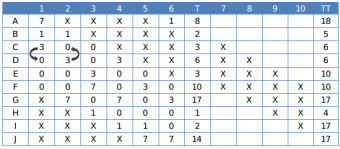

 The information known about Rounds 1 through 6: