
ENGLISH LITERATURE CLASS 12TH QUESTION PAPER 2020 (ISC)

ENGLISH PAPER-2 

LITERATURE IN ENGLISH 

SECTION A 

THE TEMPEST ⎯ Shakespeare 

Q. 1 Choose two of the passages (a) to (c) and answer briefly the questions that follow: 

(a) Prospero : 

This blue-eyed hag was hither brought with child, 

And here was left by th’ sailors. Thou, my slave, 

As thou report’s thyself, was then her servant, 

And for thou wast a spirit too delicate 

To act her earthy and abhorr’d commands, 

Refusing her grand hests, she did confine thee, 

By help of her more potent ministers 

And in her most unmitigable rage, 

Into a cloven pine….. 

(i) What leads Prospero to talk about the ‘blue-eyed hag’? 

(ii) Why was she brought to this island?

(iii) What account do we get of Ariel’s suffering in the cloven pine? Who had saved him and how? 

(iv) How does Prospero describe the hag’s son? 

(v) What does Prospero threaten to do to Ariel now? What effect does his threat have on Ariel? 

(vi) Give the meanings of the following words in the context of the passage: 

                     abhorr’d,                cloven  

(b) Caliban : 

I prithee let me bring thee where crabs grow, 

And I with my long nails will dig thee pig-nuts, 

Show thee a jay’s nest, and instruct thee how 

To snare the nimble marmoset. I’ll bring thee 

To clustering filberts, and sometimes I’ll get thee 

Young scamels from the rock. Wilt thou go with me? 

(i) To whom is Caliban speaking these lines? 

(ii) Briefly describe the circumstance under which he had met them. 

(iii) Who does he think they are? Why? 

(iv) To which other person had Caliban shown such a slavish attitude? What had the result been? 

(v) How do his present listeners respond to his words? 

(vi) Give the meanings of the following words as they are used in the context of the passage:  

            Snare,             marmoset  

(c) Ariel      :Thy thoughts I cleave to. What’s thy pleasure? 

    Prospero  : Spirit, we must prepare to meet with Caliban. 

    Ariel        : Ay, my commander. When I presented Ceres 

                     I thought to have told thee of it, but I fear’d 

                     Lest I might anger thee. 

Prospero : Say again, where didst thou leave these varlets? 

(i) For whom is the term varlets being used? 

(ii) What comical behaviour of theirs does Ariel narrate now? 

(iii) Where had these people been going? Why? 

(iv) Where did Ariel leave them eventually? What did they do then? 

(v) What does Prospero tell Ariel to do? Why? 

(vi) Give the meaning of the following words as they are used in the context of the passage: 

               cleave,                    varlets  

CANDIDA ⎯ George Bernard Shaw 

Q. 2 Choose two of the passages (a) to (c) and answer briefly the questions which follow: 

(a) Morell : (thoughtfully) Hm! Time for him to take another look at  Candida before she grows out of his knowledge. (He resigns himself to the inevitable, and goes out). 

Lexy looks after him with beaming worship.  Miss Garnett, not being able to shake Lexy, relieves her  feelings by worrying the typewriter. 

Lexy : What a good man! What a thorough loving soul he is!  (He takes Morell’s place at the table, making himself  very comfortable as he takes out a cigaret). 

Proserpine : (impatiently, pulling the letter she has been working at  off the typewriter and folding it) Oh, a man ought to be able to be fond of his wife without making a fool of  himself about her. 

Lexy : (shocked) Oh, Miss Prossy! 

(i) Who is Morell talking about? How does he react when he gets to know about the arrival of this person? 

(ii) What advice has Morell given Lexy about marriage? 

(iii) What does Proserpine say further to express her displeasure? 

(iv) When Lexy expresses unhappiness at Proserpine’s feelings against Candida,  How does Prossy defend herself? 

(v) Judging by Lexy’s disbelief, how does Proserpine condemn men’s ideas about women? 

(vi) How does Lexy voice his regret then?

(b) Marchbanks : 

(stopping her mysteriously) Hush! I go about in search  of love; and I find it in unmeasured stores in the bosoms  of others. But when I try to ask for it, this horrible  shyness strangles me; and I stand dumb, or worse than  dumb, saying meaningless things: foolish lies. And I see  the affection I am longing for given to dogs and cats and  pet birds, because they come and ask for it. (Almost  whispering) It must be asked for: it is like a ghost: it  cannot speak unless it is first spoken to. (At his usual  pitch, but with deep melancholy) All the love in the  world is longing to speak; only it dare not, because it is  shy! shy! shy! That is the world’s tragedy. (With a deep  sigh, he sits in the visitors’ chair and buries his face in his hands.) 

Proserpine : (amazed, but keeping her wits about her: her point of  honor in encounters with strange young men) Wicked people get over that shyness occasionally, don’t they? 

(i) Where are Marchbanks and Proserpine? 

(ii) How does Marchbanks offend Proserpine? 

(iii) What are Marchbanks’ ideas of love? 

(iv) What is ‘like a ghost’? Why has he used this reference? 

(v) What does Marchbanks tell about his shyness to Proserpine? 

(vi) Does Marchbanks agree with Proserpine when she says that wicked people  do not feel shy? 

(c) Marchbanks : [Convulsively]

Candida : Yes, onions. Not even Spanish ones: nasty little  red onions. You shall help me to slice them.Come  along. 

                  [She catches him by the wrist and runs out, pulling him after her. Burgess rises in  

                   consternation, and stands aghast on the hearth-rug,  staring after them.] 

      Burgess : Candy didnt oughter andle a hearl’s nevvy like that. Its going too fur with it.

(i) Why is Marchbanks disgusted by the onions? 

(ii) Why had he been similarly agitated a little earlier? 

(iii) How had Candida responded then? 

(iv) Why is Burgess shocked? 

(v) What does he get to know about Marchbanks soon? 

(vi) Why does Morell appear disinterested? 

SECTION B 

(Answer four questions on at least three textbooks which may include EITHER The Tempest OR Candida.) 

THE TEMPEST ⎯ Shakespeare 

Q. 3 Referring closely to Act IV, scene i: 

(a) Describe the blessings showered by Ceres and Iris on Miranda and Ferdinand.  

What is the significance of these blessings? 

(b) What did Prospero tell Ferdinand just before the masque? What did he emphasize and how did Ferdinand answer him? 

(c) What do you conclude about Prospero from the events that occur in the act?


Q. 4 Prospero refers to Caliban as “A devil, a born devil”. In this context, evaluate the  character and role of Caliban in the play. 

CANDIDA ⎯ George Bernard Shaw 

Q. 5 Referring closely to Act III of the play Candida

(a) Describe the conflict between Marchbanks and Morell regarding Candida.

(b) Describe the auction that Candida initiates. Why do you think she terms it an auction? 

(c) What is the reason for the choice made by her at the end of the play? 


Q. 6 In the play Candida, Shaw presents Candida as an unconventional woman. Discuss. 

THINGS FALL APART ⎯ Achebe 

Q. 7 Referring closely to the events, answer the following: 

(a) How is the Church established and what is the role of the white men in establishing it? 

(b) Why does Nwoyi secretly become attracted to the religion of the missionaries? What was his father’s reaction? 

(c) Which circumstances had led to the suicide of Okonkwo?


Q. 8 How is the story about why mosquitoes buzz around people’s ears relevant to the novel? 


Q. 9 “His whole life was dominated by fear of failure and of weakness.” Do you think this is  true of Okonkwo? Give your views with reference to the novel. 

CONTEMPLATIONS 

Q. 10 Referring closely to the essay ‘My Visions of India’, answer the following: 

(a) Relate the first and second vision of Dr. Kalam. 

(b) What does he say about his third vision?

(c) How does Dr. Kalam co-relate his message with the message of J. F. Kennedy?


Q. 11 Referring closely to the essay On being Idle, discuss how the writer treats a light subject  with a serious message. 

Q. 12 In the essay On the Decay of The Art of Lying, what makes Mark Twain argue that  “the Lie, as a Virtue, A Principle, is eternal”? According to Mark Twain, what is a silent  lie? What example does he give to demonstrate a silent lie? Why does he oppose injurious  truth and injurious lying?

ECHOES 

Q. 13  Referring closely to the short story B. Wordsworth: 

(a) Describe the interaction between B. Wordsworth and the young narrator. 

(b) What did the narrator learn from his friend? 

(c) Do you feel that B. Wordsworth was an escapist? Give reasons for your answer. 


Q. 14 How does Roald Dahl depict the theme of obsession in his short story, The Sound  Machine? 

Q. 15 How successful was the writer in bringing out the protagonist’s innate goodness in the  short story, Salvatore? 

REVERIE 

Q. 16 Referring closely to the poem Dover Beach

(a) Describe the moonlit scene described by the poet at the beginning of the poem.

(b) How does the poet introduce the note of melancholy and disturbance? In this context, what does he say about Faith? 

(c) What does the poet say about the world in which he finds himself? What is the only hope left for mankind? 


Q. 17 How is the power of the Music Makers brought out in We are the Music Makers? 

Q. 18 The poem John Brown presents two attitudes to war. Describe the two attitudes. Which  one do you sympathise with? Why?
ENGLISH LANGUAGE CLASS 12TH QUESTION PAPER 2020 (ISC)

ENGLISH PAPER -1 

(LANGUAGE) 

Q.1 Write a composition (in approximately 400 – 450 words) on any one of the following subjects: 

(You are reminded that you will be rewarded for orderly and coherent presentation of  material, use of appropriate style and general accuracy of spelling, punctuation and  grammar.) 

(a) Recently, you travelled to a place you found peaceful and rewarding. Describe the  place, the weather, the people and the local activities that make this destination  particularly attractive. 

(b) Narrate an experience when you took on a responsibility in your school that you  usually would not, and you were pleasantly surprised at the outcome. 

(c) “If winter comes, can spring be far behind?” Express your views on this statement. 

(d) Solitude. 

(e) Students should be allowed to use electronic gadgets in the classroom. Argue for  or against this proposition. 

(f) Write an original short story that begins with the line: 

The lone young man who sat hunched on the park bench had an unusual gleam in  his eyes.

Q. 2 (a) As the Secretary of the Creative Arts Club of XYZ School, you organised an  inter-school drama competition. Write a report for the school magazine in not more  than 300 words, detailing the success of the event based on the following points: 

Date, time and place – objective of the event – inauguration – schools involved – judges invited – response of participants – reaction of audience – plan for similar  events in future.  

(b) As a member of the Student Council, you have been given the responsibility of  arranging for a career guidance workshop. Write a proposal in not more than  150 words, stating the steps you would take to make the workshop a success. 


Q. 3 Answer sections (a), (b) and (c). 

(a) In each of the following items, sentence A is complete, while sentence B is not.  

Complete sentence B, making it as similar as possible to sentence A. Write  sentence B in each case.  

Example:  

(0) (A) As soon as the bell rings, the children run out to play. 

(B) No sooner……..……………………………… 

Answer: (0) No sooner does the bell ring than the children run out to play.

1 – (A) When he returned, we asked him many questions. 

(B) On his………. ………………………….. 

2 – (A) He arrived and the crowd went hysterical with joy. 

(B) Scarcely……………………………………. 

3 – (A) The bus service has been interrupted by floods. 

(B) Floods………………………………………. 

4 – (A) This scenery is breath-taking. 

(B) How…………………………………………. 

5 – (A) You are entitled to a discount as long as the offer lasts. 

(B) So long….…………………………………… 

6 – (A) He is so tall that he cannot enter through this door. 

(B) He is too……………………………………… 

7 – (A) The doctor said to him, “Drink at least three litres of water every day.” 

(B) The doctor advised……………………………

8 – (A) Sunita is the best debater in our team. 

(B) No other……………………………………….. 

9 – (A) Not only did he score a century but also took three important  wickets. 

(B) Besides………………………………………… 

10 – (A) I am sorry I am unable to accompany you. 

(B) I regret my .…………………………………… 

(b) Fill in each blank with a suitable word. (Do not write the sentence.) 

1- The antique furniture was sold ____________ an auction. 

2- The tickets were sold _____________ within an hour. 

3- I realized I had walked __________ a trap, but it was too late. 

4- She had walked ___________ two hours before she realized she was lost.

5- Can he take _________ the additional responsibility? 

6- She takes _________ her mother in all her mannerisms. 

7- Neha turned _________ a new leaf after the incident. 

8- I did not expect so many people to turn _________ for the conference.

9- The students brought___________ the first issue of their magazine. 

10- Mowgli was brought _________ by wolves in the jungle. 

(c) Fill in the blanks in the passage given below with the appropriate form of the verb given in brackets. Do not write the passage but write the verbs in the correct order. 

When Albert Einstein ___________(1)(be) three years old, his parents  ________(2)(be) very worried. He __________(3)(seem) intelligent, but had not  spoken a single word. They _________(4)(take) him to many doctors who  ___________(5)(say) that they_________(6)(find) nothing wrong with the child.  One day, at the dinner table, Albert suddenly said, “The soup __________(7)(be) too hot.” The shocked parents _______(8)(ask) him why he ________(9)(remain)  silent for so long. The young child solemnly replied, “Everything  __________(10)(be) in order until now.” 

Q. 4 Read the passage given below and answer the questions (a), (b) and (c) that  follow: 

(1) My job as the District Veterinarian in Darrowby, Yorkshire has thrown up some  interesting moments. I was driving up to Pawson’s sheep farm one morning,  when I saw this rare sight. 

(2) I suppose it isn’t unusual to see a man pushing a pram in a town, but on a lonely  moorland road this scene merits a second glance. Especially when the pram  contains a large gray dog. I drew up beside them and stopped. 

(3) I looked at the pram, ancient and rusty, and at the big animal sitting upright inside  it. He was a cross-bred greyhound, and he gazed back at me with unruffled  dignity. I couldn’t help but admire his healthy and happy disposition. 

(4) “Nice dog,” I said. 10 (5) “Aye, that’s Jake.” The man smiled, introducing himself as Roddy. 

(6) That same evening, about eight o’clock, the doorbell rang. I answered it and  found Roddy on the front doorstep. Behind him, stood the ubiquitous pram. One  look at the prone dog warned me that something was terribly wrong.  

(7) I threw the door wide open. “Bring him in.”

(8) I grabbed the animal round the middle and we lifted him onto the table. I watched  in disbelief as the huge form lay there. There was no fight for breath, he was  unconscious. His pulse was rapid and feeble, yet he didn’t breathe. 

(9) Understanding the symptoms, I said, “Roddy, he is choking. I’m going to have a  look at his throat.”

(10) I pushed Jake’s jaws apart, depressed his tongue with a forefinger, and shone my  torch into the depths. He was the kind of good-natured dog who offered no  resistance as I prodded around. I shall always be thankful that at that very instant  the dog coughed, opening up the cartilages of the larynx and giving me a glimpse of the cause of all the trouble. There, beyond the drooping epiglottis, I saw for a  25 fleeting moment a smooth round object no bigger than a pea. 

(11) “I think it’s a pebble,” I gasped. “Right inside his larynx. I’ll have to get it out.” 

(12) I seized a pair of scissors and clipped away the hair from the ventral surface of the larynx. I dared not use a general anesthetic, and therefore I infiltrated the area locals before swabbing with antiseptic. 

(13) “Hold his head steady,” I said hoarsely, and gripped a scalpel. I cut down through  skin, fascia, and the thin layers of the muscle until the ventral surface of the  larynx was revealed. 

(14) And there it was. A pebble right enough―gray and glistening and tiny, but big  enough to kill. 

(15) I had to fish it out quickly and cleanly without pushing it into the trachea. I  leaned back and rummaged in the tray until I found some broad-bladed forceps,  then I poised them over the wound. Great surgeons’ hands, I felt sure, didn’t  shake like this. 

(16) I clenched my teeth, introduced the forceps, and my hand magically steadied as I  clamped them over the pebble. 

(17) I didn’t breathe at all as I bore the shining little object slowly and tenderly  through the opening and dropped it with a gentle rat-tat on the table. 

(18) “Is that it?” asked Roddy, almost in a whisper. 

(19) “That’s it.” I reached for a needle and suture silk. “All is well now.”

(20) The stitching took only a few minutes and by the end of it, Jake was bright-eyed  and alert, paws shifting impatiently, ready for anything.  

(21) He seemed to know his troubles were over.  

Adapted from: James Herriot’s Favorite Dog Stories 

(a) (i) Given below are four words and phrases. Find the words which have a  similar meaning in the passage: 

(1) deserves 

(2) undisturbed 

(3) being unable to breathe 

(4) wet and shining 

(ii) For each of the words given below, write a sentence of at least ten words using the same word unchanged in form, but with a different meaning from that which it carries in the passage: 

(1) middle (line 16

(2) wound (line 38

(3) introduced (line 40

(4) well (line 45)

(b) Answer the following questions in your own words as briefly as possible: (i) What was unusual about the pram on the moorland road? 

(ii) How did the narrator know that the dog was choking? 

(iii) Describe how the narrator found the cause of the choking? 

(iv) What preparations did the narrator make before the surgery? 

(c) Summarise how the narrator removed the pebble and saved Jake’s life.  

(Paragraphs 11 to 19). You are required to write the summary in the form of a  connected passage in about 100 words. Failure to keep within the word limit will  be penalised.

Latest Current Affairs 01 April 2021

CURRENT AFFAIRS
01 April 2021

NATIONAL NEWS:

A) Mamata writes to 14 Opposition parties on Delhi NCT Bill, says BJP wants to establish ‘one-party authoritarian rule’

The BJP wants to establish a one-party authoritarian rule in India, reducing state governments to mere municipalities, West Bengal Chief Minister Mamata Banerjee said in a letter to heads of 14 opposition parties. She has urged them to come together to counter the BJP after the ongoing assembly polls. She has written to Congress President Sonia Gandhi, NCP chief Sharad Pawar, DMK President M K Stalin, Samajwadi Party President Akhilesh Yadav, RJD leader Tejashwi Yadav, Shiv Sena leader and Maharashtra Chief Minister Uddhav Tackeray, among others. In her three page letter, Banerjee expressed concern about the series of assaults by the BJP and the union government on democracy and Constitutional Federalism in the context of recent passage of the National Capital Territory of Delhi (Amendment) Bill by the two houses of Parliament. With this law, all policy decisions taken by the elected Delhi government have to be cleared by Lt Governor, who is nominated by the Centre, before implementation. The National Capital Territory of Delhi (Amendment) Act is a direct attack on the federal structure of the Indian republic as enshrined in the Constitution. It also makes a mockery of the letter and spirit of democracy since it disempowers the people of the national capital,” Banerjee wrote. This legislation, she wrote, also violates the Supreme Court judgement of 2018, which upheld the pre-eminence of Delhi’s elected government in all matters other than police, public order and land.

B) Supreme Court panel on farm laws submits report.

A Supreme Court-appointed panel has submitted its report on the three agricultural reform laws in a closed cover. The report will be revealed during the next hearing of the case. They submitted the report in a sealed envelope to the registrar of the court on March 19. It will be made public on the date of the next hearing of the PIL, said Anil Ghanwat, one of the members of the committee who also heads a farm union and has advocated in favour of the laws. Asked about the stakeholders consulted by the committee and their views on the laws, Ghanwat said that their role is over now. They are not authorised to say anything about it before it is made public. The three laws which were passed by Parliament in September and are being opposed by farmers’ unions are The Farmers’ Produce Trade and Commerce (Promotion and Facilitation) Act, The Essential Commodities (Amendment) Act and The Farmers (Empowerment and Protection) Agreement on Price Assurance and Farm Services Act. On January 12, the Supreme Court suspended the implementation of the three laws and appointed a four-member committee of experts to listen to the grievances of the farmers on the farm laws and the views of the government and make recommendations.  After one member, farm union leader Bhupinder Singh Mann, recused himself from the panel, the remaining three members met the stakeholders, including farmers’ groups, farmer producer organisations, officials and industry representatives from various States. However, the farm unions refused to meet the panel.

C) Government defers labour codes implementation.

The four labour codes will not come into effect from April 1 as states are yet to finalise the relevant rules, which means that there will be no change in the ‘take home’ pay of employees and provident fund liability of companies for now. Once the wages code comes into force, there will be significant changes in the way basic pay and the provident fund of employees are calculated. Since the states have not finalised the rules under the four codes, the implementation of these laws are deferred for the time being, a source told PTI. Since labour is a concurrent subject under the Constitution of India, both the Centre and the states would have to notify rules under the codes to bring those into force in their respective jurisdictions. Under the new wages code, allowances are capped at 50%. This means half of the gross pay of an employee would be basic wages. Provident fund contribution is calculated as a percentage of basic wage, which includes basic pay and dearness allowance. The employers have been splitting wages into numerous allowances to keep basic wages low to reduce provident fund and income tax outgo. The new wages code provides for provident fund contribution as a prescribed proportion of 50% of gross pay. In case the new codes had come into effect from April 1, the ‘take home’ pay of employees and provident fund liability of employers would have increased in many cases. Now the employer would get some more time to restructure salaries of their employees as per the new code on wages.

D) World Bank projects India’s growth in 2021-22 at 10.1%.

India’s economy is expected to grow at 10.1% for the year starting April 1, 2021, as the vaccine roll-out drives activity in contact-intensive sectors, as per the World Bank’s South Asia Economic Focus South Asia Vaccinates report. However, given the significant uncertainty around epidemiological and policy factors, real GDP growth could range from 7.5% to 12.5%, stabilising at 6-7% in the medium term, it said. It is not normal to talk about these wide ranges in the forecast, Hans Timmer, Chief Economist for the World Bank’s South Asia region, said on a briefing call with reporters. The reason is that we are really in unprecedented circumstances, he said. GDP had been difficult to forecast due to the size of the hit and also its nature. The normal rules of extrapolation were not usable at the moment, Timmer said. The fiscal year ending March 31 2021, is expected to register the worst economic damage due to the pandemic, the report says (the economy contracted 8.5% in FY20-21 as per the World Bank’s estimate).


E) Covid Watch: Numbers and Developments.

The number of reported coronavirus cases from India stood at 1,22,13,561 with the death toll at 1,64,291. India on Wednesday reported 354 deaths in the last 24 hours, the highest since December 17 when 355 Covid-19 fatalities were reported in a single day. This is also the highest single-day spike in casualties this year. According to the Health Ministry, six States account for 82.20% of the new deaths with Maharashtra registering the highest (139) followed by Punjab (64 daily deaths). Meanwhile, the Tamil Nadu government, which extended the Covid-19 lockdown across the state with existing restrictions and relaxations till April 30, has allowed local authorities to impose fresh restrictions to contain the spread of the pandemic in their respective areas. “Based on their assessment of the situation, local restrictions at district/sub-district and city/ward level, with a view to contain the spread of Covid-19 shall be imposed,” Chief Secretary Rajeev Ranjan said in a G.O. issued in this regard on Wednesday. All the District Collectors are to strictly enforce various measures spelt out by the State government, he said and added, For the enforcement of physical distancing, the District Administrations, as far as possible, use the provisions of Section 144 of the Criminal Procedure Code (CrPC) of 1973.

INTERNATIONAL NEWS 

A) Pakistan allows import of cotton, sugar from India.

Partially reversing a two-year old decision to suspend all trade with India, Pakistan announced on Monday that it would allow the import of cotton and sugar from across the border. The decision follows the Line of Control (LoC) ceasefire announced by India and Pakistan in February, and a number of moves seen as part of a larger dialogue process to de-freeze ties. Addressing the media at the end of a Cabinet meeting that cleared the two proposals from Pakistan’s Commerce Ministry, Pakistan’s newly appointed Finance Minister Hammad Azhar said, however, that the decision was driven by rising prices and Pakistani industry’s need for the specific products. The decision to cancel trade was taken by the Imran Khan government on August 9, 2019, days after the government amended Article 370 and reorganised Jammu and Kashmir. India’s Ministry of External Affairs did not respond to the development, nor did it respond to questions on whether it was considering any complimentary steps. While India had not banned trade with Pakistan, it suspended cross-LoC trade and withdrew Most Favoured Nation (MFN) status to Pakistan in the wake of the amended Article 370 and reorganised Jammu and Kashmir. Experts said that the move by Pakistan, which follows the granting of sports-related visas by India after a gap of three years, scheduling a much-delayed meeting of the Indus Water Commissioners in Delhi in March, peace at the LoC after more than 5,000 ceasefire violations last year, as well as the exchange of salutary messages between Prime Minister Narendra Modi and PM Khan, has raised hopes for further measures.

B) Brazil military chiefs quit after Bolsonaro fires Defence Minister. 

The leaders of all three branches of Brazil’s armed forces jointly resigned on Tuesday following President Jair Bolsonaro’s replacement of the Defence Minister, causing widespread apprehension of a military shakeup to serve the President’s political interests. The Defence Ministry reported the resignations apparently unprecedented since at least the end of military rule 36 years ago. Replacements were not named. But analysts exe pressed fears the President, increasingly under pressure, was moving to assert greater control over the military. Since 1985, they haven’t had news of such clear intervention of the President with regard to the armed forces, said Carlos Melo, a political science professor at Insper University in Sao Paulo. Mr. Bolsonaro, a conservative former Army captain who has often praised Brazil’s former military dictatorship, has relied heavily on current and former soldiers to staff key Cabinet positions since taking office in January 2019, but Mr. Melo said the military itself has so far refrained from politics. The announcement came after the heads of the Army, Navy and Air force met with the new Defence Minister, General Walter Souza Braga Netto, on Tuesday morning. Gen. Braga Netto’s first statement on the new job showed he is aligned with Mr. Bolsonaro’s views for the armed forces. The incoming Defence Minister, unlike his predecessor Fernando Azevedoe Silva, celebrated the 1964-1985 military dictatorship that killed and tortured thousands of Brazilians. The 1964 movement is part of Brazil’s historic trajectory. And as such the events of that March 31st must be understood and celebrated. Mr. Bolsonaro on Monday carried out a shake-up of top Cabinet positions that was initially seen as a response to demands for a course correction over his handling of the pandemic that has caused over deaths.

ARTS CLASS 10TH QUESTION PAPER 2020 (ICSE)

ART 

PAPER 1 

Drawing or Painting from Still Life 

Note: Two themes are given. 

Candidates may attempt either Theme A or Theme B.

EITHER  

Theme A 

Objects required: A big transparent bowl, an apple, a papaya, two bananas, an  orange and a pear. 

Arrangement: Make an interesting arrangement by placing a few fruits inside the  bowl and a few in front of the bowl.  Suitable drapery may be used for the background and foreground. 

OR 

Theme B 

Objects required: Two Samosas, a few green chillies, a big bottle of ketchup / tomato sauce, transparent tea glass with tea in it, a medium size plate and a few tissue papers. 

Arrangement: Create an attractive arrangement by placing a plate with the samosas and green chillies in front of the tomato sauce / ketchup bottle. Place a few tissue papers partially under the plate. Arrange a tea glass suitably. Coloured drapery may be used.

ART 

PAPER 2 

Drawing or Painting from Nature 

This Paper is divided into two Themes. 

Candidates may attempt the question either from Theme A or Theme B. 

EITHER  

Theme A 

A detailed study of an ‘Onion’ half cut from center. Two pieces should be kept so  that the outer and inner study of a specimen can be depicted. Special attention should be paid to colour, texture, form and structure. 

OR 

Theme B 

A healthy stem of Bougainvillea with flowers and leaves to be given to the  students. Special attention to be paid to the character of flowers and leaves through  form, structure, tone, colour and texture. In case this flower is not available, a  similar flower of the variegated kind can be used.

ART 

PAPER 3 

Original Imaginative Composition in Colour 

Attempt any one of the following topics:

 1. Depict a laundry shop. A man is ironing with a heavy iron. A radio is on. A lady  is folding and stacking clothes. A child is playing. Water mugs and hangers are  left unattended on the ground. 

2. A few ladies are sitting under a huge tree. A mother is combing her daughter’s  hair. The other ladies are busy doing other work.

3. Examinations are approaching soon. Students are visiting the school library.  Some are referring to books, studying and making notes. The librarian is keeping  an eye on all of them. 

4. Compose an early morning scene. The sweepers are cleaning the roads. A few  walkers and joggers are seen. The newspaper delivery boy is on a cycle flinging  rolled up newspapers into the front of each house, as he rides by.

ART 

PAPER 4 

Applied Art 

Attempt any one of the following questions: 

1. Design a book cover for your Grandma’s recipes. The cover title is ‘My Grandma’s Kitchen’. Use only four colours (paper white is  not considered as a colour). The size of the cover page should be  20 cm x 25 cm. 

OR 

2. Make a repeat pattern for a door panel of size 20 cm x 25 cm. Special attention should be given to creative design with good colour  scheme, tone and execution. 

Note: 

• Cutting and pasting of extra material is strictly prohibited. 

• Sequins, thread or magazine images must not be used. 

• Candidates should not use acrylic colours for making the poster.

PHYSICS CLASS 10TH QUESTION PAPER 2020 (ICSE)

PHYSICS 

SCIENCE Paper – 1 

SECTION I 

Q. 1 (a) (i) Define moment of force.  

     (ii) Write the relationship between the SI and CGS unit of moment of force. 

(b) Define a kilowatt hour. How is it related to joule? 

(c) A satellite revolves around a planet in a circular orbit. What is the work done by the satellite at any instant? Give a reason. 

(d) (i) Identify the class of the lever shown in the diagram below: 

     (ii) How is it possible to increase the M.A. of the above lever without increasing  its length? 

(e) Give one example of each when: 

     (i) Chemical energy changes into electrical energy. 

    (ii) Electrical energy changes into sound energy. 


Q. 2 (a) A crane ‘A’ lifts a heavy load in 5 seconds, whereas another crane ‘B’ does the same work in 2 seconds. Compare the power of crane ‘A’ to that of crane ‘B’.

(b) A ray of light falls normally on a rectangular glass slab. Draw a ray diagram showing the path of the ray till it emerges out of the slab. 

(c) Complete the path of the monochromatic light ray AB incident on the surface PQ of the equilateral glass prism PQR till it emerges out of the prism due to  refraction. 

(d) Where should an object be placed in front of a convex lens in order to get:  

   (i) an enlarged real image 

   (ii) enlarged virtual image? 

(e) A pond appears to be 2.7 m deep. If the refractive index of water is 4/3 , find the actual depth of the pond. 


Q. 3 (a) The wave lengths for the light of red and blue colours are nearly 7.8 x 10⁻⁷ m and 4.8 x 10⁻⁷ m respectively. 

  (i) Which colour has the greater speed in a vacuum? 

 (ii) Which colour has a greater speed in glass? 

(b) Draw a graph between displacement from mean position and time for a body executing free vibration in a vacuum. 

(c) A sound wave travelling in water has wavelength 0.4 m. Is this wave audible in air? (The speed of sound in water = 1400 ms-1

(d) Why does stone lying in the sun get heated up much more than water lying for the same duration of time? 

(e) Why is it not advisable to use a piece of copper wire as fuse wire in an electric circuit? 


Q. 4 (a) Calculate the total resistance across AB:

(b) Two metallic blocks P and Q having masses in ratio 2:1 are supplied with the same amount of heat. If their temperatures rise by same degree, compare their  specific heat capacities. 

(c) When a current carrying conductor is placed in a magnetic field, it experiences a mechanical force. What should be the angle between the magnetic field and  the length of the conductor so that the force experienced is: 

   (i) Zero 

  (ii) Maximum? 

(d) A nucleus 84X202 of an element emits an alpha particle followed by a beta  

      particle. The final nucleus is aYb. Find a and b. 

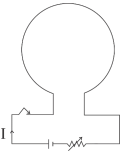
(e) The diagram below shows a loop of wire carrying current I:

(i) What is the magnetic polarity of the loop that faces us? 

(ii) With respect to the diagram how can we increase the strength of the magnetic field produced by this loop? 

SECTION II 

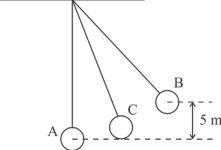
Q. 5 (a) The figure below shows a simple pendulum of mass 200 g. It is displaced from the mean position A to the extreme position B. The potential energy at the  position A is zero. At the position B the pendulum bob is raised by 5 m. 

     (i) What is the potential energy of the pendulum at the position B? 

    (ii) What is the total mechanical energy at point C? 

    (iii) What is the speed of the bob at the position A when released from B? 

            (Take g = 10 ms-2 and there is no loss of energy.) 

(b) (i) With reference to the direction of action, how does a centripetal force differ from a centrifugal force during uniform circular motion? 

     (ii) Is centrifugal force the force of reaction of centripetal force? 

     (iii) Compare the magnitudes of centripetal and centrifugal force. 

(c) A block and tackle system of pulleys has velocity ratio 4. 

    (i) Draw a neat labelled diagram of the system indicating clearly the points of  application and direction of load and effort. 

   (ii) What will be its V.R. if the weight of the movable block is doubled? 


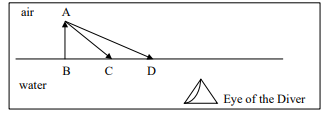
Q. 6 (a) A diver in water looks obliquely at an object AB in air.  

     (i) Does the object appear taller, shorter or of the same size to the diver? 

    (ii) Show the path of two rays AC & AD starting from the tip of the object as it  travels towards the diver in water and hence obtain the image of the object. 

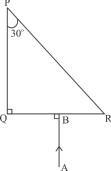
(b) Complete the path of the ray AB through the glass prism in PQR till it emerges out of the prism. Given the critical angle of the glass as 42o

(c) A lens of focal length 20 cm forms an inverted image at a distance 60 cm from the lens. 

    (i) Identify the lens. 

   (ii) How far is the lens present in front of the object? 

  (iii) Calculate the magnification of the image. 


Q. 7 (a) Give reasons for the following: During the day: 

    (i) Clouds appear white. 

    (ii) Sky appears blue. 

(b) (i) Name the system which enables us to locate underwater objects by transmitting ultrasonic waves and detecting the reflecting impulse. 

     (ii) What are acoustically measurable quantities related to pitch and loudness? 

(c) (i) When a tuning fork [vibrating] is held close to ear, one hears a faint hum. The same [vibrating tuning fork] is held such that its stem is in contact with the table surface, then one hears a loud sound. Explain. 

(ii) A man standing in front of a vertical cliff fires a gun. He hears the echo     after 3.5 seconds. On moving closer to the cliff by 84 m, he hears the echo  after 3 seconds. Calculate the distance of the cliff from the initial position  of the man. 


Q. 8 (a) The diagram below shows the core of a transformer and its input and output  connections 

  (i) State the material used for the core. 

  (ii) Copy and complete the diagram of the transformer by drawing input and output coils.  

(b) (i) What are superconductors?  

     (ii) Calculate the current drawn by an appliance rated 110 W, 220 V when connected across 220 V supply.

  (iii) Name a substance whose resistance decreases with the increase in  temperature.

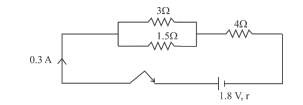
(c) The diagram above shows three resistors connected across a cell of e.m.f.  1.8 V and internal resistance r.

Calculate: 

    (i) Current through 3 Ω resistor. 

    (ii) The internal resistance r. 


Q. 9  (a) (i) Define heat capacity of a substance.  

     (ii) Write the SI unit of heat capacity. 

    (iii) What is the relationship between heat capacity and specific heat capacity of a substance? 

(b) The diagram below shows the change of phases of a substance on a temperature vs time graph on heating the substance at a constant rate. 

     (i) Why is the slope of CD less than slope of AB? 

     (ii) What is the boiling and melting point of the substance? 

(c) A piece of ice of mass 60 g is dropped into 140 g of water at 50oC.  Calculate the final temperature of water when all the ice has melted. (Assume no heat is lost to the surrounding) 

Specific heat capacity of water = 4.2 Jg-1k-1 

Specific latent heat of fusion of ice = 336 Jg-1 


Q. 10 (a) (i) Draw a neat labeled diagram of a d.c. motor.  

     (ii) Write any one use of a d.c. motor. 

(b) (i) Differentiate between nuclear fusion and nuclear fission. 

     (ii) State one safety precaution in the disposal of nuclear waste. 

(c) An atomic nucleus A is composed of 84 protons and 128 neutrons. The nucleus A emits an alpha particle and is transformed into a nucleus B.  

    (i) What is the composition of B? 

    (ii) The nucleus B emits a beta particle and is transformed into a nucleus C. What is the composition of C? 

   (iii) What is mass number of the nucleus A? 

   (iv) Does the composition of C change if it emits gamma radiations? 

CHEMISTRY CLASS 10TH QUESTION PAPER 2020 (ICSE)

CHEMISTRY 

SCIENCE

 Paper – 2 

Q. 1 (a) Choose the correct answer from the options given below:  

  (i) The element with highest ionization potential, is: 

  A. Hydrogen 

  B. Caesium 

  C. Radon 

  D. Helium  

 (ii) The inert electrode used in the electrolysis of acidified water, is: 

 A. Nickel  

 B. Platinum 

 C. Copper 

 D. Silver 

 (iii) A compound with low boiling point, is: 

 A. Sodium chloride 

 B. Calcium chloride 

 C. Potassium chloride 

 D. Carbon tetrachloride 

 (iv) The acid which can produce carbon from cane sugar, is: 

 A. Concentrated Hydrochloric acid 

 B. Concentrated Nitric acid 

 C. Concentrated Sulphuric acid 

 D. Concentrated Acetic acid 

 (v) The organic compound having a triple carbon-carbon covalent bond, is: 

 A. C3H4 

 B. C3H6 

 C. C3H8 

 D. C4H10 

(b) State one relevant observation for each of the following reactions:  

   (i) Action of concentrated nitric acid on copper.  

  (ii) Addition of excess ammonium hydroxide into copper sulphate solution. 

  (iii) A piece of sodium metal is put into ethanol at room temperature. 

  (iv) Zinc carbonate is heated strongly. 

  (v) Sulphide ore is added to a tank containing oil and water, and then stirred  or agitated with air.

(c) Write a balanced chemical equation for each of the following:  

  (i) Reaction of carbon powder and concentrated nitric acid. 

  (ii) Reaction of excess ammonia with chlorine. 

  (iii) Reaction of lead nitrate solution with ammonium hydroxide. 

  (iv) Producing ethane from bromo ethane using Zn / Cu couple in alcohol. 

   (v) Complete combustion of ethane. 

(d) (i) Draw the structural formula for each of the following:  

     1. 2,2 dimethyl pentane 

     2. methanol 

     3. Iso propane 

    (ii) Write the IUPAC name for the following compounds:  

    1. acetaldehyde 

    2. acetylene 

(e) State one relevant reason for each of the following:  

    (i) Graphite anode is preferred to platinum in the electrolysis of molten lead bromide. 

   (ii) Soda lime is preferred to sodium hydroxide in the laboratory preparation  of methane. 

  (iii) Hydrated copper sulphate crystals turn white on heating. 

  (iv) Concentrated nitric acid appears yellow, when it is left for a while in a  glass bottle. 

    (v) Hydrogen chloride gas fumes in moist air. 

(f) Calculate:  

    (i) The amount of each reactant required to produce 750 ml of carbon  dioxide, when two volumes of carbon monoxide combine with one  volume of oxygen to produce two volumes of carbon dioxide. 

                             2CO + O2 → 2CO2 

    (ii) The volume occupied by 80 g of carbon dioxide at STP. 

    (iii) Calculate the number of molecules in 4.4 gm of CO2. 

           [Atomic mass of C= 12, O=16] 

    (iv) State the law associated in Q. no. (f)(i) above. 

(g) Give one word or a phrase for the following statements: 

     (i) The chemical bond formed by a shared pair of electrons, each bonding atom contributing one electron to the pair. 

    (ii) Electrode used as cathode in electrorefining of impure copper. 

    (iii) The substance prepared by adding other metals to a base metal in appropriate proportions to obtain certain desirable properties.  

   (iv) The tendency of an atom to attract electrons to itself when combined in a compound.  

   (v) The reaction in which carboxylic acid reacts with alcohol in the presence of conc. H2SO4 to form a substance having a fruity smell. 

(h) Fill in the blanks from the choices given in brackets: 

    (i) The polar covalent compound in gaseous state that does not conduct electricity is __________.  

          (carbon tetra chloride, ammonia, methane) 

  (ii) A salt prepared by displacement reaction is __________.  

        (ferric chloride, ferrous chloride, silver chloride) 

 (iii) The number of moles in 11gm of nitrogen gas is __________.  

        (0.39, 0.49, 0.29) [atomic mass of N=14] 

 (iv) An alkali which completely dissociates into ions is __________.  

      (ammonium hydroxide, calcium hydroxide, lithium hydroxide) 

  (v) An alloy used to make statues is__________.  

        (bronze, brass, fuse metal) 

SECTION II 

Q. 2 (a) The following table represent the elements and the atomic number. 

With reference to this, answer the following using only the alphabets given in the table.  

Element Atomic number
P Q R13 7 10

    (i) Which element combines with hydrogen to form a basic gas? 

    (ii) Which element has an electron affinity zero? 

   (iii) Name the element, which forms an ionic compound with chlorine. 

(b) Draw the electron dot diagram for the compounds given below. Represent the electrons by (.) and (x) in the diagram. 

                          [Atomic No.: Ca = 20, O = 8, Cl = 17, H = 1] 

   (i) Calcium oxide 

   (ii) Chlorine molecule 

   (iii) Water molecule 

(c) Choose the correct word which refers to the process of electrolysis from A to  E, to match the description (i) to (iv):  

         A: Oxidation  B: Cathode  C: Anode  D: An electrolyte  E: Reduction 

   (i) Conducts electricity in aqueous or in molten state. 

  (ii) Loss of electron takes place at anode. 

  (iii) A reducing electrode. 

  (iv) Electrode connected to the positive end or terminal of the battery. 


Q. 3 (a) Baeyer’s process is used to concentrate bauxite ore to alumina. Give balanced chemical equations for the reaction taking place for its conversion from bauxite to alumina. 

(b) Complete the following by selecting the correct option from the choices given:                      

    (i) pH of acetic acid is greater than dilute sulphuric acid. So acetic acid  contains __________ concentration of H+ions. (greater, same, low) 

   (ii) The indicator which does not change colour on passage of HCl gas is   ________. (methyl orange, moist blue litmus, phenolphthalein)  

   (iii) The acid which cannot act as an oxidizing agent is __________.  (conc. H2SO4, conc. HNO3, conc. HCl)

(c) Match the gases given in column I to the identification of the gases mentioned    in column II:  

Column I Column II
(i) Hydrogen sulphide A. Turns acidified potassium dichromate  solution green.
(ii) Nitric oxide B. Turns lime water milky.
(iii) Carbon dioxide C. Turns reddish brown when it reacts with  oxygen.
(iv) Sulphur dioxide D. Turns moist lead acetate paper silvery  black.


Q. 4 (a) Differentiate between the following pairs based on the information given in the brackets. 

   (i) Conductor and electrolyte (conducting particles) 

   (ii) Cations and anions (formation from an atom) 

   (iii) Acid and Alkali (formation of type of ions) 

(b) Draw the structures of isomers of pentane. 

(c) Hydrogen chloride gas is prepared in the laboratory using concentrated       sulphuric acid and sodium chloride. Answer the questions that follow based on  this reaction: 

     (i) Give the balanced chemical equation for the reaction with suitable condition(s) if any. 

    (ii) Why is concentrated sulphuric acid used instead of concentrated nitric  acid? 

    (iii) How is the gas collected?  

    (iv) Name the drying agent not used for drying the gas. 


Q. 5 (a) Distinguish between the following pairs of compounds using a reagent as a chemical test:  

   (i) Calcium nitrate and Zinc nitrate solution. 

   (ii) Ammonium sulphate crystals and Sodium sulphate crystals. 

   (iii) Magnesium chloride and Magnesium nitrate solution. 

(b) Calculate the percentage of: 

     (i) Fluorine  

     (ii) Sodium and 

    (iii) Aluminium  

in sodium aluminium fluoride [Na3AlF6], to the nearest whole number. [Atomic Mass: Na = 23, Al= 27, F= 19]  

(c) (i) State the volume occupied by 40 gm of methane at STP, if its vapour density (V.D.) is 8. 

     (ii) Calculate the number of moles present in 160 gm of NaOH. 

           [Atomic Mass: Na = 23, H= 1, O= 16] 


Q. 6 (a) Identify the salts P, Q, R from the following observations: 

    (i) Salt P has light bluish green colour. On heating, it produces a black  coloured residue. Salt P produces brisk effervescence with dil. HCl and  the gas evolved turns lime water milky, but no action with acidified  potassium dichromate solution.  

   (ii) Salt Q is white in colour. On strong heating, it produces buff yellow  residue and liberates reddish brown gas. Solution of salt Q produces chalky white insoluble precipitate with excess of ammonium hydroxide.  

   (iii) Salt R is black in colour. On reacting with concentrated HCl, it liberates a pungent greenish yellow gas which turns moist starch iodide paper blue black.  

(b) Identify the substance underlined in each of the following: 

    (i) The electrode that increases in mass during the electro-refining of silver.

    (ii) The acid that is a dehydrating as well as a drying agent. 

    (iii) The catalyst used to oxidize ammonia into nitric oxide. 

(c) Copy and complete the following paragraph using the options given in brackets:  

Alkenes are a homologous series of (i) __________ (saturated / unsaturated) hydrocarbons characterized by the general formula (ii) __________  (CnH2n+2     / CnH2n). Alkenes undergo (iii) __________ (addition / substitution)  reactions and also undergo (iv) ________ (hydrogenation / dehydrogenation)  to form alkanes. 


Q. 7  (a) Write balanced chemical equations, for the preparation of the given salts 

(i) to (iii) by using the methods A to C respectively: 

     A: Neutralization             B: Precipitation               C: Titration 

    (i) Copper sulphate 

    (ii) Zinc carbonate 

    (iii) Ammonium sulphate 

(b) Name the following elements: 

     (i) An alkaline earth metal present in group 2 and period 3. 

     (ii) A trivalent metal used to make light tools. 

    (iii) A monovalent non-metal present in fluorspar. 

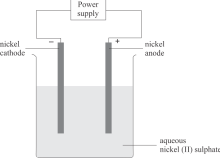
(c) An aqueous solution of nickel (II) sulphate was electrolyzed using nickel electrodes. Observe the diagram and answer the questions that follow: 

     (i) What do you observe at the cathode and anode respectively? 

     (ii) Name the cation that remains as a spectator ion in the solution. 

     (iii) Which equation for the reaction at the anode is correct? 

          1. Ni → Ni2+ + 2e 

          2. Ni + 2e → Ni2+ 

          3. Ni2+ → Ni + 2e 

          4. Ni2+ + 2e → Ni 

×

Hello!

Click one of our representatives below to chat on WhatsApp or send us an email to info@vidhyarthidarpan.com

×