

GEOGRAPHY CLASS 10TH QUESTION PAPER 2018 (ICSE)

GEOGRAPHY 

H.C.G. – Paper – 2 

PART I 

Q. 1 Study the extract of the Survey of India Map sheet No. 45D/7 and answer the following  questions:  

(a) Give the six figure grid reference for: 

     (i) ∆ 268 

    (ii) Temple south east of Khara                                                       

(b) Name the following: 

    (i) The drainage pattern seen in 9185. 

    (ii) The pattern of settlement seen in 9787.  

(c) What do the following symbols mean? 

    (i) 3r in 9089. 

   (ii) 200 in 9383. 

(d) Name two types of vegetation found in the region east of easting 93. 

(e) Give two evidences which suggest that the rainfall received in the region shown on the map extract is seasonal. 

(f) Calculate the area of the region between 85 – 90 northing and 90 – 95 easting. Give your answer in kilometer. 

(g) Mention any two manmade features and two natural features in grid square 9080. 

(h) What is the direct distance in kilometers between the surveyed tree west of Rampura (9580) to the chhatri in Juvol (9282)? 

(i) Mention: 

     (i) The most commonly used means of transport in the area shown on the map extract. 

     (ii) The main occupation of the people of the region in the south eastern part of the map extract. 

(j) (i) What is the compass direction of Rampura (9580) from Karja (9781)? 

    (ii) Identify the landform marked by contours in 9782. 


Q. 2 On the outline map of India provided: 

(a) Shade and label Thar desert. 

(b) Label the river Narmada. 

(c) Shade and name the Wular lake. 

(d) Shade and label Kanara coast. 

(e) Mark and name Mount Kanchenjunga.

(f) Shade and label a densely-populated region in India. 

(g) Shade and label a region with Red soil in India. 

(h) Mark with a dot and name Chennai. 

(i) Mark and label the Arabian Sea branch of S.W. Monsoon. 

(j) Mark with a dot and name Singhbhum. 

Index No.……………………………………… UID…………………………………. 

(This map, if used, must be fastened with all other answers) 

                                                               Map of India 

PART II 

Q. 3 (a) How is the winter rainfall of the northwest part of India different from the winter rainfall of the southeast part of India? 

(b) (i) Name a state that is the first to experience the onset of the monsoon.  

     (ii) How does the “Mango shower” influence the state of Karnataka? 

(c) Give a reason for each of the following:  

     (i) Kanyakumari experiences equable climate. 

     (ii) Central Maharashtra gets less rainfall than the coastal area of Maharashtra.

     (iii) Jaipur has a higher annual range of temperature than Mumbai. 

(d) Write three differences between summer monsoon season and retreating monsoon season. 


Q. 4 (a) (i) Why does alluvial soil differ in texture?  

      (ii) State two cash crops that grow well in alluvial soil. 

(b) With reference to black soil answer the following: 

      (i) Name one important crop which grows in this soil. 

      (ii) Give one chemical property of this soil. 

(c) Give one geographical reason for each of the following: 

     (i) Red soil requires irrigation. 

    (ii) Afforestation prevents soil from getting eroded. 

    (iii) Laterite soil is red in colour. 

(d) (i) What is soil erosion? 

    (ii) Mention two causes of soil erosion in India. 


Q. 5 (a) (i) Name an area in India where Tropical Monsoon forest is found. 

     (ii) How is this forest of great commercial value to India? 

(b) With reference to Littoral forest, answer the following questions: 

     (i) Why do the trees in this forest grow aerial roots? 

     (ii) Name one area in India where this forest is found. 

(c) (i) Name a state in India where thorn and scrub forest is found. 

     (ii) Give two ways by which the trees that are found here have adapted to the climate. 

(d) (i) Give two ways in which forests are important. 

     (ii) Mention one forest conservation method followed in India. 


Q. 6 (a) There is plenty of rain in India during the rainy season, yet we need irrigation.    

      Give two reasons to support this statement. 

(b) (i) Name three traditional means of irrigation.  

     (ii) Give a reason why traditional means of irrigation are still important in most parts of India. 

(c) (i) Differentiate between Surface water and Ground water. 

     (ii) Mention two reasons to explain as to why we are facing water scarcity in recent times. 

(d) (i) What is rain water harvesting? 

     (ii) What are the advantages of rain water harvesting? 

     (iii) Name two water harvesting systems practised in India. 


Q. 7 (a) Give two advantages that non-conventional energy sources have over conventional energy sources. 

(b) (i) Mention one advantage of the use of natural gas over coal or petroleum. 

     (ii) Name one off shore oil field of India. 

(c) Answer the following: 

     (i) State one industrial use of copper. 

     (ii) Mention one advantage of generating power from bio-gas. 

     (iii) Name the mineral that toughens steel and makes it rust-proof. 

(d) (i) Name the metal obtained from Bauxite.  

         Give any one use of the metal mentioned by you. 

    (ii) Which multi-purpose project provides power to both Punjab and Himachal Pradesh? 


Q. 8 (a) With reference to the cultivation of tea answer the following: 

     (i) Why is tea grown on hill slopes? 

     (ii) Why tea bushes have to be pruned at regular intervals? 

(b) With reference to rice cultivation answer the following: 

      (i) Why does the cultivation of rice require a lot of manual labour? 

      (ii) Mention two geographical conditions which suit the cultivation of rice. 

(c) Give a geographical reason for each of the following: 

      (i) Cotton is a labour intensive crop. 

      (ii) Jute is retted after it has been harvested. 

      (iii) The growing of pulses is important in India. 

(d) (i) Why is agriculture important in India? 

      (ii) Name the two main agricultural seasons of India. 

      (iii) What is mixed farming? 


Q. 9 (a) (i) Name the private sector iron and steel plant of India.  

      (ii) From where does it get its supply of: 

          1. Iron ore  

          2. Manganese 

          3. Coal? 

(b) Mention any two problems faced by the cotton textile industry of India. 

(c) Give a geographical reason for each of the following: 

    (i) Silk industry is doing particularly well in Karnataka. 

   (ii) Petrochemical products are gaining popularity in modern times. 

    (iii) The electronics industry is proving to be an asset for our country in the Field of education. 

(d) Name the following: 

      (i) A city most famous for electronics and hence called “The Electronics Capital  of India”. 

      (ii) The location of an iron and steel industry set up with German collaboration. 

      (iii) A by-product of sugar industry which is used in the manufacture of wax and  shoe polish. 


Q. 10 (a) Give two reasons for the “means of transport” being called the lifelines of a nation’s economy. 

(b) Give two ways in which rail transport is useful for the people of India. 

(c) (i) State one advantage of inland waterways. 

     (ii) State one advantage of roadways. 

     (iii) State one disadvantage of water transport. 

(d) Give three reasons as to why airways are becoming a popular means of transport in modern India. 


Q. 11 (a) Give two reasons as to why there is a need for safe waste disposal. 

(b) How can waste be reused? Explain with the help of an example. 

(c) Mention one way in which waste accumulation has an effect on the following:   

     (i) aquatic life 

     (ii) terrestrial life 

     (iii) landscape 

(d) What do you mean by the following terms? 

     (i) Segregation. 

    (ii) Composting. 

    (iii) Dumping. 

ART CLASS 10TH QUESTION PAPER 2018 (ICSE)

ART

PAPER-1 

Drawing or Painting from Still Life 

Candidates may attempt either Theme A or Theme B. 

EITHER  

Theme A  Objects required: A ladies hand bag with a handle, a mobile phone, a pair of sunglasses and a closed colourful umbrella.  Arrangement: Arrange all the items to form an interesting composition. The items should be placed a few inches below the eye level. 

OR 

Theme B  Objects required: A big transparent jar, sugar, seasonal fruits (4 – 5 varieties) and a  spoon.  Arrangement: A spoon is placed in the jar which is half filled with sugar. Arrange fruits aesthetically around or below the sugar jar.

ART

PAPER-2 

Drawing or Painting from Nature 

Candidates may attempt the question either from Theme A or Theme B. 

EITHER  

Theme A 

A healthy stem of Gladiolus flowers to be given to the students. Special attention  should be paid to the character of flowers, leaves and buds (form, structure, tone  and colour). In case this flower is not available, a similar flower of the variegated  kind can be used. 

OR 

Theme B 

Make a detailed study of one full and a half cut Papaya. Candidates may then  make an interesting arrangement.  

Special attention should be paid to details in the study of shape, light and texture.


ART

PAPER-3 

Original Imaginative Composition in Colour 

Attempt any one of the following topics:  1.- A beggar is begging at the traffic lights. The road is crowded and people are busy on the move. Some are walking on the pavement ignoring the presence of the beggar.  2.- Show preparation, decoration and celebration with respect to any one festival. 3.- In a shop selling Indian sweets a man with a turban and a big moustache is seen preparing Jalebies. A few people are waiting to be served.  4.-During vacation, a group of children are having fun. A child is teaching another to cycle. A few are cheering and motivating the rider.

ART

PAPER-4 

Applied Art 

Attempt any one of the following questions:

Q.1 Design an expressive logo for an NGO working on ‘Educate the Girl Child’. The size should not exceed 15 cm x 25 cm. 

OR

Q.2 Design a poster creating awareness of ‘Global Warming’. The slogan ‘Are you doing all you can?’ should be incorporated in your design. The poster must be 15 cm x 25 cm in size.  Note: 

  • Cutting and pasting of extra material is strictly prohibited. 
  • Sequins, thread or magazine images must not be used. 
  • Candidates should not use acrylic colours for making the poster.

Latest Current Affairs 22 March 2021

CURRENT AFFAIRS
22 March 2021

NATIONAL NEWS:


A) Mumbai Police ex-chief Julio Ribeiro can probe allegations against Maharashtra Home Minister, says Sharad Pawar. 

Nationalist Congress Party (NCP) president Sharad Pawar on Sunday said the charges against senior NCP leader and Maharashtra Home Minister Anil Deshmukh, made by former Mumbai Police Commissioner Param Bir Singh, are ‘serious’ and any decision regarding him will be taken by Chief Minister Uddhav Thackeray. Pawar, however, questioned the timing of the allegations levelled by Singh. On Saturday, in an email letter to Chief Minister Thackeray, Singh had alleged that the Home Minister had asked police officers, including the suspended officer, Sachin Vaze, to collect ₹100 crore every month from bars and hotels in the city. Pointing out that the allegations were made after Singh was removed as police chief over the ‘lapses’ in the probe into the security threat outside industrialist Mukesh Ambani’s residence, Antilia, Pawar suggested an in-depth probe by former Mumbai top cop, Julio Ribeiro, whose credibility is beyond questioning. He also claimed that Sachin Vaze, who remained suspended for over 16 years for his role in a custodial death case, was reinstated by Singh last year and neither the Chief Minister nor the State Home Minister was responsible for it. The NCP chief told reporters at his official residence in Delhi that Param Bir Singh did meet him but it was only when his transfer orders were about to be issued by the Maharashtra government. The episode has led to tensions in the Maha Vikas Aghadi (MVA) government as the Shiv Sena leadership is reported to be against Deshkmukh’s continuance as a minister. Pawar is learnt to have convened a meeting of party leaders, including Deputy Chief Minister Ajit Pawar and State NCP chief Jayant Patil to discuss the issue. The NCP supremo also said the party must hear out Deshmukh, who has categorically denied all the allegations, before taking a final decision. There were allegations that he had directed the police to collect ₹100 crore. There is no information on actual transaction of money. No Information on any money being transferred to the Home Minister, he pointed out. The central leadership of the Congress party, the third partner in the MVA alliance, decided to adopt a ‘wait and watch approach’. Party spokesperson Abhishek Singhvi said the All India Congress Committee’s (AICC) Maharashtra in-charge, H.K, Patil, will speak on the issue soon.

B) West Bengal Assembly Elections | BJP manifesto promises CAA implementation. 

The BJP on Sunday promised implementation of the Citizenship Amendment Act (CAA), reservation of 33% for women in government jobs, and allocation of ₹18,000 pending to 75 lakh farmers under the PM Kisan Samman Nidhi in its manifesto for the West Bengal Assembly polls. Releasing the party’s manifesto titled ‘Sonar Bangla Sonkolpo Potro 2021’, Union Home Minister Amit Shah said that the manifesto is a vision of realising the party’s slogan of ‘Sonar Bangla (Golden Bengal)’. Along with 33% reservation for women in government jobs, the BJP promised free education for girls from kindergarden to post-graduation, free rides for women in public transport, and conditional cash transfer to school-going girls in Class VI,IX, XI and XII. The Trinamool Congress has a conditional cash transfer scheme for school-going girls called Kanyashree Scheme, which has received international acclaim. Shah promised the implementation of CAA in the first Cabinet meeting of the BJP government in West Bengal. The BJP had promised implementation of CAA in the 2019 Lok Sabha polls, and the Bill was passed in the Parliament the same year. During the run-up to the election campaign, the BJP leadership, including Shah, have maintained that the rules for the CAA were being framed and the Act will be implemented after the vaccination for Covid-19 is completed. The refugees who have come to the State as early as 70 years ago are still awaiting their rights. We will implement CAA in the first Cabinet of the BJP government. Under the CM Refugee Welfare scheme ₹10,000 will be given to each of the refugee families for the next five years, Shah said. CAA is an emotive issue for Matuas, Hindu refugees who migrated from Bangladesh. Matuas can influence electoral results in 40 out of the 294 seats in West Bengal.

C) Allahabad High Court to consider transfer of Hathras gang-rape and murder case. 

Responding to an affidavit filed by the elder brother of the Hathras gang-rape and murder victim to stay the trial proceedings in view of the real and grave risk of a miscarriage of justice after he and his counsel were allegedly threatened in the courtroom of the Special Judge (SC/ST), Hathras, on March 5, the Allahabad High Court has asked the District Judge, Hathras, and the Inspector General Central Reserve Police Force to look into the allegations and submit a report within 15 days. After that, the two-judge Bench of Justices Rajan Roy and Jaspreet Singh said on Friday that it would consider whether trial in question before the Special Judge (SC/ST), Hathras is required to be stayed and is to be transferred elsewhere in the exercise of powers under Section 407 of CrPc. Policemen cremated the body of a 19-year-old Dalit gang rape victim in the early hours of September 30, 2020 in U.P.’s Hathras district. The affidavit submitted by the victim’s brother on March 18 said that on March 5, when he, accompanied by his wife, and counsel Seema Kushawaha, went to the Special Court of B.D. Bharti to record prosecution evidence, an advocate named Tarun Hari Sharma stormed into the courtroom and charged towards him and his counsel, shouting and issuing threats. Sharma seemed to be under the influence of alcohol and he said that Kushwaha could not represent the victim’s family. The affidavit further said a large mob, including lawyers, gathered inside the courtroom in order to threaten and intimidate the complainant and his counsel. On account of fear for their life and security, the affidavit said, the prosecution witness could not depose properly. When the proceedings resumed, the affidavit stated, another advocate, Hari Sharma, who is said to be the father of Tarun Hari Sharma, entered the courtroom and issued threats. After this, the affidavit said, the Presiding Judge was forced to stop the proceedings, ask police personnel present in the court to provide security cover within court premises, and direct the Station House Officer (SHO), Kotwali to provide safe and secure passage to Kushwaha.

D) Two PDP leaders resign from party.

Two PDP (Peoples Democratic Party) leaders including Khursheed Alam, who was named in the party’s political affairs committee last week, resigned from the party on Sunday. Alam, a former trade union leader who joined PDP after retiring from government service, said he has resigned from the party as it lacked any vision. Asked about his future course of action, he said he will make an announcement about it in due course. Alam, who rose through the ranks in the Consumer Affairs Department, was a surprise induction in the PDP as it tried to strengthen its base in Srinagar City. Another PDP leader Yasir Reshi, who had rebelled against party president Mehbooba Mufti two years ago, said he has also sent his resignation formally. Reshi, who hails from Bandipora district in north Kashmir, said he will consult his workers and well-wishers before deciding on his future course.

INTERNATIONAL NEWS 

A) India, Pakistan, China to participate in SCO joint anti-terrorism exercise this year. 

India, Pakistan, China and other members of the Shanghai Cooperation Organisation (SCO) will hold a joint anti-terrorism exercise this year, the eight-member bloc said. The decision to hold the joint exercise, ‘Pabbi-Antiterror-2021’, was announced during the 36th meeting of the Council of the Regional Anti-Terrorist Structure (RATS) held in Tashkent, Uzbekistan on March 18. At the meeting, representatives of the SCO member states also approved the draft program of cooperation for 2022-2024 to counter terrorism, separatism and extremism. Decisions have been made to improve cooperation between the competent authorities of the SCO member states in identifying and suppressing channels that finance terrorist activities, China’s state-run Xinhua news agency reported, quoting a RATS statement. Delegations of the competent authorities of India, Kazakhstan, China, the Kyrgyz Republic, Pakistan, Russia, Tajikistan, Uzbekistan and the RATS Executive Committee attended the meeting, Xinhua reported. RATS, headquartered in Tashkent, is a permanent organ of the SCO which serves to promote cooperation of member states against terrorism, separatism and extremism. The SCO is an economic and security bloc in which India and Pakistan were admitted as full members in 2017. Its founding members included China, Russia, Kazakhstan, Kyrgyzstan, Tajikistan and Uzbekistan. The next meeting of the Council of the RATS SCO is scheduled to be held in September in Uzbekistan.

B) Myanmar border shut amid strains over refugee crisis. 

Mizoram Chief Minister Zoramthanga held a virtual meeting on Sunday with Foreign Minister of Myanmar Zin Mar Aung amid the ongoing military crackdown following the February coup, even as India sealed all entry points along the border with the southeast Asian neighbour and is closely monitoring them to prevent any Myanmar national from entering the country. Had a fruitful meeting [online] this morning with Zin Mar Aung, Hon’ble Foreign Minister, Myanmar. Our thoughts and prayers are with Myanmar in these trying times, Mr. Zoramthanga said on Twitter. He had earlier written a letter to Prime Minister Narendra Modi, urging intervention so that political refugees from Myanmar are given asylum and food and shelter in the country. The tussle between the Centre and the State on the issue has created a tough time for New Delhi and security agencies in handling the situation on the ground, multiple officials said. In the letter dated March 18, Mr. Zoramthanga said the people residing on both sides have close linkages. India cannot turn a blind eye to the humanitarian crisis unfolding in front of us in our own backyard, the Chief Minister said. The letter comes after a series of exchanges between the State and the Central governments over the handling of the refugees. Stating that the whole of Myanmar is in turmoil and innocent hapless citizens are being persecuted by the military regime, who are supposed to be their guardians and protectors, Mr. Zoramthanga said the Myanmar area bordering Mizoram is inhibited by Chin communities, who are ethnically our brethren with whom we have been having close contacts throughout all these years even before India became independent. Following the February 1 coup when the Myanmar military overthrew the democratically elected government, around 300 Myanmarese nationals, including many policemen, have crossed into India and sought refuge.

SCIENCE BIOLOGY CLASS 10TH QUESTION PAPER 2018 (ICSE)

BIOLOGY 

SCIENCE Paper – 3 

SECTION I 

Q.1 (a) Name the following: 

     (i) The organization which procures and supplies blood during an emergency. 

     (ii) The blood vessel which supplies blood to the liver. 

     (iii) The number of chromosomes present in a nerve cell of a human being.

     (iv) The layer of the eyeball that forms the transparent Cornea. 

     (v) The wax-like layer on the epidermis of leaves which reduces transpiration.

(b) Choose the correct answer from each of the four options given below: 

      (i) The number of Spinal nerves in a human being are: 

           A. 31 pairs 

           B. 10 pairs 

           C. 21 pairs 

           D. 30 pairs 

(ii) Which one of the following is non-biodegradable? 

        A. DDT 

        B. Vegetable peel 

        C. Cardboard 

        D. Bark of trees 

(iii) Aqueous humour is present between the: 

        A. Lens and Retina 

        B. Iris and Lens 

        C. Cornea and Iris  

       D. Cornea and Lens 

(iv) A strong chemical substance which is used on objects and surfaces in our  

       surroundings to kill germs: 

       A. Cresol 

       B. Carbolic acid 

       C. Iodine 

       D. Mercurochrome 

(v) Which one of the following is a Greenhouse gas? 

       A. Oxygen 

       B. Methane 

       C. Sulphur dioxide 

       D. Nitrogen 

(c) Complete the following paragraph by filling in the blanks (i) to (v) with appropriate words: 

To test a leaf for starch, the leaf is boiled in water to (i)__________. It is then  boiled in Methylated spirit to (ii)__________. The leaf is dipped in warm water to soften it. It is placed in a petri dish, and (iii)__________ solution is added. The region of the leaf which contains starch, turns (iv)__________ and the region which does not contain starch, turns (v)__________. 

(d) Match the items given in Column A with the most appropriate ones in Column B and rewrite the correct matching pairs          

Column A Column B

(i) Cretinism
(a) Hypersecretion of adrenal cortex
(ii) Diabetes insipidus (b) Hyposecretion of Thyroxine
(iii) Exophthalmic       Goitre © Hyposecretion of growth hormone
(iv) Adrenal virilism (d) Hyposecretion of Vasopressin
(v) Dwarfism (e) Hyposecretion of adrenal cortex
  (f) Hypersecretion of Growth hormone
  (g) Hypersecretion of Thyroxine

(e) Correct the following statements by changing the underlined words: 

     (i) Normal pale yellow colour of the urine is due to the presence of the pigment Melanin. 

    (ii) The outermost layer of Meninges is Pia mater. 

   (iii)The cell sap of root hair is Hypotonic. 

   (iv) Xylem transports starch from the leaves to all parts of the plant body. 

   (v) Nitrogen bonds are present between the complementary nitrogenous bases  of 

(f) Choose between the two options to answer the Q.specified in the brackets for the following:  

An example is illustrated below. 

Example: Corolla or Calyx (Which is the outer whorl?)    Answer: Calyx 

   (i) Blood in the renal artery or renal vein (Which one has more urea?) 

  (ii) Perilymph or endolymph (Which one surrounds the organ of Corti?) 

  (iii) Lenticels or stomata (Which one remains open always?) 

  (iv) Sclerotic layer or choroid layer (Which one forms the Iris?) 

  (v) Blood in the pulmonary artery or pulmonary vein (Which one contains less oxyhaemoglobin?) 

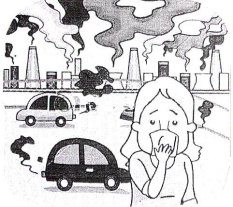
(g) Given below is a representation of a type of pollution.  

     Study the picture and answer the questions: 

    (i) Name the type of pollution shown in the picture. 

    (ii) Name one source of this pollution. 

   (iii) How does this pollution affect human health? 

   (iv) Write one measure to reduce this pollution. 

   (v) State one gaseous compound that leads to the depletion of the ozone layer and creates ‘Ozone holes’. 

(h) Choose the ODD one out from the following terms given and name the CATEGORY to which the others belong:  

Example: Nose, Tongue, Arm, Eye 

Answer: Odd Term – Arm, Category – Sense organs 

      (i) Detergents, X-rays, sewage, oil spills 

     (ii) Lumen, muscular tissue, connective tissue, pericardium 

    (iii) Dendrites, Medullary Sheath, Axon, Spinal cord 

    (iv) Centrosome, Cell wall, Cell membrane, Large vacuoles 

   (v) Prostate gland, Cowper’s gland, seminal vesicle, seminiferous tubules. 

SECTION II 

Q.2 (a) The diagram given below represents a stage during cell division.  

Study the same and answer the questions that follow: 

       (i) Identify whether it is a plant cell or an animal cell.  

            Give a reason in support of your answer. 

      (ii) Name the stage depicted in the diagram.  

           What is the unique feature observed in this stage? 

     (iii) Name the type of cell division that occurs during:  

           1. Replacement of old leaves by new ones. 

           2. Formation of gametes. 

    (iv) What is the stage that comes before the stage shown in the diagram? 

    (v) Draw a neat, labelled diagram of the stage mentioned in (iv) above keeping the chromosome number constant. 

(b) Mention the exact location of the following:  

      (i) Epididymis 

     (ii) Lacrimal gland 

     (iii) Malleus 

     (iv) Hydathodes 

     (v) Pulmonary semilunar valve 


Q.3 (a) Given below are diagrams showing the different stages in the process of 

      fertilisation of an egg in the human female reproductive tract.  

      Study the diagrams and answer the questions: 

       A                    B                    C                        D

      (i) Arrange the letters given below each diagram in a logical sequence to show the correct order in the process of fertilisation. 

     (ii) Where does fertilisation normally take place? What is ‘Implantation’ that follows fertilisation? 

   (iii) Mention the chromosome number of the egg and zygote in humans. 

   (iv) Explain the term ‘Gestation’. How long does Gestation last in humans? 

   (v) Draw a neat, labelled diagram of a mature human sperm. 

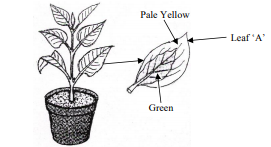
(b) A potted plant with variegated leaves was taken in order to prove a factor necessary for photosynthesis. The potted plant was kept in the dark for 24 hours  and then placed in bright sunlight for a few hours. Observe the diagrams and  answer the questions. 

      (i) What aspect of photosynthesis is being tested in the above diagram? 

     (ii) Represent the process of photosynthesis in the form of a balanced equation.  

     (iii) Why was the plant kept in the dark before beginning the experiment? 

     (iv) What will be the result of the starch test performed on leaf ‘A’ shown in the diagram? Give an example of a plant with variegated leaves. 

     (v) Draw a neat labelled diagram of a chloroplast. 


Q.4 (a) The diagram given below shows the internal structure of a spinal cord depicting a phenomenon. Study the diagram and answer the questions: 

       (i) Name the phenomenon that is depicted in the diagram. Define the phenomenon. 

      (ii) Give the technical term for the point of contact between the two nerve cells. 

     (iii) Name the parts numbered 1, 2 and 3. 

     (iv) How does the arrangement of neurons in the spinal cord differ from that of  the brain? 

     (v) Mention two ways by which the spinal cord is protected in our body. 

(b) Give appropriate biological or technical terms for the following:  

      (i) Process of maintaining water and salt balance in the blood. 

      (ii) Hormones which regulate the secretion of other endocrine glands. 

      (iii) Movement of molecules of a substance from their higher concentration to lower concentration when they are in direct contact. 

      (iv) The condition in which a pair of chromosomes carry similar alleles of a particular character. 

     (v) The complex consisting of a DNA strand and a core of histones. 

     (vi) The onset of menstruation in a young girl. 

     (vii)Squeezing out of white blood cells from the capillaries into the surrounding tissues. 

   (viii) The fluid which surrounds the foetus. 

    (ix) The relaxation phase of the heart. 

    (x) The difference between the birth rate and the death rate. 


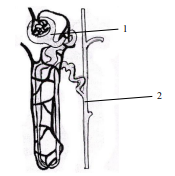
Q.5 (a) The diagram given below is that of a structure present in a human kidney.  

      Study the same and answer the questions that follow: 

     (i) Name the structure represented in the diagram. 

     (ii) What is the liquid entering part ‘1’ called?  

          Name two substances present in this liquid that are reabsorbed in the tubule. 

    (iii) What is the fluid that comes to part ‘2’ called?  

           Name the main nitrogenous waste in it. 

   (iv) Mention the three main steps involved in the formation of the fluid mentioned in (iii) above.  

   (v) Name the substance which may be present in the fluid in part ‘2’ if a person suffers from Diabetes mellitus. 

(b) Differentiate between the following pairs on the basis of what is indicated in the  brackets.  

     (i) Leaf and Liver [form in which glucose is stored] 

    (ii) ATP and AIDS [expand the abbreviations] 

   (iii) Testosterone and Oestrogen [organ which secretes] 

   (iv) Ureter and Urethra [function] 

   (v) Hypotonic solution and Hypertonic solution [condition of a plant cell when placed in them] 


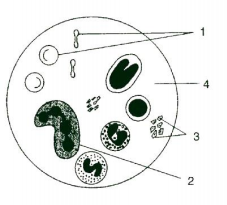
Q.6 (a) Given below is a diagram of a human blood smear.  

     Study the diagram and answer the questions that follow: 

     (i) Name the components numbered ‘1’ to ‘4’. 

    (ii) Mention two structural differences between the parts ‘1’ and ‘2’. 

    (iii) Name the soluble protein found in part ‘4’ which forms insoluble threads during clotting of blood. 

    (iv) What is the average lifespan of the component numbered ‘1’? 

    (v) Component numbered ‘1’ do not have certain organelles but are very efficient in their function. Explain. 

(b) Give biological explanations for the following: 

      (i) Education is very important for population control. 

      (ii) The placenta is an important structure for the development of a foetus. 

      (iii) All the food chains begin with green plants. 

      (iv) Plants growing in fertilized soil are often found to wilt if the soil is not adequately watered. 

     (v) We should not put sharp objects into our ears. 


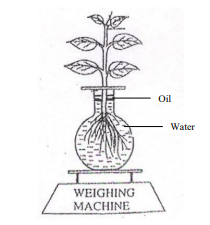
Q.7 (a) The diagram below represents a process in plants.  

    The setup was placed in bright sunlight. Answer the following questions: 

  (i) Name the physiological process depicted in the diagram.  

       Why was oil added to the water? 

  (ii) When placed in bright sunlight for four hours, what do you observe with   

        regard to the initial and final weight of the plant?  

        Give a suitable reason for your answer. 

  (iii) What happens to the level of water when this setup is placed in: 

          1. Humid conditions? 

          2. Windy conditions? 

  (iv) Mention any three adaptations found in plants to overcome the process mentioned in (i). 

   (v) Explain the term ‘Guttation’. 

(b) A pea plant which is homozygous for Green pods which are inflated [GGII] is crossed with a homozygous plant for yellow pods which are constricted [ggii].  

     Answer the following questions:  

    (i) Give the phenotype and genotype of the F1 generation. Which type of pollination has occurred to produce F1 generation? 

   (ii) Write the phenotypic ratio of the F2 generation. 

   (iii) Write the possible combinations of the gametes that can be obtained if two F1 hybrid plants are crossed. 

  (iv) State Mendel’s law of ‘Segregation of Gametes’. 

  (v) What is the scientific name of the plant which Mendel used for his experiments on inheritance? 

SCIENCE CHEMISTRY CLASS 10TH QUESTION PAPER 2018 (ICSE)

CHEMISTRY 

SCIENCE Paper – 2 

SECTION I 

Q.1 (a) Choose the correct answer from the options given below: 

  (i) The salt solution which does not react with ammonium hydroxide is: 

      A. Calcium Nitrate  

      B. Zinc Nitrate  

      C. Lead Nitrate  

      D. Copper Nitrate 

 (ii) The organic compound which undergoes substitution reaction is: 

      A. C2H2 

      B. C2H4 

      C. C10H18 

      D. C2H6 

 (iii) The electrolysis of acidified water is an example of: 

     A. Reduction 

     B. Oxidation 

     C. Redox reaction 

     D. Synthesis 

 (iv) The IUPAC name of dimethyl ether is: 

    A. Ethoxy methane 

    B. Methoxy methane 

    C. Methoxy ethane 

    D. Ethoxy ethane 

(v) The catalyst used in the Contact Process is: 

     A. Copper  

     B. Iron  

     C. Vanadium pentoxide  

     D. Manganese dioxide 

(b) Give one word or a phrase for the following statements: 

      (i) The energy released when an electron is added to a neutral gaseous  isolated atom to form a negatively charged ion. 

      (ii) Process of formation of ions from molecules which are not in ionic state.  

     (iii) The tendency of an element to form chains of identical atoms. 

  (iv) The property by which certain hydrated salts, when left exposed to atmosphere, lose their water of crystallization and crumble into powder.  

      (v) The process by which sulphide ore is concentrated. 

(c) Write a balanced chemical equation for each of the following: 

      (i) Action of concentrated sulphuric acid on carbon. 

     (ii) Reaction of sodium hydroxide solution with iron (III) chloride solution. 

     (iii) Action of heat on aluminum hydroxide. 

     (iv) Reaction of zinc with potassium hydroxide solution. 

     (v) Action of dilute hydrochloric acid on magnesium sulphite. 

(d) (i) Give the IUPAC name for each of the following: 

      (ii) Write the structural formula of the two isomers of butane.  

(e) State one relevant observation for each of the following: 

     (i) Lead nitrate solution is treated with sodium hydroxide solution drop wise till it is in excess. 

    (ii) At the anode, when molten lead bromide is electrolyzed using graphite electrodes. 

    (iii) Lead nitrate solution is mixed with dilute hydrochloric acid and heated. 

    (iv) Anhydrous calcium chloride is exposed to air for some time. 

    (v) Barium chloride solution is slowly added to sodium sulphate solution. 

(f) Give a reason for each of the following: 

    (i) Ionic compounds have a high melting point. 

    (ii) Inert gases do not form ions. 

    (iii) Ionisation potential increases across a period, from left to right. 

    (iv) Alkali metals are good reducing agents. 

    (v) Conductivity of dilute hydrochloric acid is greater than that of acetic acid. 

(g) Name the gas that is produced in each of the following cases: 

     (i) Sulphur is oxidized by concentrated nitric acid. 

    (ii) Action of dilute hydrochloric acid on sodium sulphide. 

    (iii) Action of cold and dilute nitric acid on copper. 

    (iv) At the anode during the electrolysis of acidified water. 

    (v) Reaction of ethanol and sodium. 

(h) Fill up the blanks with the correct choice given in brackets. 

   (i) Ionic or electrovalent compounds do not conduct electricity in their_____________ state. (fused / solid) 

  (ii) Electrolysis of aqueous sodium chloride solution will form _______at the cathode. (hydrogen gas / sodium metal) 

  (iii) Dry hydrogen chloride gas can be collected by ___________displacement of air. (downward / upward) 

   (iv) The most common ore of iron is _____________. (calamine / haematite) 

    (v) The salt prepared by the method of direct combination is _____________. (iron (II) chloride / iron (III) chloride) 

SECTION II 

Q.2 (a) (i) What do you understand by a lone pair of electrons? 

      (ii) Draw the electron dot diagram of Hydronium ion. (H=1; O=8) 

(b) In Period 3 of the Periodic Table, element B is placed to the left of element A. On the basis of this information, choose the correct word from the brackets to complete the following statements: 

   (i) The element B would have (lower / higher) metallic character than A. 

   (ii) The element A would probably have (lesser / higher) electron affinity than B. 

  (iii) The element A would have (greater / smaller) atomic size than B. 

(c) Copy and complete the following table which refers to the conversion of ions to neutral particles.  

Conversion  Ionic Equation Oxidation /  Reduction
Chloride ion to chlorine 
molecule Lead (II) ion to lead
(i) __________ 
(iii)_________
(ii)__________ 
(iv)_________


Q.3 (a) (i) Write the balanced chemical equation to prepare ammonia gas in the laboratory by using an alkali. 

      (ii) State why concentrated sulphuric acid is not used for drying ammonia gas. 

      (iii) Why is ammonia gas not collected over water? 

(b) (i) Name the acid used for the preparation of hydrogen chloride gas in the laboratory. Why is this particular acid preferred to other acids? 

     (ii) Write the balanced chemical equation for the laboratory preparation of hydrogen chloride gas. 

(c) For the preparation of hydrochloric acid in the laboratory: 

     (i) Why is direct absorption of hydrogen chloride gas in water not feasible? 

     (ii) What arrangement is done to dissolve hydrogen chloride gas in water? 

(d) For the electro-refining of copper: 

    (i) What is the cathode made up of? 

   (ii) Write the reaction that takes place at the anode. 


Q.4 (a) The percentage composition of a gas is: Nitrogen 82.35%, Hydrogen 17.64%.  

      Find the empirical formula of the gas. [N = 14, H = 1] 

(b) Aluminum carbide reacts with water according to the following equation: 

                          Al4C3 + 12H2O –> 4Al (OH)3 + 3CH4 

  (i) What mass of aluminum hydroxide is formed from 12g of aluminum carbide? 

  (ii) What volume of methane at s.t.p. is obtained from 12g of aluminum carbide? 

          [Relative molecular weight of Al4C3 = 144; Al(OH)3 = 78] 

(c) (i) If 150 cc of gas A contains X molecules, how many molecules of gas B will be present in 75 cc of B?  

       The gases A and B are under the same conditions of temperature and  pressure. 

       (ii) Name the law on which the above problem is based.  

(d) Name the main component of the following alloys: 

      (i) Brass 

     (ii) Duralumin 


Q.5 (a) Complete the following table which relates to the homologous series of hydrocarbons. 

General  formula IUPAC name of the  homologous series Characteristic bond  type IUPAC name of the  first member of the  series
CnH2n – 2  (A) __________  (B)__________  (C)__________
CnH2n + 2  (D)__________  (E)__________  (F)__________

(b) (i) Name the most common ore of the metal aluminum from which the metal is extracted. Write the chemical formula of the ore. 

     (ii) Name the process by which impure ore of aluminum gets purified by  using concentrated solution of an alkali. 

    (iii) Write the equation for the formation of aluminum at the cathode during  the electrolysis of alumina. 


Q.6 (a) A compound X (having vinegar like smell) when treated with ethanol in the  presence of the acid Z, gives a compound Y which has a fruity smell.  

      The reaction is:  

     (i) Identify Y and Z. 

     (ii) Write the structural formula of X. 

     (iii) Name the above reaction. 

(b) Ethane burns in oxygen to form CO2 and H2O according to the equation: 

                      2C2H6 + 7O2 –> 4CO2 + 6H2O.  

      If 1250 cc of oxygen is burnt with 300 cc of ethane. 

      Calculate: 

       (i) the volume of CO2 formed. 

       (ii) the volume of unused O2. 

(c) Three solutions P, Q and R have pH value of 3.5, 5.2 and 12.2 respectively. 

      Which one of these is a: 

     (i) Weak acid? 

    (ii) Strong alkali? 


Q.7 (a) Give a chemical test to distinguish between the following pairs of chemicals: 

     (i) Lead nitrate solution and Zinc nitrate solution 

     (ii) Sodium chloride solution and Sodium nitrate solution 

(b) Write a balanced equation for the preparation of each of the following salts: 

     (i) Copper sulfate from Copper carbonate. 

    (ii) Zinc carbonate from Zinc sulfate. 

(c) (i) What is the type of salt formed when the reactants are heated at a suitable temperature for the preparation of Nitric acid? 

     (ii) State why for the preparation of Nitric acid, the complete apparatus is made  up of glass. 

(d) Which property of sulfuric acid is shown by the reaction of concentrated sulfuric acid with:  

       (i) Ethanol? 

       (ii) Carbon? 

SCIENCE PHYSICS CLASS 10TH QUESTION PAPER 2018 (ICSE)

PHYSICS 

SCIENCE Paper – 1 

SECTION I 

Q.1 (a) (i) State and define the S.I. unit of power.  

              (ii) How is the unit horse power related to the S.I. unit of power? 

(b) State the energy changes in the following cases while in use:  

     (i) An electric iron. 

    (ii) A ceiling fan. 

(c) The diagram below shows a lever in use:  

  (i) To which class of levers does it belong? 

  (ii) Without changing the dimensions of the lever, if the load is shifted towards  the fulcrum what happens to the mechanical advantage of the lever?  

(d) (i) Why is the ratio of the velocities of light of wavelengths 4000Å and in vacuum 1:1? 

      (ii) Which of the above wavelengths has a higher frequency?  

(e) (i) Why is the motion of a body moving with a constant speed around a circular path said to be accelerated? 

      (ii) Name the unit of physical quantity obtained by the formula  Where K: kinetic energy, V: Linear velocity. 
 

Q.2 (a) The power of a lens is –5D. 

     (i) Find its focal length. 

     (ii) Name the type of lens. 

(b) State the position of the object in front of a converging lens if: 

     (i) It produces a real and same size image of the object. 

    (ii) It is used as a magnifying lens. 

(c) (i) State the relation between the critical angle and the absolute refractive index of a medium. 

     (ii) Which colour of light has a higher critical angle? Red light or Green light. 

(d) (i) Define scattering.  

      (ii) The smoke from a fire looks white.  

           Which of the following statements is true? 

           1. Molecules of the smoke are bigger than the wavelength of light.  

           2. Molecules of the smoke are smaller than the wavelength of light.  

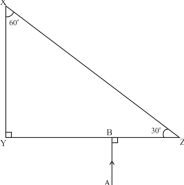
(e) The following diagram shows a 60o, 30o, 90oglass prism of critical angle  42o. Copy the diagram and complete the path of incident ray AB emerging out of the  prism marking the angle of incidence on each surface. 


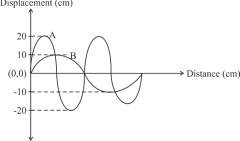
Q.3 (a) Displacement distance graph of two sound waves A and B, travelling in a

     medium, are as shown in the diagram below.  

Study the two sound waves and compare their:  

   (i) Amplitudes  

  (ii) Wavelengths 

(b) You have three resistors of values 2Ω, 3Ω and 5Ω. How will you join them so that the total resistance is more than 7Ω?  

    (i) Draw a diagram for the arrangement. 

   (ii) Calculate the equivalent resistance. 

(c) (i) What do you understand by the term nuclear fusion? 

    (ii) Nuclear power plants use nuclear fission reaction to produce electricity. What is the advantage of producing electricity by fusion reaction? 

(d) (i) What do you understand by free vibrations of a body?  

      (ii) Why does the amplitude of a vibrating body continuously decrease during  damped vibrations? 

(e) (i) How is the e.m.f. across primary and secondary coils of a transformer related with the number of turns of coil in them?  

     (ii) On which type of current do transformers work? 


Q.4 (a) (i) How can a temperature in degree Celsius be converted into S.I. unit of temperature?  

     (ii) A liquid X has the maximum specific heat capacity and is used as a coolant in Car radiators. Name the liquid X. 

(b) A solid metal weighing 150 g melts at its melting point of 800 oC by providing heat at the rate of 100 W. The time taken for it to completely melt at the same  temperature is 4 min. What is the specific latent heat of fusion  of the metal? 

(c) Identify the following wires used in a household circuit:  

     (i) The wire is also called as the phase wire. 

     (ii) The wire is connected to the top terminal of a three pin socket. 

(d) (i) What are isobars?  

     (ii) Give one example of isobars. 

(e) State any two advantages of electromagnets over permanent magnets.


SECTION II 

Q.5 (a) (i) Derive a relationship between S.I. and C.G.S. unit of work.  

     (ii) A force acts on a body and displaces it by a distance S in a direction at an  angle θ with the direction of force. What should be the value of θ to get the maximum positive work? 

(b) A half metre rod is pivoted at the centre with two weights of 20 gf and 12 gf suspended at a perpendicular distance of 6 cm and 10 cm from the pivot respectively as shown below. 

(i) Which of the two forces acting on the rigid rod causes clockwise moment?

(ii) Is the rod in equilibrium? 

(iii) The direction of 20 gf force is reversed. What is the magnitude of the resultant moment of the forces on the rod? 

(c) (i) Draw a diagram to show a block and tackle pulley system having a velocity  ratio of 3 marking the direction of load(L), effort(E) and tension(T).  

(ii) The pulley system drawn lifts a load of 150 N when an effort of 60 N is applied. Find its mechanical advantage.  

(iii) Is the above pulley system an ideal machine or not? 


Q.6 (a) A ray of light XY passes through a right angled isosceles prism as shown below. 

(i) What is the angle through which the incident ray deviates and emerges out of the prism?  

(ii) Name the instrument where this action of prism is put into use. 

(iii) Which prism surface will behave as a mirror? 

(b) An object AB is placed between O and F1 on the principal axis of a

     converging lens as shown in the diagram. 

       Copy the diagram and by using three standard rays starting from point A, obtain  an image of the object AB.  

(c) An object is placed at a distance of 12 cm from a convex lens of focal length  8 cm. Find:  

    (i) the position of the image  

   (ii) nature of the image 


Q.7 (a) Draw the diagram of a right angled isosceles prism which is used to make an inverted image erect. 

(b) 

The diagram above shows a wire stretched over a sonometer. Stems of two  vibrating tuning forks A and B are touched to the wooden box of the sonometer. It is observed that the paper rider (a small piece of paper folded at the centre)  present on the wire flies off when the stem of vibrating tuning fork B is touched  to the wooden box but the paper just vibrates when the stem of vibrating tuning  fork A is touched to the wooden box.  

    (i) Name the phenomenon when the paper rider just vibrates.  

    (ii) Name the phenomenon when the paper rider flies off.  

    (iii) Why does the paper rider fly off when the stem of tuning fork B is touched  to the box? 

(c) A person is standing at the sea shore. An observer on the ship which is anchored in between a vertical cliff and the person on the shore, fires a gun. The person  on the shore hears two sounds, 2 seconds and 3 seconds after seeing the smoke  of the fired gun. If the speed of sound in the air is 320 ms-1then calculate: 

    (i) the distance between the observer on the ship and the person on the shore.  

    (ii) the distance between the cliff and the observer on the ship. 


Q.8 (a) (i) A fuse is rated 8A. Can it be used with an electrical appliance rated 5 KW, 200 V? Give a reason.  

     (ii) Name two safety devices which are connected to the live wire of a household electric circuit. 

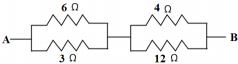
(b) (i) Find the equivalent resistance between A and B. 

     (ii) State whether the resistivity of a wire changes with the change in the thickness of the wire. 

(c) An electric iron is rated 220V, 2kW.  

     (i) If the iron is used for 2h daily find the cost of running it for one week if it  costs ` 4.25 per kWh.  

    (ii) Why is the fuse absolutely necessary in a power circuit? 


Q.9  (a) (i) Heat supplied to a solid changes it into liquid. What is this change in phase  called?  

     (ii) During the phase change does the average kinetic energy of the molecules  of the substance increase?  

    (iii) What is the energy absorbed during the phase change called? 

(b) (i) State two differences between “Heat Capacity” and “Specific Heat Capacity”.  

     (ii) Give a mathematical relation between Heat Capacity and Specific Heat Capacity.  

(c) The temperature of 170g of water at 50°C is lowered to 5°C by adding certain amount of ice to it. Find the mass of ice added.  

    Given: Specific heat capacity of water = 4200 J kg-1 ⁰C-1and Specific latent  heat of ice = 336000 J kg-1 


Q.10 (a) 

The diagram shows a coil wound around a U shape soft iron bar AB.

(i) What is the polarity induced at the ends A and B when the switch is pressed? 

(ii) Suggest one way to strengthen the magnetic field in the electromagnet. 

(iii) What will be the polarities at A & B if the direction of current is reversed in the circuit? 

(b) The ore of Uranium found in nature contains 92U238 and 92U235. Although both  the isotopes are fissionable, it is found out experimentally that one of the two  isotopes is more easily fissionable. 

      (i) Name the isotope of Uranium which is easily fissionable. 

      (ii) Give a reason for your answer. 

      (iii) Write a nuclear reaction when Uranium 238 emits an alpha particle to form  a Thorium (Th) nucleus.  

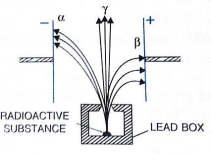
(c) Radiations given out from a source when subjected to an electric field in a direction perpendicular to their path are shown below in the diagram. The arrows show the path of the radiation A, B and C. Answer the followingquestions in terms of A, B and C. 

(i) Name the radiation B which is unaffected by the electrostatic field. 

(ii) Why does the radiation C deflect more than A? 

(iii) Which among the three causes the least biological damage externally?  

(iv) Name the radiation which is used in carbon dating.  

×

Hello!

Click one of our representatives below to chat on WhatsApp or send us an email to info@vidhyarthidarpan.com

×