Q. 1 The man who is now Municipal Commissioner worked as ___________________ .
A. the security guard at a university
B. a security guard at the university
C. a security guard at university
D. the security guard at the university
Q. 2 Nobody knows how the Indian cricket team is going to “cope with” the difficult and seamer friendly wickets in Australia.
Choose the option which is closest in meaning to the underlined phrase in the above
sentence.
A. put up with
B. put in with
C. put down to
D. put up against
Q. 3 Find the odd one in the following group of words:
Mock, Deride, Praise, Jeer
A. Mock
B. Deride
C. Praise
D. Jeer
Q. 4 Find the odd one from the following options.
A. CADBE
B. JHKIL
C. XVYWZ
D. ONPMQ
Q. 5 In a quadratic function, the value of the product of the roots (α, β) is 4. Find the value of (α^n + β^n) / (α^-n + β^-n)
A. n^4
B. 4^n
C. 2^2n – 1
D. 4^n – 1
Q. 6 Among 150 faculty members in an institute, 55 are connected with each other through Facebook and 85 are connected through WhatsApp. 30 faculty members do not have Facebook or WhatsApp accounts. The number of faculty members connected only through Facebook accounts is __________.
A. 35
B. 45
C. 65
D. 90
Q. 7 Computers were invented for performing only high-end useful computations. However, it is no understatement that they have taken over our world today. The internet, for example,is ubiquitous. Many believe that the internet itself is an unintended consequence of the original invention. With the advent of mobile computing on our phones, a whole new dimension is now enabled. One is left wondering if all these developments are good or, more importantly, required.
Which of the statement(s) below is/are logically valid and can be inferred from the above
paragraph?
(i) The author believes that computers are not good for us.
(ii) Mobile computers and the internet are both intended inventions
A. (i) only
B. (ii) only
C. both (i) and (ii)
D. neither (i) nor (ii)
Q. 8 All hill-stations have a lake. Ooty has two lakes.
Which of the statement(s) below is/are logically valid and can be inferred from the above sentences.
(i) Ooty is not a hill-station.
(ii) No hill-station can have more than one lake.
A. (i) only
B. (ii) only
C. both (i) and (ii)
D. neither (i) nor (ii)
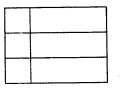
Q. 9 In a 2 x 4 rectangle grid shown in figure (1), each cell is a rectangle. How many rectangles can be observed in the grid?
A. 21
B. 27
C. 30
D. 36
Q. 10 Choose the correct expression for f(x) given in the graph in figure (1).
A. f(x) = 1 – |x – 1|
B. f(x) = 1 + |x – 1|
C. f(x) = 2 – |x – 1|
D. f(x) = 2 + |x – 1|
Q. 11 The maximum value attained by the function f(x) = x (x – 1) (x – 2) in the interval [1, 2] is __________ .
Q. 12 Consider a 3 x 3 matrix with every element being equal to 1. Its only non-zero eigenvalue is _________.
Q. 13 The Laplace Transform of f(x) = e^2t sin (5t) u(t) is
A. 5 / s^2 – 4s + 29
B. 5 / s^2 + 5
C. s – 2 / s^2 – 4s + 29
D. 5 / s + 5
Q. 14 A function y(t), such that y(0) = 1 and y(1) = 3e^-1, is a solution of the differential equation d^2y / dt^2 + 2 (dy / dt) + y = 0. Then y(2) is
A. 5e^-1
B. 5e^-2
C. 7e^-1
D. 7e^-2
Q. 15 Find the value of integral given in figure (1), over the contour |z| = 1, taken in the anticlockwise direction, would be:
A. 24πi / 13
B. 48πi / 13
C. 24 / 13
D. 12 / 13
Q. 16 The transfer function of a system is Y(s) / R(s) = s / s + 2. The steady state output y(t) is A cos (2t + φ) for the input cos(2t). The values of A and φ, respectively are
A. 1 / √2, – 45°
B. 1 / √2, +45°
C. √2, -45°
D. √2, +45°
Q. 17 The phase crossover frequency of the transfer function G(s) = 100 / (s + 1)^3 in rad/s is
A. √3
B. 1 / √3
C. 3
D. 3√3
Q. 18 Consider a continuous-time system with input x(t) and output y(t) given by
y(t) = x(t) cos(t)
A. linear and time-invariant
B. nonlinear and time-invariant
C. linear and time-varying
D. nonlinear and time-varying
Q. 19 Find the value of the given function given in figure (1), where δ(t) is the Dirac delta function, is
A. 1 / 2e
B. 2 / e
C. 1 / e^2
D. 1 / 2e^2
Q. 20 A temperature in the range of -40° C to 55° c is to be measured with a resolution of 0.1° C. The minimum number of ADC bits required to get a matching dynamic range of the temperature sensor is
A. 8
B. 10
C. 12
D. 14
Q. 21 Consider the following circuit which uses a 2-to-1 multiplexer as shown in the figure (1). The Boolean expression for output F in terms of A and B is
A. A
B. B
C. C
D. D
Q. 22 A transistor circuit is given below. The Zener diode breakdown voltage is 5.3 V as shown in figure (1). Take base to emitter voltage drop to be 0.6 V. The value of the current gain β is _________.
Q. 23 In cylindrical coordinate system, the potential produced by a uniform ring charge is given by φ = f (r, z), where f is a continuous function of r and z. Let ⃗E be the resulting electric field. Then the magnitude of ∇ × ⃗E
A. increases with r
B. Is 0
C. Is 3
D. Decreases with z
Q. 24 A soft-iron toroid is concentric with a long straight conductor carrying a direct current I. If the relative permeability μ, of soft-iron is 100, the ratio of the magnetic flux densities at two adjacent points located just inside and just outside the toroid, is ____.
Q. 25 RA and RB are the input resistances of circuits as shown in figure (1). The circuits extend infinitely in the direction shown. Which one of the following statements is TRUE?
A. RA=RB
B. RA=RB=0
C. RA< RB
D. RB= RA /(1+RA)
Q. 26 In a constant V / f induction motor drive, the slip at the maximum torque
A. is directly proportional to the synchronous speed.
B. remains constant with respect to the synchronous speed.
C. has an inverse relation with the synchronous speed.
D. has no relation with the synchronous speed
Q. 27 In the portion of a circuit shown in figure (1), if the heat generated in 5 Ω resistance is 10 calories per second, then heat generated by the 4 Ω resistance, in calories per second, is _______.
Q. 28 In the given circuit shown in figure (1), the current supplied by the battery, in ampere, is _________________ .
Q. 29 In a 100 bus power system, there are 10 generators. In a particular iteration of Newton Raphson load flow technique (in polar coordinates), two of he PV buses are converted to PQ type. In this iteration,
A. the number of unknown voltage angles increases by two and the number of unknown voltage magnitudes increases by two
B. the number of unknown voltage angles remains unchanged and the number of unknown voltage magnitudes increases by two.
C. the number of unknown voltage angles increases by two and the number of unknown voltage magnitudes decreases by two
D. the number of unknown voltage angles remains unchanged and the number of unknown vp;tage magnitudes decreases by two
Q. 30 The magnitude of three-phase fault currents at buses A and B of a power system are 10 pu and 8 pu, respectively. Neglect all resistances in the system and consider the pre-fault system to be unloaded. The pre-fault voltage at all buses in the system is 1.0 pu. The voltage magnitude at bus B during a three-phase fault at bus A is 0.8 pu. The voltage magnitude at bus A during a three-phase fault at bus B, in pu, is _________________.
Q. 31 Consider a system consisting of a synchronous generator working at a lagging power factor, a synchronous motor working at an over excited condition and a directly grid connected induction generator. Consider capacitive V Ar to be a source and inductive V Ar to be a sink or reactive power. Which one of the following statements is TRUE?
A. Synchronous motor and synchronous generator are sources and induction generator is a sink of reactive power.
B. Synchronous motor and induction generator are sources and synchronous generator is a sink of reactive power.
C. Synchronous motor is a source and induction generator and synchronous generator are sinks of reactive power.
D. All are sources of reactive power.
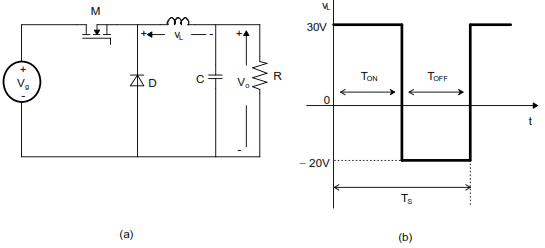
Q. 32 A buck converter, as shown in Figure (a), is working in steady state. The output voltage and the inductor current can be assumed to be ripple free. Figure (b) shows the inductor voltage VL during a complete switching interval. Assuming all devices are ideal, the duty cycle of the buck converter is ________.
Q. 33 A steady dc current of 100 A is flowing through a power module (S, D) as shown in Figure (a). The V-I characteristics of the IGBT (S) and the diode (D) are shown in Figures (b) and (c), respectively. The conduction power loss in the power module (S, D), in watts, is ________.
Q. 34 A 4-pole, lap-connected, separately excited dc motor is drawing a steady current of 40 A while running at 600 rpm. A good approximation for the waveshape of the current in an armature conductor of the motor is given by the figure (A), (B), (C), (D)
A. (A)
B. (B)
C. (C)
D. (D)
Q. 35 If an ideal transformer has an inductive load element at port 2 as shown in the figure (1), the equivalent inductance at port 1 is
A. nL
B. n^2L
C. n / L
D. n^2 / L
Q. 36 Candidates were asked to come to an interview with 3 pens each. Black, blue, green and red were the permitted pen colours that the candidate could bring. The probability that a candidate comes with all 3 pens having the same colour is _________.
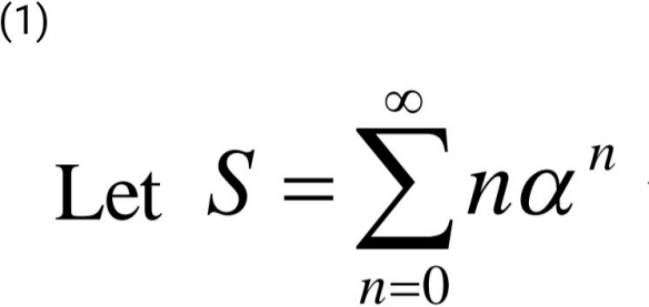
Q. 37 The value of S is given in the figure (1) where |α| < 1. The value of α in the range 0 < α < 1, such that S = 2α is _______________.
Q. 38 Let the eigenvalues of a 2 x 2 matrix A be 1, -2 with eigenvectors x1 and x2 respectively. Then the eigenvalues and eigenvectors of the matrix A^2 − 3A + 4I would, respectively, be
A. 2, 14; x1, x2
B. 2, 14; x1 + x2, x1 – x2
C. 2, 0; x1, x2
D. 2, 0; x1 + x2, x1 – x2
Q. 39 Let A be a 4 x 3 real matrix with rank 2. Which one of the following statement is TRUE?
A. Rank of A^T A is less than 2
B. Rank of A^T A is equal to 2
C. Rank of A^T A is greater than 2
D. Rank of A^T A can be any number between 1 and 3
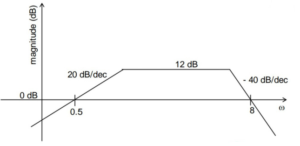
Q. 40 Consider the following asymptotic Bode magnitude plot given in figure (1) (ω is in rad/s). Which one of the following transfer functions is best represented by the above Bode magnitude plot?
A. 2s / (1 + 0.5s) (1 + 0. 25s)^2
B. 4 (1 + 0.5s) / s (1 + 0.25s)
C. 2s / (1+ 2s) (1 + 4s)
D. 4s / (1+ 2s) (1 + 4s)^2
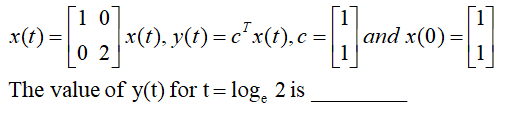
Q. 41 Consider the following state-space representation of a linear time-invariant system given in figure (1).
The value of y(t) for (t) = log e 2 is _____________.
Q. 42 Loop transfer function of a feedback system is G(s) H(s) = s + 3 /s^2 (s – 3). Take the Nyquist contour in the clockwise direction. Then, the Nyquist plot of G(s) H(s) encircles – 1 + j0.
A. once in clockwise direction
B. twice in clockwise direction
C. once in anticlockwise direction
D. twice in anticlockwise direction
Q. 43 Given the following polynomial equation:
s^3 + 5.5 s^2 + 8.5 s + 3 = 0,
the number of roots of the polynomial, which have real parts strictly less than -1, is ___________.
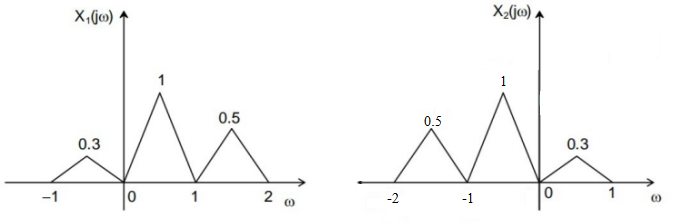
Q. 44 Suppose x1(t) and x2(t) have the Fourier transforms as shown in figure (1).
Which one of the following statements is TRUE?
A. x1(t) and x2(t) are complex and x1(t) x2(t) is also complex with nonzero imaginary part
B. x1(t) and x2(t) are real and x1(t) x2(t) is also real
C. x1(t) and x2(t) are complex but x1(t) x2(t) is real
D. x1(t) and x2(t) are imaginary but x1(t) x2(t) is real
Q. 45 The output of a continuous-time, linear time-invariant system is denoted by T {x(t)} where x(t) is the input signal. A signal z(t) is called eigen-signal of the system T, when T {z(t)} = γ z(t), where γ is a complex number, in general, and is called an eigenvalue of T. Suppose the impulse response of the system T is real and even. Which of the following statements is TRUE?
A. cos(t) is an eigen-signal but sin(t) is not
B. cos(t) and sin(t) are both eigen-signals but with different eigenvalues
C. sin(t) is an eigen-signal but cos(t) is not
D. cos(t) and sin(t) are both eigen-signals with identical eigenvalues
Q. 46 The current state QA QB of a two JK flip-flop system is 00. Assume that the clock rise-time is much smaller than the delay of the JK flip-flop. The next state of the system given in figure (1) is
A. 00
B. 01
C. 11
D. 10
Q. 47 A 2-bit flash Analog to Digital Converter (ADC) is given below. The input is 0 ≤ VIN ≤ 3 Volts. The expression for the LSB of the output B0 as a Boolean function of X2, X1, and X0 is
A. (a)
B. (b)
C. (c)
D. (d)
Q. 48 Two electric charges q and -2q are placed at (0, 0) and (6, 0) on the x-y plane. The equation of the zero equipotential curve in the x-y plane is:
A. x = – 2
B. y = 2
C. x^2 + y^2 = 2
D. (x + 2)^2 + y^2 = 16
Q. 49 In the circuit shown in figure (1), switch S2 has been closed for a long time. At time t = 0 switch S1 is closed. At t = 0+, the rate of change of current through the inductor, in amperes per second, is __________.
Q. 50 A three-phase cable is supplying 800 kW and 600 kV Ar to an inductive load. It is intended to supply an additional resistive load of 100 kW through the same cable without increasing the heat dissipation in the cable, by providing a three-phase bank of capacitors connected in star across the load. Given the line voltage is 3.3 kV, 50 Hz, the capacitance per phase of the bank, expressed in microfarads, is ____________________.
Q. 51 A 30 MVA , 3-phase, 50 Hz, 13.8 kV, star-connected synchronous generator has positive, negative and zero sequence reactances, 15%, 15% and 5% respectively. A reactance (Xn) is connected between the neutral of the generator and ground. A double line to ground fault takes place involving phases ‘b’ and ‘c’, with a fault impedance of j0.1 p.u. The value of Xn (in p.u.) that will limit the positive sequence generator current to 4270 A is __________________.
Q. 52 If the star side of the star-delta transformer shown in figure (1) is excited by a negative sequence voltage, then
A. VAB leads Vab by 60°
B. VAB lags Vab by 60°
C. VAB leads Vab by 30°
D. VAB lags Vab by 30°
Q. 53 A single-phase thyristor-bridge rectifier is fed from a 230 V, 50 Hz, single-phase AC mains. If it is delivering a constant DC current of 10 A, at firing angle of 30°, then value of the power factor at AC mains is:
A. 0.87
B. 0.9
C. 0.78
D. 0.45
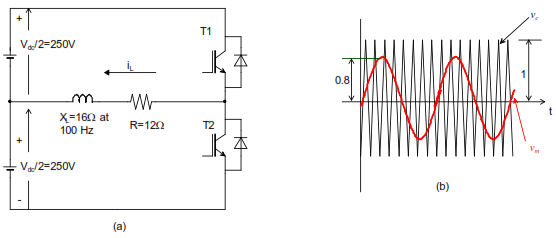
Q. 54 The switches T1 and T2 in Figure (a) are switched in a complementary fashion with sinusoidal pulse width modulation technique. The modulating voltage vm(t) = 0.8 sin (200πt) V and the triangular carrier voltage (vc) are as shown in Figure (b). The carrier frequency is 5 kHz. The peak value of the 100 Hz component of the load current (iL), in ampere, is ________ .
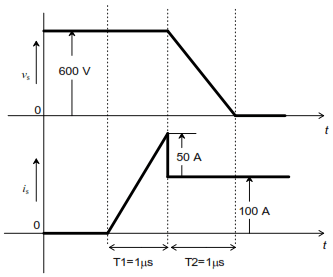
Q. 55 The voltage (vs) across and the current (is) through a semiconductor switch during a turn – ON transition are shown in figure (1). The energy dissipated during the turn – ON transition, in mJ, is _____________.
Q. 56 A single-phase 400 V, 50 Hz transformer has an iron loss of 5000 W at the rated condition. When operated at 200 V, 25 Hz, the iron loss is 2000 W. When operated at 416 V, 52 Hz, the value of the hysteresis loss divided by the eddy current loss is ______.
Q. 57 A DC shunt generator delivers 45 A at a terminal voltage of 220V. The armature and the shunt field resistances are 0.01 Ω and 44 Ω respectively. The stray losses are 375 W. The percentage efficiency of the DC generator is _______________ .
Q. 58 A three-phase, 50 Hz salient-pole synchronous motor has a per-phase direct-axis reactance (Xd) of 0.8 pu and a per-phase quadrature-axis reactance (Xq) of 0.6 pu. Resistance of the machine is negligible. It is drawing full-load current at 0.8 pf (leading). When the terminal voltage is 1 pu, per-phase induced voltage, in pu, is _________.
Q. 59 A single-phase, 22 kVA, 2200 V / 220 V, 50 Hz, distribution transformer is to be connected as an auto-transformer to get an output voltage of 2420 V. Its maximum kVA rating as an auto-transformer is
A. 22
B. 24.2
C. 242
D. 2420
Q. 60 A single-phase full bridge voltage source inverter (VSI) is fed from a 300 V battery. A pulse of 120° duration is used to trigger the appropriate devices in each half cycle. The rms value of the fundamental component of the output voltage, in volts, is
A. 234
B. 245
C. 300
D. 331
Q. 61 A single-phase transmission line has two conductors each of 10 mm radius. These are fixed at a center-to-center distance of 1 m in a horizontal plane. This is now converted to a three phase transmission line by introducing a third conductor of the same radius. This conductor is fixed at an equal distance D from the two single-phase conductors. The three phase line is fully transposed. The positive sequence inductance per phase of the three phase system is to be 5% more than that of the inductance per conductor of the single phase system. The distance D, in meters, is __________.
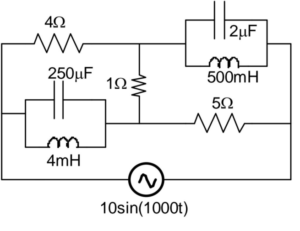
Q. 62 In the circuit shown in figure (1), the supply voltage is 10 sin (1000t) volts. The peak value of the steady state current through the 1 Ω resistor, in amperes, is _________________ .
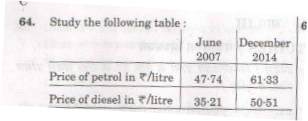
Q. 63 A dc voltage with ripple is given by v(t) = [100 + 10sin (ωt) – 5 sin (3ωt)] volts. Measurements of this voltage v(t), made by moving-coil and moving-iron voltmeters, show readings of V1 and V2 respectively. The value of V2 – V1, in volts is __________.
Q. 64 The circuit given in figure (1) is excited by a sinusoidal source. The value of R, in Ω, for which the admittance of the circuit becomes a pure conductance at all frequencies is _____________ .
Q. 65 In the circuit shown in figure (1), the node voltage VA is __________________ V.
Q. 1 Two students read the same passage yet construct entirely different interpretations of its meaning. Which of the following is true about them?
A. It is not possible and the students need to re-read the passage.
B. It is possible because the teacher has not explained the passage.
C. It is possible because different factors affect learning of individuals in varied ways.
D. It is not possible because learning is not meaning – making.
Q. 2 According to the National Curriculum Framework, 2005, learning is _________________ and _____________ in its character.
A. active; social
B. passive; simple
C. passive; social
D. active; simple
Q. 3 To enable students to think independently and become effective learners, it is important for a teacher to:
A. offer rewards for each success achieved by the students
B. teach students how to monitor their own learning
C. give information in small units or chunks
D. present information in an organised manner to make it easier to recall
Q. 4 If a teacher wants her students to acquire problem-solving skills, the students should be engaged in activities that involve:
A. structured worksheets containing multiple-choice questions
B. recall, memorization and comprehension
C. drill and practice
D. inquiring, reasoning and decision making
Q. 5 Knowing the naive conceptions that students bring to the classroom:
A. pulls down the teacher’s morale since it increases his work
B. does not serve any purpose of the teacher
C. helps the teacher to plan teaching more meaningfully
D. hampers the teacher’s planning and teaching
Q. 6 Which of the following factors affect learning?
A. Motivation of the learner
B. Maturation of the learner
C. Teaching strategies
D. Physical and emotional health of the learner
A. A, B, C and D
B. A and B
C. A and C
D. A, B and C
Q. 7 Meaningful learning is:
A. pairing and association between the stimulus and the response
B. imitation of adults and more able peers
C. passive receiving of the given information
D. active creation of knowledge structures from personal experience
Q. 8 Which of the following is not one of the primary tasks of a teacher for effective student learning?
A. Transmitting information to the students in a didactic manner
B. Knowing the concepts that students bring to the classroom
C. Requiring students to respond to higher-order questioning
D. Teaching students how to monitor and improve their own learning by effort
Q. 9 Which of the following statements about principles of development is incorrect?
A. Development depends on maturation and learning
B. Development takes place due to constant interaction between heredity and environment
C. Every child goes through stages of development, yet there are wide individual differences among children
D. Development is a quantitative process which can be measured precisely.
Q. 10 The unique interaction of _______ and __________ can result in different paths and outcomes of development.
A. challenges; limitations
B. heredity; environment
C. stability; change
D. exploration; nutrition
Q. 11 Which of the following is true of school and socialization?
A. School is an important agent of socialization
B. School does not play any role in socialization
C. School plays very little role in socialization
D. School is the first primary agent of socialization
Q. 12 Which of the following statements is correct about Jean Piaget’s theory of cognitive development?
A. Piaget argues that instead of progressing through stages, cognitive development is
continuous
B. Piaget has proposed five distinct stages of cognitive development
C. The stages are invariant which means that no stage can be skipped
D. The sequence of the stages can vary according to the cultural context of children
Q. 13 The context of ‘conservation’ as proposed by Jean Piaget means that:
A. it is important to protect wildlife and forests
B. certain physical properties remain the same even when outward appearances change
C. one can arrive at the correct conclusion by systematically testing hypothesis
D. taking the perspective of others into consideration is an important cognitive ability
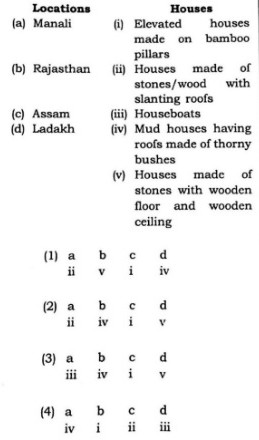
Q. 14 Match the following in the light of Howard Gardner’s theory of Multiple Intelligence (Given in the figure):
A. a(v), b(ii), c(iv), d(i)
B. a(ii), b(iv), c(i), d(v)
C. a(iv), b(ii), c(i), d(v)
D. a(iv), b(ii), c(v), d(iii)
Q. 15 According to Lev Vygotsky:
A. interaction with adults and peers does not influence language development
B. language development changes the nature of human thought
C. culture plays a very small role in language development
D. children learn language through a language acquisition device
Q. 16 Lawrence Kohlberg’s theory of moral reasoning has been criticized on several counts. Which of the following statements is correct on the context of their criticism?
A. Kohlberg has not given typical responses to each stage of moral reasoning.
B. Kohlberg has duplicated Piaget’s methods of arriving at his theoretical framework.
C. Kohlberg’s theory does not focus on children’s responses.
D. Kohlberg has based his study primarily on a male sample
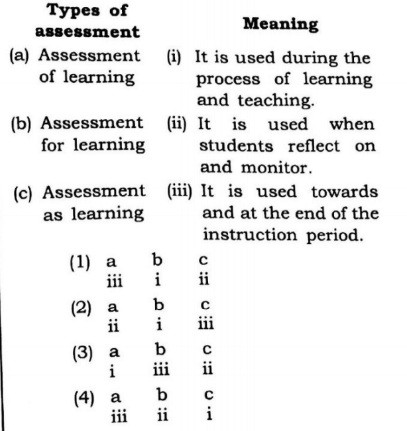
Q. 17 Which of the following highlights assessment for learning?
A. The teacher assesses conceptual understanding of the students besides focusing on the processes of thinking
B. The teacher assesses the students by comparing their responses to ‘standard’ Responses
C. The teacher assesses the students based on the information given in the textbooks
D. The teacher assesses a student based on his/her performance in comparison to others.
Q. 18 ‘Child-centred’ pedagogy means:
A. the teacher dictating the children what should be done.
B. giving primacy to children’s experiences and their voices.
C. enabling the children to follow prescribed information.
D. the teacher leading all the learning in the classroom.
Q. 19 Which of the following statements describes Piaget and Vygotsky’s views on language and thought correctly?
A. According to Vygotsky, thought emerges first and according to Piaget, language has a profound effect on thought
B. According to Piaget, thought emerges first and according to Vygotsky, language has a profound effect on thought
C. Both view thought as emerging from the children’s language
D. Both view language as emerging from the child’s thought
Q. 20 Watching her grandfather arguing with her father for going on a school trip, the grandmother say, “Why can’t you be obedient like a good girl? Who will marry you if you behave like a boy?” This statement reflects which of the following?
A. Gender constancy
B. Gender stereotypes about attributes of girls and boys
C. Improper gender identification of the girl
D. Difficulties faced by families in child-rearing
Q. 21 Which of the following statements about assessment are correct?
A. Assessment should help students see their strengths and gaps help the teacher finetune her teaching accordingly
B. Assessment is meaningful only if comparative evaluations of students are made
C. Assessment should assess not only memory but also understanding and application
D. Assessment cannot be purposeful if it does not induce fear and anxiety
A. B and C
B. A and B
C. B and D
D. A and C
Q. 22 According to the Right to Education Act, 2009, children with special needs should study:
A. at home with their parents and caregivers providing necessary support
B. in special schools created exclusively for them
C. in inclusive education setups with provisions to cater to their individual need
D. in vocational training centres which would prepare them for life skills
Q. 23 An effective teacher in a classroom where students come from diverse backgrounds, would:
A. push students from deprived backgrounds to work hard so that they can match up with their peers
B. focus on their cultural knowledge to address individual differences among the group
C. ignore cultural knowledge and treat all his students in a uniform manner
D. create groups of students with those from the same economic background put together
Q. 24 Match the following principles of development with their correct descriptions (Given in the figure):
A. a(v), b(ii), c(i), d(iii)
B. a(ii), b(iv), c(i), d(iii)
C. a(ii), b(iv), c(iii), d(i)
D. a(iv), b(ii), c(i), d(iii)
Q. 25 Which of the following statements about cognition and emotions is correct?
A. Cognition and emotions are interwined and affect each other
B. Cognition and emotions are processes independent of each other
C. Cognition affects emotions but emotions do not affect cognition
D. Emotions affect cognition but cognition does not affect emotions
Q. 26 In an inclusive classroom with diverse learners, cooperative learning and peer-tutoring
A. should be used only sometimes since it promotes comparison with classmates
B. should be actively discouraged and competition should be promoted
C. should be actively promoted to facilitate peer-acceptance
D. should not be practised and students should be segregated based on their abilities
Q. 27 A teacher can address diversity in her class by:
A. accepting and valuing differences
B. using socio – cultural background of children as a pedagogic resource
C. accommodating different learning styles
D. giving standard instruction and setting uniform benchmarks for performance
Select the correct answer using the code given below:
A. A, B, C and D
B. A, B and D
C. B, C and D
D. A, B and C
Q. 28 A teacher asks her class to cover sharp edges of furniture with cotton and use “Touch and Feel” notice boards and books. The needs of which category of special learners is the attempting to cater to?
A. Visually – impared learners
B. Hearing – impared learners
C. Learning – impared learners
D. Socially disadvantaged learners
Q. 29 Gifted children are best catered to by educational programmes that:
A. make use of gifts and rewards to motivate them to perform according to minimum standards of learning
B. emphasize mastery of knowledge by recall
C. stimulate their thinking and give them opportunities to engage in divergent thinking
D. control their aggressive behaviour
Q. 30 Which of the following statements about student’s failure in schools are correct?
A. Students belonging to certain castes and communities fail since they do not have ability
B. Students fail in schools because appropriate rewards are not offered for their learning
C. Students fail because teaching is not done in a manner in which it is meaningful to them
D. Students fail because school system does not cater to individual child’s needs and interests
A. C and D
B. A and B
C. B and C
D. B and D
Q. 31 Neeta, a Class VII mathematics teacher, assigns a lot of survey-based projects to mathematics classrooms. The purpose of such activity is:
A. to promote problem-solving skills
B. to give an opportunity to students to collect authentic data
C. to break the monotony of the classroom
D. to use it as an alternate assessment
Which of the above purposes are true?
A. A, B and C
B. A and B
C. A and C
D. A, B and D
Q. 32 Which of the following terms in mathematics is defined?
A. Point
B. Line
C. Diagonal of a quadrilateral
D. Plane
Q. 33 Which of the following is not an important aspects in ‘Algebra’?
A. Visualisation
B. Measurement
C. Transposition
D. Generalisation
Q. 34 ‘Problem posing’ in mathematics means:
A. inability to solve problems
B. raising doubts in the class
C. solving problems
D. creating problems from the context
Q. 35 A good textbook contains a lot of:
A. questions for exploration
B. questions for practice
C. worked out examples
D. theorems and proofs
Q. 36 Consider the following statement;
“Every odd natural number is a prime number.”
Which of the following methods of “proof” can be used to prove/disprove the above statement?
A. Method of disproof
B. Direct proof
C. Proof by contrapositive
D. Proof by contradiction
Q. 37 Which of the following is not a contributing factor responsible for mathematics anxiety?
A. Nature of subject
B. Gender
C. Examination system
D. Curriculum
Q. 38 Which of the following numbers does not lie between -5/6 and 7/8?
A. 5/6
B. -17/24
C. -3/4
D. -11/12
Q. 39 The reciprocal of [(3/8)⁻² x (-4/5)⁻³] is:
A. (8/3)² x (5/-4)³
B. -9/125
C. 125/9
D. 9/125
Q. 40 If (13² – 5²)^3/2 = 6³ x A, then the value of A is:
A. 2⁴
B. 2
C. 2²
D. 2³
Q. 41 If x√243 = y√867, where x and y are co-prime numbers, then the value of (x-y) is:
A. 8
B. 3
C. 4
D. 6
Q. 42 The sum of all possible values of a, for which the 4 – digit number 547a is divisible by 3, is
A. 15
B. 7
C. 10
D. 13
Q. 43 A common factor of x⁴ – 256, x³ – 4x² + 3x – 12 and x² – 7x + 12 is:
A. x – 3
B. x + 4
C. x – 4
D. x + 3
Q. 44 On dividing the polynomial 8x³ – 6x² + 10x + 3 by (4x + 1), the quotient is 2x² + k, where k is equal to:
A. -3 + 2x
B. 3 – 2x
C. 3 + 2x
D. -3 -2x
Q. 45 If the product of (9x² + 15 – x) and (-1 – x + x²), if A, B and C are the coefficients of x³, x² and x respectively, then the value of (A + B – C) is:
A. 14
B. -3
C. -17
D. 11
Q. 46 When x = 1/9 and y = -3/4, then the value of the expression 81x² + 16y² -72xy is:
A. 9/16
B. 25
C. 16
D. 9/4
Q. 47 Abhi is twice as old as his daughter. Five years ago, his age was four times his daughter’s age. If the present age of the daughter is x years, then:
A. 2(x – 5) = 4(2x + 5)
B. 2(x – 5) = 4(2x -5)
C. 4(x – 5) = 2x – 5
D. 4(x + 5) = 2(2x – 5)
Q. 48 A sum of Rs. 6250 at 8% per annum compounded annually, after 2(3/4) years amounts to:
A. Rs. 7872.60
B. Rs. 7165.60
C. Rs. 7581.40
D. Rs. 7727.40
Q. 49 A person marks his goods 40% above the cost price and allows 40% discount on the marked price. His loss/gain percent is:
A. No loss/gain
B. loss, 8%
C. gain, 10%
D. loss, 16%
Q. 50 The angles of a quadrilateral are in the ratio 2 : 3 : 5 : 8. The sum of the supplement of the largest angle and the complement of the smallest angle is:
A. 80°
B. 50°
C. 60°
D. 70°
Q. 51 Two sides if a right triangle measure 15 cm and 17 cm. Which of the following statements can be true of the length of the third side of the triangle?
A. It is between 4 cm and 7 cm.
B. It is between 20 cm and 23 cm
C. It is less than 10 cm
A. A and C only
B. B only
C. A and B only
D. B and C only
Q. 52 If one angle of a triangle is 110°, then the angle between the bisectors of the other two angles measures:
A. 145°
B. 90°
C. 100°
D. 110°
Q. 53 In ΔABC, AB = 4cm, AC = 5cm and BC = 6cm. In ΔPQR, PR = 4cm, PQ = 5cm and RQ = 6cm. ΔABC is congruent to:
A. ΔRPQ
B. ΔPQR
C. ΔPRQ
D. ΔQRP
Q. 54 A tank is in the form of a cuboid. It holds a maximum of 540 m³ water. If the tank is 8 m long and 15 m wide, then how many metres deep must the water be when the tank is 2/3 full?
A. 4.5
B. 2
C. 2.5
D. 3
Q. 55 The ratio of the areas of two equilateral triangles is 16 : 9. If the perimeter of the smaller triangle is 63 cm, then how much larger is a side of the larger triangle than a side of the smaller triangle?
A. 7cm
B. 3cm
C. 4cm
D. 5cm
Q. 56 The area of a triangle is equal to the area of a circle whose perimeter is 6π cm. If the base of the triangle is 8 cm, then its corresponding height (in cm) is:
A. 2.25
B. π
C. 2
D. 2.25π
Q. 57 The mean of mode, median and range of the data:
2, 1, 2, 3, 3, 6, 4, 8, 14, 9, 4, 8, 4
A. 9
B. 4
C. 6
D. 7
Q. 58 Some students of your class are repeatedly not able to do well in mathematics
examinations and tests. As a teacher you would:
A. explain the consequences of not doing well
B. give more tests for practice
C. diagnose the cause and take steps for remediation
D. make them sit with high achievers
Q. 59 In a inclusive mathematics classroom, what would be your strategy for addressing the needs of visually challenged
A. Design alternate teaching-learning and assessment methods
B. Send the learners to a special educator
C. Offer them another subject in lieu of mathematics
D. Pair them with high scorers in mathematics
Q. 60 Which of the following assessment strategies can be used to assess learners’ interest in and attitude to mathematics?
A. Oral test, Paper-pencil test, Class participation
B. Checklist, Portfolio, Paper-pencil test
C. Checklist, Portfolio, Project, Class participation
D. Portfolio, Project, Paper-pencil test
Q. 61 Which of the following is not a purpose of conducting practicals/experimental activities on science?
A. They help in scoring high grades or marks.
B. They enhance understanding of science ideas.
C. They provide and opportunity for problem solving.
D. They help in developing manipulative skills.
Q. 62 A few small wax pieces are fixed at nearly equal distances on a flat strip of aluminium. On end of the strip is clamped to a stand and the other end is heated. Consider the following statements A and B:
A. Wax pieces begin to fall one-by-one in the order of their increasing distance from the flame.
B. Aluminium strip transfers heat from the end nearest to the flame to the other end Of the two statements given below:
A. Both A and B are inferences
B. A is observation and B is inference
C. B is observation and A is inference
D. Both A and B are observations
Q. 63 The students of class VII are asked the following question by a teacher:
“Two identical cubes of ice are taken out of a refrigerator. One is crushed and the other is left as it is. It is noticed that the crushed ice melts faster. What could be the reason?”
Which process skill is promoted through this question?
A. Experimentation
B. Observation
C. Hypothesizing
D. Controlling variables
Q. 64 A teacher of class VII demonstrates the following activity in the class:
“A leaf is put in a test tube and spirit is poured over it. Then the test tube is put in a beaker half-filled with water and heated till the leaf is discoloured. The leaf is then taken out and a few drops of iodine are put on it. The leaf turns blue-black in colour.” After this activity, the teacher gives some questions for the assessment of various indicators of learning.
Which of the following would assess ‘analysis’?
A. What care is taken to prevent damage to the leaf?
B. What care is taken while pouring spirit into the test tube?
C. What happens to the colour of the leaf when solution is poured on it?
D. Can this test be done without removing chlorophyll?
Q. 65 You want your Class VI students to figure out that the property of solubility of salt in water can be used to separate a mixture of sand and salt. As a supporter of inquiry-oriented pedagogy, you would:
A. provide the mixture of sand and salt to students, ask them to think up different ways of separation and help them in trying out their ideas
B. explain different methods of separation of mixtures first and then explain the separation of sand and salt mixture
C. ask students to hypothesize about different ways in which a mixture of sand and salt can be separated and then lead them to the correct answer through detailed explanations
D. take a mixture of sand and salt, demonstrate its separation and then ask students to repeat it on their own
Q. 66 Which among the following statements describes the relationship between science and technology?
A. Science is a boarder endeavour while technology is goal-oriented and often localespecific
B. Technology is a more creative process as compared to science
C. Science is an ancient enterprise but technology is relatively recent
D. Science and technology proceed independently and in isolation from each other
Q. 67 Which among the following is not a single flower but a group of flowers?
A. Datura
B. Rose
C. China rose
D. Sunflower
Q. 68 A bicycle is moving on a straight road at a constant speed. The wheels of the cycle exhibit:
A. circular, translational and periodic motion
B. circular and translational motion
C. translational and periodic motion
D. circular and periodic motion
Q. 69 Suppose you have a farmer living at a place having black soil. If the climate of your region is warm and you want to grow fibre-yielding plants in your fields, then which of the following would you prefer?
A. Rayon
B. Coconut
C. Jute
D. Cotton
Q. 70 Choose the odd one out:
A. Embryo
B. Egg
C. Ovum
D. Gamate
Q. 71 The function of saliva is to:
A. convert starch into sugars
B. prevent the food from entering the windpipe
C. convert carbohydrates into proteins
D. convert starch into fats
Q. 72 Which of the following statements is correct?
A. Both inhaled air and exhaled air contains oxygen
B. Inhaled air does not contain carbon dioxide
C. Exhaled air does not contain oxygen
D. Exhaled air does not contain carbon dioxide
Q. 73 Ritu is standing in front of a plane mirror. The distance between Ritu and her image is 10m. If she moves 2 m towards the mirror, then the distance between Ritu and her image is:
A. 8 m
B. 10 m
C. 12 m
D. 6 m
Q. 74 You have three test tubes X, Y and Z half-filled with different solutions, as X is filled with sodium chloride solution, Y is filled with sodium hydroxide solution and Z is filled with dilute hydrochloric acid. On adding one drop of phenolphthalein solution to each of the above solutions, you would observe the solutions in the test tubes as:
A. X is colourless; Y is pink and Z is colourless
B. X is pink; Y is pink and Z is colourless
C. X is pale green; Y is colourless and Z is red
D. X is colourless; Y is pale green and Z is pink
Q. 75 In our mouth, the arrangement of different types of teeth from front to back is:
A. canine – incisor – molar – premolar
B. incisor – canine – premolar – molar
C. canine – incisor – premolar – molar
D. incisor – canine – molar – premolar
Q. 76 In plants and trees, water goes up high due to suction pull. Which of the following phenomena causes this suction pull?
A. Photosynthesis
B. Transpiration
C. Respiration
D. Absorption
Q. 77 Which of the following is the reproducing part of ginger?
A. Leaf
B. Root
C. Stem
D. Seed
Q. 78 Which among the following liquids are conductors of electricity?
A. Vinegar
B. Sugar solution
C. Salt solution
D. Distilled water
A. B and C
B. A, C and D
C. A and C
D. C and D
Q. 79 Consider the following statements:
A. Plants can survive for some time even without photosynthesis.
B. Plants can survive for some time even without respiration.
C. Photosynthesis and respiration both are essential for the survival of plants
D. Photosynthesis and respiration both are simultaneous process in plants during daytime.
The correct statements are:
A. A, B and D
B. A, B and C
C. B, C and D
D. A, C and D
Q. 80 A block of wood is lying at rest on a table. What can be said about the force(s) acting on it?
A. Gravitational and frictional forces are acting on it
B. There is no force acting on it
C. There is a pair of balanced forces acting on it
D. Only gravitational force is acting on it
Q. 81 Which type of leaf pattern, i.e., leaf venation and root type are presented in bamboo?
A. Reticulate venation and tap root
B. Parallel venation and fibrous root
C. Parallel venation and tap root
D. Reticulate venation and fibrous root
Q. 82 Which of the following facts is nor correct about magnets?
A. Magnetic field lines originate from north pole and merge at south pole of a magnet
B. Attraction is a sure test of magnetism
C. Like poles of magnet repel each other
D. Magnetic field is stronger at the poles of a bar magnet
Q. 83 Match the following metals and non-metals with their uses. (Given in figure)
A. a(iv), b(ii), c(iii), d(i)
B. a(i), b(ii), c(iii), d(iv)
C. a(ii), b(iii), c(iv), d(i)
D. a(iii), b(ii), c(iv), d(i)
Q. 84 Select the true statement from the following:
A. Melamine is a thermoplastic whereas bakelite is a thermosetting plastic
B. Bakelite and melamine are both thermoplastics
C. Bakelite and melamine are both thermosetting plastics
D. Bakelite is a thermoplastic whereas melamine is a thermosetting plastic
Questions: 85 – 87
A teacher of class VIII demonstrates the following activity in her class:
“The teacher takes a small amount of sulphur in a spoon and burns it. She then puts the spoon into a tumbler with a kid to ensure that the gas produced does not escape. After a few minutes, she adds water to the tumbler.”
Q. 85 What happens if blue and red litmus papers are put into the tumbler?
A. No change in both
B. Blue litmus turns red
C. Blue litmus remains red
D. Red litmus turns blue
Q. 86 In the above demonstrated activity, which substance is formed when sulphur dioxide is dissolved in water?
A. Sulphur hydroxide
B. Sulphuric acid
C. Sulphuric oxide
D. Sulphurous acid
Q. 87 Which process skills can be promoted through the above activity?
A. Observation and controlling variables
B. Observation, inference and measurement
C. Observation, classification and inference
D. Observation and measurement
Q. 88 A science teacher asked her students to put two drops each of oil and sugar solution on a flat surface. She then asks them to tilt the surface and observe the order in which of the drops reach the bottom. Which property of the liquids is the teacher trying to bring to the students’ attention through this activity?
A. Point
B. Viscosity
C. Solubility
D. Volume
Q. 89 You find that many of your class VI students believe that raw material for plant growth comes only from the soil. Which among the following would be the most appropriate strategy to counter this idea?
A. Show the students a well-prepared PowerPoint presentation on photosynthesis.
B. Explain in detail the process of photosynthesis and the chemical reactions involved.
C. Provide the students with a money plant in water and ask them to observe its growth and make an inference.
D. Provide the students with an interesting reading material on the process of food manufacture in plants.
Q. 90 The criterion of process validity of science curriculum requires that:
A. science should be taught as a specialised discipline with its unique characteristics
B. science should be presented as a value-free discipline uninfluenced by societal concerns
C. learners should be familarised with various natural processes
D. learners should be engaged in processes that lead to generation of scientific knowledge
Q. 91 Language is a tool because:
A. it is used for communication
B. it is used for processing ideas
C. it is used for thinking
D. it is used for conveying ideas
Q. 92 Children can best learn a language when they have:
A. a proficient language teacher
B. inhibition
C. motivation
D. a good textbook
Q. 93 TBLT in second language teaching is:
A. Task Book Language Teaching
B. Tool Based Language Teaching
C. Task Based Language Teaching
D. Task Based Language Training
Q. 94 The second language should be taught through:
A. using the target language as much as it is possible
B. mother tongue and translation
C. learners’ background and talent
D. grammar and rules of language
Q. 95 There are 44 sounds in English. Out of these, how many sounds are vowels and how many are consonants respectively?
A. 5, 39
B. 22, 22
C. 10, 34
D. 20, 24
Q. 96 A speech community refers to a community which:
A. speaks different dialects
B. uses different languages
C. speaks the same language
D. connects by virtue of a link language
Q. 97 Pedagogical grammar is:
A. learning of meanings through form
B. learning of rules first and then the meanings of words
C. learning of grammar in context through use
D. learning of grammar through prose and poetry
Q. 98 When learners have diverse linguistic backgrounds, the teacher should:
A. form groups in accordance with their linguistic backgrounds
B. ascertain their learning styles
C. use multilingual approach
D. start the class with brainstorming sessions
Q. 99 Which of the following ways is not appropriate for teaching a reading text?
A. Teacher reads out and explains the text line-by-line
B. Learners are made into groups and asked to read by taking turns
C. Learners read individually and discuss with their friends the ideas of the text
D. Learners divide the text into small chunks and read
Q. 100 Post-reading tasks are meant for:
A. assessing the learning and connecting it to real-life situations
B. giving the meaning of difficult words
C. introducing the main idea of the text
D. explaining the grammatical rules in the text
Q. 101 Intensive reading is aimed at helping the learners read a text for:
A. improving study skills
B. accuracy
C. pleasure only
D. information
Q. 102 Process writing approach could be described as:
A. horizontal approach
B. bottom-up approach
C. top-down approach
D. vertical approach
Q. 103 Abeera, an English teacher, describes a scene and asks the learners to draw what they have heard. This is a:
A. picture story
B. mutual dictation
C. picture dictation
D. picture composition
Q. 104 While teaching a ‘One-Act Play’, a tableau can be used as one of the teaching strategies. The tableau refers to:
A. a monologue
B. silent still image made by actors posing as characters
C. some musical instrument
D. dialogues between different actors
Q. 105 A teacher divides her class into pairs to exchange their notebooks and make corrections as per the direction of the teacher. What does she do?
A. Group assessment
B. Correction
C. Assessment
D. Peer assessment
Questions: 106 – 114
Read the passage given below and answer the questions that follow;
What we call Old Delhi is actually only about 350 years old, which is not terribly ancient, considering that the city was inhabited around 1000 to 800 BC. But it is a good place to look because Old Delhi has retained its character from the Mughal days. Most of what we call Old Delhi was built by the emperor Shah Jahan who, with characteristic modesty, called it Shahjahanabad. The city was built around 1640 – 1650 AD (so, by Delhi standards, it is actually young!) and remained the capital of the Mughal empire ever since. India was one of the world’s richest countries in that age, so the capital’s commercial quarter was one of the most important trading and business centres in the East. The original Chandni Chowk was built around a canal of the Yamuna, which passes down the street, forming a pool that reflected the moonlight and gave the area its name. The business of Chandni Chowk was business only. Some people say that it was the ruthless reprisals from the British after the 1857 Mutiny/War of Independence that destroy the peaceful character of Chandni Chowk; as did the looting that was the hallmark of the East India Company’s soldiers. Others say that the rot set in after New Delhi was created in the 20th century. Either way, Chandni Chowk is a mess now. It is overcrowded, parts of it are dirty and its wonderful historical mansions are now in disrepair. In an era when the world’s great squares have become landmarks, why should Chandni Chowk become a slum?
Q. 106 Study the following statements:
A. A canal used to run through Chandni Chowk.
B. Business and trading was done on the banks of the canal.
C. People visited Chandni Chowk to view the moonlight reflected in the canal.
Which of the above statements are true?
A. A, B and C
B. A and B
C. B and C
D. A and C
Q. 107 Shah Jahan named the new city of Delhi, Shahjahanabad. It shows his:
A. love of art
B. pride
C. modesty
D. character
Q. 108 By Delhi standards, Old Delhi is called young because:
A. it was built around 1640-1650 AD
B. it was an active business centre
C. it was visited by young tourists
D. it was inhabited around 1000-800 BC
Q. 109 During the Mughal period, Delhi was very prosperous because:
A. it was built by Shah Jahan
B. it was looted by East India Company’s soldiers
C. a lot of trade and commerce took place here
D. it was ruled by the rich Mughals
Q. 110 East India Company’s soldiers were:
A. greedy but not cruel
B. noble and brave
C. cruel and greedy
D. cruel but not greedy
Q. 111 “…… a pool that reflected the moonlight …….”
Which part of speech is the underlined word?
A. An interjection
B. A pronoun
C. An adjective
D. A determiner
Q. 112 “….. terribly ancient, considering that …… “
The underlined word is a/an:
A. adverb
B. noun
C. participle
D. verb
Q. 113 “Either way, Chandni Chowk is a mess now.”
The word ‘mess’ means the same as:
A. upset
B. canteen
C. snare
D. confusion
Q. 114 “…. a pool that reflected the moonlight …”
The word opposite in meaning to ‘reflected’ is:
A. discredited
B. imitated
C. claimed
D. absorbed
Questions: 115 – 120
Read the extract given below and answer the questions that follows.
I love the Brooks which down their channels fret,
Even more than when I tripped lightly as they;
The innocent brightness of a new-born Day Is lovely yet;
The Clouds that gather round the settling sun
Do take a sober colouring from an eye
That hath kept watch o’er man’s mortality;
Another race hath been, and other palms are won.
Thanks to the human heart by which we live,
Thanks to its tenderness, its joys and fears,
To me the meanest flower that blows can give
Thoughts that do often lie too deep for tears.
Q. 115 The poet loves the brooks:
A. because he too can run briskly like them
B. because they flow between their banks
C. now more than when he was young
D. as they are overflowing their banks
Q. 116 The clouds around the setting sun make the poet:
A. sad
B. thoughtful
C. happy
D. curious
Q. 117 During his lifetime, the poet has thought about:
A. love in human heart
B. the rate race of man
C. the dawn of the new day
D. mortal nature of man
Q. 118 Today the poet is thankful for:
A. the human heart which is full of joys and sorrows.
B. the beauty of the meaning flower
C. the palms won by him in the race of life
Which of the above are true?
A. A, B and C
B. A and B
C. B and C
D. A and C
Q. 119 The figure of speech used in line 1 is:
A. irony
B. a simile
C. a metaphor
D. personification
Q. 120 “The innocent brightness …..”is an example of:
A. irony
B. metonymy
C. synecdoche
D. transferred epithet
Q. 121 When children are introduced to English as a second language:
A. they should read first
B. they should begin with letters of alphabet
C. they should be exposed to language orally
D. they should begin writing first
Q. 122 Eclecticism in language teaching refers to using:
A. all the methods to teach language
B. appropriate strategies from various methods of teaching
C. the best method of teaching
D. technology to teach language
Q. 123 Which of the following approaches/methods advocates linguistic competence and performance?
A. Communicative approach
B. Grammar-translation method
C. Direct method
D. Structural approach
Q. 124 Global listening is not listening:
A. for specific information
B. without being constrained by preset questions or tasks
C. at different levels of comprehension
D. for improving recognition of spoken text
Q. 125 Which of the following activities needs to be taken care of for helping non-native speakers to produce the sounds of the target language?
A. Distinguishing the vowel from consonant sounds
B. Imitating the way a native speaker produces sounds
C. Ensuring that the words spoken are intelligible to others
D. Maintaining the regional interference
Q. 126 The concept of transformative – generative grammar was given by:
A. Bruner
B. Ferdinand Saussure
C. Noam Chomsky
D. Piaget
Q. 127 Tail question also refers to:
A. follow-up question
B. question tag
C. insignificant question
D. most important question
Q. 128 A teacher of Class VII while teaching the poem, The Solitary Reaper by William Wordsworth asks children to find how the last words of each line sound. What is she trying to draw the attentions of learners to?
A. Theme of the poem
B. Spelling of words
C. Rhyme scheme
D. Vocabulary
Q. 129 To help the students overcome the problems of spelling mistakes, the teacher will use __________ as the teaching strategy.
A. loud reading
B. brainstorming
C. pronunciation drill
D. dictation
Q. 130 Grammar-translation method of teaching English heavily relies on:
A. form-focused teaching
B. meaning-focused teaching
C. direct teaching as a strategy for learning
D. language use as the main focus
Q. 131 Language proficiency refers to:
A. fluency
B. accuracy
C. appropriateness
D. efficiency
Which of the above are true?
A. A, B and D
B. A, B and C
C. B, C and D
D. A, C and D
Q. 132 Written description of a child’s progress that a teacher keeps on a day-to-day basis is:
A. rubric
B. anecdotal record
C. portfolio
D. rating scale
Q. 133 A teacher of Class VI in a writing assessment task asked students to write on : “If I were famous for something…… “. This is assessment of a/an _______ answer.
A. narrative
B. extrapolative
C. factual
D. descriptive
Q. 134 A good language textbook should:
A. contain learner-centred materials
B. contain teacher-friendly instruction and content-related materials
C. incorporate language skills throughout
D. have more syntactical items in its content
Which of the above are true?
A. B, C and D
B. A, B and C
C. A, B and D
D. A, C and D
Q. 135 Kavya notes down the errors committed by learners of the class and discusses them once in a fortnight. What is this practice known as ?
A. Providing feedback
B. Evaluation
C. Assessment
D. Error correction
Questions: 136 – 143
Read the passage given below and answer the questions that follow.
‘Although India has a tradition of women warriors, participation in the Salt Satyagraha was their first appearance in any modern militant political campaign and I could hardly suppress my excitement at the enormity of the occasion and my own good fortune to be amongst the first. As I attached my name to the pledge to devote myself to my country’s freedom battle, my hand shook a little under my tumultuous emotions. It seemed such a stupendous moment in my life, in the life of the women of my country. I felt I was tracing not the letters of my name, but recording a historic event. There was not much time for thought, however. The next instant we were filing out, taking the road to the sea, marching with quick steps. Great sky-rending cries or ‘Jai’ filled the air. Heavy-scented flower garlands almost smothered us. From the balconies and roofs unseen hands showered rose-petals until the road became a carpet of flowers. Often our match was stopped and bright-eyed women sprinkled rose water from silver sprays, tipped our palms with sandalwood paste and perfume and blessed us waving lights round our heads and faces for good omen.” The long narrow strip of sand that borders the city like a white ribbon was transformed this morning into another sea – a sea of human faces that swayed and dance and bobbed about even as did the deep azure waves that rimmed the shore. The city seemed to have disgorged almost its entire population onto the sands. It was not the struggling batch of seven that was breaking the Salt law, but hundreds and thousands now filling the water’s edge. And still they kept coming, thousands of women against them, striding like proud warriors, gracefully balancing their pitchers of maroon-red earth and shimmering brass that scattered a thousand hues as the sunrays struck them. Even as I lit my little fire to boil the saltwater, I saw thousands of fire aflame dancing in the wind. The copper pans sizzled in laughter while their bosoms traced the white grains of salt as the heat lapped up the last drop of water.
Q. 136 Participation in the Salt Satyagraha evoked in the author a feeling of:
A. ecstasy
B. pride
C. excitement
D. fear
Q. 137 The author took a pledge to:
A. launch a literacy campaign
B. fight against social evils
C. serve the poor people of India
D. be part of India’s freedom struggle
Q. 138 The warm welcome given to the Satyagrahis showed:
A. general resentment against British exploitation of the people
B. that the Indian people turn every event into a joyous occasion
C. the full support of the people for breaking the Salt law
D. people’s hatred of the British
Q. 139 “A sea of human faces that swayed and danced” means:
A. human faces resembling a sea
B. people dancing while bathing
C. people bathing and frolicking in the sea
D. a large number of enthusiastic people
Q. 140 Women lighted their little fires on the seashore to:
A. make tea and drink it to overcome fatigue
B. protect themselves from cold
C. boil seawater to make salt
D. express their anger against the British
Q. 141 The word which nearly means the same as ‘stupendous’ is:
A. wonderful
B. crucial
C. significant
D. influential
Q. 142 The word opposite in meaning to the word ‘proud’ as used in the passage is:
A. gentle
B. humble
C. decent
D. fawning
Q. 143 Which part of speech is the quoted word in the following sentence?
“I could ‘hardly’ suppress my excitement.”
A. Pronoun
B. Adverb
C. Adjective
D. Conjunction
Questions: 144 – 150
Read the passage given below and answer the following questions:
Where does all our garbage disappear once it leaves our homes? There are four methods of managing waste: recycling, landfilling, composing and burning. Each method has its strength and weaknesses. Recycling is the process of turning waste into new materials. For example, used paper can be turned into paperboard, which can be used to make book covers. Recycling can reduce pollution, save materials and lower energy use. Some argue that collecting, processing and converting waste uses more than it saves. Landfilling is the oldest method of managing waste. Landfilling is to bury garbage in a hole. Over a period of time the process of landfilling has advanced. Garbage is compacted before it if thrown into the pit. In this way garbage can fit in each landfill. Large garbage bags are placed at the bottom of a landfill so that the toxic garbage juice does not get into the groundwater. But in spite of bags, landfills may pollute the underground water. Not to mention that all garbage stinks. Nobody wants to live next to a landfill. As landfill space increases, interest in composting grows. Composting is when people pile up organic matter, such as food waste, and allow it to decompose. The product of this decomposition is compost. Compost can be added to the soil to make the soil richer and better for growing crops. One thing that is easier to do is burning garbage. There are two main ways to burn waste. The first is to harvest fuel from the waste. The second is to burn the waste directly; the heat from this burning process can boil water, which can provide steam generators. Unfortunately, burning garbage pollutes the air.
Q. 144 Garbage recycling:
A. uses more energy than it saves
B. saves a lot of energy
C. saves only a little energy
D. wastes a lot of energy
Q. 145 Consider the following statements:
A. Landfilling does not allow water and air pollution.
B. Composting is better than landfilling.
Which of the above statements is/are true?
A. Both A and B
B. Only A
C. Only B
D. Neither A nor B
Q. 146 It is safe to dispose of garbage through:
A. burning and landfilling
B. recycling and burning
C. composting and burning
D. recycling and composting
Q. 147 Consider the following statements:
A. We do not use any energy in the process of composting.
Q. 1 Which of the following is most effective method to encourage conceptual development in students ?
A. give students multiple examples and encourage them to use reasoning
B. Use punishment till students have made the required conceptual changes
C. New concepts need to be understood on their own without any refrence to the old ones
D. Replace the studnets incorrect ideas with the correct ones by asking them to memorize
Q. 2 Primary school children will learn more effectively in an atmosphere :
A. Where the focus and stress are only on mastering primarly cognitive skills of reading , writing and mathematics .
B. Where the teacher leads all the learning and expects students to play a passive role.
C. Where their emotional needs are met and they feel that they are valued .
D. Where the teacher is authorative and clearly dictates what should be done
Q. 3 A child sees the crow flying past the window and says “a bird’. what does this suggests about the child’s thinking .
A. The child has previosly stored memories
B.The child has developed the concept of ” bird “.
C.The child has developed some tools of language to communicate her expereince
A. A,B and C
B. Only B
C. A and B
D. B and C
Q. 4 What should a teacher tell her students to encourage them to do tasks with instristic motivation ?
A. “complete the task and get a toffee “
B. ” Try to do it , you will learn “
C. “come on ,finish it before she does “
D. ” why cant you be like him? see, he has done it perfectly “
Q. 5 How can a teacher encourage her students to be intrinsccally motivated towards learning for the sake of learning ?
A. By supporting them in setting individual goals and their mastery
B. By offering tangable rewards such as toffees
C. By inducing anxiety and fear
D. By giving competitive tasks
Q. 6 In an elementary classroom the effective teacher should aim at students to be motivated:
A. By using punitive measures to respect the teacher
B. to perform so that they get good marks in the end
C. To learn so that they become curious
D. to rote memorize so that they become good at recall
Q. 7 Which of the following is example of effective school practise ?
A. Individualised learning
B. competitive classroom
C. Constant comparitive evaluation
D. Corporal punishment
Q. 8 The cephalocaudal principle of development explains how development proceeds from :
A. head to toe
B. rural to urban areas
C. general to specific functions
D. differentiated to integrated functions
Q. 9 Which of the following is a sensitive period pertaining to language development ?
A. Adulthood
B. early childhood period
C. prenetal period
D. middle childhood period
Q. 10 A 6 year old girl shows exceptional sporting ability .Both of her parents are sport persons ,send her for coaching everyday and train her on weekends .Her capabilities are most likely to be the results of an interaction between
A. health and training
B. discipline and nutrition
C. heridity and environment
D. growth and develpment
Q. 11 Which of the following are secondary agents of socialization?
A. School and immediete family members
B. family and relatives
C. family and neighbourhood
D. school and neighbourhood
Q. 12 According to Lev vygotsky ,the primary cause of cognitive development is :
A. adjustment is mental schemas
B. stimulus repsonse pairing
C. equilibration
D. social interaction
Q. 13 In the context of Kohlberg’s stages of moral reasoning under which stage would the given response for the child fall ?
“your parents should be proud of you if you be honest ,. So you should be honest .”
A. Good girl- good boy orientation
B. law and order orientation
C. punishment -obedeinece orientation
D. social contract orientation
Q. 14 According to Jean -piaget which one of the following is necessary for learning?
A. Belief in immanent justice
B. reinforcement by teachers and parents
C. Active exploration of the environment by the learner
D. observing the behaviour of the adults
Q. 15 According to the jean piaget ,schema building occurs as a result of modifying new information to fit existing schemes and by modifying old schemes as per new information . These 2 processes are known as ;
A. equilibration and modification
B. assimilation and accomidation
C. accomidation and adpation
D. assimilation andadaption
Q. 16 In a progressive classroom set up the teacher facilitates by providing an environment that :
A. discourages inclusion
B. encourages repetition
C. promotes discovery
D. is restrictive
Q. 17 Howards gardners theory of multiple intelligence (MI) suggests that :
A. Teachers should use MI as a framework for devising alternative ways to teach the subject matter
B. ability is destiny and does not change over a period of time
C. every child should be taught every subject in 8 different ways to develop all of the inteligence
D. intelligence is soley determined by IQ tests
Q. 18 A 5 year old girl talks to her self while folding a tshirt .Which of the following statements is correct in context of the behavior displayed by the girl ?
A. Jean piaget would explain this as a social interaction while Lev vygtosky would explain this as an exploration
B. Jean piaget and lev vygotsky would explain this as the child’s attempt to immitate her mother
C. Jean piaget and lev vygotsky would explain this as egocentric nature of the childs thoughts
D. jean piaget would explain this as egocentric speech while , lev vygotsky would explain this as the childs attempt to regulate her actions through private speech
Q. 19 “Gender” is an /a :
A. innate quality
B. social construct
C. biological entity
D. Physiological construct
Q. 20 As a teacher who firmly believes in social constructivist theory of Lev Vygotsky which of the following methods you would prefer for assessing your students ?
A. Fact based recall questions
B. Objective multiple choice type questions
C. collabarative projects
D. standardized tests
Q. 21 To cater to individual differences in his classroom , a teacher should :
A. engage in dialouge with students and value their perspectives
B. impose strict rules upon his students
C. have uniform and standard ways of teaching and assessment
D. segregate and label children based on their marks
Q. 22 Assessment is purposeful if
A. it is done only onceat the end year
B. comparitive evalutions are made to differentiate between the students acheivements
C. it induces fear and stress among the students
D. it serves as a feedback for the students as well as the teachers
Q. 23 According to NCF ,2005 the role of the teacher has to be :
A. permissive
B. facilitative
C. authoritavtive
D. dictorial
Q. 24 Research suggests that in a diverse classroom , a teachers expectations from her students ________ learning
A. should not be correlated with
B. do not have an effect on
C. have a significant impact on
D. are the sole determinant of
Q. 25 Inclusion of children with special needs :
A. will increase the burden on schools
B. requires a change in attitude, content and approach to teaching
C. is an unrealistic goal
D. is detrimental to children with disabilities
Q. 26 “Having a diverse classroom with children from varied social ,economic and cultural backrgrounds enriches the learning experiences of all students “.The statement is :
A. Correct , because it makes the classroom more hirarchical .
B. incorrect , because it leads to unneccessary competition
C. incorrect, because it may confuse the children and they may feel lost
D. correct , becuase children learn many skills from their peers
Q. 27 A child with hearing impairment:f
A. can do very well in a regular school if suitable facilitation and resources are provided
B. Will never be able to perform on par with classmates in a regular school
C. Should be sent only to a school for the hearing impaired and not a regular school
D. Correct beacuse children many skills from their peers
Q. 28 Which of the following is a charecteristic of a gifted learner ?
A. He is highly tempermental
B. he indulges in ritualistic behavior like hand flapping ,rocking etc.
C. He gets aggressive and frustrated
D. He can feel undersimulated and bored if the class activities are not challenging enough
Q. 29 A teacher can enhance effective learning in her elementary classroom by :
A. encouraging competition among her students
B. connecting content to the lives of the students
C. offering rewards in small steps of learning
D. drill and practise
Q. 30 Which of the following statements about children are correct ?
A. Children are passive recipients of knowledge
B Children are problem solvers .
C. Children are scientifc investigators
D. Children are active explorers of the environment
A. A, B,C and D
B. A, B and ,C
C. A, B and ,D
D. B,C and D
Q. 31 A teacher of class II asks her students to write 4 ones and 3 tens some students write as 43 instead of 34. As a teacher how will you help the students to understand the concept.
A. Give a lot of questions to practise in column method
B. ask the students to represent in abacus and then write
C. tell them it is wrong and ask them to write the correct answer 5 times
D. always teach by column method of tens and ones to avoid confusion
Q. 32 Which of the following is not true about the mapping in mathematics ?
A. mapping promotes proportional reasoning
B. mathematics is not a part of mathematics curriculam
C. mapping can be integrated in many topics in mathematics
D. mapping strengthens spatial thinking
Q. 33 Which of the following aspects of shapes is not dealt with at primary level ?
A. angle
B. symmetry
C. tesellation
D. pattern
Q. 34 The mathematical games and puzzles help in
A. developing a positive attitude towards mathematics
B. making connection between mathematics and everyday thinking
C. making mathematics enjoybale
D. promoting problem solving skills
Q. 35 A given rectangle and parellelogram have same area however many class IV studnets respond to that the parellelogram has the larger area. How can a teacher help the students to understand that their areas are same ?
A. using a scale
B. using a geoboard
C. using a graph paper
D. using paper folding
Q. 36 Which of the following is not an objective of teaching mathematics at primary level accoridng to NCF2005 ?
A. making mathematics part of child’s experience
B. promoting problem solving and problem posing skills
C. promoting logical thinking
D. preparing for learning higher and abstract mathematics
Q. 37 The difference between the place value of 5 in 29503 and and face value of 7 in 32071 is
A. 493
B. 2
C. 43
D. 430
Q. 38 IF 30028 = 28 ones +28 thousands +___ tens , then the number in the blank space is ?
A. 280
B. 28
C. 120
D. 200
Q. 39 WHen the remainder obtained on dividing 80808 by 108 is divided by the remainder obtained on dividing by 90909 by 109 ,then the quotient is ;
A. 12
B. 3
C. 6
D. 8
Q. 40 If 603 x 28 = 63 x 4 x _______ , then the number in the blank space is :
A. 67
B. 21
C. 28
D. 63
Q. 41 The smallest common multiple of 30 , 45 and 60 between 200 and 400 /The largest factor of 15 24 and 45 is equal to :
A. 180
B. 60
C. 90
D. 120
Q. 42 A number is smaller than half of 100 and lies between 4 tens and 5 tens .One digit is one less than the 10 digit .if the sum of digits is 7 then the product of digits in the number is :
A. 24
B. 12
C. 16
D. 20
Q. 43 In schools there are 360 students out of which 2/3rds are girls and the rest are boys .3/4th of the number of boys are players .The number of boys who are not pplayers is :
A. 75
B. 25
C. 30
D. 60
Q. 44 Harish bought a scooter for Rs.49,553 . He paid Rs.8076 in cash and agreed to pay the remaining amount in 37 equal instalments .What is the amount of each instalment ?
A. Rs.1339
B. Rs.1021
C. Rs.1121
D. Rs.1201
Q. 45 A train left Hyderabad at 13:15 on friday and reached Bengaluru at 7:30 on saturday. the duration of the journey was.
A. 19 hours 45 mins
B. 5 hours 35 mins
C. 12 hours 45 mins
D. 18 hours 15mins
Q. 46 The number of minutes in 15 days in equal to the number of seconds in
A. 8 hours
B. 5 hours
C. 4 hours
D. 6 hours
Q. 47 15 litres 286 ml of orange juice is mixed with 19 l and 714 ml of carrort juice. 12 l 750 ml of the mixture is used and the rest in filled in bottles each contianing 250 ml .The number of bottles is :
A. 77
B. 89
C. 85
D. 81
Q. 48 The prcies of fruits per kg are given below
Watermelon : Rs.18.50
Cherry : rs.72
Grape :Rs.120-60
Apple :Rs 78-40
Reshma bought 4(1/2) watermelon 1kg 200g cherry ,250 g grapes and 1(3/4) kgp apples. She gave a 500 note to the shopkeeper .How much did she get back ?
A. Rs. 173
B. Rs 162
C. Rs.163
D. Rs 172
Q. 49 The size of a soap cake is 7cm x5cm x2.5 cm .The maximum number of soap ckaes which can be placed into 2 boxes each having internal measurements as 56 cm x 0.4 m x 0.25 m is
A. 2560
B. 640
C. 960
D. 1280
Q. 50 The length of a rectangle is three times half breadth .The breadth is half the size of a sqaure whose perimeter is 72 cm . then
A. The perimeter of a rectangle is less than the perimeter of a sqaure
B. The areas of the sqaure and rectangle are
C. The area of rectangle is more than the area of a square
D. the perimeter of both rectangle and sqaure are equal
Q. 51 Which one of the follwoing is not correct .
A. The volume of cuboid of length 45 cm and breadth 15 cm and height 40 cm is eqaul to the volume of the cube whose side is 0.3 m
B. one hundredth of 10 is eqaul to 0,1
C. 55 litres 55 millimeters = 55.55 l
D. 2005 gms – 2.005 kgs
Q. 52 Which of the following is an essential pre-requisite to understand multiplication of a 2 digit number by a one digit number or a two digit number ?
A. commutative property of multiplication
B. Multiplication as distribution over addition
C. Multiplication as inverse of addition
D. Commutative property of addition
Q. 53 Which of the following cannot be considered as a reason for fear and failure in mathematics ?
A. symbolic notations
B. structure mathematics
C. gender differences
D. classroom experiences
Q. 54 Which of the following teaching learning resources would be more appropriate to teach the concept of addition of 2 decimal numbers ?
A. beads and string
B. graph paper
C. abacus
D. geo board
Q. 55 The majority of class 4 learners think that multiplication of 2 numbers always results in a number which is bigger than both the numbers. How will you show it is not same in all the cases ?
A. By showing it through repeated addition of numbers
B. By showing multiplication algorithm of 2 decimals
C. By showing on a grid paper multiplication of 2 decimals
D. By showing multiplication algorithm of one whole number and a fraction on a number Line
Q. 56 Which of the following statements is true in the context of teaching measurement to primary class studnets ?
A. Non standard measurements are followed by standard measures .
B. only non standard measures should be used
C. non standard measures should not be used
D. standard measures should be followed by non standard measures
Q. 57 Which of the following assessment strategies can be used to make connections of matheatics with real life and promote discliplinarty ?
A. survey , project ,check list
B. field trip , oral test , check list
C. filed trip , survey , project
D. field trip, oral test , drill worksheet
Q. 58 Which of the following can be used as learning resources for visually challenged in a mathematics classroom ?
A. Number chart ,computer ,geo board
B. Taylors abacus ,computer, geo board
C. computer ,number chart , geo board
D. Taylors abacus, fraction kit , number chart
Q. 59 In a context of numbers i . e the children in the age group of 8 – 9 years are able to accomplish which one of the following sets ?
A. seiriation reversibilty , proportional reasoning
B. seiriation, classification ,proportional reasoning
C. seiriation reversibilty ,classification
D. reversibilty ,classification,proportional reasoning
Q. 60 A teacher of class 1 asks a student to count the total number of objects in a collection of pens, erasers and sharpners .The studnets uts all the objects in a line and starts counting ,He says hat there are 2 pens , 5 erasers and 3 sharpners instead of 10 objects .In which principle of counting do you the student is facing difficulty .
A. Stable order and abstarction principles
B. one – to – one correspondence principle
C. abstraction principle
D. abstraction and order irrelevnece principle .
Q. 61 In EVS syllabus structured around 6 themes plants and animals have consiously been included in the theme family and friends .All the following could be cited as reasons for this inclusion excpet one .Whihc one is that ?
A. To help students to locatte plants and animals in social and cultural context
B. To highlight how humans share a close relationship with each other
C. To highlight how lives and livelihood of some communities are closely connected iwth some plants and animals
D. To enable studnets to understand plants and animals from a science perspective
Q. 62 The purpose of survey in teaching -learning in EVS .
A. to provide an oppurtunity to react with community
B. to make children sensitive to diferent people
C. to provide an oppurtunity to collect information first -hand
D. to use it as an oppurtunity for assessment
Which one of the above are correct ?
A. A ,B , C ,D
B. A ,B , C
C. A ,B , D
D. A, C D
Questions: 63 – 65
Question numbers 63- 65 are based on the following paragraph .
Given are responses of 7 -8 year old children after thet have observed an experiment done by the teacher , in which water in a bowl is heated and it was evaoprated .
“water is disappeared “
“The bowl has observed the water “
” fire drank the water “
“God drank the water “
Q. 63 What do these responses tell us about children and their thinking ?
A. children’s responses are impossible
B. Children’s thinking is incorrect
C. Children cannot make good observation
D. Children have alternative ideas about evaporation
Q. 64 How should the teacher deal with these responses ?
A. Show the standard water cycle chart
B. Give the definition of evaporation and ask the children to memorize it
C. intiate a discussion to revisit their ideas
D. Tell the children that they are wrong
Q. 65 Which of the following is question assessing divergent thinking of children on the topic of evaporation ?
A. What will happen if there is no watercycle
B. List the steps in sequence of water cycle
C. Draw and label water cycle
D. write five advantages of water cycle
Q. 66 Which of the following are the neighbouring states of jammu and kashmir ?
A. Himachal pradesh , Punjab
B. Himachal pradesh ,Uttar pradesh
C. Uttarakhand , Rajasthan
D. Himachal pradesh, Uttarakhand
Q. 67 Match each of the locations with a correct description of common houses built in that area
A. (1)
B. (2)
C. (3)
D. (4)
Q. 68 The different patterns on the skin of animals are ?
A. an indication of their physical strength
B. due to reflected light
C. due to hair on their skin
D. due to the weather conditions they live in
Q. 69 People who have been living in the forest for atleast 25 years have a right to forest land and and what is grown on it .This is mandated by
A. Indian forest act ,1927
B. Right to forest act , 2007
C. land aquisation act , 1894
D. the constitution (scheduled caste ) orders (amendment bill) 2012
Q. 70 Which of the following is a set of diseases spread by mosquitoes ?
A. malaria, HIV -AIDS ,Dengue
B. HIV -AIDS ,Dengue ,cholera
C. Dengue,malaria,chickungunia
D. typhoid, cholera, chickungunia
Q. 71 Pitcher plant (Nepenthes)
A. is not found in india
B. clevrly traps and eats frog, insects and mice
C. emits sounds of high pitch to attarct insects
D. has mouth covered with tiny hooks
Q. 72 Which of the following set of eatables is rich in iron
A. Amla, spinach , potato
B. Amla, potato , tomato
C. cabbage , okra , jaggery
D. amla ,spinach , jaggery
Q. 73 Almost in every part of the country chillies are added while cooking food. chillies were brought brought to our country by the traders who came from
A. South america
B. Afganisthan
C. Australia
D. Uzbekistan
Q. 74 Which of the following birds makes its nest among the thrones of a cactus plant ?
A. weaver bird
B. robin bird
C. dove
D. sunbird
Q. 75 Read the following description of an animal and identify it :
” it looks like a bear but its not .It spends almost 17 hours a day sleeping while handing upside down on a tree branch .It eats the leaves of the same tree on which it lives .It lives for about 40 years
A. Chimpanzee
B. Panda
C. sloth
D. Langur
Q. 76 Which of the following groups of animals has excellent sight and see things 4 times more than humans ?
A. Snakes , silkworms , lizards
B. Kites , eagles , vulltures
C. Bees, mosquitoes , butterflies
D. Tigers , leoperds , bulls
Q. 77 Read the given description of the farming and identify its type .
After cutting one crop, the land is left as it for some years .Nothing is grown there. The bamboos or weeds which grown on that land are not pulled out .They are cut and burnt. The ash makes the land more fertile .When the land is ready for farming, it is lightly dug up not ploughed .Seeds are dropped in it .
A. Jhoom farming
B. Step farming
C. Irrigation farming
D. co operative farming
Q. 78 When a snake charmer plays on his muusical instrument Been the snakes swings it head to and fro to its sound.How do you think the snakes responds to the musical instrument.
A. By smelling the instrument
B. By hearing the sound produced by the instrument
C. By seeing the movement of the instrument
D. By respondong to the vibrations produced by the instrument .
Q. 79 A family is a unit consisting of mother , father and their 2 children .This statement is
A. Incorrect t, there are many kinds of families and one cannot classify family as being only one kind
B. Correct , since this is an ideal family size
C. Correct , this is what all indian famileis are like
D. incorrect , because the statemnet should specify the children are biological
Q. 80 The gastric juice in the stomach of the human beings is ______ and aids in the digestion of food.
A. neutral
B. acidic
C. alkaline
D. amphoteric
Q. 81 A teacher of class 3 had asked children to classify the leaves of the following trees /plants into different groups – lemon, mango , basil ,mint ,neem , banana etc.some studnets clssified leaves as (a) leaves with medicine values and leaves without medicine values (b) big levaes and small leaves .The teacher grouped a as right and b as wrong. Which of the follwoing reflects the teachers view of learning and assessment.
A. Children bring multiple perspectives in classrooms which is to be appreciated .
B. Children can use multiple use of classification depending upon their experiences .
C. Classification task is very specific and structured and there is one right answer
D. The activity is focused to seek information from which can be interpreted differnetly
Q. 82 Which of the following considerations would you keep in mind while designing a group activity in your EVS class?
A. Engage the interests of the children
B. Appeal equally to boys and girls
C. Use expensive material
D. Appeal to children of all religious and cultural backgrounds.
A. A,B and D
B. A,C and D
C. B and D
D. B and C
Q. 83 All of the following statements provide arguments in favour of teachers and students collectively participate in group activities in EVS, except one. Which is that statement?
A. Children learn more by talking and discussing with other children.
B. Children show marked improvements in scores because of group activities
C. Adult support can help children construct knowledge beyond their ability
D. children learn to cooperate and collaborate
Q. 84 Which of the following tools will be appropriate for assessing social personal qualities of children learning EVS through group work ?
A. Paper pencil tests
B. oral questions
C. Rating sales
D. Assignments
Q. 85 Follwoing are some intutive ideas of children about plants .Which of them is scientifically correct ?
A. Seeds are not part of a plant
B. Carrot and cabbage are not plants
C. grass is not a plant
D. some vegetables are fruits
Q. 86 A teacher of class IV told her studnets -Ask some old people if there are plants they had seen when they were young but seen not nowadays .
Which of the following skillls is not likelyto be assessed by asking questions ?
A. Questioning
B. Experimentation
C. Expression
D. discussion
Q. 87 A teacher asks every student to use some waste material from their homes and make something useful out if it
The pedagogical intention of the teacher is not to :
A. judge the best student of the class
B. develop creativity among children
C. make children understand the concept of recycle , reuse and reduce
D. organize an exhibition best articles made out of waste
Q. 88 Read the following questions :
A.How well did I plan for the activity .
B.Gow well did I follow the plan
c.What were my strengths
D.What exactly did i find difficult .
Answers to the above 4 types of questions will comprise .
A. summative assessment by the teacher
B. children’s self assessment
C. teacher’s self assessment
D. self assessment of children and teacher both
Q. 89 the language used in EVS textbook is
A. should be technical and formal
B. should be related to everyday language of the child
C. should be terse an difficult for children to comprhend
D. should be formalized with emphasis on definition
Q. 90 A teacher gives pictures of different animals to his students and asks them to colour the animals that do not live in their houses.the obejective of this activity is to develop
A.Creativity
B.Observation
C.Classification skill
D.Data collection
A. A, C , D
B. A,B,C
C. A,B .D
D. A, C ,D
Q. 91 Home language is _______ in a normal way .
A. promoted
B. acquired
C. learnt
D. taught
Q. 92 Which of the following in not true while teaching the learners in their motehr tongue at primary level ?
A. It helps children in learning in natural environment
B. It develops self confidence in the child
C. It makes learning easy
D. It helps in intellectual development of child
Q. 93 Communicative language teaching emphasis on :
A. grammatical comptency
B. language use
C. form
D. writing
Q. 94 Ria a class II student is presenting language in her instructions items and the learners are doing exactly as she is telling them to do .What is she presenting
A. Total physique response
B. direct method
C. lingual method
D. communicative language
Q. 95 While tecahing a language to the learners the teacher should teach
A. by giving instructions
B. thorugh imitation
C. in isolation
D. in integrated manner
Q. 96 A intonation may not be a _______ tone
A. sliding
B. rising
C. falling
D. loud
Q. 97 Functional grammar stands for using /teaching grammar in/through :
A. explantion of literary content
B. context
C. isloation
D. parsing
Q. 98 A techer asks learners to think of ideas quickly about the topic “save water ” and also asks them to note down their ideas before writing their article on save water. She is foocusng on
A. brain storming
B. assessment
C. checklist
D. drill
Q. 99 Which of the following is not a form of literature?
A. one act play
B. dictionary
C. memoir
D. travel logue
Q. 100 Assessment is :
A. Judgemental
B. product -oriented
C. process oriented
D. both product -oriented and process oriented
Q. 101 Which of the following is not formative assessment ?
A. term end assessment
B. ancetodal records
C. portfolios
D. oral testing
Q. 102 A teacher askes their studnets to assess their classmates during a debate compettion in the class This method of assessment is :
A. individual assessment
B. peer assessment
C. self assessment
D. group assessment
Q. 103 Match the following
A. (1)
B. (2)
C. (3)
D. (4)
Q. 104 Which of the following is not appropriate about language games ?
A. Language games create stress free and natural environment where learners can learn english the way they learnt L1.
B. Language games create an environment even for the shy learners to participate .
C. Language games provide competitive environment to the learners to win the game by any means
D. Language games create a real world context in classroom and enhance the usage of english
Q. 105 Remedial teaching is for :
A. improving the image of school
B. the learner to learn better
C. the learner to learn better and improve the teacher to teach better
D. the teacher to teach better
Questions: 106 – 114
The Mahatma’s remarkable wide Kasturabai, did not object when he failed to set aside,any part of his wealth, for the use of herself and their children. Married in early youth, Gandhi and his wife took the vow of celibacy after the birth of several sons. A tranquil heroine in the intense drama, that has been their life together, Kasturabai has followed her husband to prison, shared his three-week fasts and fully borne her share of his endless responsibilities. She has paid Gandhi the following tribute. I thank you for having had the privilege of being your lifelong companion and helpmate. I thank you for the perfect marriage in the world, based on Brahmacharya(self-control) and not on sex. I thank you for having me considered your equal in your lifework for India. I thank you for not being one of those husbands, who spend their time in gambling, racing, women, wine, and song tiring of their wives and children as he little boy quickly tires of his childhood toys. How thankful I am that you were noy one of those husbands who devote their time to growing rich on the exploitation of the labour of others. How thankful I am that you put God and country before the bribes, that you had the courage of your convictions, and a complete and implicit faith in God. How thankful I am for a husband that put God and country before me. I am grateful for your tolerance of me and my shortcomings of youth, when i grumbled and rebelled against the changes you made in our living, from so much to so little. As a young child I lived in your parents’ home, your mother was a great and good woman, she trained me, taught me hoe to be brave , a courageous wife, and how to keep the love and respect for her son, my future husband, As the years passed and you became the India’s most beloved leader, I had none of the fears that beset the wife who maybe cast aside when her husband has climbed the ladder of success, and so often happens in other countries. I knew that death would still find us husband and wife.
Q. 106 How did Kasturabai act to Gandhiji’s will?
A. She felt quite unhappy
B. She was astonished
C. She accepted the decision without arguing
D. She decided to discuss the matter with her parents.
Q. 107 Kasturabai impressed the author the most becaue she:
A. was an embodiment of humilty
B. never questioned her husband’s decisions
C. was at his beck and call
D. stood by him through trying times
Q. 108 Husbands given to vices made Kasturabai feel:
A. disgusted
B. furious
C. unhappy
D. sad
Q. 109 Kasturabai’s relationship with her mother-in-law can be described as:
A. respectful
B. formal
C. unconventional
D. informal
Q. 110 The author’s attitude to Kasturabai is :
A. sympathetic
B. comendatory
C. neutral
D. ambivalent
Q. 111 The word ‘tranquil’ as used in the passage means:
A. loyal
B. sober
C. gentle
D. calm
Q. 112 The word opposite in meaning to ‘lifelong’ is:
A. weak
B. ardent
C. temporary
D. bereif
Q. 113 Which part of speech is the underlined word in the following sentence?
“…. any part of his wealth”
A. conjunction
B. adjective
C. adverb
D. noun
Q. 114 The sentence, “some husbands spend their time in gambling” when changed to passive voice becomes:
A. Some husbands whose time was spent in gambling
B. some husbands spent their time in gambling
C. Time is spent in gambling by some husbands
D. some husbands whose time is sent in gambling.
Questions: 115 – 120
Read the extract given below and answer the questions that follow by selctecing approporitae options :
I cannot rest from travel : I will drink
Life to the lees : All time I have enjoyed
Greatly have suffered .Greatly both with those
That loved me, and alone,and shore, and when
Thro scudding drifts, the rainy Hyades
Vext the dim sea: I am become a name;
For always roaming with a hungry heart,
Much have I seen and known, cities of men;
And manners, climates, councils, governments,
Myself not least, but honour’d of them all;
Q. 115 The speaker can be described as :
A. a frolicsome person
B. a vagabond
C. a seeker after the truth
D. an adventure
Q. 116 The expression “drink life to the less means “
A. to live life to the fullest
B. to live a life of pressure
C. to face challenges bravely
D. to live life of adventure
Q. 117 Which of the following statemnets is true ?
A. he has lost instrest inlife
B. the speaker is an aimless wanderer
C. his adventures have not chnaged hi outlook
D. he has suffered and enjoyed greatly
Q. 118 The line myself not least but honoured of them all reveals that the speaker is :
A. aroogant
B. prone to bragging
C. a garrulous person
D. consious of his merits
Q. 119 The figure of speech used in drink life to the less is :
A. assonance
B. smile
C. metaphor
D. personification
Q. 120 Which literray device has been used in hungry heart ?
A. Irony
B. assonance
C. smile
D. alietration
Q. 121 Language is not
A. social
B. aribitrary
C. symbolic
D. instinctive
Q. 122 When language development is a deliberate and a conscious effort, language is
A. brushed up
B. learned
C. acquired
D. honed
Q. 123 What is a ‘task’ in task-based language learning?
A. A piece of work for parents to do their children’s homework
B. A piece of activity for teachers to do in the classroom
C. A piece of work which exposes learners to language
D. A piece of work which enables learners to do an activity.
Q. 124 Travelogue is a genre of :
A. biography
B. literature
C. poetry
D. cristicsm
Q. 125 The most important assessment of effective language classroom is to provide learners with an oppurtunity to :
A. interfere
B. assess
C. imitate
D. interact
Q. 126 A teacher of class V is practising interactive listening in the class .She should focus on :
A. Listening to words stress and intonation
B. listening to the pronunciation
C. listening and responding
D. listening and observing speakers attitude
Q. 127 A word with same spelling and same pronunciation as another but one with a different meaning is a
A. homophone
B. antonym
C. synonym
D. homonym
Q. 128 A shorter form of a group of words which usually occurs in auxilary verb is :
A. connector
B. contraction
C. conjunction
D. connation
Q. 129 Aditi, a visually challenged child id class IV, does not have any text in brallie. How can a teacher faciliatet her in reading a english book ?
A. Instead of focussing on this single child , she may use her energy in the remaining class
B. She may ask her parents to look after her child
C. She may ask the principle to arrange a special teacher for her
D. She may arrange and give audio cd of the textbook to the child
Q. 130 Peotry teaching is generally meant for :
A. learning punctuation
B. enjoying and appreciation
C. language learning
D. learning grammaar
Q. 131 Reading english as a second language means
A. reading for grammar
B. meaning making
C. decoding of letter and words
D. reading aloud
Q. 132 When learners give feedback on each other langauges, work ,learning strategies, performance etc .
A. group assessment
B. self assessment
C. peer assessment
D. formal assessment
Q. 133 A teacher after completing a chapter asks the students some questions to review their learning and check their understanding , the questions she will be asking based on :
A. hyper order thinking skills
B. higher order thinking skills
C. middle order thinking skills
D. lower order thinking skills
Q. 134 A good teaching- learning material can best :
A. help the teacher to transact material without any modification
B. help the learners acquire the language
C. faciltate the teaching- learning
D. be a source of entertaiment
Q. 135 while providing the feedback to the students a teacher should not :
A. share the incidents recorded in ancedotes
B. compare their child with other children .
C. compare the current performance of the child with her previous performance
D. give qualitative feedback about the child
Questions: 136 – 143
Read the following passage and answer the following questions :
The art of madhubani painting is the traditional style developed in the mithila region , in the Madhubani Bihar.Madhubani literally means forest of honey .This style of painting has been traditionally used by the women of the region ,though men are involved to meet the demand .The work is done on freshly painted mud walls for commerical purposes ,it is now beign done on cloth and paper etc. The paintings are basically religious nature .They are done in special rooms their homes on the main village , walls , etc for ceremonal or ritualistic purposes .The women offer praters to the deities before starting their work .Figures fromnature and mythology ara adapted to suit their style .The themes and designs widely painted are worship of hindu deites such as krishna .rama shiva durga lakshmi sun and mood s=tulsi plant. Floral animal and bird moffits geometricals designs are used to fill the gaps. there is harldy any space between the styles.cotton wrapped around a bamboo sticks from the brush .It is beliebed that genesis of madhubani paintings came about when a king janaka asked for paintings to be developed for his daughter sitas wedding.
Q. 136 Madhubani paintings are no longer done exclusively by women on walls :
A. bacause cloth is more durable
B. to meet their widespread demand
C. as men as better painters
D. as paper is cheaper
Q. 137 Madhubani paintings are essentially of religious nature when they are done :
A. iin the pooja room
B. in the bride room
C. on the village walls
D. using figures as nature
Q. 138 These paintings become secular when they object :
A. court scenes
B. workship of sarswati
C. tulsi plant
D. wedding scenes
Q. 139 A madhubani painting shows only
A. a balanced potrayl of all of them
B. hindu deities
C. flowers and plants
D. geometrical designs
Q. 140 The art of madhubani painting is learnt in the :
A. Asharms of madhurbani
B. schools of art
C. families of home
D. homes of reowned artsits
Q. 141 Floral is the adjective derived from the noun flower aural is derived from the noun :
A. mouth
B. morning
C. ear
D. eye
Q. 142 On freshly plastered mud walls .the word plastered is a /an :
A. particle
B. gerund
C. infinitive
D. participle
Q. 143 The word genesis means the same as
A. growth
B. birth
C. original
D. spirit
Questions: 144 – 150
Read the passage given below and answer the following questions .
A remarkable feature of edisons inventions was their basic simplicity .there were innumerable scientists possessing deep knowledge of electicity ,chemistry etc.but it was unschooled genius who succeeded where the failed .What were his unique qualities .? firstly he had an ,uncanny ability to judge the practical use of any scientific fact .Secondly, he was blessed with patience and preservnece .He would try out countless ideas till he found the right one .Third was his business acumen which enablled him to earn the large sums of money to conduct the experimental work . Edisons enthusiasm for work and optimistic attitude ensured an long and productive life .Only after crossing the age of 75 did he start slowing down. During his final illness , his curiosity about his condition ,medicines and treatment made the doctors think that possibly he was thinking about his condition, medicines and treatment, made the doctors think that possibly he was taking this too as one of his scientific investigations! He passed away on 18 October, 1931, at the ripe old age of eighty four. During his lifetime itself Edison became one of the famous men in the world. Honours were showered on him. Among them was the congressional gold in 1928, for his contributions to human welfare. In 1960,he was posthumously elected to the Hall of Fame for great Americans at the New York university. But the tribute that was most eloquent was quite unintened.
Q. 144 The most remarkable feature of Edison’s inventions was their:
A. aesthetic aspect
B. fundamental simplicity
C. multiple use fullness
D. low cost
Q. 145 According to the author, Edison became prosperous because he:
A. had luck on his side
B. worked very hard
C. made the best use of his time
D. had great business sense
Q. 146 To conduct experimental work Edison needed:
A. sophisticated gadgets
B. support of generous patrons
C. huge amount of money
D. calm and quiet atmosphere
Q. 147 Edison’s long and productive life can be attributed to:
A. his immensely good health
B. a large circle of friends
C. his involvement in charitable work
D. his positive attitude
Q. 148 The word ‘uncanny’ as used in the passage means:
A. weird
B. great
C. terrific
D. astonishing
Q. 149 The opposite of ‘famous’ is:
A. unnoticeable
B. unpopular
C. unknown
D. negligable
Q. 150 Which part of speech is the underlined word?
Q. 1 Which of the following statements best summarizes the relationship between development and learning as proposed by vygtosky ?
A. development is independent of learning
B. development process lags behind the learning process
C. development is synonymus with learning
D. learning and development are parallel process
Q. 2 What is the major criticism of Kohlbergs theory ?
A. Kohlberg created a theory without any empirical basis
B. Kohlberg proposed that moral reasoning is developmental
C. Kohlberg did not account for cultural differences in moral reasoning of men and women
D. Kohlberg did not give clear cut stages of moral development
Q. 3 In a learner-centered classroom , the teacher would .
A. encourage children to compete with each other for marks to facilitate learning
B. demonstrates what she expects her students to do then give them guidelines to do the same
C. employ such methods in which the learners are encouraged to take initiative for their own learning
D. use lecture method to explain key facts and then assess the learners for their attentiveness
Q. 4 According to garderns theory of multiple intellligence the factor would contribute most for being self aware would be
A. musical
B. spiritual
C. linguistic
D. intrapersonal
Q. 5 A major differences between the perspectives of vygtosky and piaget pertains
A. their critque behavioristic princples
B. the role of providing a nurturing environment of children
C. their views about language and thought
D. their conception of children as active constructors of knowlegde
Q. 6 a lot of debate sorrounds whether girls and boys have specific sets of children due to thier genetic materials. which one of the following are you most likely to agree withh in this context ?
A. girls are socialized to be caring while boys are discouraged to show emotions such as crying.
B. after puberty boys and girls cannot play with each other since thrir interests are complete opposites
C. all girls inherit talent for arts while boys are genetically programmed to be better at agreessive sports
D. boys cannot be caring because they are born that way
Q. 7 A teacher wants to ensure that her students are motivated intrinsically She would
A. Specify uniform standards for acheivement for all children
B. forcus on the process of learning of individual children rather than on the final outcome
C. offer tangable rewards
D. plan learning activities with encourage convergent thinking
Q. 8 Failure of a child to perform well in classtests leads us to beleive that
A. assessment i objective and can be used to clearly identify failures
B. There is need to reflect upon the syllabus ,pedagogy and assessment process.
C. some children are deemed to fail irrespective of how hard system tries
D. children are born with certain capabilities and defiects
Q. 9 There are few children in your class who makes errors .which of these is most likely to be your analsys of the situation ?
A. The children have poor intelligence
B. the children are not inetrested in studies and want to create indiscipline
C. the children should not have been promoted to your class
D. the children have not yet gained conceptual clarity andthere is need for you to reflect on your pedagogy
Q. 10 A student hightlights the main points in a ,chapter , draws a visual representation and poses questions that arise in her mind at the end of the chapter . She is
A. trying to regulate her own thinking by organisation of ideas
B. trying to use strategies to maintanance rehersal
C. ensuring observational learning
D. trying to use method of loci
Q. 11 How can a teacher help students become better problem solvers ?
A. By giving children a variety of problems to solve and support while solving them
B. By encouraging children to look for answers to the problems in the textbook
C. By providing correct solutions to all the problems they pose to students
D. By giving tangible rewards for solving problems
Q. 12 Of the following statemnets which one do you agree with ?
A. learning is completey governed by external stimuli
B. learning cannot take place unless it is assessed externally in terms of marks
C. learning has taken place only if it is evident in behaviour
D. learning takes place in soico culteral contest
Q. 13 which one of these is principle of child development ?
A. development occurs due to interaction between maturition and experience .
B. experience is sole determinant of development
C. development is determined by reinforcement and punishment
D. development can accurately predict the pace of intelleignet child
Q. 14 In the context of nature -nature debate which one of the following statements seem appropriate to you ?
A. A child is like a balnk state whose charecter can be moulded by the environment in any shape
B. Environmental influences only have a little value in shaping up childs behaviour which is primarly genetically determined
C. heredity and environment are inseperably interwoven and both influence development
D. Children are genetically predisposed to what they would like to irrespective of whatever environment they are grown in
Q. 15 Socialization is a process of :
A. acquiring values, beliefs and expectations
B. assimilation and accomidation
C. learning to critique the culture of society
D. socializing with friends
Q. 16 Piaget proposes that pre-operation children are unable to conserve. He attributes this inability to which one of the following factors?
A. inability of hypothetico-deductive reasoning.
B. Personal fable
C. Irreversibility of thought
D. lack of high-level abstract reasoning.
Q. 17 According toPiagets theory children learn by
A. memorizing information by paying due attention.
B. scaffolding provided by more able members of the society
C. processes of adoptation
D. changing their behaviour when offered appropriate rewards.
Q. 18 According to Vygotsky, zone of proximal development is
A. zone demarking the support offered by the teacher
B. the gap between what the child can do independently and with assistance
C. the amount and the nature of the support provided to the child to achieve her potential.
D. what the child can do on her own which cannot be assessed.
Q. 19 A teacher in a multi-cultural classroom would ensure that the assessment consider the following;
A. Reliability and validity of her assessment tool
B. Expectation of the school administration by complying with the minimum levels of learning
C. Standardization of the assessment tool
D. Socio-cultural context of her students
Q. 20 An upper primary school constructivist classroom would foresee the following role of students in their own assessement
A. Make detailed guidelines for how marks would be correlated to students achievement and prestige in class.
B. Students would be the sole determenants of their own assessments.
C. Students would plan for assessment with the teacher.
D. Denying the assessment has a role in teaching and learning.
Q. 21 The rationale behind incluisve edocation that is
A. society heterogenous and schools need to be inclusive to cater to heterogenous society
B. we need to take pity on special children and provide them access to facilities .
C. it is not cost -effective to provide for seperate schools for special children .
D. the benchmarks for performance of each child should be uniform and standalized
Q. 22 Which one of the following would be most effective way to identify a creative child by the student ?
A. observing how child interacts with peers in team task.
B. administering standarlized intelligence tests
C. giving objective type tests
D. detailed observation of the child especially when she solves the problems
Q. 23 A teacher can effectively respond to the children from disadvantged sections of society by
A. telling the other children to co-operate with the disadvantaged children and help them learn the ways of school .
B. reflecting on the school system and herself about various ways in which biases and sterotype surfaces .
C. ensuring that the children do not get a chance to interact with each other of their chances of being bulllied .
D. sensitizing the disadvantaged children to the norms and structures of schools so that they can comply with those
Q. 24 Research has pointed out that several levels of discrimintaion exist in schools .Which of these is not an example of discrimination at upper primary level ?
A. Many teachers use only lecture methods to teach
B. Dalit children are made to sit seperatly during mid daymeals
C. Girls are not encouraged to take maths and science
D. Teachers have low expectations of children from lower econmic strata
Q. 25 Which of these is a charecterstic of a child with learning disability ?
A. An IQ below 50
B. Bulleying other children and engaging in aggressive acts
C. doing the same motor action repeatedly
D. Difficulty in reading fluently and reversing ideas
Q. 26 Which of the following statements best describes why children should be encouraged to ask questions in the class ?
A. Questions increase the curiosity of the children
B. Questions take learning forward by interactions and lead to conceptual clarity .
C. Children need to practise their language needs
D. Children can be made to realise that they lack intelligence by making them think of all the things they dont know about
Q. 27 Which of the following assessment practises will bring out the best in students ?
A. When students are required to reproduce facts as tested via multiple choice questions
B. When conceptual change and students alternative solutions are assessed thorugh several different methods of assessment
C. When the marks obtained and the position secured by the student in the class are the ultimate determinants of succcess
D. When the emphasis laid upon positive correlation between test scores and student ability
Q. 28 The amount and type of scaffolding of a child would change depending upon on the :
A. mood of the teacher
B. reward offered for the task
C. levels of child performance
D. childs innate abilities
Q. 29 As an upper primary school mathematics teacher you believe that :
A. students errors provide insights about their thinking
B. not all the children have the ability to study mathematics in upper primary school
C. boys will learn mathematics without much effort since they are born with it and you need to pay more attention to the girl
D. students need to possess procedural knowledge even if they dont understand conceptual basis
Q. 30 Which of these statements do you agree with ?
A. A childs feels beacuse the government is not giving enough technological sources in schools
B. A child’s failure can be attributed directly to the genetic material he/she has acquired from his/her parents
C. A child’s failure is a reflection on the system and its inability to respond to the child
D. A child’s failure is primarly due to the lack of parents education and economic status
Q. 31 Which one of the following is not a component of maps ?
A. size
B. symbols
C. distance
D. direction
Q. 32 What is the angle of inclination of the earths axis with its orbits place ?
A. 23(1/2)°
B. 45°
C. 66(1/2)°
D. 90°
Q. 33 The janpad panchayat has
A. many zila parishads under it
B. many municipal wards under it
C. many gram sabhas under it
D. many gram panchayats under it
Q. 34 Consider the following statements A and B on social advertisements and choose the correct answer
A. Social advertisements are advetisements that have larger messages for the society
B. Social advertisements are made only by the state
A. Both A and B are false
B. Both A and B are true
C. A is true B is false
D. A is false B is true
Q. 35 Which one of the following states in India has the famous kalamkari print ?
A. Tamil Nadu
B. Karanataka
C. Andhra Pradesh
D. Punjab
Q. 36 Which one of the following tribes is only confined to Uttarakhand ?
A. Gonds
B. Mala Irular
C. Bhil
D. Bhotia
Q. 37 Who among the following rulers were best known for controlling the silk route around 2000 years ago ?
A. kushanas
B. Pandyas
C. Cheras
D. Cholas
Q. 38 Under subsidary alliance the East India Company forced the Indian rulers of the states to
A. Have their independent armed forces ,not get protection by the company , but still pay towards its maintanance .
B. not have their independent armed forces ,get protection by the company without any payment towards its maintanance
C. Have their independent armed forces as well as get protection by the company and pay towards its maintanance .
D. not have their independent armed forces , but get protection by the company ,and pay towards its maintanance .
Q. 39 Which one of the following is not a fact about Ahom ?
A. The Ahom state was divided into Clans called Paiks .
B. The Ahom state was very sophisticated .
C. The state of Ahom was suppressing the older political system of the Bhuiyans .
D. The Ahom state dependent on forced labour
Q. 40 The term ,Hagiography refers to
A. writing of saint’s biography
B. writing of saint’s autobiography
C. writing of ruler’s biography
D. writing of ruler’s autobiography
Q. 41 Which one of the following is a type of tropical grasslands ?
A. Savanna
B. steppe
C. down
D. pampas
Q. 42 Consider the following statements A and B ,about food security and choose the correct answer .
A. The ultimate aim of agricultural development is to increase food security .
B. Food security refers to the existence of availabilty of food to all the people in the times of natural calamities ,when there occurs a shortage of food .
A. Both A and B are true
B. Both A and B are false
C. A is true and B is false
D. A is false and B is true
Q. 43 Which of the following is not considered as fossil fuel ?
A. Petroleum
B. natural gas
C. fire wood
D. cool
Q. 44 Which one of the following may cause tremendeous chnages only on the coastal areas ?
A. Tsunami
B. volcano
C. Tides
D. Earthquake
Q. 45 The inner most layer of the earth is mostly made up of :
A. Silica and Iron
B. nickel and alumina
C. Silica andalumina
D. nickel and Iron
Q. 46 Which one of the following is the result of depositional work of river ?
A. Manders
B. ox-bow lake
C. waterfall
D. food plain
Q. 47 During an earthqauke at what measurement on the ritcher scale do things begin to fall ?
A. 6.0 or higher
B. over 7.0
C. 2.0
D. over 5.0
Q. 48 Which one of the following was introduced with the coming of british art in India during colonial period ?
A. mural art
B. oil painting
C. perspective
D. miniatures
Q. 49 Around 2000 years ago varanasi was a famous craft centre where shrenis were.
A. Buddhist monesteries
B. association of craft persons and merchants
C. iron ploughshares used for agriculteral production
D. coins that have designs punched on to the metal
Q. 50 consider the following statements A and B on manuscripts and inscriptions and choose the correct answer .
A. Manuscripts were usually written on palm leaf or on the specially prepared bark of a tree known as brich
B.Inscriptions were written on relatively hard surfaces like stone and metal.
A. Both A and B are true
B. Both A and B are false
C. A is true and B is false
D. A is false and B is true
Q. 51 Which of the following was language of administration under the Delhi Sultans?
A. Persian
B. Hindi
C. Arabic
D. Urdu
Q. 52 In Buddism ,Bhoddisattavas were
A. Persons who attended enlightenment
B. Chinese buddhist pilgrims
C. Buddhist scholars
D. Statues of buddha
Q. 53 Which one of the following was not a condition to become a member of sabha in a chola empire ?
A. they should be between 25 to 70 years of age
B. they should have their own homes
C. they should have knowledge of vedas
D. they should be owners of land which land revenue is collected
Q. 54 The Rowlatt act ,1919 was opposed because .
A. it gave right to seperate electorates to muslims
B. it disallowed indians to from possessing arms
C. it curbed the fundamental rights like freedom of expression and strengthened police powers
D. introduced dyranchy in provinces
Q. 55 Many of chanakya’s ideas were written in the book called the
A. Atharvaveda
B. Yajurveda
C. Dharmashastras
D. Arthashastras
Q. 56 Garbhagriha , the most important part of some of the earliest hindu temples was ,
A. the place in temples where people could assemble
B. caves elaboratley developed with sculpteres and painted walls
C. the place where the image of the cheif deity was installed
D. the place where religious rituals were not performed
Q. 57 Which one of the following grasslands is a hometown of native americans ?
A. Steppe
B. Pampas
C. Velds
D. Prairies
Q. 58 Breeding of fish in specially constructed tanks and ponds is known as :
A. Pisiculture
B. Horticulture
C. sericulture
D. viticulture
Q. 59 Being Strait is a narrow stretch of shallow water that connects.
A. Pacific ocean and Atlantic Ocean
B. Pacific ocean and Arctic Ocean
C. Pacific ocean and Indian Ocean
D. Atlantic Ocean and Indian Ocean
Q. 60 On 21st march and 23rd september ,the whole earth experiences equal days and nights, this is because ,
A. Direct rays of the sunfall on the eqautor and at this position ,none of the poles is titles towards the sun
B. Direct rays of the sunfall on the tropic of cancer and at this position ,one of the poles is titles towards the sun
C. Direct rays of the sunfall on the eqautor and at this position ,one of the poles is titles towards the sun
D. Direct rays of the sunfall on the Tropic of capricorn and at this position ,none of the poles is titles towards the sun
Q. 61 What kind of language is used in social science language ?
A. Representative of the dominant groups
B. Discriminatory
C. neutral and sensitive
D. difficult
Q. 62 Projects and democratic institutions could be done to show that
A. they can be analysed to identify features and challenges
B. they are as described in the textbooks
C. they are ineffective
D. students must accept their institutions as they are
Q. 63 Summative assessment is inapprpriate for the following
A. deciding upon the grade
B. end of the term assessment
C. monitoring the progress of teaching -learning process
D. summarising student learning
Q. 64 what are pie diagrams useful for ?
A. Showing features of historic period
B. comparing different amounts
C. showing in a particular amount in relation of the whole
D. showing in pattern
Q. 65 Each chapter of the history for class Vi has been introduced by a young boy or a girl .Why do you think this strategy is adopted by the textbook makers ?
A. To show boys and girls can study history
B. To evaluate the content of the chapter
C. To inculcate a spirit of enquiry and iscovery in studnets
D. To show how intriduction can be done
Q. 66 You are a peasnat in Alauddin Khalijis or mohammad bin tuglaq reign and you cannot pay taxes demanded by the sultan .What will you do? In the above question what is being encouraged
A. Historical imagination
B. Importance of sources
C. Respect of culture
D. Imporrtance of literature
Q. 67 At the upper primary stage , Geography and economics together can help in the following
A. Developing a perspective of issues of environment ,resources and development .
B. understanding plurailty
C. developing knowledge of places and environment
D. understanding optimal allocation of resources
Q. 68 When is formative evaluation conducted?
A. At the end of the session
B. before starting the new unit
C. during teaching -learning process
D. at the end of the unit
Q. 69 Biases , discrimination and prejudices in the classroom could be avoided by
A. organising a lecture on humanity
B. ignoring them as children will grow out ofthem one day
C. discussing different dimensions of social relief
D. handling out the preamble of the constitution
Q. 70 Teacher B is currently teaching a lesson on history of a region .What do you think B should do ?
A. Highlight the similarities and changes in different time periods.
B. Highlight identities of different rulers
C. Encourage students to remember main parts of the periods
D. Highlight the similarities of the present with the past
Q. 71 What is the purpose of evaluation ?
A. To identify students
B. to rank children
C. to encourage competition
D. to improve teaching-learning process
Q. 72 Historcal films are useful in social science teaching as they .
A. concentrate on individual problem
B. potray history as fiction
C. bring alive various dimensions of a special social setting
D. have good entertainment value
Q. 73 What kind of outlook should be there towards social science textbooks?
A. As a document to be memorized
B. As an avenue of further enquiry
C. As a repository of knowledge
D. As a final statement
Q. 74 Tawa Matsya sangh , a federation of fishworkers co-opertaives is an organisation fighting for the rights of displaced forest dwellers in the state of
A. uttarakhand
B. Chattisgarh
C. Jharkhnd
D. Madhyapradesh
Q. 75 Which of the following fundamental rights is not guarenteed to every arrested person under the criminal law as stated in article 22 of the constitution ?
A. confessions made in police custody can be used as evidence against the custody
B. the right not to be ill treated or tortured during the arrest in the custody
C. the right to be informed at the time of arrest of the offence for which the person is arrested
D. the right to be prepared before a magistrate within 24 hours of arrest
Q. 76 The members of legisilative assembly ?
A. elected by the people
B. appointed by the governer
C. appointed by the prime minister
D. appointed by the cheif minister
Q. 77 A coalition government implies
A. power sharing between 2 or more poltical parties after elections when no party has been able to get a clear majority .
B. power sharing between state governmet or panchayti raj institutions
C. power sharing between government at centre and state
D. power sharing between executive and judiciary
Q. 78 At the upper stage ,social science comprises
A. Geography, history , political science and economics
B. Geography, history , political science and sociology
C. Geography, history , political science and environmental science
D. Geography, history , economics and environmental science
Q. 79 The position paper on teaching of social science emphasis on
A. respecting different opinions and examining ideas and practises
B. accept social heirarchies
C. increase the use of textbooks
D. encourgaing memorization
Q. 80 Maps and diagrams in a social science textbook are relevant as they
A. add a new dimension and concept
B. are made by experts
C. make a textbook attractive
D. clarify a concept
Q. 81 A case study of social movement given to a class for discussion need not incorporate the following :
A. solutions to the movement
B. background of the movement
C. objectives of the movement
D. problem areas of the movement
Q. 82 While teaching human resources to class VIII students , what core message would you like to promote ?
A. Importance of people as a resource
B. utilization of resources by human beings
C. distribution of population
D. importance of physical resources
Q. 83 Which one of the following is not a function of gram panchayat ?
A. executing government schemes related to generation of employment in the villages
B. the construction and maintance of the infrastructure of the villages
C. levying and collecting local taxes
D. gram panchayat elects its panchayat secretery
Q. 84 Which one of the following does not fall within the purview of civil law ?
A. disputes related to safe of land
B. harassing a woman for dowry
C. filing a divorce case
D. cliaming custody of children
Q. 85 Which one of the following statements is incorrect about the judiciary ?
A. Judiciary has a power to strike down laws passed by the parliament
B. the judicial system provides a mechanism for resolving disputes between citizens and the government , but not between state governments
C. the legislature and execuitve cannot interfere in the work of judiciary
D. it plays a crucial role in fundamnetal rights of citizens
Q. 86 The right of constitutional remedies
A. allows only linguistic minorities to approach the court if they believe that the cultural and educational rights provided in have been violated by the state
B. allows all the citizens to approach the court if they believe that any of the directive principles of state policy have not been fulfilled by the state
C. allow citizens to approach the court if they believe that any of their fundamental rights hvae been viollated.
D. allows only religious minority to approach the court if they believe that their cultural and educational rights provided in the constitution have been violated by the state
Q. 87 The civil rights movements is started in USA
A. to demand eqaul rights and address racial discrimination for all the african -american people
B. to demand voting rights for all the african -american men
C. to demand social security of the african -american senior citizens
D. to demand voting rights for all the african -american women
Q. 88 Which of the following statements in not true about the parliament of india ?
A. In the matters dealing with finances , the governement does not require parliaments approval
B. The parliament while in session , begins with a question hour
C. The parliament consists of the President , Lok sabha ,Rajya Sabha
D. The parliament in our system has immense powers because it is the represntative of the people
Q. 89 While teaching social science , a teacher must attempt to ,
A. focus upon remembering the details
B. focus upon values , patterns and facts
C. focus upon facts but not on values
D. focus upon values but not on facts
Q. 90 Suppose a prescribed social science textbook is difficult for students .What will you do ?
A. provide a variety of supplementary materials
B. dictate summary of each lesson
C. use question answer technique
D. emphasize rote learning
Questions: 91 – 99
The real indictment against colonialsm was to be found in the villages of India. There was a rot at the top ,too, in the thousands of young intellectuals trained in english schools for jobs that did not exist in limited civil services .The towns and cities were frothing with unhappy young men cultered and well educated who could find no jobs and were not allowed by the old super structure of empire to create them . But the real proof of evil ,I say again was in misearbale villages .I thought i had seen poverty in china ,Yet when i see indian villages i knew the chinesepeasant was rich in comparission.Only the russian peasant i had seen years before could compare with the indian villagers ,although the russian were very different creature and inferior in many ways. And the children , the little children of the indian villages they tore at my heart: thin, big bellied and all with huge darks eyes !I wondered that any englishmen could look at them and not execute himself .Three hundred years of english occupation and rule and could there be children like this .Yes millions of them !! And the final indicement surely was that the life span in india was only 27 years .No matter then that man married very young so that there could be children as many as possible before he died..I love england remembering all the happy days there ,but in india i saw england i did not know
Q. 91 During the colonial rule ,the villagers suffered because there was/were
A. no schools in the village
B. not enough land for agriculture
C. not enough food for children
D. no jobs in the village
Q. 92 Even the city people were not happy because _______ .
A. there were not enough jobs for all
B. the trade was under the colonial control
C. there were a large number of young intellectuals
D. business was not flourishing
Q. 93 However,the cities were better off than the villages because ______
A. the young men were happy
B. the children at least wee not hungry
C. all children were highly educated
D. the educated youth got jobs
Q. 94 Which one of the following is true ?
A. The russian peasant could compare with the indian peasant .
B. The Indian peasants were superior to the chinese peasants
C. The chinese peasants were better off the russian peasants
D. The Indian peasants were inferior to the russian peasants
Q. 95 The writer believes that a/an _______ should feel sorry at the sight of these poor children .
A. russian
B. Indian
C. chinese
D. englishmen
Q. 96 The english rule made India _____
A. technically rich
B. industrially strong
C. culterally strong
D. economically poor
Q. 97 The average life of an indian during the british rule was 27 years .The result was that _______.
A. Indians married young
B. Indians did not have many children
C. Indian was full of young people
D. Indians lived a healthy life
Q. 98 The towns and cities were frothing with unhappy young men .The underlined phrase means ______.
A. devoid of
B. full of
C. lacking in
D. angry with
Q. 99 The final indicment was inevitable .What does the underlined word mean ?
A. award
B. negation
C. accusement
D. punishment
Questions: 100 – 105
I want to be with people with submerge in the task ,who go into the fields of harvest and work in a row and pass the bags along , who are not parlour generals and field deserters but move in common rhythm when the food must come in or the fire be put out The work of the world is common as mud Botched ,it smears the hands , crumbles to dust . But the thing worth doing well done has a shape that satisfies ,clean and evident Greek amphores for wine and oil , hopi vases that held corn are put in in museums but you know they were made to be used The pitcher cries for water to carry and the person for work that is real .
Q. 100 The poet seems to admire __________.
A. parlour generals
B. field deserters
C. wage earners
D. farm workers
Q. 101 What is common between parlour generals and feild deserters ?
A. both love to work
B. both enjoy respect in society
C. neither of them fights
D. both of them love fighting
Q. 102 What happens when work with mud gets botched ?
A. It leads to satisfaction
B. hands get dirty
C. no one pays for it
D. it is abondoned
Q. 103 The figure of speech used in lines 12-14 is
A. personification
B. alteration
C. irony
D. metaphor
Q. 104 Mud in the hands of good craftsmen becomes _____
A. a useful article
B. an expensive article
C. a work of art
D. a museum piece
Q. 105 Amphoras, vases and pitchers are metaphors for ______
A. useful human labour
B. pride in wealth
C. items of luxury
D. antique art
Q. 106 Anshu is teaching English to class IV students and her class seems to be noisy. She is probably
A. teaching a crowded class
B. not bothered about the noise
C. having group work
D. not be able to manage the class
Q. 107 A method is a body of ______ a teacher adopts the teaching learning process
A. techniques
B. pointers
C. printers
D. norms
Q. 108 One of the objectives of teaching vocabulary is not to
A. be able to use words in different context
B. enable learners to use the dictionry
C. understand the meaning of words
D. develop active and passive vocabulry
Q. 109 one of the obectives of teaching vocabulary is not to
A. be able to use words in different contexts
B. enables learners to use the dictionary
C. understand the meaning of words
D. develop active and passive vocabulary
Q. 110 While selecting a reading text for you students , which of the following is learning important.
A. is approprite for their age level
B. it harldy gives space to think ahead hypothesize and predict .
C. the language of the text is comprehnesible to the learners
D. the context of text is acessable to the learners to applu their own background knowledge
Q. 111 giving effective feedback to the learners means
A. doagnosing the problems and guiding the learners on how to improve
B. giving approriate time and space for corrections
C. focus on positive aspects as well as negative
D. correcting their mistakes in the class
Q. 112 Which one of the following recommended the 3 language formula ?
A. National policy on education 1968
B. National policy on education 1986
C. kothari commission 1966
D. chattopadyaya commission 1985
Q. 113 Which one of the following a teacher should not use while initiating the process writing approach ?
A. Dreafting and revising
B. proof reading before final draft
C. brainstorimng
D. dictating notes
Q. 114 Point out the figure of speech used in the sentence below
The moon smiled at the stars around her .
A. metaphor
B. oxymoron
C. personification
D. smile
Q. 115 Active vocalbulary consists of words which
A. we use frequently in our daily life
B. are difficult
C. we recognise and understand
D. we use occasionally
Q. 116 A purposeful collection of students work that demonstates their efforts , progress and acheivement in a given area is called a/ an
A. antecedal record
B. checklsit
C. rating scale
D. portfolio
Q. 117 Every class is a mixed ability class so while dividing the students into different groups for a language activity a teacher should
A. give students different tasks according to their strength
B. arrange groups differently for different kinds of activities
C. put weeker and stornger students in different groups
D. mix weeker and stornger groups
Q. 118 constructivist approach learning does not emphasize .
A. that authentic task in a meaningful context should be used
B. that learners construct knowledge for themselves
C. knowledge construction instead of knowledge reproduction
D. teaching as the transmission of knowledge form the enlightened to the unenlightened
Q. 119 A learner -centred class should not be one where
A. the learner should do the given excerisize silently as is better for learning to occur
B. the learners are intrinstically interested and are inclined to explore
C. the teacher acts as more as another particpant in the learning process
D. the learner’s personal views and feelings are taken into consideration
Q. 120 Summative assessment is
A. assessment in learning
B. assessment as learning
C. assessment for learning
D. assessment of learning
Questions: 121 – 129
The nation is proud of its scientists and scholars ,though ,of course many of them could reply that they doubt whether the nation cares for them at all. When asked why many of our best and brightest have gone abroad to make a living , they opine that this is because of nation we have not cared for the talented and meritorious. There is some truth in what they say .However by and large comparison to the situation before independence government assessment has provided a tremendous opportunity for higher education.If today Indian scientists ,technologies and scholars in different fields are respected worldwide .,it is because of the education system that we built up. Our excellence is evidence within the confines of the limited opportunities which were available for research and development in the universities and national R&D laboratories .We believe and appeal that scientists and researchers and scholars should shed their pessimism.There are many reasons for it. We know the problems face they ,especially the younger ones ,and also those who are not in positions of power in these institutions the so called middle levels and lower levels .They also have the capability to absorb the knowledge base which is growing at an explosive rate.
Q. 121 What is ironic about the pride in our scientists ?
A. They go abroad to make a living
B. They are held in high esteem
C. The nation cares for them
D. they are talented and meriterious
Q. 122 What happens to our best scientists ?
A. They get government grants
B. They starting teaching in colleges.
C. They start doing research
D. They don’t get respectable jobs here
Q. 123 After Independence how has the situation changed in India .
A. The government is sending scientists abroad
B. Foreign scholars are teaching in our universities .
C. The scientists are given padma awards
D. Our system of higher education has improved a lot
Q. 124 Our scientists have proved to be excellent even if ________
A. We have excellent research centres
B. we pay them well
C. we offer them limited oppurtunities
D. we offer them excellent oppurtunities
Q. 125 The writer wants our scientists to ______
A. to go abroad to make a living
B. be optimistic in their optimistic
C. become a part of scientific community
D. be pessimitic in their approach
Q. 126 Which one of the following is true ?
A. Our scientists are respected all over the world
B. We have the best research facilities in India
C. we care for our scientists
D. our scientist are not talented
Q. 127 The writer makes an appeal to ______.
A. neither the middle nor the lower level scoentists
B. both the middle and the lower level scoentists
C. the middle level scientists only
D. the lower level scientists only
Q. 128 The phrase at an explosive rate means .______
A. at abnormal speed
B. at normal speed
C. at a great speed
D. With the help of an explosion
Q. 129 The word opposite in meaning to unleashed is .______
A. controlled
B. unfastened
C. inexpensive
D. uncontrolled
Questions: 130 – 135
My heart grieved when I read the other day a news item that more than 2/3rd of the elderly are being ignore din their twilight years.They are isolated by their own children and are expecting loneliness in their present lives.Most of them say that they are not being respected or given good treatment by their family or society and they are being discriminated against in their old age.Majority of elderly attributed their loneliness to no or little interaction with the family members .With fast changing sociology -economic scenarios ,growing nuclear families and changing value systems ,the need of the elderly have also changed ..The most common problems that the elderly face are -marginalization ,lack of love and affection ,little or no access to medicines ,finding it difficult to secure their life and property . To improve the situation of the elderly ,the government of India may consider enacting a law like many other countries have to make it compulsory for children to maintain and look after their parents and also establish the commission for elderly persons .At the same time the facts remain that the real compulsion has to come out of the conds of affection between parents and children .We would not be wrong in saying that in India the joint family system has made a powerful contribution in cementing the bonds of affection between the old and the young.
Q. 130 The twilight years are when one is ______
A. middle -aged
B. old
C. a child
D. young man
Q. 131 The elderly do not feel ______
A. respected
B. discriminated against
C. lonely
D. ignored
Q. 132 What the elderly do not lack ______.
A. is security of life and proeperty
B. is loneliness in their lives
C. are love and affection
D. are medicines and health care
Q. 133 Only _____ can keep the old united in the family .
A. courts
B. social compusions
C. joint family systems
D. governments
Q. 134 Which of the following is false ?
A. the old love to live in extended families
B. the old are not very mobile .
C. ones need gets changed when one gets old
D. most old people are financially secure
Q. 135 Which word in the passage means same as saddened ?
A. isolated
B. restricted
C. grieved
D. ignored
Q. 136 For process writing ,which one of the following points should be followed ?
A. use of personal prononts
B. word limit
C. logical sentence
D. organisation of points
Q. 137 Problems of spelling errors of the studnets can be easily solved though ____.
A. dictionary
B. dictation
C. teaching aids
D. textbooks
Q. 138 _______ is the pre-requisite of the learning language
A. motivation
B. knowing words and their meaning
C. knowledge of grammar
D. reading words
Q. 139 Cognitive code approaches focuses more ___________
A. vocabulary
B. spelling
C. grammar values
D. pronunciation
Q. 140 According to which one of the following linguists ,labguage cannot be sub standard may be non standard ?
A. william labov
B. stephen krashen
C. chomsky
D. basil bernstain
Q. 141 Which one of the following is not a langauge component ?
A. structure
B. script
C. vocabulary
D. sound
Q. 142 Decoding stands for _______.
A. deciphering in sounds in words and sentences
B. only recognising the differences between the sounds
C. failure to understand the giventext
D. passing on message toothers
Q. 143 In order to improve the learners pronunciation , the teacher first needs to ____
A. Use record model of sounds
B. show the documentary/films of the language
C. ask them to read more
D. do pronunciation drills
Q. 144 Intensive reading stands for ______.
A. reading of enrichment of vocabulary
B. reading of developing literary sensitivy
C. reading the texts in parts of details
D. reading for pleasure
Q. 145 Scanning is a reading activity which helps the learners to _____ from /of the text .
A. draw out information
B. develop competency in the linguistic items
C. know the meaning of the words
D. enteric the vocabulary
Q. 146 A good listener can ______ .
A. correctly respond to every question asked
B. pronounce each and every word correctly
C. understand how to spell a word
D. recognize how inootation used
Q. 147 Constructivist approach to language learning promotes ________
A. a child centred approach
B. a teacher centred approach
C. culture of silence
D. classroom noise
Q. 148 ______ is the father of modern linguistics .
A. Bloomsfield
B. Chomsky
C. Chaucer
D. Ferdinand de saussure
Q. 149 A Phoneme is a _____ .
A. technique to improve pronunciation
B. sound pattern
C. lexal item
D. single sound unit
Q. 150 In order to add language proficiency which one is not essentially required ?
Q. 1 Teachers, in order to help learners construct knowledge, need to focus on
A. scores/marks obtained by the learner.
B. involving the learner for active participation.
C. mastering learning of concepts by the learner.
D. making sure the learner memories everything.
Q. 2 Giftedness from teacher’s point of view is a combination of
A. High Motivation – High Commitment – High Talent
B. High Ability – High Talent – High Commitment
C. High Talent – High Creativity – High Memory
D. High Ability – High Creativity – High Commitment
Q. 3 According to NCF 2005, errors are important because they
A. provide a way to the teachers to scold the children
B. provide an insight into the child’s thinking and help to identify solutions
C. provide space for removing some children from the class
D. are an important tool in classifying students into groups of ‘passed’ and ‘failed’
Q. 4 A child’s notebook shows errors in writing like reverse images, mirror imaging, etc. Such a child is showing signs of
A. Learning disability
B. Learning difficulty
C. Learning problem
D. Learning disadvantage
Q. 5 Which one of the following is best suited for emotional development of children?
A. No involvement of the teachers as it is the task of the parents
B. Controlled classroom environment
C. Authoritarian classroom environment
D. Democratic classroom environment
Q. 6 Teachers need to create a good classroom environment facilitate children’s learning. To create such a learning environment, which one of the given statements is not true?
A. Compliance with teachers
B. Acceptance of the child
C. Positive tone of the teacher
D. Approval of the child’s efforts
Q. 7 Given below are some statements about boys and girls. According to you, which one of these is true?
A. Boys should help in household chores
B. All boys should be taught Science and girls, Home Science
C. Girls should help in household chores
D. Boys should help in activities outside the home
Q. 8 To be an effective teacher it is important to
A. focus on individual learning rather than group activity
B. avoid disruption caused due to questioning by students
C. be in touch with each and every child
D. emphasize dictating answers from the book
Q. 9 Which one of the following is not a suitable formative assessment task?
A. Project
B. Observation
C. Ranking the students
D. Open-ended questions
Q. 10 Deficiency in the ability to write, associated with impaired handwriting, is a symptom of
A. Dyspraxia
B. Dyscalculia
C. Dyslexia
D. Dysgraphia
Q. 11 According to Piaget theory, which one out of the following will not influence one’s cognitive development?
A. Social experiences
B. Maturation
C. Activity
D. Language
Q. 12 Which of these does not imply practical intelligence in the Triarchic theory?
A. Thinking practically about oneself only
B. Choosing an environment in which you can succeed
C. Adapting to the environment
D. Reshaping the environment
Q. 13 “Anyone can become angry – that is easy, but to be angry with the right person, to the right degree, at the right time, for the right purpose, and in the right way – that is not easy.” This is related to
A. Social development
B. Cognitive development
C. Physical development
D. Emotional development
Q. 14 In learning, assessment is essential for
A. Screening test
B. Motivation
C. Fostering of the purpose of segregation and ranking
D. Grades and Marks
Q. 15 Fitting new information into existing schemes is known as
A. Equilibrium
B. Assimilation
C. Organisation
D. Accomodation
Q. 16 We all differ in terms of our intelligence, motivation, interest, etc. This principle refers to
A. Theories of Intelligence
B. Heredity
C. Environment
D. Individual differences
Q. 17 Students of disadvantaged groups should be taught along with the normal students. It implies
A. Special Education
B. Integrated Education
C. Exclusive Education
D. Inclusive Education
Q. 18 ‘Out-of-the-box’ thinking is related to
A. Memory based Thinking
B. Divergent Thinking
C. Convergent Thinking
D. Consistent Thinking
Q. 19 The assessment of students can be used by teachers in teaching to develop insight into
A. not promoting those students who do not meet school standards
B. changing the teaching approach according to the learners’ need
C. creating groups of ‘bright’ and ‘weak’ students in the class
D. identifying the students who need to be promoted to the higher class
Q. 20 Learning experiences should be planned in a manner so as to make learning meaningful. Which of the given learning experiences does not facilitate meaningful learning for the children?
A. Formulating questions on concept
B. Discussion and debate on the topic
C. Presentation on the topic
D. Repetition based on mere recall of content
Q. 21 Giving punishment, verbal or non-verbal, to the children results in
A. protecting the child’s image
B. improving their scores
C. damaging their self-concept
D. motivating them to work
Q. 22 A teacher, labelled the head of a committee, as ‘chairperson’ instead of ‘chairman’. It indicates that the teacher
A. has a good command of language
B. is using a gender-free language
C. has gender bias
D. follows a more acceptable term
Q. 23 Continuous and Comprehensive Evaluation is essential for
A. diluting the accountability of the Board of Education
B. correcting less-frequent errors more than more-frequent errors
C. understanding how learning can be observed, recorded and improved upon
D. fine tuning of test with the teaching
Q. 24 In Lawrence Kohlberg’s theory, which level signifies the absence of morality in the true sense?
A. Level IV
B. Level I
C. Level II
D. Level III
Q. 25 Which one of the following is not correct for the progressive model of socialisation of children?
A. Children accept what they are offered by the school irrespective of their social backgrounds
B. They should be a place for democracy in the classroom
C. Socialisation is an adoption of social norms
D. Active participation in the group work and learning social skills
Q. 26 The teacher noticed that Pushpa cannot solve problem on her own. However, she does so in the presence of adult or peer guidance. This guidance is called
A. Pre-operational thinking
B. Zone of proximal development
C. Scaffolding
D. Lateralization
Q. 27 Which one out of the following provides information about the roles and behaviours which are acceptable in a group, during early childhood period?
A. Teachers and Peers
B. Peers and Parents
C. Parents and Siblings
D. Siblings and Teachers
Q. 28 Which of the following age groups falls under later childhood category?
A. 18 to 24 years
B. Birth to 6 years
C. 6 to 11 years
D. 11 to 18 years
Q. 29 Aarjav says that language development is influenced by one’s innate predisposition while Sonali feels that it is because of the environment. This discussion between Aarjav and Sonali is about
A. Stability and Instability argument
B. Continuous and Discontinuous learning
C. Nature and Nurture debate
D. Critical and Sensitive feeling
Q. 30 Making students members of a cleanliness community to motivate them for the same, reflects
A. Behaviouristic approach to motivation
B. Humanistic approach to motivation
C. Cognitive approach to motivation
D. Socio-cultural conceptions to motivation
Q. 31 The sum of place values of 5 in 6251, 6521 and 5621 is
A. 15
B. 5550
C. 5050
D. 550
Q. 32 Which one of the following statements is true?
A. The difference of an even number and an odd number can be an even number.
B. The sum of two odd numbers and one even number is an even number.
C. The sum of three odd numbers is an even number.
D. The product of three odd numbers is an even number.
Q. 33 A one-litre carton of juice is in the shape of a cuboid and has a square base of size 8 cm by 8 cm. The depth of juice in the carton, in centimeters, is closest to
A. 22
B. 16
C. 18
D. 20
Q. 34 Which one of the following does not match curricular expectations of teaching
mathematics at the primary level?
A. Analyse and infer from representation of grouped data
B. Develop a connection between the logical functioning of daily life and that of mathematical thinking
C. Develop language and symbolic notations with standard algorithms of performing number operations
D. Represent part of whole as a fraction and order simple fractions
Q. 35 The main goal of Mathematics education is
A. to help the students to understand mathematics.
B. to develop useful capabilities
C. to develop children’s abilities for mathematization
D. to formulate theorems of Geometry and their proofs independently.
Q. 36 At primary level use of tangram, dot games, patterns, etc. helps the students to
A. enhance spatial understanding ability
B. develop sense of comparing numbers
C. strengthen calculation skills
D. understand basic operations
Q. 37 From the unit if ‘Shapes’ the teacher asked the students to “Make/draw and picture by using shapes”.
The objective that can be achieved through this activity is
A. Knowledge
B. Comprehension
C. Creating
D. Application
Q. 38 Arjun, a student of class IV, is able to answer all questions related to Number System orally, but commits mistakes while writing the solutions of problems based on Number System. The best remedial strategy to remove errors in his writing is
A. to relate real life experiences with mathematical concepts
B. to provide him a worksheet with partially solved problems to complete the missing gaps
C. to teach more than one way of solving problems of Number System
D. to give him 10 practice tests
Q. 39 What is the value of
-1 + 2 – 3 + 4 – 5 + 6 – 7 + … + 1000?
A. 2000
B. 0
C. 1
D. 500
Q. 40 Perimeter of a square is 44 cm. The perimeter of a rectangle is equal to the perimeter of this square. The length of the rectangle is 5 cm more than the side of the square. The sum of areas (in cm²) of the square and the rectangle is
A. 229
B. 169
C. 140
D. 217
Q. 41 As per the NCF 2005, the narrow aim of teaching Mathematics at schools is
A. to develop numeracy related skills
B. to teach algebra
C. to teach calculation and measurements
D. to teach daily life problems related to linear algebra
Q. 42 Ravi has three dozen chocolates. He gave one-third of them to his neighbour, one-sixth to Rehana and one-fourth to his sister. How many chocolates are left with him?
A. 10
B. 6
C. 8
D. 9
Q. 43 A child who is able to perform all number operations and is able to explain the concept of fractions is at
A. operational phase
B. emergent phase
C. quantifying phase
D. partition phase
Q. 44 A teacher introduced multiplication in her class as repeated addition and then by grouping of same number of objects taken multiple times she introduced the ‘x’ symbol and further conducted a small activity of finding product using criss-cross lines or matchsticks. Here the teacher is
A. using multiple representations to make the class interesting.
B. developing a lesson and taking students ‘from concrete to abstract concept’.
C. catering to learners with different learning styles.
D. providing remedial strategies for low achievers in mathematics.
Q. 45 Akansha wants to become good mathematics teacher. To be a good mathematics teacher she must have
A. a
B. b
C. c
D. d
Q. 46 It is important to conduct mathematical recreational activities and challenging geometrical puzzles in the class as
A. they bring students out of the monotonous and boring routines of mathematical classroom.
B. they give space to gifted learners.
C. they are helpful to enhance spatial and analytical ability of every learner.
D. they can create interest in low achievers and slow learners in mathematics.
Q. 47 ‘Vedic Mathematics’ is becoming popular nowadays especially amongst primary school children and is used to enhance
A. the problem solving skills of students in mathematics
B. the concentration of students in mathematics
C. the calculation skills and speed in mathematics
D. the algorithmic understanding of students in mathematics
Q. 48 Formative Assessment in Mathematics at primary stage includes
A. identification of common errors
B. testing of procedural knowledge and analytical abilities
C. grading and ranking of students
D. identification of learning gaps and deficiency in teaching
Q. 49 A teacher uses the exploratory approach, use manipulatives and involvement of students in discussion while giving the concepts of mathematics. She uses this strategy to
A. develop manipulative skills among the students
B. create a certain way of thinking and reasoning
C. achieve the narrow aim of teaching mathematics
D. achieve the higher aim of teaching mathematics
Q. 50 A teacher asks Shailja of Class V about the perimeter of a figure.
She also asked Shailja to explain the solution in her words. Shailja was able to solve the problem correctly but was not able to explain it. This reflects that Shailja is having
A. poor understanding of concept of perimeter but good verbal ability
B. lower language proficiency and lower order mathematical proficiency
C. lower language proficiency and higher order mathematical proficiency
D. poor confidence level and poor mathematical skills
Q. 51 The section, ‘Practice Time’ included in different topics in Mathematics textbook aims at
A. having a change in daily routine
B. ensuring better utilization of time
C. providing extended learning opportunities
D. providing fun and enjoyment to students
Q. 52 13 students of class V A and 15 of Class V B participated in a writing competition. They scored marks as follows:
Class V A : 14, 6, 15, 12, 11, 11, 7, 9, 17, 13, 3, 10, 18
Class V B : 13, 9, 0, 7, 14, 6, 0, 9, 16, 9, 13, 16, 5, 18, 11
What inference can you draw from the given data?
A. Class V A performed better because the average score of V A is more
B. Both the sections performed equally well because the total marks scored by both the sections are the same
C. Both the sections performed equally well because the average marks of both the sections are the same
D. Both the sections performed equally well because the highest score of both the sections is 18
Q. 53 How many 1/10 are in 6/5?
A. 5
B. 12
C. 10
D. 8
Q. 54 On dividing 110111 by 11, the sum of the quotient and the remainder is
A. 11001
B. 10101
C. 10011
D. 11011
Q. 55 What should be subtracted from the product 102 x 201 to get 19999?
A. 602
B. 103
C. 401
D. 503
Q. 56 Which of the following is not correct?
A. 2 kg 30 g is the same as 2030 g
B. 3 litres 80 millilitres = 380 millilitres
C. Area of a square of side 10 cm = Area of the rectangle of length 100 cm and breadth 0.01 m
D. 3 hours 14 minutes = 194 minutes
Q. 57 Number of degrees in two and two-third of a right-angle is
A. 270
B. 180
C. 210
D. 240
Q. 58 (Sum of multiples of 7 between 21 and 49) ÷ (Biggest common factor of 25 and 30) is equal to
A. 37
B. 14
C. 21
D. 35
Q. 59 The sum of all the positive factors of 96 is
A. 252
B. 155
C. 156
D. 251
Q. 60 A train leaves a station at 6 : 14 a.m. and reaches its destination after 13 hours 48 minutes. The time at the destination is
A. 8 : 12 p.m.
B. 7 : 02 p.m.
C. 7 : 12 p.m.
D. 8 : 02 p.m.
Q. 61 NCF 2005 has not recommended any prescribed curriculum and textbooks for EVS for classes I and II. The most appropriate reason for this:
A. EVS is only for class III onwards
B. Learners in Class I and II cannot read and write
C. To provide contextual learning environment
D. To reduce the load of curriculum
Q. 62 A teacher has to teach about cultural diversity in food in our country to class IV students. Which of the following is the best way to teach the topic?
A. Give a project to students about different kinds of food taken by the people of various states in our country
B. Ask students what they have eaten, followed by a discussion
C. Ask students to collect information about the kind of food taken in their family
D. Show flash cards having pictures of various food items
Q. 63 All of the following are indicative of the general approach to be followed for EVS in primary classes except from
A. concrete to abstract
B. simple to complex
C. local to global
D. abstract to concrete
A. Only D
B. Only A and B
C. Only B and C
D. Only B
Q. 64 Study the table given in the figure.
After studying the table, Devmeet a class V student, wrote the following in his notebook:
A. Petrol is a more expensive fuel than diesel.
B. The percentage increase in price of diesel is more than that of petrol.
C. Diesel is cheaper and that is why public transport runs on it.
D. Diesel is a cheaper fuel than petrol. People should buy diesel vehicles.
Which one of the following is correct?
A. C and D are inferences
B. A and D are observations
C. A and C are observations
D. B and C are inferences
Q. 65 Mahika, a teacher of Class V, wants her students to observe the plants in the surroundings. For meaningful learning, what should she encourage the children to do?
A. Appreciating that plants are useful for us
B. Writing the names of maximum number of plants
C. Observing the differences in their heights, leaves, smell and place of growing
D. Understanding that plants are living beings
Q. 66 Which of the following should not be an appropriate indicator for assessment in EVS at primary level?
A. Questioning
B. Concern for justice and equality
C. Cooperation
D. Remembering
Q. 67 Your principal asks you to take class V students on an educational visit. What would you include while planning for such a visit to make it meaningful?
A. Asking students to find and read the information about the place to be visited
B. Taking enough food and games to enjoy
C. Ensuring that students should be disciplined and should visit the place quietly
D. Preparing structured activity sheet about the place to be visited and sharing the same with the students before the visit for an authentic and meaningful learning
Q. 68 Stories and poems can be effectively used in teaching of EVS at primary level. The main purpose of using them in EVS is to
A. providing contextual leaning environment
B. make lessons enjoyable
C. promote linguistic skills
D. cater to diversity in classroom
Q. 69 How would a primary teacher effectively assess her students of class IV on the topic of “Scarcity of Water”?
A. Conducting a written test on the above topic
B. By finding out how they have started saving water in their day-to-day life
C. Organising a poster making activity on water conservation
D. Asking children to write slogans on saving water
Q. 70 ‘Mapping’ at primary level promotes which of the following skills in learners?
A. Calculations and Estimations
B. Drawing according to scale
C. Idea about relative positions and orientations
D. Neat drawing
Q. 71 This plant has leaves which are used as vegetables. Its seeds are used to produce oil. The plant is
A. Coconut
B. Cabbage
C. Mustard
D. Spinach
Q. 72 Which one of the following is a set of diseases caused/spread by mosquitoes?
A. Cholera, Dengue, Malaria
B. Chikungunya, Dengue, Malaria
C. Chikungunya, Cholera, Typhoid
D. Chikungunya, Malaria, Typhoid
Q. 73 On a state map, at its one corner it is mentioned ‘Scale 1 cm = 110 metres”. If on the map the measured distance between any two cities is 9.7 cm, the actual distance between the two cities is approximately
A. 2.01 km
B. 11 km
C. 10 km
D. 1.067 km
Q. 74 Study the following statements about bronze:
A. It is an element like aluminium, iron and copper.
B. It is made by melting copper and tin in a furnace.
C. Tribal people have been using bronze since thousands of years.
D. The objects made of bronze are lighter but much stronger than those made of aluminium.
The correct statements are
A. Only B and C
B. A, B and C
C. B, C and D
D. Only A and D
Q. 75 Which of the following is/are tools and techniques of assessment in EVS at primary level?
A. Project work.
B. Field trip.
C. Journal writing
D. Concept mapping
A. Only D
B. A, B, C and D
C. Only A and B
D. Only B and C
Q. 76 Which one of the following strategies seems most appropriate for teaching maps to primary graders?
A. Instructing learners to bring the map of India from their home
B. Showing an atlas to learners and asking them to locate different place
C. Facilitating learners to construct maps of their immediate surroundings by using their own symbols and focusing on relative position and direction of things
D. Drawing of the map by the teacher on the black-board and asking learners to locate different places
Q. 77 Which one of the following should be a most important aspect of EVS teaching at primary level?
A. Achieving success in assessment
B. Understanding the basic concepts of science
C. Connecting learners to the natural and socio-cultural environment
D. Conducting activities and developing skills
Q. 78 Teaching of EVS should encourage process skills, which are the core of inquiry-based, hands-on learning. Which one of the following is not such a skill?
A. Determination
B. Inferring
C. Observation
D. Prediction
Q. 79 Study the following statements about the Jhoom farming practised in Mizoram:
A. After cutting one crop, the land is left as it is for some years.
B. The bamboo or weeds which grow on that land are cut and burnt.
C. The land is deeply ploughed before sowing the seeds.
D. In one farm three or four different types of crops are grown.
E. Chemical fertilizers and pesticides are also used as per need.
The correct statements are
A. A, B and D
B. Only A and B
C. Only B and D
D. C, D and E
Q. 80 Radha uses travel tickets of different types. Which of the following concepts could be effectively discussed by using such tickets?
A. The cost of travel by different means is different.
B. The cost of travel depends upon the fuel used by the vehicle.
C. We need tickets to travel by public transport from one place to another.
D/. Understanding the reservation process.
Choose the most appropriate option:
A. A and D
B. A and C
C. B and C
D. C and D
Q. 81 If we observe birds, we find that most of the birds often move their neck. It is because
A. their ears are covered and they can fly
B. the birds have two eyes
C. their eyes can focus on two different objects at a time
D. in most of the birds, the eyes are fixed and cannot move
Q. 82 Reena loves mangoes. She wants to preserve these for winters. Which one of the following is a good way for preserving them?
A. Prepare juice and store in an airtight container.
B. Put in a plastic bag.
C. Store in a refrigerator.
D. Make ‘aam papad’ and pickle.
Q. 83 Which one of the following animals’ front teeth keep on growing throughout its life? It has to keep gnawing on things to keep its teeth from becoming too long.
A. Squirrel
B. Lizard
C. Rat
D. Termite
Q. 84 A farmer is growing paddy crop over and over again using excess of fertilizers and pesticides in his fields. This practice will make the soil of this fields
A. fit for ploughing
B. barren
C. fertile for other crops also
D. useful for the paddy crops only
Q. 85 The neighbouring states of Kerala are
A. Karnataka and Maharashtra
B. Andhra Pradesh and Karnataka
C. Karnataka and Tamil Nadu
D. Tamil Nadu and Andhra Pradesh
Q. 86 In which one of the following states of our country do most people like to eat sea fish cooked in coconut oil?
A. Goa
B. Jammu and Kashmir
C. Bihar
D. Mizoram
Q. 87 Study the following statements about “Desert Oak”.
A. Desert Oak is a tree that grows almost as tall as our classrooms, i.e., about 4 meters.
B. The roots of this tree go down nearly 30 times its height till they reach water.
C. Water is stored in the trunk of this tree.
D. This tree is found in Abu Dhabi.
The correct statements are
A. B, C and D
B. Only A and B
C. A, B and C
D. A, B and D
Q. 88 A person boarded a train on 02.01.2015 at Madgaon for Nagercoil. The train departed from Madgaon at 07 : 45 hours and reached Nagercoil at 04 : 45 hours onthe next day i.e., 03.01.2015. If the distance between these two stations is 1140 km, the average speed of the train was approximately
A. 51 km/h
B. 59 km/h
C. 57 km/h
D. 54 km/h
Q. 89 A person living in New Delhi wants to visit first Bhopal (Madhya Pradesh) and then Ranchi (Jharkhand). The directions of his journey will be first towards
A. west and then towards south
B. south and then towards east
C. south and then towards west
D. east and then towards south
Q. 90 Which one of the following characteristics is shared by all the animals given below?
Lizard, Sparrow, Turtle, Snake
A. They are poisonous
B. They can live on land as well as in water
C. Their bodies are covered with scales
D. They lay eggs
Q. 91 Role Play should be an integral part of every language classroom because
A. it is an effective classroom management technique
B. it enables students to engage in meaningful talk
C. it enables students to memorize the story
D. it enables girls and boys to interact freely
Q. 92 A language teacher wants her students to write for an authentic audience and purpose. What would be the best writing task to achieve this?
A. Students write answers to questions given at the end of the chapter after discussing them with each other.
B. Students write a movie review of a movie that watched recently.
C. Students write on the topic, “My School”.
D. Students write a letter to the principal expressing their opinion on a school-related issue.
Q. 93 Which one of the following is an example of Basic Interpersonal Communication Skills (BICS)?
A. Discussing response to a story in a small group in the classroom
B. Taking notes during a lecture or a talk
C. Negotiating turn taking with a peer during free play
D. Explaining a procedure to a peer during an experiment
Q. 94 B. F. Skinner claimed that language is learnt through
A. reinforcement and engagement
B. drill and practice
C. immersion and employment
D. repetition and approximation
Q. 95 Rani is from Delhi. She has taken admission in a school in Assam. In the final exams, she faces difficulty in writing a composition on ‘Bihu’. The most probable reason for Rani’s problem is that
A. Her parents are unable to help her in understanding the school culture.
B. She is not a hardworking girl and is not trying to adapt to the school curriculum.
C. Her background is deficient and is not on a par with the standard school culture.
D. There is a discontinuity between her home environment and the school curriculum.
Q. 96 A language textbook for class 1 starts with poems and stories (complete text) and ends with alphabets. Which approach does this kind of arrangement reflects in language pedagogy?
A. Top-down approach
B. Aesthetic approach
C. Bottom-up approach
D. Eclectic approach
Q. 97 Which of the following is not true about sentences in the passive voice?
A. The verb in passive sentences is always in perfect participle form.
B. It is generally used where the subject is hidden, not clear or not significant.
C. Sentences with intransitive verbs cannot be passivized.
D. Any declarative sentence can be passivized.
Q. 98 A child reads ‘She bought three apples’ as ‘She bought tree apples’ and explains it as ‘apples from trees’. How would you rate this child’s reading skills?
A. She reads with spelling errors.
B. She reads carelessly.
C. She reads with comprehension.
D. She reads without comprehension.
Q. 99 The most important purpose of formative assessment is
A. to form an opinion about the best student in the class
B. to score and rank students on the basis of their performance
C. to provide qualitative feedback on students’ learning
D. to judge the performance of teachers and schools
Q. 100 In the primary classes, it is recommended that children should be taught in their mother tongue because
A. it creates a natural environment
B. children develop self-confidence
C. it promotes regional languages
D. it enables children to comprehend
Q. 101 A student of class V has just read a text about the water problems of a community living on the outskirts of a city. After reading the chapter, the student remarks how difficult it must be to struggle for water every day. Which comprehension strategy does this remark reveal?
A. Summarizing
B. Metacognition
C. Inferential reading
D. Read aloud
Q. 102 A common developmental reading disorder is
A. Dyslexia
B. Aphasia
C. Autism
D. Impairment
Q. 103 Writing is a _____________ and not a ____________.
A. product; formation
B. process; product
C. process; formation
D. product; process
Q. 104 Which one of the following principles is not appropriate for vocabulary development?
A. Provide opportunities to consult a dictionary
B. Integrate new words with old
C. Make a new word ‘real’ by connecting it to the learners’ world
D. Passive vocabulary should be learnt by heart
Q. 105 Storytelling should be used frequently in classrooms because
A. it lays the foundation of logical understanding and imagination
B. it lays the foundation for other academic engagements
C. it allows students to imagine and relax
D. it provides space for teachers to engage in other academic tasks
Questions: 106 – 114
Read the passage given below and answer the questions that follow:
Adversity provides us with an opportunity to develop our character in a natural, recurring and powerful way that only the challenges of adversity offer. According to Solomon, adversity refines and reveals the gold and silver of our character. A lot of times adversity comes our way as a direct or indirect result of our actions. We make a bad choice or a bad decision, or we simply fail to do something we should have done. When I made bad investment decisions, I had to accept responsibility for my greed and naive choices. Yes, several men had misrepresented the opportunities to me, but the fact is, I am the one who made the decisions. And I experienced the very consequences, that Solomon had cautioned us about. Any time you make a contribution to your own adversity, you need accept responsibility for it. Don’t simply blame someone or something else. Nonetheless, throughout our lives we will experience a great deal of adversity that is not a result of our own actions. It is critically important that we do not assign fault to ourselves or to those who had nothing to do with it. When a friend of mine lost his daughter to leukemia, he confided to me that he felt God was punishing him for his past sins. In other words, he was blaming himself. It is believed that adversity sometimes has a purpose that we cannot know or understand. As tempting as it may be, to try to figure out such a mystery is not only an exercise in futility, it is foolish also.
Q. 106 Adversity provides us with an opportunity to
A. develop our character
B. test our friends
C. evaluate our own character
D. introspect
Q. 107 The author quotes Solomon to
A. show his veneration for him
B. emphasize that adversity is part of life
C. embellish his prose
D. lend force to his argument
Q. 108 Most often our misfortunes are the result of our own
A. haste
B. follies
C. actions
D. idleness
Q. 109 The synonym for ‘cautioned’ is
A. threatened
B. suggested
C. persuaded
D. warned
Q. 110 The phrase ‘exercise in futility’ means
A. something that is pointless
B. hopes of future
C. an irrational act
D. a foolish approach
Q. 111 Identify the correct statement.
A. Adversity is a curse
B. The mystery of adversity can be easily understood
C. Adversity helps us improve our character
D. Adversity is purposeless
Q. 112 Which of the following statements is not true?
A. The bravest are bogged down by misfortunes
B. Adversity refines our character
C. Adversity sometimes has a purpose
D. Adversity is a test of our character
Q. 113 The antonym for the word ‘adversity’ is
A. luxury
B. luck
C. emptiness
D. prosperity
Q. 114 When adversity strikes us we blame
A. providence
B. our stars
C. everything and everyone except ourselves
D. supernatural powers and evil spirits
Questions: 115 – 120
Read the poem given below and answer the questions that follow:
Invictus
Out of the night that covers me,
Black as the pit from pole to pole,
I thank whatever gods may be
For my unconquerable soul.
In the fell clutch of circumstances
I have not winced nor cried aloud.
Under the bludgeoning of chance
My head is bloody, but unbowed.
Beyond this place of wrath and tears
Looms but the Horror of the shade,
And yet the menace of the years
Finds, and shall find, me unafraid.
William Ernest Henley
Q. 115 The phrase ‘unconquerable soul’ means a person who is
A. compassionate
B. noble
C. sensitive
D. invincible
Q. 116 Lines 5 and 6 show that the speaker
A. remains undaunted even under the worst circumstances
B. is overwhelmed by adverse circumstances
C. accepts life’s challenges
D. refuses to surrender
Q. 117 ‘Wrath and tears’ means
A. anger causing havoc
B. anger and sorrow
C. unfavourable circumstances
D. unbearable suffering
Q. 118 The phrase ‘menace of the years’ suggests
A. danger to life
B. cruel fate
C. evils of life
D. threats of the times
Q. 119 The word ‘winced’ in the second stanza means
A. ruffled
B. frightened
C. worried
D. recoiled
Q. 120 The poetic device used in ‘Black as the pit from pole to pole’ is
A. irony
B. simile
C. parallelism
D. metaphor
Questions: 121 – 126
Read the passage given below and answer the questions that follow:
As District Employment Officer, my Father was given a jeep by the government. There was no garage in the office, so the jeep was parked in our house. My father refused to use it to commute to the office. He told us that the jeep is an expensive resource given by the government – he reiterated to us that it was not ‘his jeep’ but the government’s jeep. Insisting that he would use it only to tour the interiors, he would walk to his office on normal days. He also made sure that we never sat in the government jeep – we could sit in it only when it was stationary. That was our childhood lesson in governance – a lesson that corporate managers learn the hard way, some never do. The driver of the jeep was treated with respect due to any other member of my Father’ office. As small children, we were taught not to call him by his name. We had to use the suffix ‘dada’ whenever we were to refer to him in public or private. When I grew up to own a car and a driver by the name of Raju was appointed, I repeated the lesson to my two small daughters. They have, as a result, grown up calling him ‘Raju Uncle’ – very different from many of their friends who refer to their family drivers as ‘my driver’. When I hear that term from a school or college going person, I cringe. To me, the lesson was significant – you treat small people with more respect than you treat big people. It is more important to respect your subordinates than your superiors.
Q. 121 The author’s father would not allow his family to use the jeep because
A. the roads were full of potholes
B. he was afraid of accidents
C. the jeep was in a bad conditions
D. it was not their private vehicle
Q. 122 The author taught his children to
A. treat small people with respect
B. maintain a discreet distance from servants
C. be kind to small people
D. be firm with servants
Q. 123 The author was critical of his children’s friends because their attitude to servants smacked of
A. coarseness
B. arrogance
C. loftiness
D. weakness
Q. 124 The author’s attitude towards servants can be described as
A. indifferent
B. rational
C. affectionate
D. respectful
Q. 125 The opposite of the word refused’ is
A. received
B. justified
C. admired
D. accepted
Q. 126 The word that can replace ‘reiterated’ is
A. repeated
B. recalled
C. reconsidered
D. revised
Questions: 127 – 135
Read the passage given below and answer the questions that follow:
Srinivasa Ramanujan (1887 – 1920)
Ramanujan was born on December 2, 1887, in Erode (South India) as the eldest son in a family of six children. In November 1892, he entered, the Town High School at Kumbakonam as a half-fee scholarship-holder and passed the Matriculation Examination in 1904. In the school, he became a minor celebrity, walking off with merit certificates and prizes for academic brilliance. This school nourished him for six years, bringing him as close as he would ever come to a satisfying academic experience. When he was in the seventh standard, he gave clear evidence of his mathematical gifts; he could reel off the square root of a natural number to the specified number of places; he could point to the indeterminate nature of zero divided by zero. Ramanujan’s mother – the family being close to penury – took in college students as boarders who noticing Ramanujan’s interest in mathematics, bought him textbooks from the college library. Loney’s ‘Trigonometry’ was one such treasure which be mastered. During 1906-1912, Ramanujan was constantly in search of an employer to earn his livelihood. With his ‘Note-books’ as his only recommendation, he sought the patronage of V. Ramaswamy Iyer, the founder of Indian Mathematical Society who was at Tirukovillur and asked for a clerical job in his office. The former had no mind to smother Ramanujan’s genius and sent him back to Madras with a letter of introduction to P. V. Seshu Aiyar, then at the Presidency College, Madras. He gave in turn, Ramanujan a letter of recommendation to that true lover of mathematics, R. Ramachandra Rao, the District Collector, Nellore. This was the turning point in his life. On the advice of P. V. Seshu Aiyar, Ramanujan communicated his theorems on divergent series in a historic letter dated January 16, 1913 to G. H. Hardy, who was ten years senior to Ramanujan. With the personal interest of Gilbert Walker and support given by Indian stal.. , then University of Madras awarded its first scholarship to Ramanujan to study in Cambridge. Over the next three months, Ramanujan received four long letters from Hardy, who had already sprung into action, advising the India Office, of his wish to bring him to Cambridge.
Q. 127 Merit certificates and prizes awarded to Ramanujan at school are a proof of his
A. intellectual brilliance
B. sincerity
C. dedication
D. commitment
Q. 128 Ramanujan’s mother took in college students as boarders because
A. she wanted to give her son all the comforts of life
B. she wanted to save money to buy a house
C. she had to pay up huge debts
D. the family was on the verge of property
Q. 129 The turning point in Ramanujan’s life came when
A. he got a job in Indian Mathematical Society
B. his name was recommended to the District Collector, Nellore
C. he was awarded a big cash award
D. he was given a scholarship
Q. 130 Identify the correct statement.
A. Ramanujan did not get much support from his school
B. Ramanujan’s mother did not want him to go abroad
C. Seshu Aiyar was Ramanujan’s patron
D. Ramanujan was offered a job at Cambridge
Q. 131 The phrasal verb, ‘reel off’ means to
A. fishing
B. rehearse easily
C. articulate fast
D. say quickly
Q. 132 The closest synonym for the word ‘smother’ is
A. stifle
B. discourage
C. ruin
D. deaden
Q. 133 The antonym for the word ‘recommendation’ is
A. condemnation
B. criticism
C. revulsion
D. disapproval
Q. 134 The word that can best replace ‘nourished’ is
A. sent
B. supported
C. served
D. gifted
Q. 135 To support Ramanujan received from his school suggests that
A. a talented person needs nourishment to flourish
B. luck is more important than patronage
C. support or no support, men with talent forge ahead
D. fortune favours those who dares
Q. 136 Skilled reading is
A. Deliberate
B. Constructive
C. Imaginative
D. Progressive
Q. 137 Of the following, which one is the most important prerequisite for language learning, whether first or second?
A. Skills-based instruction
B. A multilingual approach
C. An input-rich communicational environment
D. A structural-situational approach
Q. 138 A Hindi-speaking teacher gets posted in a primary school which is situated in a remote area of Rajasthan. Since she doesn’t know the local language, she faces lots of problems. She should
A. focus on the textbook as source of standard Hindi
B. use the child’s language as a resource while teaching
C. encourage the community to learn standard Hindi
D. try to get a posting to a Hindi-speaking area
Q. 139 While teaching children to read, at which point should the teacher focus on
comprehension?
A. After children have learned how to decode
B. Right from the beginning
C. Once children have mastered phonics
D. When children reach class II
Q. 140 Here is a list of tasks commonly included in a language classroom. Which of these sees children as active learners?
A. Children carefully memorise correct answers to questions on a poem
B. Children write answers to questions given at the end of a poem
C. Children carefully note down answers from the blackboard
D. Children work in groups to generate interpretations of a poem
Q. 141 The assessment of students’ writing should most importantly focus on
A. using idioms and metaphors
B. correct spelling and grammar
C. expressions and ideas
D. keeping to the world limit
Q. 142 Choose the correct spelling.
A. Dosent
B. Doesn’t
C. Does’nt
D. Doesnt’
Q. 143 A primary teacher should introduce reading through
A. picture books
B. alphabet books only
C. phonic teaching
D. stories
Q. 144 A teacher of class III realizes that vocabulary development is an important factor in enabling students to become better readers. Of the following, which might be a good strategy for vocabulary development?
A. Students learn to use the context to guess the meaning of new words
B. Students memorise extensive word-lists of synonyms and antonyms
C. Students consult a dictionary whenever they come across a new word
D. Students underline difficult words from a text and make sentences with them
Q. 145 Children’s oral language development forms an important foundation for learning literacy. Which of the following classroom practices enables oral language development?
A. Chorus reading of a story in the textbook along with the teacher
B. Practising the correct pronunciation of words in a chorus
C. Participating in role-plays on favourite stories
D. Memorising and reciting poems individually or in a chorus
Q. 146 Which one of the following would be the best evidence to demonstrate to parents and administrators what students can do with language?
A. Lists of course goals and objectives
B. Marks in a test
C. Poems or paragraphs written by students
D. National curriculum and syllabi
Q. 147 Before students start reading a story titled, ‘Brave Bitto’, the teacher initiates a discussion with them on ‘Bravery’. What is the teacher trying to achieve through this activity?
A. Activate the intellectual stance of students
B. Activate enthusiasm in students
C. Activate the efferent stance in students
D. Activate the previous knowledge of students
Q. 148 Mrs. Sinha asks prediction questions as she reads aloud a story to her class III students. She does this to
A. make the story interesting
B. focus in comprehension
C. help students remember important details in the story
D. improve students’ vocabulary
Q. 149 Scribbling is a stage of
A. Listening
B. Writing
C. Reading
D. Speaking
Q. 150 If a student is making pronunciation errors, the best way to help him/her is to
A. call his/her parents and complain
B. scold him/her in class for incorrect pronunciation
C. mock at him/her in class for incorrect pronunciation
D. provide him/her with correct pronunciation without any humiliation
Q. 1 In the progressive model of education as implemented by CBSE, socialization of children is done in such a way so as to expect them to
A. give up time consuming social habits and learn how to score good grades
B. be an active participant in the group work and learn social skills
C. prepare themselves to conform to the rules and regulations of society without questioning
D. accept what they are offered by the school irrespective of their social background
Q. 2 which of the following is based on vygotsky’s sociocultural theory?
A. operant conditioning
B. reciprocal teaching
C. cultural neutral cognitive development
D. insight learning
Q. 3 A teacher says to her class, ”As individual assignments are designs to help individual students learn more effectively, a;; students should complete assignments prescribed without any assistance”. she is referring to which of the following stages of kohlberg’s moral development.
A. conventional stage 4-law and order
B. post conventional stage 5 –social contract
C. pre conventional stage 1–punishment avoidance
D. pre conventional stage 2 –individualism and exchange
Q. 4 fourteen-year old girl devika attempting to develop a sense of herself as a separate, self governing individual. she is developing.
A. hatred for rules
B. autonomy
C. teenage arrogance
D. maturity
Q. 5 In context of progressive education, which of the following statements is true according to
John Dewey
A. there should not be a place for democracy in a classroom
B. students should be able to solve social problems themselves
C. curiosity does not belong to the inherent nature of the students rather it is to be cultivated
D. students should be observed and not heard in the classroom
Q. 6 A disorder related to the language comprehension is
A. apraxia
B. sydlexia
C. aspeechxia
D. aphasia
Q. 7 following are the critical views about the “theory of the multiple intelligences,” except
A. it is not research based
B. different intelligences demand different methods for different students
C. gifted students usually excel in a single domain
D. it lacks of empirical support
Q. 8 theory of multiple intelligences cannot be legitimized as it
A. is not possible to measure different intelligences as there are no specific tests
B. does not place equal importance on all seven intelligences
C. is based on the sound empirical studies done by abraham maslow throughout his life
D. is not compatible with general intelligence “g”, which is most important
Q. 9 The individual differences of students in a classroom are
A. disadvantages as teachers need to control a diverse classroom
B. detrimental as they lead to student-student conflicts
C. inexpedient as the reduce the speed of the curriculum transaction to the level of the slowest student
D. advantageous as they lead teacher to explore a wider pool of cognitive structures
Q. 10 school-based assessment was introduced to
A. decentralize the power of boards of school education in the country
B. ensure the holistic development of all the students
C. motivate teachers to punctiliously record all the activities of students for better interpretation of their progress
D. encourage schools to excel by competing with the other schools in their area
Q. 11 which one of the following is not related to other options?
A. organizing question-answer sessions
B. taking feedback from students on a topic
C. conducting quiz
D. modeling the skills of self assessment
Q. 12 which one of the following questions is correctly matched with its specified domain?
A. could you group your : evaluating students on the basis of their achievement in mathematics?
B. what was the turning : creating point in the cricket match telecast last night?
C. write down a new: application recipe to cook chicken by using herbs
D. determine which of the : analyzing given measures would most likely lead to achieve best results
Q. 13 which of the following is the most effective way to convey students from disadvantaged sections that you expect them to participate and succeed?
A. articulate your confidence in their ability to succeed
B. develop your own interest in the topics to be taught
C. compare them with other children as frequently as possible to make them realize their goal
D. emphasize the point that you have high expectation of them
Q. 14 following are the examples developmental disorder, except
A. autism
B. cerebral palsy
C. post-traumatic stress
D. attention deficit hyperactivity disorder
Q. 15 multiple pedagogical techniques, assorted learning material, multiple assessment techniques and varying the complexity and nature of the content are associated with which of the following ?
A. universal design for learning
B. remedial teaching
C. differentiated instruction
D. reciprocal teaching
Q. 16 which of the following is true about gifted learners?
A. they make everyone else smarter and are essential for collaborative learning
B. they always lead others and assume extra responsibility in the classroom
C. they may achieve lower grades due to their heightened sensitivity
D. their importance is primarily due to their brain power
Q. 17 inclusion in schools primarily focuses on
A. making subtle provisions for special category children
B. fulfilling the needs of children with disabilities
C. meeting the need of the disabled child ate the expense of entire class
D. including the educational needs of illiterate parents in schools
Q. 18 the cause of learned helplessness in children is their
A. acquired behaviour that they will not succeed
B. callous attitude towards classroom activities
C. non-compliance with expectations of their parents
D. moral decision for not taking up studies seriously
Q. 19 If a student is consistently getting lower grades in schools, her parents can be advised to help her by
A. working in close association with teachers
B. with holding mobile phones, movies, comics and extra time for play
C. narrating her the hardships of life for those who do not possess proper education
D. forcing her to work harder at home
Q. 20 which of the following does not deter problem solving?
A. insight
B. mental sets
C. entrenchment
D. fixation
Q. 21 A teacher is connecting a text to the previously learnt text and showing children how to summarize it. she is
A. helping children to develop their own strategy to comprehend it
B. insinuating that there is no need to go through the entire text
C. reinforcing the importance of text from the assessment point of view.
D. encouraging children to mug it up effectively as possible
Q. 22 what kind of errors is common between a learner who is learning his mother tongue and the learner who learns the same language as a second language?
A. overgeneralization
B. simplification
C. developmental
D. hypercorrection
Q. 23 the stress affects performance in examinations . this fact reflects which of the following relationships?
A. cognition-emotion
B. stress-omission
C. performance-anxiety
D. cognition-competition
Q. 24 A teacher is trying to counsel a child who is not performing well after an accident. which of the following is most appropriate about counselling in schools?
A. it is about the palliative measures for making people comfortable
B. It builds self-confidence of people by letting them explore their own thoughts
C. it is about giving the best possible advice to students about their future career options
D. it can be done only by the professional experts
Q. 25 which of the following would encourage at least a student who wants to become a highly creative theatre artist?
A. try to win the state level competition that will ensure you scholarship
B. develop empathetic, amicable and supportive relationships with your peer theatre artists
C. devote your time to those theatrical skills that you find most enjoyable
D. read about the performances of the worlds best theatre artists and try to learn
Q. 26 which of the following theorists would be of the opinion be that students study hard for their personal growth and development?
A. bandura
B. maslow
C. skinner
D. piaget
Q. 27 which of the following factors supports leaning in a classroom?
A. increasing the number of tests to motivate children to learn
B. supporting the autonomy of children by the teachers
C. sticking to one particular method of instruction to maintain uniforming
D. increasing the time interval of periods from 40 minutes to 50 minutes
Q. 28 mature students
A. believe that emotion has no place in their studies
B. resolve easily all their conflicts with their intellect
C. sometimes need emotional support in their studies
D. do not get upset by studies in difficult situations
Q. 29 A child coming to pre-schools for the first time cries profusely. After two years when the same child goes to the primary school for the first time, he does not express his tension by crying rather his shoulder and neck muscles become tense. This change in his behaviour can be can be explained on the basis of which of the following principles?
A. development proceeds in a sequential manner
B. development is gradual
C. development is different in different people
D. development is characterized by differentiation and integration
Q. 30 which of the following statements is true?
A. genetic makeup impacts responsiveness of an individual to qualities of the environment
B. adoptive children possess same IQs as their adoptive siblings
C. experience does not influence brain development
D. intelligence remains unaffected by the schooling
Q. 31 the perimeter of a square is 20 cm. A rectangle has the same width as the square. The length of the rectangle is double its width. The area, in square cm, of the rectangle is
A. 30
B. 50
C. 100
D. 25
Q. 32 The internal length, breadth and height of a rectangular box A are 20 cm, 18 cm and 15 cm respectively and that of box B are 18 cm, 12 cm and 5 cm respectively. The volume of the box A is how many times that of box B?
A. 4
B. 5
C. 6
D. 3
Q. 33 Which of the following is not correct?
A. area of a square of side 10 cm, area of a rectangle of length 10 cm and breadth 0.1 m
B. 1 meter 5 centimeter = 1.5 meter
C. 0.40 is same as 0.4
D. rupee 3/4 = rupee 0.75
Q. 34 one orange costs five and half rupees and one kg apple costs 80 rupees then the total cost of one and half dozen of oranges and one and three-fourth kg of apples is
A. rs. 219
B. rs. 229
C. rs. 239
D. rs. 209
Q. 35 NCF, 2005 states that mathematics teaching should be ambitious, coherent and important. Here, ‘ambitious’ refers to achievement of
A. narrow goals of mathematics
B. linking of mathematics with other subjects
C. application of mathematics
D. higher goals of mathematics
Q. 36 In class II, concept of even number and odd number was introduced by activity of pairing the given number with concrete objects. then teacher asked the students to check
(i) whether the total number of crayons in their colour boxes is even in number or odd in number,
(ii) whether the number of pages in their maths notebook is odd or even. This task of finding even or odd number of crayons/pages is
A. assessment of learning
B. assessment as learning
C. assessment at the end of learning
D. assessment of learning
Q. 37 After explaining the operation of subtraction in class II , teacher drew the following diagram on the board and asked the students to fill in the circles:
the purpose of the exercise is
A. strengthening skill of addition and subtraction
B. summative assessment
C. arranging fun activity for the students
D. mathematization of mind
Q. 38 How many rectangles are there in the following figures?
The above question is testing
A. knowledge of learner
B. understanding of learner
C. creativity of learner
D. memory of learner
Q. 39 Which of the following activities is meant to enhance problem solving abilities of students of class III?
A. A crossword puzzle containing clues for all key terms learnt like even numbers, odd numbers, composite number, prime number, etc
B. A group project: how the students of primary wing shall be distributed equally in four (house system of school)so that every house has talented students from sports, arts, cultural and academic activities
C. conduct an interclass quiz in the class on ‘numbers and operations’
D. A worksheet containing problems on four basic operations like find 25 x 34, 451÷11 etc.
Q. 40 The recommended key concept in the unit of ‘multiplication’ in class III is
A. multiplication of 2 digit number with 2 digit number
B. properties of multiplication–order property and group property
C. word problem based on multiplication
D. multiplication of 3 digit numbers by 10
Q. 41 from the unit of ‘fraction’ teacher asked the students to list any five fractions.
this question refers to
A. higher level of thinking
B. analytical thinking
C. spatial thinking
D. lower level of thinking
Q. 42 In an exercise, the question was-measure the lengths of the segment P—–Q and R—–S the child answered
length of AB = 5 cm
length of AB = 3 cm
this refers to
A. conceptual error
B. procedural error
C. error due to habit of naming line segment as AB
D. reading error
Q. 43 A teacher distributed newspaper in class V and asked the students to read the cricket scores of indian team in latest match. then she asked them to draw bar graph of the scores. the teacher is trying to
A. help the students to make connections between mathematical concepts and real life
B. teach them through project approach
C. make the class joyful and communicating
D. enhance the reasoning power of the students
Q. 44 The following word problem was given to a child of class IV:
Mumbai has 336 bus stops. Delhi has 127 more bus stops than Mumbai. How many bus stops are there in all, in Delhi. The child’s response to the above problem is recorded as– total bus stops in Delhi are 336+127 = 463
the teacher shall report about his performance as
A. the child can find the answer correctly but his expression is poor
B. the child is good at visualizing and analyzing , and his problem solving ability is appreciable
C. the child has not adopted the right procedure, he needs to practise more
D. the child is not able to write all steps required properly
Q. 45 A student was asked to read the following numbers:
306, 408, 4008, 4010. He read as follows:
thirty six, forty eight, four hundred eight, forty ten
the reason for error in reading is that
A. the student does not like mathematics class and finds the class boring
B. the student has understood the concept of place value but does not know how to use it C. the student is not fit for study of maths
D. the student is not able to understand the concept of place value and feels comfortable using two-digit numbers only
Q. 46 The parameter(s) of assessment for ‘time’ for class IV shall be
A. reading time on analogue clock only
B. reading time on digital and analogue clock, concept of half past, quarter past, quarter to, a.m , p.m , relation between minutes and seconds.
C. reading time on digital clock , concept of a.m and p.m only
D. reading time on digital clock only
Q. 47 Tall shape of mathematics mentioned in NCF, 2005 refers to
A. solving challenging problems
B. creating maths game
C. providing hands on experience
D. building of one concept on other
Q. 48 consider the following:
5 + 3 = ?
the open minded question corresponding to the above close ended question is
A. find the sum of 5 and 3
B. what shall be added to 5 to get 8 ?
C. give any two numbers whose sum is 8
D. what is the sum of 5 and 3
Q. 49 Farhan went to school library and found that 100 books kept in story section are spoiled. 20 books are missing. 219 are kept in shelf and 132 were issued to students. How many story books were there in the library?
teacher can teach the following value through this question
A. helping others
B. sharing books with others
C. taking good care of books
D. sense of cooperation
Q. 50 The product of the place values of 5 and 6 in 70560 is
A. 300
B. 3000
C. 30000
D. 30
Q. 51 when 3010301 is divided by 43, the quotient is
A. 70707
B. 70007
C. 7077
D. 7007
Q. 52 what should be subtracted from the product 3001 x 101 to get 300311?
A. 2790
B. 2090
C. 2970
D. 270
Q. 53 (smallest common multiple of 36 and 60)+(largest common factor of 18 and 45) is equal to
A. 20
B. 30
C. 40
D. 10
Q. 54 (10 tens + 11 hundreds + 12 ones) equals
A. 1213
B. 111012
C. 101112
D. 1212
Q. 55 the number of factors of 42 is
A. 7
B. 8
C. 9
D. 6
Q. 56 when 3488 is divided by 12 and 2478 is divided by 11, the difference between the remainders in both cases is
A. 5
B. 6
C. 7
D. 3
Q. 57 A train leaves P at 8:18 a.m and reaches station Q at 10:28 p.m. on the same day. The time taken by the train to reach Q is
A. 14 hours 10 minutes
B. 14 hours 46 minutes
C. 18 hours 46 minutes
D. 13 hours 10 minutes
Q. 58 14 L 280 ml of orange juice and 18 l 830 ml of carrot juice were mixed together. This mixture was filled in 15 bottles each containing 1.5 L. How much mixture was left?
A. 11 L 105 mL
B. 9 L 610mL
C. 11 L 60 mL
D. 10 L 610 mL
Q. 59 One fourth of a pizza was eaten by Renu. The rest was equally distributed among 12 children. what part of the pizza did each of three children get?
A. 1/16
B. 1/32
C. 3/16
D. 1/8
Q. 60 The number of seconds in 6 hours equals the number of minutes in
A. 4 days
B. 10 days
C. 15 days
D. 2 days
Q. 61 select the true statements from the following:
I. elephants love to play with muddy water as it keeps their skin cool
II. most elephants like to take rest and sleep nearly 10 hours a day.
III. A three month old elephant weighs about 200 kg
IV. most adult elephants eat about 100 kg of leaves/twigs in one day.
A. II and IV only
B. I and IV only
C. I, III and IV only
D. I and II only
Q. 62 select the correct statements about madhubani paintings:
I. to make these paintings, indigo, turmeric, colours from flowers and trees, etc..are used
II. The paintings show human beings, animals, trees, flowers, birds, fish etc
III. it is a very old from of folk art and is named after the place madhubani
IV. madhubani is a well-known district of Rajasthan
A. I, III and IV
B. I, II and IV
C. II, III and IV
D. I, II and III
Q. 63 A bird makes its nest high up on a tree. This bird could be
A. sun bird
B. indian robin
C. crow
D. dove
Q. 64 Pochampally is a village which is famous for the special cloth which is also called pochampally. This village is a part of
A. kerala
B. karnataka
C. andhra pradesh
D. tamil nadu
Q. 65 select the correct statements about desert oak.
A. it is a tree found in Australia.
B. this is a special kind of tree which has its roots growing from its branches.
C. The roots of this tree go deep till they reach water
D. This tree stores water in its truck . Local people use thin pipe to drink this water
A. A, B and D
B. A, C and D
C. B, C and D
D. A, B and C
Q. 66 Select the correct statements about Abu dhabi:
A. it is located in desert area
B. water is costlier than petrol in Abu dhabi
C. Arabic is the local language here.
D. Money used in Abu Dhabi is called Dinar.
A. A, B and D
B. A,C and D
C. B,C and D
D. A, B and C
Q. 67 There are animals that awake night. These animals can see things only in
A. violet and blue colours
B. green and yellow colours
C. black and white colours
D. red and orange colours
Q. 68 Here in fig. I, a 24-hour clock is shown and in fig. II and fig III sleeping times of two animals X and Y are shown by shaded portions. select the correct statement about the sleeping times X and Y
A. X sleeps for 20 hours while Y sleeps for 18 hours
B. X sleeps for 18 hours while Y sleeps for 4 hours
C. X sleeps for 4 hours while Y sleeps for 18 hours
D. X sleeps for 4 hours while Y sleeps for 20 hours
Q. 69 Which is the dead sea?
A. A sea whose water is poisonous
B. a sea which is saltiest of all oceans and seas
C. a sea in which high and low tides are very frequent
D. a sea in which it is dangerous to sail ships
Q. 70 anjali desires to emphasize on cultural/regional diversity in food habits, while teaching the topics on ‘food’ to class III students. which one of the following learning experiences given to students bring about the desired result?
A. use a chart showing foods of different cultures/ regions and explain
B. ask students from different cultures/ regions to bring food from home, display it and share the information with classmates
C. explain the information given in the text book about different foods in greater detail
D. request an external professional cooking agency to display food of different regions/ cultures
Q. 71 Preeti wants to lay greater emphasis on pollution while teaching environmental concerns to class V students. Which one of the following activities is likely to be most effective in achieving the desired objective?
A. asking students to prepare charts on different kinds of pollution
B. taking students on a field visit to a polluted river
C. asking students to take up group projects related to different kinds of pollution
D. inviting experts to talk on air, water and noise pollution
Q. 72 neha uses the following assessment techniques in the subject of EVS for class V:
I. hands on activity assessment
II. home assignment assessment
III. project work assessment
IV. oral testing
Which one of the following pairs of techniques is likely to be more objective assessment?
A. II and III
B. I and IV
C. II and IV
D. I and II
Q. 73 A good home assignment in EVS should primarily focus on
A. revision and reinforcement
B. mastery learning
C. challenge and excitement for extended learning
D. better utilization of time
Q. 74 Shalini has planned a field trip for class IV students to the science centre. which one of the following general instructions given to the students is irrelevant for the trip?
A. ask questions for your doubts on displays
B. carry your full school bag for the day
C. do not go anywhere without informing me
D. take a notepad and pen with you
Q. 75 Good EVS curriculum at primary stage should
A. include more practise questions in end exercises
B. provide opportunities to explore surroundings
C. focus more on detailed explanation of concepts
D. emphasize more on exact definition of terms
Q. 76 poems and stories have been included in EVS text books for primary stage in order to
A. develop literary skills in students
B. provide fun and enjoyment in learning of the subject
C. enhance understanding of fundamental concepts
D. have a change in routine and monotony of presentation of content
Q. 77 four perspective teachers were asked to make a presentation on the theme travel to class V students each of them mainly focussed on one of the following strategies
A. using charts to show different modes of travel along with explanation
B. using textbook content to explain different modes of travel
C. asking students to collect pictures of different modes of travel and prepare a scrapbook
D. asking students to narrate their own travel experiences using various modes of travel
Q. 78 think and discuss section in one chapter of EVS textbook in class V includes the following statement:
what would happen if you don’t get petrol or diesel for a week in your village or town the statement primarily aims at
A. sensitizing students on using oil judiciously
B. assessing students on sources of petrol and diesel
C. promoting imaginative and thinking skills to understand real life concerns
D. creating awareness about scarcity of petrol and diesel
Q. 79 The technique of classrooms questioning in teaching of EVS can be used best for
A. drawing attention of students
B. arousing curiosity in the learners
C. promoting practical skills
D. maintaining discipline in the class
Q. 80 one of the major objectives of teaching of EVS at primary stage is to
A. develop in depth understanding of basic concepts of the subject
B. prepare students for studies at the next stage
C. help the learners link classroom learning to life outside the school
D. acquire skills to carry out hands on activities independently
Q. 81 which one of the following is not a suitable activity at primary stage to sensitize students to the concept of conservation of trees
A. organizing a slogan writing competition on trees
B. encouraging every student to adopt a tree and look after it
C. showing children storage of logs of wood
D. organizing a poster making competition on trees.
Q. 82 while teaching the topic on water in her EVS classroom, Anjali organizes role-play on different sources of water and individual actions to conserve water. The activity to primarily aimed at
A. improving social skills of students
B. breaking monotony in the process of learning
C. ensuring active participation of students in the process of learning
D. enhancing students knowledge on sources of water
Q. 83 EVS curriculum at primary stage has been developed to include pure science as well as social science concepts. This has been done primarily to
A. enable a learner look at environment in a holistic manner
B. reduce the number of subjects that are studied
C. reduce the load of school bag
D. reduce requirement of subject teachers
Q. 84 which one of the following will be more effective learning experience to emphasize more on social inequalities in an EVS class?
A. showing video films on related issue
B. organizing special lectures on related issue
C. conducting a quiz contest on the issue
D. asking the students undertake group projects
Q. 85 while discussing liking and disliking a student says , I and my mother both love to eat snakes. whenever we feel like eating snakes, we go to a nearby hotel and eat ling-hu-fen. this student must belong to
A. assam
B. hong kong
C. odisha
D. arunachal pradesh
Q. 86 study the following statements about braille script.
I. braille is written on a thick paper by making dots(raised points)
II. this script is based on eight points
III. rows of dots are made with a pointed tool
IV. it is read by running the fingers on the raised dots.
the correct statements are
A. I, III and IV
B. I, II and IV
C. II, III, and IV
D. I, II and III
Q. 87 Select the correct statements from the following:
A. animals that have outside ears and hair on their body gave birth to the young ones.
B. animals that do not have outside ears and hair on their body lay eggs.
C. animals that do not have outside ears and hair on their body give birth to the young ones
D. animals that have outside ears and hair on their body lay eggs
A. A and C only
B. B and D only
C. B and C only
D. A and B only
Q. 88 Select the correct statements about beekeeping:
I. january to march is the best time to start beekeeping.
II. honey bees are attracted to the lichi flowers
III. boxes are needed for keeping bees and storing honey produced by them
IV. sugar is purchased to make syrup for honeybees.
A. II and III only
B. I and IV only
C. II, III and IV
D. I and II only
Q. 89 A student noted down the following information in her diary about her journey from ahmedabad to nagercoil:
from the above information the following conclusions were drawn:
A. the distance between ahmedabad and nagarcoil is 2348 Km.
B. The train covers this distance in 40 hours 55 minutes.
C. the train covers this distance in 40 hours 55 minutes
D. the average speed of the train is about 80 Km per hour.
The correct conclusions are
A. A, C and D
B. A, B and D
C. A and B only
D. A and C only
Q. 90 which of the following information may be obtained from a reserved rail ticket/
A. bate and time of booking, date and time of the start of journey
B. coach number, berth number and fare
C. train number with name, boarding station and last station.
D. date and time of arrival at the destination.
E. date and time of arrival at the destination
A. A, B and D
B. A, B, C and D
C. A, B , D and E
D. A,C and E only
Questions: 91 – 99
He has reservations on the treatment of dance in the Indian films, but given a chance to work on his own terms, legendary kathak dancer pandit birju maharaj would like to work more n bollywood. To make it more dramatic, the dancers are asked to perform in an exaggerated manner. That makes any kind of dance impure, especially classical dance. I’d like to work more in Hindi films, provided my dance is not tampered with. the kathak maestro tells us that over the years he’s been highly impressed with how some female actors have showcased classical dance on screen. On being asked on how he sees the passion for dance among youngsters in the country, birju maharaj says, I see that the young generation is divided in their response to classical dance. But in all my interactions with the younger lot, I have been impressed. These children have such amazing presence of mind, listening and learning while I talk and teach them. It is often said that classical dance does not receive due credit, but the man who is an authority on the subject thinks Delhi receives the art well. I fell that classical dance might not be on a rise, in popularity , but I have always been overwhelmed by the response that I have received in Delhi. My performances have always been applauded by packed houses in the capital, he opines.
Q. 91 The information presented here about birju maharaj can be found in a/an
A. newspaper article
B. diary
C. encyclopedia
D. autobiography
Q. 92 The observation that dance is adulterated means that the dance form is
A. not practiced according to tradition
B. found in adult entertainment
C. performed only in films
D. suitable to be performed by adults
Q. 93 here to perform is an exaggerated manner suggests that performers
A. are not professionally trained
B. deliberately distort the dance form
C. only dance for a selected audience
D. cannot dance
Q. 94 A packed house during his performance suggests that it was
A. jammed in tightly
B. filled into
C. exceeding allotted time
D. well attended
Q. 95 The younger dancers have presence of mind means that they
A. are open to learning the pure form of the dance
B. prefer traditional styles of dancing
C. can combine to perform in the traditional and modern styles
D. are calm while they prepare to perform
Q. 96 Birju maharaj assessment of his popularity lies in
A. the large numbers of practitioners and admirers of his style in Delhi
B. the influence of traditional styles in modern dance
C. his mirating to mumbai on popular demand by producers
D. the number of dances he has choreographed in films
Q. 97 A word that can replace the phrase tampered with in the passage is
A. falsified
B. misrepresented
C. disturbed
D. misused
Q. 98 An antonym for the word showcased is
A. advertised
B. published
C. abridged
D. withheld
Q. 99 A synonym for the word inspired from the text is
A. adulterated
B. impressed
C. received
D. divided
Q. 100 to evaluate the reading comprehension at class III level, students may be asked to
A. retell a story in their own words or to summarize the main idea or the moral of the story
B. take a short dictation of what they have read
C. write a short diary based on one of the characters
D. use a set of identified vocabulary on their own
Q. 101 An exercise where words are left out of a shorter passage and the pupil must fill in the blanks with suitable words based on her reading assesses her ability to
A. comprehend
B. use new words
C. summarize
D. spell words
Q. 102 creating or retrieving what the student wants to say then generating a suitable text to say it, are stages of the______process
A. listening
B. writing
C. speaking
D. creative
Q. 103 use of grammar punctuation and spelling pertains to
A. text production while writing
B. formal speech
C. listening to a lecture
D. informal conversation
Q. 104 Read the following exchange
speaker 1 : have you been to indore?
speaker 2 : who?
speaker 1 : to indore in madhya pradesh
speaker 2 : umm.. I am not sure
during the assessment of students speaking skills marks would be deducted during this exchange for
A. none of them
B. the second speaker
C. both of them
D. the first speaker
Q. 105 A student recommends the reading of the latest best seller saying that it is very interesting. you listen trying to make out whether the students observation is a sincere or not. This type of listening can be described as
A. critical
B. comprehension
C. sympathetic
D. active
Q. 106 children deserve most of the credit for language that they acquire. This observation implies that in modern classrooms
A. students pursue their own lines enquiry
B. students need not attend L2 classes
C. students may choose L2 on their own
D. the teacher establishes the task and supports or facilitates learning
Q. 107 types of text media are
A. audio discs and tapes
B. illustrations and diagrams
C. motion pictures and documentaries
D. digital e-books, e-journals
Q. 108 which of the following resources will help to break down communication barriers and enable children to study and learn in both L1 and L2?
A. multilingual
B. multimedia
C. more textual
D. commutative
Q. 109 students learning a language often lack confidence when speaking due to the languages unique pronunciation rules. One way to overcome this problem
A. children reading aloud in class
B. using game like activities which require verbal interactions in the classroom
C. conducting special speech therapy with a counsellor
D. correcting errors whenever they happen
Q. 110 The contemporary target language classroom is a confluence of varied languages and language abilities. Teachers should restructure their practices by exposing students to
A. summaries and simplified versions of the learning materials, e.g stories, grammar, notes etc
B. worksheets with a variety of tasks which cover the syllabus, and students give their responses in class under teachers guidance
C. appropriate challenges based on the syllabus in a secure environment opportunities for all students to explore ideas and gain mastery
D. adequate self explanatory notes, either prepared by teacher or from material writers
Q. 111 for students to gain language skills from textbooks, the textbook learning should
A. correlate with assessment and achievement
B. lead to using the textbook sparingly
C. expose them to more literary reading
D. become more cost-effective compared to technologically supported courses
Q. 112 while teaching hearing impaired students in an inclusive class, it is necessary for teachers to
A. make sure that they are including signs and non verbal signals to strengthen any communication
B. conduct regular a special class for such students
C. be in constant touch with the parents of such students
D. use cue cards to signal the teaching content
Q. 113 while translating a subject and using the translation in the mainstream curriculum, the benefit is
A. promoting national identity
B. enriching linguistic capability and appreciation
C. enabling teachers who are not complement in the mainstream language to take classes
D. standardizing cultural identify
Q. 114 some criteria for the selection of language items should involve
A. enough worksheets for practise
B. everyday vocabulary and sentences
C. their learnability coverage and teachability
D. a focus on language rules
Questions: 115 – 120
sprinkle, squish between my toes,
the smell of ocean to my nose.
I can feel each grain of sand,
It falls from air into my hand.
the shells i find along the shore,
picked up by birds that fly and soar.
they sparkle like the oceans waves,
and carry sand from all the lakes.
I walk
That’s where my feet leave prints to be.
I walk all the way to the end of the land,
the land that holds this beautiful sand
Q. 115 The poem’s central theme is
A. a factual description of nature
B. sharing experience with nature
C. a recollection of a visit
D. an introspection by the writer
Q. 116 Here to the end of the land refers to the
A. sealine
B. land
C. sky
D. horizon
Q. 117 here, that’s where my feet leave prints to be means that the writer
A. knows that everything is temporary
B. relives past visits
C. expects to forget the experience
D. hopes to remember his visit
Q. 118 The phrase in the poem that conveys the same meaning as along the tip of the sea is
A. each grain of sand
B. end of the land
C. air into my hand
D. like the oceans waves
Q. 119 The poetic device used in the line. They sparkle like the oceans waves is a/an
A. hyperbola
B. exaggeration
C. simile
D. allegory
Q. 120 A word that can replace squish is
A. crush
B. hold
C. scrunch
D. trample
Questions: 121 – 129
“Get well soon !” shanta said, handling partha a yellow balloon. she was his third visitor. That’s because she was his third visitor. that’s because she was his class teacher’s daughter, and her mother made her visit him. The other two, Rahul and syed , weren’t really his friends , although they often granted up with him against other kinds to take away their lunch pocket money. Partha knew he wouldn’t have long to live. He could feel it, deep inside. seeing his aunty crying after talking with the doctor confirmed it. his time had come. He didn’t tell his visitors, though. They would either pity him, or be happy to get rid of him. once shantha left, he ripped a page off from his notebook and wrote– “Dear god, I know I messed up and nobody likes me. Please give me a second chance. I show you what a good friend can be.” He drew a map showing the way from the school to the hospital, walked shakily to the window and let the balloon fly away, carrying his message towards god. The balloon was heading straight to a telephone pole, but a gentle breeze blew it away just in time. It crossed the park and disappeared out of view. The next day, a boy he had never met before came to visit him. “I find balloon “,he said. “You are lonely?”
he just nodded, too startled to talk. ”I lonely too. My family come from Afghanistan and I no speak English good.” He smiled. “I bring gift to you.” He handed him a small bag of fruits. “I pray for friend, and god give me friend.” Normally, he would have made fun of his broken english and his long, baggy brown kurta, but he knew better. He smiled and offered him the first orange.
Q. 121 one student the reader understands did not really want to meet partha that is
A. shantha
B. syed
C. rahul
D. the afghan boy
Q. 122 Partha felt lonely because _____visited him when he was at the hospital.
A. his class teacher
B. only syed and rahul from his class
C. he had no friends at school, so no one
D. shantha
Q. 123 A synonym for the word Startled in the passage
A. surprised
B. stunned
C. avoided
D. composed
Q. 124 An antonym for the word shakily in the passage
A. unsure
B. unsteady
C. firmly
D. rickety
Q. 125 Parthas feeling of loneliness soon turned to
A. irritation
B. sympathy
C. self pity
D. anger
Q. 126 partha would not go back to school to meet his schoolmates and teachers because
A. his parents wanted to change his school
B. he did not have long to live
C. he hated his school as he had no friends
D. his doctors did not let him
Q. 127 The message in the passage is
A. loneliness is inevitable
B. about faith in god
C. all actions have consequences
D. friendship is rare
Q. 128 The change in parthas attitude is evident when he
A. accepted the fruits from a stranger though he disliked oranges
B. refrained from poking fun at the afghan boy and shared the fruits
C. was unmoved even when his aunt was crying
D. sent a letter to god written on a balloon
Q. 129 A phrase that can replace the words ganged up is
A. joined in opposition
B. formed a group
C. supported together
D. became friends
Q. 130 while evaluating students response for reading comprehension , marks may be deduced for errors
A. grammatical
B. syntactical
C. content
D. spelling
Q. 131 A text that requires students to scan in order to understand and analyze the writer’s message and purpose could be
A. an encyclopedia extract
B. a newspaper headline
C. a set of instructions to assemble a device
D. a poem
Q. 132 while drafting a notice, students may be instructed to use____language
A. direct
B. intrigue
C. descriptive
D. elaborate
Q. 133 For evaluating a poster designed as a part of a competition, which of the following criteria would be the most appropriate for the judges?
A. relevant content, style and word limit
B. use of quotations style and visual appeal
C. creativity relevant content and visual appeal
D. creativity fonts and visual appeal
Q. 134 for evaluating poster designs as a part of a competition, which of the following criteria would be the most appropriate for the judges ?
A. relevant content, style and word limit
B. use of quotations, style and visual appeal
C. creativity, relevant content and visual appeal
D. creativity, fonts and visual appeal
Q. 135 In order to drive home the point that listening skills matter, students should be
A. exposed to popular english films and reviewing them
B. taken to the languagelab once a week for practise aloud by well-known voice artists
C. allowed to listen to CD’s of poetry read aloud by well known voice artists
D. reminded that listening skill practices relate to real life
Q. 136 learning a new language after puberty leads to ______of a foreign language
A. difficulty in acquisition
B. normal acquisition
C. greater mastery
D. loss of mastery
Q. 137 An activity that requires a class to design and present a powerpoint on the importance of water conservation in a target language is a ____activity.
A. multidisciplinary
B. science project
C. group
D. language practise
Q. 138 To enable students to distinguish between academic and spoken forms of a target language in a bilingual class, they should be encouraged to
A. speak in the target language
B. read more books written in the target language
C. write more in the target language
D. watch more related bilingual films
Q. 139 providing learning support to pupils who lag far behind their counterparts in school performances includes
A. giving more activities for language practise
B. providing extra notes and coaching
C. allowing them to complete assignments without time limits
D. initially adapting school curricula and teaching strategies
Q. 140 enriching the curriculum for learners who are gifted and talented
A. give them leadership roles in class activities
B. increase complexity of curriculum for them to experience a wider variety of language and opportunities for creativity
C. promote them to a higher class so that they are exposed to a more difficult syllabus
D. introduce a foreign language
Q. 141 identify the false assumption:
language course books prescribed for students should provide’
A. detailed lesson plans for teachers
B. suggested sequence of teaching procedures
C. balanced presentation of information
D. organized units of learning experience
Q. 142 students who do not have the opportunities to use the target language outside the classroom, demonstrate much lower levels of language competency. This can be overcome by
A. conducting tests periodically to motivate them to learn
B. giving them a set of commonly used sentences and vocabulary which they are expected to use
C. setting separate tasks which are easier, with more time to complete them
D. engaging them in specific language focused tasks which are in =directly monitored by their group leaders
Q. 143 A foreign/ non mother tongue language teacher often faces the problem of a class full of reluctant, unmotivated learners. This can be helped by
A. using methods and strategies to motivate and make learning more challenging in the class
B. taking the help of an academic counsellor who will address the class
C. identifying the students who are unmotivated and taking a special class for them
D. encouraging learners to take their own time to complete assignments
Q. 144 Language learners learn to do by doing. which activity supports this observation?
A. opportunities to practise as it helps with habit formation
B. encourage the use of their mother tongue to promote better understanding of the meaning of a prescribed text
C. go from concrete to abstract texts
D. the teacher models the writing and speaking styles which learners copy
Questions: 145 – 150
our consumption of palm oil is rocketing commitments from various governments to increase the amount of biofuels being sold are pushing this rise in demand, because they re sold seen as an attractive quick fix to reduce greenhouse gas emissions. India wanted 20% of its diesel to be biodiesel by 2012. The irony is that these attempts to reduce the impact of climate change could actually make things worse–clearing forests and draining and burning peatlands to grow palm oil which releases more carbon emissions than burning fossil fuels. but this phenomenal growth of palm oil industry spells disaster for local communities, biodiversity, and climate change as palm plantations encroach further and further into forested areas where the emissions of greenhouse gases is largely due to deforestation. for example, much of the current and predicted oil palm expansion is taking place on forested peatlands. peat locks up huge amounts of carbon. so clearing peatlands by draining and burning releases huge greenhouse gases. The roundtable on sustainable palm oil (RSPO) has established clear ethical and ecological standards for producing palm oil. but since then, forest destruction has continued unabated.
Q. 145 The passage is about the impact of _____on environment
A. destruction of peatlands
B. palm oil industries
C. drilling for diesel fuel
D. loss of communities
Q. 146 Peatlands are natural
A. means to suppress carbon emissions
B. causes of environmental destruction
C. sources of biofuels when burnt
D. sources of diesel
Q. 147 The phrase in the passage means speedy remedy is
A. phenomenal growth
B. quick fix
C. current and predicted
D. draining and burning
Q. 148 The synonym of the word irony is
A. respect
B. reality
C. praise
D. paradox
Q. 149 The RSPO was converted to
A. control destructive practises in palm oil production
B. control the burning of peatlands
C. rehabilitate local communities
D. force the closure of palm oil industries
Q. 150 The passage suggests that RSPO’s efforts to carry out its responsibility has been
A. mostly successful
B. mostly a failure
C. no information in the passage
D. partly successful
Answer Sheet
Question
1
2
3
4
5
6
7
8
9
10
Answer
B
B
A
B
B
D
C
A
D
B
Question
11
12
13
14
15
16
17
18
19
20
Answer
D
D
A
C
C
A
A
A
A
A
Question
21
22
23
24
25
26
27
28
29
30
Answer
A
C
A
B
A
B
B
C
D
A
Question
31
32
33
34
35
36
37
38
39
40
Answer
B
B
B
C
D
A
A
B
B
B
Question
41
42
43
44
45
46
47
48
49
50
Answer
D
C
A
B
D
B
D
C
C
C
Question
51
52
53
54
55
56
57
58
59
60
Answer
B
A
A
D
B
A
A
D
A
C
Question
61
62
63
64
65
66
67
68
69
70
Answer
C
D
B
C
B
D
C
C
B
B
Question
71
72
73
74
75
76
77
78
79
80
Answer
C
B
C
B
B
B
D
C
B
C
Question
81
82
83
84
85
86
87
88
89
90
Answer
C
C
A
D
B
A
D
C
C
A
Question
91
92
93
94
95
96
97
98
99
100
Answer
A
A
B
D
A
A
B
D
B
A
Question
101
102
103
104
105
106
107
108
109
110
Answer
A
B
A
B
A
A
D
A
B
C
Question
111
112
113
114
115
116
117
118
119
120
Answer
A
A
B
C
B
A
D
B
C
D
Question
121
122
123
124
125
126
127
128
129
130
Answer
A
C
B
C
C
B
C
B
A
C
Question
131
132
133
134
135
136
137
138
139
140
Answer
D
A
C
A
D
A
A
B
D
B
Question
141
142
143
144
145
146
147
148
149
150
Answer
A
D
A
A
B
A
B
D
A
B
×
Hello!
Click one of our representatives below to chat on WhatsApp or send us an email to info@vidhyarthidarpan.com


 GATE 2016 Electrical Engineering Session 1