Malaviya National Institute of Technology
is one of the leading national engineering colleges in India, affiliated by
Ministry of Human Resource Department(MHRD) enlist about 3,872 students pursuing different undergraduate and postgraduate courses in
about 15 departments.
Here we enlist you different courses and
degree offered by the institute,
Academic Programme (UG) :
The institute offers 8 different
undergraduate courses out of which 7 are B.Tech.(Bachelors of Technology)
courses with 4 years of duration and 1 is B.Arch.(Bachelors of Architecture)
which is a five years course. Admission under these course are done through
scores obtained in JEE(Joint Entrance Exam) whereas for students from outside
India SAT scores are taken into consideration.
Department
Degree
Duration
COMPUTER SCIENCE AND ENGINEERING
B.Tech
4 years
ELECTRONICS AND COMMUNICATION ENGINEERING
B.Tech
4 years
ELECTRICAL ENGINEERING
B.Tech
4 years
MECHANICAL ENGINEERING
B.Tech
4 years
CIVIL ENGINEERING
B.Tech
4 years
CHEMICAL ENGINEERING
B.Tech
4 years
METALLURGICAL AND MATERIALS ENGINEERING
B.Tech
4 years
ARCHITECTURE AND PLANNING
B.Arch
5 years
Academic Programme (PG) :
There are 15 departments offering post
graduation courses in MNIT with about 27 degrees of specialization. Where the
major courses offer M.Tech.(Masters of Technology), there are also courses
which offer M.Plan.(Masters of Planning) , M.Sc.(Masters of Science) and
MBA(Masters of Business Administration).Admission to M.Tech. and M.Plan. courses are done through
GATE(Graduate Aptitude Test in Engineering) score whereas for M.Sc. is through
CCMN(Centralised Counselling for M.Sc./M.Sc.(Tech.) admissions to NITs and
CFTIs) and MBA is through GMAT/CAT.
Department
Specialization
Degree
COMPUTER SCIENCE AND ENGINEERING
COMPUTER ENGINEERING AND INFORMATION SECURITY
M.Tech
COMPUTER ENGINEERING
M.Tech
ELECTRONICS AND COMMUNICATION ENGINEERING
ELECTRONICS AND COMMUNICATION ENGINEERING
M.Tech
EMBEDDED SYSTEMS
M.Tech
VLSI DESIGN
M.Tech
WIRELESS AND OPTICAL COMMUNICATIONS
M.Tech
ELECTRICAL ENGINEERING
POWER ELECTRONICS AND DRIVES
M.Tech
POWER SYSTEM ENGINEERING
M.Tech
MECHANICAL ENGINEERING
DESIGN ENGINEERING
M.Tech
INDUSTRIAL ENGINEERING
M.Tech
PRODUCTION ENGINEERING
M.Tech
THERMAL ENGINEERING
M.Tech
CIVIL ENGINEERING
DISASTER ASSESSMENT AND MITIGATION
M.Tech
ENVIRONMENTAL ENGINEERING
M.Tech
STRUCTURAL ENGINEERING
M.Tech
TRANSPORTATION ENGINEERING
M.Tech
WATER RESOURCES ENGINEERING
M.Tech
CHEMICAL ENGINEERING
CHEMICAL ENGINEERING
M.Tech
METALLURGICAL AND MATERIALS ENGINEERING
METALLURGICAL AND MATERIALS ENGINEERING
M.Tech
STEEL TECHNOLOGY
M.Tech
ARCHITECTURE AND PLANNING
URBAN PLANNING
M.Plan
NATIONAL CENTRE FOR DISASTER MITIGATION AND
MANAGEMENT
Malaviya National Institute of Technology
is one of the leading national college of India. Besides being a college with
major in engineering, science and management; there are numerous events, fests,
societies and sports activities to entertain you and provide various platform
to showcase your inner talent.
Fests
MNIT, Jaipur extends to you plethora of
amusement through its technical, cultural fests. Let’s talk about some
Sphinx (Technical Fest)
Sphinx is the largest techno-fest of Rajasthan,
a 3 day long junction of technical events (robowar, egg-drop, technical quizzes
and code-of-war), powerful tech-talks with experts from industries is a perfect
location to learn, enhance and showcase your technical skills. Sphinx also exhibit
cultural nights like EDM, band night and others.
Blitzschlag (Annual Cultural Fest)
The annual cultural fest of MNIT
Blitzschlag is a 3 day extravagant ride of endless fun, enthusiastic cultural
displays and plethora of exciting events. The events are categorized by societies
of CACS such as literary, music and dance, photography, fine arts etc. The
first 2 day of fest are generally band performance and EDM night whereas the
third day is most enthralling i.e. CELEBRITY NIGHT. From last three years we
had Armaan Mallik , KK and Javed Ali.
Youth Fest
The youth fest of MNIT is organised by
Vyaktitva Srijan Club of MNIT on the birth anniversary of Swami Vivekananda Ji
yearly. This 3 day annual gathering of youth includes various sports, cultural,
literary activities.
MST (Malaviya Sports Tournament)
MST as the name suggests is inter college
sports tournament in which various colleges from and out of Rajasthan
participate. The major events of MST include Basketball, Football, Volleyball
and Badminton.
Scholar’s Cup
Scholar’s cup is Intra Nit fest where a
team of 10 students upholds through various challenges and beat other teams to
victory. The challenges genres expand from north to south. From investor’s meet
to fashion show, from socio shots to improve comedy and Kathakarita. The league
touches everything and expands your overall knowledge. You have to make DPR’s,
there is court trial where you have to save the victim, poster presentation and
list goes on. This four day challenge is enough to groom you for upcoming provocations.
Except all the fests organised in the college, all the festivals are celebrated here in case you feel away from home. We have Dandiya Night, Deepavali, Holi celebration, Makar Sankranti and many more. Also there is yearly athletic meet, Inter Branch Tournament. We also participate in various Inter NIT Tournaments.
Societies
There are 9 societies approved under CACS (Creative
Arts and Cultural Society),
Music and Spic Macay
Dramatics
Fine Arts
Technical
Film and Photography Club
Literary
Vyaktitva Srijan Club
SMP – Student Mentorship
Programme
NSS
Every student has to join at least one
society in their odd semester or they can choose any sport also. Vyaktitva
Srijan Club and SMP do not fall under the choices for society. In the second
and third year students can give interview for managerial post of the societies.
Class 12th is the stage in a student’s life where ‘What you want to pursue in life?’ becomes a serious question apart from being asked casually by relatives and friends in everyday life. It is like the junction where many paths diverge and once you delve into one, there is no looking back.
So, it becomes the first step to a future worth all the struggle to choose the course one actually would like to pursue. So here we’ve a list of some courses which promise a bright future and higher chances of growth in the time ahead :
Engineering
The one couse that is profoundly chosen by students with physics, maths, and chemistry as their majors during high school. This course is itself diversified into so many fields that it appeals most to the students, whether already passionate or not. The most prestigious institute in the country for Engineering are the group of IITs ( Indian Institute of Technology ), NITs ( National Institute of Technology ), IIITs ( Indian Institute of Information Technology ) and many other government colleges. There are also privately owned institutes like BITS, Pilani ( Birla Instititute of Technology, Pilani) that impart high quality education. A student can prepare for the IIT JEE entrance exam to get admission in the top-ranked IITs (Indian Institutes of Technology), state level engineering entrance exams and many privately conducted exams to make it to the courses like B.E and B. Tech. Some of the branches of engineering are computer science, civil, mechanical, electrical, IT, electronics, and agricultural. One can easily get a job after completing their B.E /B. Tech course. The average starting salary of an engineer is 3 lakhs per annum.
Architecture
Every thing we see around, ranging from small 1-BHKs to astonishing and eye feasting malls, old monuments to international trade centers, is a blend of creativity and technique. If you have a keen sense of observation, planning and implementing, then this 5 year course is the key to your next milestone. Some top colleges for Architecture are IIT Roorkee; Sir JJ College of Architecture; IIT Kharagpur; National Institute of Technology, Thiruchirapalli, etc. You can appear in the national level examination NATA (National Aptitude Test in Architecture) conducted by the Council of Architecture, for getting admission in this course or get through IIT JEE with an additional test for the B.Arch course. With the rapid growth in urbanization, architects are in high demand. The average starting salary of an architect is 5-6 lakhs per annum.
Aviation
If you’re not someone looking for a just desk job and looking forward to fly high, then avaiation or the profile of a Commercial Pilot ( or Aircraft Maintenance Engineer) is the answer in the form of perfect blend of science, travel and technology. Some top colleges for Aviation are Indira Gandhi Rashtriya Uran Academy (IGRUA), Rae Bareilly; Rajiv Gandhi Academy of Aviation Technology, Kerala, etc. Being in this field, you can find opportunities with major international and domestic airlines, airport authorities and aircraft manufacturing firms.
Ethical Hacking
As eccentric as it sounds, Ethical Hacking earns you the profiles of Network Security Engineer, Penetration Tester, and Security Consultant etc. Some top colleges for Ethical Hacking are Indian School of Ethical Hacking (ISOEH), Kolkata, Institute of Ethical Hacking and Forensics, Odisha, Arizona Infotech, Pune, etc. Due to high security needs against malicious activities, and the growing digitalisation in the country, the demand for ethical hackers has grown substantially and hence promises job security in the future.
Fashion Technology:
A very few of us are aware that there is an application of technology in the Fashion world too. Here both the principles of manufacturing and technology are used, to ensure quality of the fiber and the fabric using Computer Aided Design (CAD) software. Those with panache for fashion and a love for technology can apply for this sort of carrer. Top Colleges for Fashion Technology in India is National Institute of Fashion Technology located in various locations which after graduation direct your way towards branded fashion houses, fashion magazines, fashion houses, film and television industry etc.
Statistics
Analysing trends and making predictions using the knowledge of Statistics and Mathematics to build data models has become so popular in modern industries that it provides a number of job opportunities to people who do not mind spending their whole day crunching numbers. Some top colleges for Statistics are Indian Statistical Institute, Bangalore ( Delhi and Kolkata ); Lady Shri Ram College, Delhi; St. Xavier’s College, Mumbai; IIT Kanpur; IIT Bombay, etc. which help earn the profiles of Market Researcher, Data Analyst, Financial Analyst in Banking, Insurance, Data Science sort of fields.
Defence
For those who have a zeal to serve their mother nation, protect from the evil intentions of the enemies and serve at any cost to nation’s security, the most pretigious career to pursue is Defense which has branches namely, the Army, the Navy, and the Air Force. They can choose any of the three by undergoing varying entry and training procedures. There are no particular colleges for defense services, you join the NDA (National Defense Academy) after clearing its entrance exam held during class 12th.
Merchcant Navy
While Indian Navy defends the nation at sea, the Merchant Navy serves to facilitate international trade, by transporting cargo, goods, and commercial items across the globe. If you’re someone who would not mind being at sea for days and months, then this is a highly rewarding and an off-beat carrer. Some top colleges for Merchant Navy are Indian Maritime University, Chennai; International Maritime Institute, Delhi NCR; Coimbatore Marine College, Coimbatore, etc. which prepare the young minds to work across various departments of merchant ship.
Animation & Graphics
It is one of the passion orientedsector which is growing exponentially in India which the increasing demand for professionals in the field of 3D Animation, Digital Film-Making, Animation, Graphic Design, etc. who have love for technology and prevalent asthetic sense. Some top colleges for Animation & Graphics are National Institute of Design, Ahmedabad; IIT Bombay; Indian Institute of Digital Arts and Animation, Kolkata; Birla Institute of Technology, Noida, etc.
Industrial Design
There are certain fields in designing that require the technical expertise of a science student. The job is to design and manufacture products like Bluetooth headphones, watches, home appliances, etc. Some top colleges for Industrial Design are IIT Bombay; IIT Guwahati; Indian School of Design & Innovation, Mumbai; Symbiosis Institute of Design, Pune, etc. which help earn the rewarding position in departments of various automotive firms, such as General Motors, Honda, Tata Motors, etc.
Bachelor in Computer Application (B.C.A.)
For those interested in computer science but do not want to pursue engineering can opt for this bachelor’s degree . Graduates from this course have huge scope and abundant opportunities to work as a Software Developer, Database Adminstrator, App Develper etc. Some top colleges for B.C.A. are Symbiosis Institute Of Computer Studies And Research, Pune; Christ University, Bengaluru; Amity University, Noida, etc.
Bachelor of Science ( B.Sc. )
It is a 3-year bachelor degree program providing a degree in numerous fields like Computer Science, Biotechnology, Mathematics, Physics, etc.
Some of the top colleges for B.Sc. are University of Delhi, New Delhi; Christ University, Bengaluru; University of Mumbai, Mumbai, Banaras Hindu University, Varanasi etc. that help open the door to more post graduation courses in the chosen field.
An aeronautical
engineer is the designer of airplanes, jet planes, and air crafts.
Their role is to study, design, manufacture and test the air capable
machines. As it is one of the challenging fields of engineering, a
deep technical and good presence of mind is very necessary.
Eligibility
Below are the
eligibility conditions which one must satisfy to enter the
aeronautical field:
A student
must have completed 10+2 with PCM from a recognized institution for
polytechnic diploma course and undergraduate degree.
A student
should appear for JEE mains for entering a bachelor’s degree
course.
A student
needs to have a bachelor’s degree in applying for a master’s
degree.
A student
should have a master’s degree in order to apply for doctoral
courses.
Courses and Duration
The below mentioned
are some of the courses which one can apply for. One should check the
complete details from related sources in order to apply for the
course of his/her interest.
A Dermatologist is
the doctor of skin diseases, hair diseases, and nails treatment.
Dermatology is considered to be a highly competitive field of
medicine as it requires a number of years of study to be a pro in
this field.
Eligibility
To be a
dermatologist, one must meet the following eligibility criteria:
Completed
10+2 with PCB from a recognized university/ institution for applying
for a bachelor’s degree in MBBS.
After MBBS,
one can pursue a master level degree in dermatology that is MD in
dermatology.
Courses and Duration
Apart from
above-mentioned courses, there are some other courses available along
with duration as mentioned below:
Type of course
Name of course
Duration of course
Diploma
Diploma in Dermatology
2 years
Bachelor’s
Bachelor of Science in
Dermatology
3 years
PG Course
Post Graduate Diploma in
Dermatology, Venerology & Leprosy
2 years
Master’s
Master of Science in Dermatology,
Venereology & Leprology
2 years
Doctoral
Doctor of Medicine in Dermatology
& Venereology
3 years
Doctor of Philosophy in
Dermatology & Venereology
3 years
Admission
For admission, one
should appear for the NEET exam. Also, for direct entry to AIIMS, a
student needs to appear for AIIMS exam. The other colleges conduct an
exam as per their standards which a student needs to crack in order
to take admissions.
Read the following passage carefully and answer the Q(1-3).
In recent times, India has grown fast not only compared to its own past but also in comparison with other nations. But there cannot be any room for complacency because it is possible for the Indian economy to develop even faster and also to spread the benefits of this growth more widely than has been done thus far. Before going into details of the kinds of micro-structural changes that we need to conceptualize and then proceed to implement, it is worthwhile elaborating on the idea of inclusive growth that constitutes the defining concept behind this Government’s various economic policies and decisions. A nation interested in inclusive growth views the same growth differently depending on whether the gains of the growth are heaped primarily on a small segment or shared widely by the population. The latter is caused for celebration but not the former. In other words, growth must not be treated as an end in itself but as an instrument for spreading prosperity to all. India’s own past experience and the experience of other nations suggest that growth is necessary for eradicating poverty but it is not a sufficient condition. In other words, policies for promoting growth need to be complemented with policies to ensure that more and more people joined in the growth process and, further, that there are mechanisms in place to redistribute some of the gains to those who are unable to partake in the market process and, hence, get left behind.
A simple way of giving this idea of inclusive growth a sharper form is to measure a nation’s progress in terms of the progress of its poorest segment, for instance the bottom 20 per cent of the population. One could measure the per capital income of the bottom quin tile of the population and also calculate the growth rate of income; and evaluate our economic success in terms of these measures that pertain to the poorest segment. This approach is attractive because it does not ignore growth like some of the older heterodox criteria did. It simply looks at the growth of income of the poorest sections of the population. It also ensures that those who are outside of the bottom quintile do not get ignored. If that were done, then those people would in all likelihood drop down into the bottom quintile and so would automatically become a direct target of our policies. Hence the criterion being suggested here is a statistical summing up of the idea of inclusive growth, which, in turn, leads to two corollaries : to wish that India must strive to achieve high growth and that we must work to ensure that the weakest segments benefit from the growth.
Q. 1 The author’s central focus is on
A. Applauding India’s economic growth not only against its own past performance, but against other nations.
B. Emphasizing the need for economic growth which is the sole determinant of a country’s prosperity.
C. Emphasizing inclusive growth where gains of growth are shared widely by the population.
D. Emphasizing high growth
Q. 2 The author supports policies which will help
A. Develop economic growth.
B. Better distributions of incomes irrespective of rate of growth.
C. Develop economic growth and redistribute economic gains to those getting left behind.
D. Put an emphasis on the development of the poorest segments of society.
Q. 3 According to the author, India’s economy has grown but there is no room for complacency as
1. Growth eradicates poverty.
2. Growth has resulted in prosperity for all.
Which of the statements given above is/are correct?
A. 1 only
B. 2 only
C. Both 1 and 2
D. Neither 1 nor 2
Questions: 4 – 5
Passage – 2
It is easy for the government to control State-owned companies through nods and winks. So what really needs to be done as a first step is to put petrol pricing on a transparent formula – if the price of crude is x and the exchange rate y, then every month or fortnight, the government announces a maximum price of petrol, which anybody can work out from the x and the y. The rule has to be worked out to make sure that the oil-marketing companies can, in general, cover their costs. This will mean that if one company can innovate and cut costs, it will make greater profits. Hence, firms will be more prone to innovate and be efficient under this system. Once the rule is announced, there should be no interference by the government. If this is done for a while, private companies will re-enter this market. And once a sufficient number of them are in the fray, we can remove the rule-based pricing and leave it truly to the market (subject to, of course, the usual regulations of anti-trust and other competition laws).
Q. 4 Consider the following statements:
According to the passage, an oil company can make greater profits, if a transparent formula for petrol pricing is announced every fortnight or month, by
1. Promoting its sales.
2. Undertaking innovation.
3. Cutting costs.
4. Selling its equity shares at higher prices.
Which of the statements given above is/are correct?
A. 1 only
B. 2 and 3
C. 3 and 4
D. 1, 2 and 4
Q. 5 Consider the following statements:
According to the passage, private oil companies re-enter the oil producing market if
1. a transparent rule-based petrol pricing exists.
2. there is no government interference in the oil producing market.
3. subsidies are given by the government.
4. regulations of anti-trust are removed.
Which of the statements given above are correct?
A. 1 and 2
B. 2 and 3
C. 3 and 4
D. 2 and 4
Q. 6 Five persons five bullets at an interval 0f 6, 7, 8, 9, and 12 seconds respectively. The number of times they would fire the bullets together at the target in an hour is
A. 6
B. 7
C. 8
D. 9
Q. 7 A group of 630 children is seated in rows for a group photo session. Each row contains three less children than the row in front of it. Which one of the following number of rows is not possible?
A. 3
B. 4
C. 5
D. 6
Q. 8 There are seven persons up on a ladder, A, B, C, D, E, F and G (not in that order). A is further up than E but is lower than C. B is in the middle. G is between A and B. E is between B and F. If F is between E and D, the person on the bottom step of the ladder will be
A. B
B. F
C. D
D. E
Q. 9 Consider that:
1. A is taller than B.
2. C is taller than A.
3. D is taller than C.
4. E is the tallest of all.
If they are made to sit in the above order of their height, who will occupy the mid position?
A. A
B. B
C. C
D. D
Q. 10 Consider the following statements:
There are six villages A, B, C, D, E and F.
F is 1km to the west of D.
B is 1km to the east of E.
A is 2km to the north of E.
C is 1km to the east of A.
D is 1km to the south of A.
Which three villages are in a line?
A. A, C, B
B. A, D, E
C. C, B, F
D. E, B, D
Q. 11 Four children are sitting in a row. A is occupying the seat next to B but not next to C. If C is not sitting next to D, who is/are occupying seat/seats adjacent to D?
A. B
B. A
C. B and A
D. Impossible to tell
Q. 12 Assume that:
1. the hour and minute hands of a clock move without jerking.
2. the clock shows a time between 8 o’clock and 9 o’clock.
3. the two hands of the clock are one above the other.
After how many minutes (nearest integer) will the two hands be again lying one above the other?
A. 60
B. 62
C. 65
D. 67
Questions: 13 – 14
Passage – 1
Climate change poses potentially devastating effects on India’s agriculture. While the overall parameters of climate change are increasingly accepted – 1’C average temperature increase over the next 30 years, sea level rise of less than 10 cm in he same period, and regional monsoon variations and corresponding droughts – the impacts in India are likely to be quite site and crop specific. Some crops may respond favorably to the changing conditions, others may not. This emphasizes the need to promote agricultural research and create maximum flexibility in the system to permit adaptations. The key ingredient for”drought proofing” is the managed recharge of aquifers. To ensure continued yields of important staple crops (e.g. wheat), it may also be necessary to shift the locations where these crops are grown, in response to temperature changes as well as to water availability. The latter will be a key factor in making long term investment decisions. For example, water runoff from the Himalayas is predicted to increase over the next 30 years as glaciers melt, but then decline substantially thereafter. It will be critical to provide incentives to plan for these large-scale shifts in agro-ecological conditions. India needs to make long term investment in research and development in agriculture. India is likely to experience changed weather patterns in future.
Q. 13 Consider the following statements:
Climate change may force the shifting of locations of the existing crops due to
1. Meting of glaciers.
2. water availability and temperature suitability at other locations.
3. Poor productivity of crops.
4. Wider adaptability of crop plants.
Which of the statements given above are correct?
A. 1, 2 and 3
B. 2 and 3 only
C. 1 and 4 only
D. 1, 2, 3 and 4
Q. 14 According to the passage, why is it important to promote agricultural research in India?
A. To predict variations in monsoon patterns and to make water resources.
B. To make long term investment decisions for economic growth.
C. To facilitate wider adaptability of crops.
D. To predict drought conditions and to recharge aquifers.
Questions: 15 – 18
Passage – 2
It is essential that we mitigate the emissions of greenhouse gases and thus avoid some of the worst impacts of climate change that would take place in coming years and decades. Mitigation would require a major shift in the way we produce and consume energy. A shift away from overwhelming dependence on fossil fuels is now long overdue, but unfortunately, technological development has been slow and inadequate largely because government policies have not promoted investments in research and development, myopically as a result of relatively low prices of oil. It is now, therefore, imperative for a country like India treating the opportunity of harnessing renewable energy on a large scale as a national imperative. This country is extremely well endowed with solar, wind and biomass sources of energy. Where we have lagged, unfortunately, is in our ability to develop and to create technological solutions for harnessing these resources. One particular trajectory for carrying out stringent mitigation of greenhouse gas emissions assessed by the Intergovernmental Panel on Climate Change (IPCC) clearly shows the need for ensuring that global emissions of greenhouse gases peak no later than 2015 and reduce rapidly thereafter. The cost associated with such a trajectory is truly modest and would amount, in the estimation of IPCC, to not more than 3 percent of the global GDP in 2030. In other words, the level of prosperity that the world would have reached without mitigation would at worst be postponed by a few months or a year at the most. This is clearly not a very high price to pay for protecting hundreds of millions of people from the worst risks associated with climate change. Any such effort, however, would require lifestyles to change appropriately also. Mitigation of greenhouse gas emissions is not a mere technological fix, and clearly requires changes in lifestyle and transformation of a country’s economic structure, whereby effective reduction in emissions is brought about , such as through the consumption of much lower quantities of animal proteins. The Food and Agricultural Organization (FAO) has determined that the emissions from the livestock sector amount to 18% of the total. The reduction of emissions from this source is entirely in the hands of human beings, who have never questioned the impact that their dietary habits of consuming more and more animal protein are bringing about. Mitigation overall has huge co-benefits, such as lower air pollution and health benefits, higher energy and greater employment.
Q. 15 According to the passage, which of the following would help in the mitigation of greenhouse gases?
1. Reducing the consumption of meat.
2. Rapid economic liberalization.
3. Reducing the consumerism.
4. Modern management practices of livestock.
Select the correct answer using the code given below:
A. 1, 2 and 3
B. 2, 3 and 4
C. 1 and 3 only
D. 2 and 4 only
Q. 16 Why do we continue to depend on the fossil fuels heavily?
1. In adequate technological development.
2. Inadequate funds for research and development.
3. Inadequate availability of alternative sources of energy.
Select the correct answer using the code given below:
A. 1 only
B. 2 and 3 only
C. 1 and 3 only
D. 1, 2 and 3
Q. 17 According to the passage, how does the mitigation of greenhouse gases help us?
1. Reduces expenditure on public health
2. Reduces dependence on livestock.
3. Reduces energy requirements.
4. Reduces rate of global climate change
Select the correct answer using the code given below:
A. 1, 2 and 3
B. 1, 3 and 4
C. 2, 3 and 4
D. 1 and 4 only
Q. 18 What is the essential message of the passage?
A. We continue to depend on fossil fuels heavily.
B. Mitigation of the greenhouse gases is imperative.
C. We must invest in research and development.
D. People must change their lifestyle.
Q. 19 There are 50 students admitted to a nursery class. Some student can speak only English and some can speak only Hindi. 10 students can speak both English and Hindi. If the number of students who can speak English is 21, then how many students can speak Hindi, how many can speak only Hindi and how many can speak only English?
A. 21, 11 and 29 respectively
B. 28, 18 and 22 respectively
C. 37, 27 and 13 respectively
D. 39, 29 and 11 respectively
Q. 20 A gardener increased the area of his rectangular garden by increasing its length by 40% and decreasing its width by 20%. The area of the new garden is
A. Has increased by 20%.
B. Has increased by 12%
C. Has increased by 8%
D. Is exactly the same as the old area.
Q. 21 Six books are labelled A, B, C, D, E and F and are placed side by side. Books B, C, E and F have green covers while others have yellow covers. Books A, B and D are new while the rest are old volumes. Book A, B and C are Law reports while the rest are medical extracts. Which two books are old medical extracts and have green covers?
A. B and C
B. E and F
C. C and E
D. C and F
Q. 22 A straight line segment is 36cm long. Points are to be marked on the line from both the end points. From each end, the first point is at a distance of 1 cm from the end, the second point is at a distance of 2 cm from the first point and the third point is at distance of 3 cm from the second point and so on. If the points on the ends are not counted and the common points are counted as one, what is the number of points?
A. 10
B. 12
C. 14
D. 16
Q. 23 If Sohan, while selling two goats at the same price, makes a profit of 10% on one goat and suffers a loss of 10% on the other.
A. he makes no profit and no loss.
B. he makes a profit of 1%.
C. he suffers a loss of 1%.
D. he suffers a loss of 2%
Q. 24 Out of a total of 120 musicians in a club, 5% can play all the three instruments, guitar, violin and flute. It so happens that the number of musicians who can play any two and only two of the above instrument is 30. The number of musicians who can play the guitar alone is 40. What is the total number of those who can play violin alone or flute alone?
A. 45
B. 44
C. 38
D. 30
Q. 25 Six identical cards are placed on a table. Each card has number ‘1’ marked on one side and number ‘2’ marked on its other side. All the six cards are placed in such a manner that the number ‘1’ is on the upper side. In one try, exactly four (neither more nor less) cards are turned upside down. In how many least number of tries can the cards be turned upside down such that all the six cards shows number ‘2’ on the upper side?
A. 3
B. 5
C. 7
D. This cannot be achieved
Questions: 26 – 29
Passage – 1
The Himalayan ecosystem is highly vulnerable to damage, both due to geological reasons and on account of the stress caused by increased pressure of population, exploitation of natural resources and other related challenges. These aspects may be exacerbated due to the impact of climate change. It is possible that climate change may adversely impact the Himalayan ecosystem through increased temperature, altered precipitation patterns, episodes of drought and biotic influences. This would not only impact the very sustenance of the indigenous communities in uplands but also the life of downstream dwellers across the country and beyond. Therefore, there is an urgent need for giving special attention to sustain the Himalayan ecosystem. This would require conscious efforts for conserving all the representative systems. Further, it needs to be emphasized that the endemics with restricted distribution, and most often with specialized habitat requirements, are among the most vulnerable elements. In this respect the Himalayan biodiversity hotspot, with rich endemic diversity, is vulnerable to climate change. The threats include possible loss of genetic resources and species, habitats and concomitantly a decrease in ecosystem services. Therefore, conservation of endemic elements in representative ecosystems/habitats assumes a great significance while drawing conservation plans for the region. Towards achieving the above, we will have to shift toward contemporary conservation approaches, which include a paradigm of landscape level inter connectivity between protected area systems. The concept advocates a shift from the species-habitat focus to an inclusive focus on expanding the bio geographic range so that natural adjustments to climate change can proceed without being restrictive.
Q. 26 Consider the following statements:
According to the passage, the adverse impact of climate change on an ecosystem can be a
1. permanent disappearance of some of its flora and fauna.
2. permanent disappearance of ecosystem itself
Which of the statements given above is/are correct?
A. 1 only
B. 2 only
C. Both 1 and 2
D. Neither 1 nor 2
Q. 27 Which of the following statements best implies the need to shift toward contemporary conservation approach?
A. Exploitation of natural resources causes a stress on the Himalayan ecosystem.
B. Climate change alters precipitation patterns, causes episodes of drought and biotic interference.
C. The rich biodiversity, including endemic diversity, makes the Himalayan region a biodiversity hotspot.
D. The Hiamalayan biogeographic region should be enabled to adapt to climate change smoothly.
Q. 28 What is the most important message conveyed by the passage?
A. Endemism is a characteristic feature of Himalayan region.
B. Conservation efforts should emphasize on biogeographic ranges rather than on some species or habitats.
C. Climate change has adverse impact on the Himalayan ecosystem.
D. Without Himalayan ecosystem, the life of the communities of upland and downstreams will have no sustenance.
Q. 29 With reference to the passage, the following assumptions have been made:
1. To maintain natural ecosystems, exploitation of natural resources should be completely avoided.
2. Not only anthropogenic but also natural reasons can adversely affect ecosystems.
3. Loss of endemic diversity leads to the extinction of ecosystems.
Which of the following assumptions are is/are correct?
A. 1 and 2
B. 2 only
C. 2 and 3
D. 3 only
Questions: 30 – 33
Passage – 2
It is often forgotten that globalization is not only about policies on international economic relationships and transactions, but has equally to do with domestic policies of a nation. Policy changes necessitated by meeting the internationally set conditions (by WTO etc.) of free trade and investment flows obviously affect domestic producers and investors. But the basic philosophy underlying globalization emphasizes absolute freedom to markets to determine prices and production and distribution patterns, and view government interventions as processes that create distortions and bring in inefficiency. Thus, public enterprises have to be privatized through disinvestments and sales; sectors and activities hitherto reserved for the public sector have to be opened to the private sector. This logic extends to the social services like education and heath. Any restrictions on the adjustments in workplace by way of retrenchment of workers should also be removed and exit should be made easier by removing any restrictions on closures. Employment and wages should be governed by free play of market forces, as any measures to regulate them can discourage investment and also create inefficiency in production. Above all, in line with the overall philosophy of reduction in the role of the State, fiscal reforms should be undertaken to have generally low levels of taxation and government expenditure should be kept to he minimum to abide by the principle of fiscal prudence. All these are policy actions on the domestic front and are not directly related to the core items of the globalization agenda, namely free international flow of goods and finance
Q. 30 According to the passage, under the globalization, government interventions are viewed as processes leading to
A. distortions and inefficiency in the economy.
B. optimum use of resources.
C. more profitable to industries.
D. free play of market forces with regards to industries.
Q. 31 According to the passage, the basic philosophy of globalization is to
A. give absolute freedom to producers to determine prices and productions.
B. give freedom to producers to evolve distribution patterns.
C. give absolute freedom to markets to determine prices, production and employment.
D. give freedom to producers to import and export.
Q. 32 According to the passage, which of the following is/are necessary for ensuring
Globalization?
1. Privatization of public enterprises.
2. Expansionary policy of public expenditure.
3. Free play of market forces to determine wages and employment.
4. Privatization of social services like education and health.
Select the correct answer using the code given below:
A. 1 only
B. 2 and 3 only
C. 1, 3 and 4
D. 2, 3 and 4
Q. 33 According to the passage, in the process of globalization the State should have
A. expanding role.
B. reducing role.
C. statutory role.
D. none of the above roles.
Questions: 34 – 37
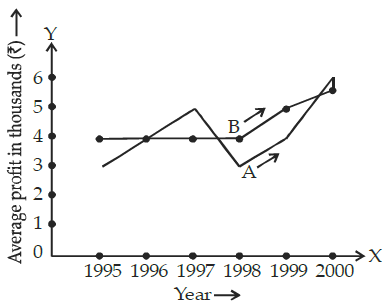
The following graph shows the average profit of two fruit-sellers A and B in thousands (Rs.) per year from the year 1995 to 2000. Consider the graph and answer the 4 (four) items that follows:
Q. 34 In which year is the average profit of A and B is same?
A. 1995
B. 1996
C. 1997
D. 1998
Q. 35 What is the difference between the average profit of B and A in the year 1998?
A. – Rs. 100
B. – Rs. 1,000
C. + Rs. 600
D. – Rs. 300
Q. 36 How much more average profit did A make in the year 2000 than in the year 1999?
A. Rs. 200
B. Rs. 1,000
C. Rs. 1,500
D. Rs. 2,000
Q. 37 What is the trend of the average profit of B from the year 1997 to the year 2000?
A. Non-increasing
B. Non-decreasing
C. Steady
D. Fluctuating
Q. 38 The following table shows the marks obtained by two students in different subjects: The difference in the mean aggregate percentage marks of the students is
A. 2.5%
B. 13.75%
C. 1.25%
D. Zero
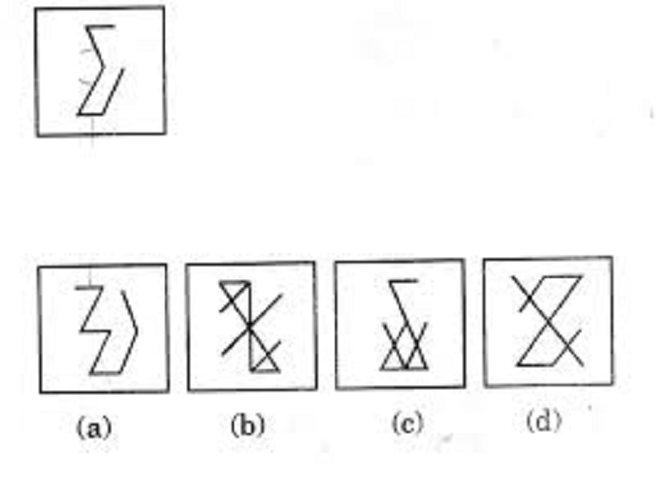
Q. 39 Examine the figure 1:
Which one of the following figures (a), (b), (c), (d) has the above figure embedded in it?
A. (a)
B. (b)
C. (c)
D. (d)
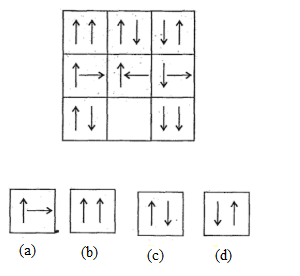
Q. 40 Consider the following matrix of figure 1:
Which one of the following figures (a), (b), (c), (d) fits into the blank part of the above matrix?
A. (a)
B. (b)
C. (c)
D. (d)
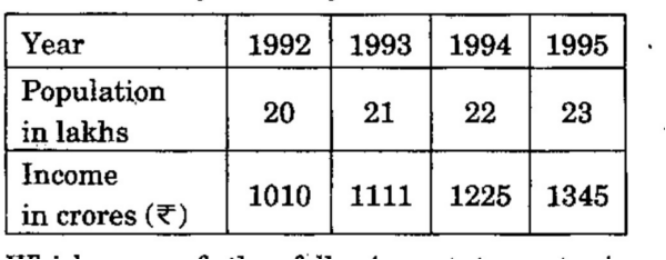
Q. 41 The following table gives population and total income of a city for four years:
Which one of the following statements is correct in respect of the above data?
A. Population increased by 5% or more every year.
B. Income increased by 10% or more every year.
C. Per capita income was always above Rs. 5,000.
D. Per capita income was highest in 1994.
Q. 42 Consider the table given below in which the numbers bear certain relationship among themselves along the rows:
Which one of the following numbers is the missing number indicated above by X?
A. 19
B. 15
C. 14
D. 8
Q. 43 Consider the following matrix of figure 1 with one empty block in the lower extreme corner:
Which one of the following figures (a), (b), (c), (d) could fit in the empty block and thus complete the matrix?
A. (a)
B. (b)
C. (c)
D. (d)
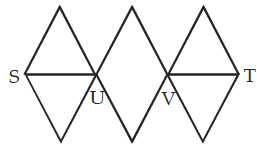
Q. 44 With reference to the figure given below, the number of different routes from S to T without retracing from U and/or V, is
A. 3
B. 6
C. 9
D. 18
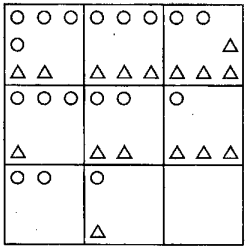
Q. 45 Consider the following sequence in figure 1:
Change in positions of beads in the four figures above follows a sequence. Following the same sequence, which of the figures (a), (b), (c), (d) should appear as the fifth figure above?
A. (a)
B. (b)
C. (c)
D. (d)
Q. 46 A bell rings every 18 minutes. A second bell rings every 24 minutes. A third bell rings every 32 minutes. If all the three bells ring at the same time at 8 o’clock in the morning, at what other time will they all ring together?
A. 12 : 40 hrs
B. 12 : 48 hrs
C. 12 : 56 hrs
D. 13 : 04 hrs
Q. 47 “Price is not the same thing as value. Suppose that on a day the price of everything viz., coal, bread, postage stamps, a day’s labour, the rent of houses, etc. were to double. Prices then would certainly rise, but values of all things except one would not.” The writer wants to say that if prices of all things were doubled
A. the values of all things would remain constant.
B. the values of the things sold would be doubled.
C. the values of the things bought would be halved.
D. the value of money only would be halved.
Q. 48 A and B decide to travel from place X to place Y by bus. A has Rs. 10 with him and he finds that it is 80% of the bus fare for two persons. B finds that he has Rs. 3 with him and hands it over to A. In this context, which one of the following statements is correct?
A. Now the money A has is just enough to buy two tickets.
B. A still needs Rs. 2 for buying the tickets.
C. After buying the two tickets A will be left with 50 paise.
D. The money A now has is still not sufficient to buy two tickets.
Q. 49 As per agreement with a bank, a businessman had to refund a loan in some equal installments without interest. After paying 18 installments he found that 60 percent of his loan was refunded. How many installments were there in the agreement?
A. 22
B. 24
C. 30
D. 33
Q. 50 A worker reaches his factory 3 minutes late if his speed from his house to the factory is 5km/hr. If he walks at a speed of 6km/hr, then he reaches the factory 7 minutes early. The distance of the factory from his house is
A. 3 km
B. 4 km
C. 5 km
D. 6 km
Q. 51 “Liberty, therefore, is never real unless the Government can be called to account when it invades rights.”
Which one of the following is the best justification of the above statement?
A. In the realization that the government can be brought to book in a court of law.
B. In identifying a man as a political unit in a way which distinguishes him from other citizens.
C. In a decentralised society wherein the basic needs of men can find satisfaction.
D. In the understanding that liberty and restraints are complementary.
Questions: 52 – 54
Passage – 1
Many nations now place their faith in capitalism and governments choose it as the strategy to create wealth for their people. The spectacular economic growth seen in Brazil, China and India after the liberalisation of their economies is proof of its enormous potential and success. However, the global banking crisis and the economic recession have left many bewildered. The debates tend to focus on free market operations and forces, their efficiency and their ability for self correction. Issues of justice, integrity and honesty are rarely elaborated to highlight the failure of the global banking system. The apologists of the system continue to justify the success of capitalism and argue that the recent crisis was a blip. Their arguments betray an ideological bias with the assumptions that an unregulated market is fair and competent, and that the exercise of private greed will be in the larger public interest. Few recognize the bidirectional relationship between capitalism and greed; that each reinforces the other. Surely, a more honest conceptualisation of the conflicts of interest among the rich and powerful players who have benefited from the system, their biases and ideology is needed; the focus on the wealth creation should also highlight the resultant gross inequity
Q. 52 The apologists of the “Free market system”, according to the passage, believe in
A. market without control by government authorities.
B. market without protection by the government.
C. ability of market to self correct.
D. markets for free goods and services.
Q. 53 With reference to “ideological bias”, the passage implies” that
A. free market is fair but not competent.
B. free market is not fair but competent.
C. free market is fair and competent.
D. free market is neither fair nor biased.
Q. 54 “The exercise of private greed will be in the larger public interest” from the passage
1. refers to the false ideology of capitalism.
2. underlies the righteous claims of the free market.
3. show the benevolent face of capitalism.
4. ignores resultant gross inequity.
Which of the statements given above is/are correct?
A. 1 only
B. 2 and 3
C. 1 and 4
D. 4 only
Questions: 55 – 58
Passage – 2
Net profits are only 2.2% of their total assets for central public sector undertakings, lower than for the private corporate sector. While the public sector or the State-led entrepreneurship played an important role in triggering India’s industrialization, our evolving development needs, comparatively less-thansatisfactory performance of the public sector enterprises, the maturing of our private sector, a much larger social base now available for expanding entrepreneurship and the growing institutional capabilities to enforce competition policies would suggest that the time has come to review the role of public sector.
What should the portfolio composition of the government be? It should not remain static all times. The airline industry works well as a purely private affair. At the opposite end, rural roads, whose sparse traffic makes tolling unviable, have to be on the balance-sheet of the State. If the government did not own rural roads, they would not exist. Similarly, public health capital in our towns and cities will need to come from the public sector. Equally, preservation and improvement of forest cover will have to be a new priority for he public sector assets. Take the example of steel. With near-zero tariffs, India is a globally competitive market for the metal. Indian firms export steel into the global market, which demonstrates there is no gap in technology. Indian companies are buying up global steel companies, which shows there is no gap in capital availability. Under these conditions, private ownership works best. Private ownership is clearly desirable in regulated industries, ranging from finance to infrastructure, where a government agency performs the function of regulation and multiple competing firms are located in the private sector. Here, the simple and clean solution – government as the umpire and the private sector as the players is what works best. In many of these industries, we have a legacy of government ownership, where productivity tends to be lower, fear of bankruptcy is absent, and the risk of asking for money from the tax payer is ever present. There is also the conflict of interest between government as an owner and as the regulator. The formulation and implementation of competition policy will be more vigorous and fair if government companies are out of action.
Q. 55 According to the passage, what is/are the reason/reasons for saying that the time has come to review the role of public sector?
1. Now public sector has lost its relevance in the industrialization process.
2. Public sector does not perform satisfactorily.
3. Entrepreneurship in private sector is expanding.
4. Effective competition policies are available now.
Which of the statements given above is/are correct in the given context?
A. 1 and 3 only
B. 2 only
C. 2, 3 and 4 only
D. 1, 2, 3 and 4
Q. 56 According to the passage, rural roads should be in the domain of public sector only. Why?
A. Rural developmental work is the domain of government only.
B. Private sector cannot have monetary gains in this.
C. Government takes money from tax payers and hence it is the responsibility of government only.
D. Private sector need not have any social responsibility.
Q. 57 The portfolio composition of the government refers to
A. Public sector assets quality.
B. Investment in liquid assets.
C. Mix of government investment in different industrial sectors.
D. Buying Return on investment yielding capital assets.
Q. 58 The author prefers government as the umpire and private sector as players because
A. Government prescribes norms for a fair play by the private sector.
B. Government is the ultimate in policy formulation.
C. Government has no control over private sector players.
D. None of the above statements is correct in this context.
Q. 59 A question paper must have a question on one of the eight poets: A, B, C, D, E, F, G or H.
The first four belong to the medieval period while the rests are considered modern poets. Generally, modern poets figure in the question paper in alternate years. Generally those who like H like G also; and those who like F like E also. The paper-setter does not like to ask about F as he has written a book on F, but he likes F. Last year, the paper contained a question on A. On the basis of the information given, this year’s paper is most likely to contain a question on
A. C
B. E
C. F
D. H
Q. 60 In a group of six women there are four dancers, four vocal musicians, one actress and three violinists. Girija and Vanaja are among the violinists while Jalaja and Shailaja do not know how to play on the violin. Shailaja and Tanuja are among the dancers. Jalaja, Vanaja, Shailaja and Tanuja are all vocal musicians and two of them are also violinists. If Pooja is an actress, who among the following is certainly a dancer and a violinist?
A. Jalaja
B. Pooja
C. Shailaja
D. Tanuja
Q. 61 The letter L, M, N, O, P, Q, R, S and T in their order are substituted by nine integers 1 to 9 but not in that order. 4 is assigned to P. The difference between P and T is 5. The difference between N and T is 3. What is the integer assigned to N?
A. 7
B. 5
C. 4
D. 6
Q. 62 The number of deaths among the army personnel is 8 in 1000, but among the civilian population it is 20 per 1000. Which one of the following inferences can be drawn from this statement?
A. It is better to joined the army.
B. The relationship is fortuitous.
C. Quality of Life index is very high within the armed forces.
D. The groups cannot be compared due to their heterogeneity
Q. 63 Given the statement: “Buses are the cause of more accidents than cars, and trucks cause fewer accidents than buses”, which of the following conclusions can we draw?
A. There are more buses on the roads than trucks.
B. Car drivers are more careful than bus drivers.
C. Truck drivers are more skilled than either car or bus drivers.
D. None of the above.
Q. 64 ”If political leadership fails to emerge, there is likelihood of military taking over power in developing countries. Radical student groups or labour may try to raise revolution but they are not likely to compete with the military. Military intervention, rule, and withdrawal from politics is closely related to a society’s level of political development.” In the context of political development, the assumption in the above passage is that
A. Political leadership is not an effective instrument.
B. Military fills in political vacuum.
C. Military intervention in inevitable for development.
D. None of the above.
Q. 65 Four persons, Alok, Bhupesh, Chander and Dinesh have a total of Rs. 100 among themselves. Alok and Bhupesh between them have as much money as Chander and Dinesh between them, but Alok has more money than Bhupesh; and Chander has only half the money that Dinesh has. Alok has in fact Rs. 5 more than Dinesh has. Who has the maximum amount of money?
A. Alok
B. Bhupesh
C. Chander
D. Dinesh
Q. 66 Examine the following statements:
1. George attends Music classes on Monday.
2. He attends Mathematics classes on Wednesday.
3. His Literature classes are not on Friday.
4. He attends History classes on the day following the day of his Mathematics classes.
5. On Tuesday, he attends his Sports classes.
If he attends just one subject in a day and his Sunday is free, then he is also free on
A. Monday
B. Thursday
C. Saturday
D. Friday
Q. 67 In a row ‘A’ is in the 11th position from the left and ‘B’ is in the 10th position from the right. If ‘A’ and ‘B’ interchange, then ‘A’ becomes 8th from the left. How many persons are there in the row other than ‘A’ and ‘B’?
A. 27
B. 26
C. 25
D. 24
Q. 68 Location of B is north of A and location of C is east of A. The distances AB and AC are 5km and 12km respectively. The shortest distance (in km) between the locations B and C is:
A. 60
B. 13
C. 17
D. 7
Q. 69 Two cars start towards each other, from two places A and B which are at a distance of 160km. They start at the same time 08 : 10 AM. If the speed of the cars are 50km and 30km per hour respectively, they will meet each other at
A. 10 : 10 AM
B. 10 : 30 AM
C. 11 : 10 AM
D. 11 : 20 AM
Questions: 70 – 71
Passage – 1
In front of us was walking a bare-headed old man in tattered clothes. He was driving his beasts. They were all laden with heavy loads of clay from the hills and looked tired. The man carried a long whip which perhaps he himself had made. As he walked down the road he stopped now and then to eat the wild berries that grew on bushes along the uneven road. When he threw away the seeds, the bold birds would fly to peck at them. Sometimes a stray dog watched the procession philosophically and then began to bark. When this happened, my two little sons would stand still holding my hands firmly. A dog can sometimes be dangerous indeed.
Q. 70 The author’s children held his hand firmly because
A. they were scared of the barking dogs.
B. they wanted him to pluck berries.
C. they saw the whip in the old man’s hand.
D. the road was uneven.
Q. 71 The expression ”a stray dog watched the procession philosophically” means that
A. the dog was restless and ferocious.
B. the dog stood aloof, looking at the procession with seriousness.
C. the dog looked at the procession with big, wandering eyes.
D. the dog stood there with his eyes closed.
Questions: 72 – 75
Passage – 2
Cynthia was a shy girl. She believed that she was plain and untalented. One day her teacher ordered the entire class to show up for audition for the school play. Cynthia nearly died of fright when she was told that she would have to stand on stage in front of the entire class and deliver dialogues. The mere thought of it made her feel sick. But a remarkable transformation occurred during the audition. A thin, shy girl, her knees quaking, her stomach churning in terror, began to stun everyone with her excellent performance. Her bored classmates suddenly stopped their noisy chat to stare at her slender figure on the stage. At the end of her audition, the entire room erupted in thunderous applause.
Q. 72 Cynthia was afraid to stand on stage because
A. she felt her classmates may laugh at her.
B. her stomach was churning.
C. she lacked self-confidence.
D. she did not like school plays.
Q. 73 Cynthia’s classmates were chatting because
A. it was their turn to act next.
B. they were bored of the performances.
C. Cynthia did not act well.
D. the teacher had no control over them.
Q. 74 Cynthia’s knees were quaking because
A. she felt nervous and shy.
B. the teacher scolded her.
C. she was very thin and weak.
D. she was afraid of her classmates.
Q. 75 The transformation that occurred during the audition refers to
A. the nervousness of Cynthia.
B. the eruption of the entire room in thunderous applause.
C. the surprise on the faces of her classmates.
D. the stunning performance of Cynthia
Q. 76 If the 3rd day of a month is Monday, which one of the following will be the fifth day from 21st of this month?
A. Monday
B. Tuesday
C. Wednesday
D. Friday
Q. 77 For a charity show, the total tickets sold were 420. Half of these tickets were sold at the rate of Rs. 5, one-third at the rate of Rs. 3 each and the rest for Rs. 2 each. What was the total amount received?
A. Rs. 900
B. Rs. 1,540
C. Rs. 1,610
D. Rs. 2,000
Questions: 78 – 80
A, B, C, D, E, F are members of a family. They are engineer, stenographer, doctor,draughtsman, lawyer and judge (not in order). A, the engineer is married to the lady stenographer. The judge is married to the lawyer. F, the draughtsman is the son of B and brother of E. C, the lawyer is the daughter-in-law of D. E is the unmarried doctor. D is the grandmother of F. There are two married couples in the family.
Q. 78 What is the profession of B?
A. Judge
B. Lawyer
C. Draughtsman
D. Cannot be determined
Q. 79 Which of the following is/are a couple/couples?
A. AD only
B. BC only
C. Both AD and BC
D. Both AC and BD
Q. 80 What is the profession of D?
A. Judge
B. Stenographer
C. Doctor
D. Cannot be determined
Answer Sheet
Question
1
2
3
4
5
6
7
8
9
10
Answer
C
C
D
B
A
B
D
C
C
B
Question
11
12
13
14
15
16
17
18
19
20
Answer
B
C
B
C
C
D
B
B
D
B
Question
21
22
23
24
25
26
27
28
29
30
Answer
B
B
C
B
A
A
D
B
B
A
Question
31
32
33
34
35
36
37
38
39
40
Answer
C
C
B
B
C
D
B
D
C
B
Question
41
42
43
44
45
46
47
48
49
50
Answer
C
D
A
D
B
B
D
C
C
C
Question
51
52
53
54
55
56
57
58
59
60
Answer
D
C
C
C
C
B
C
D
B
D
Question
61
62
63
64
65
66
67
68
69
70
Answer
D
D
D
B
A
D
C
B
A
D
Question
71
72
73
74
75
76
77
78
79
80
Answer
D
D
D
D
D
C
C
A
C
B
×
Hello!
Click one of our representatives below to chat on WhatsApp or send us an email to info@vidhyarthidarpan.com